From Thomas George John's 1919 start to the Three Litre era, the 1967 end of car production, aero engines and the continuation cars of today.
Founded in 1919, Alvis built road cars, racing cars, aircraft engines and armoured vehicles from its Coventry base until its car range closed in 1967. Its Three Litre models are the best-known road cars, and continuation cars have since brought the name back.
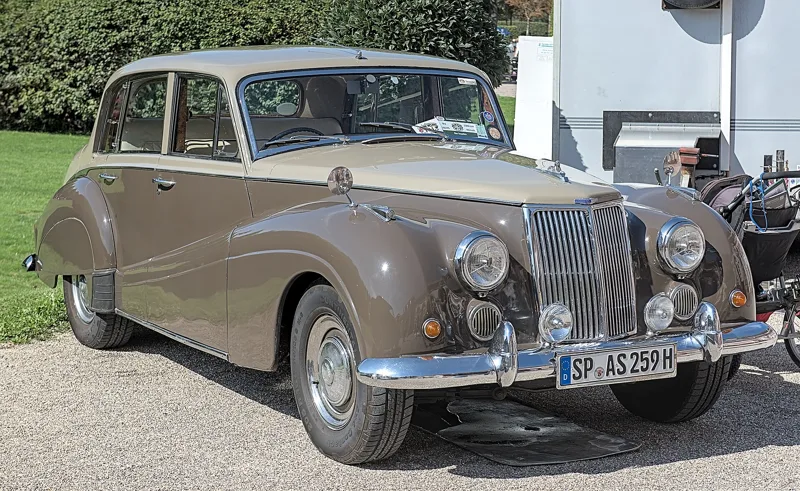
Alvis was a British manufacturer based in Coventry from 1919 to 1967. Alongside its road cars it built racing cars, aircraft engines and armoured vehicles, and the armoured side of the business outlived the car range. The company's three-litre cars of the 1950s and 1960s are its best-known road models, and the marque has been revived in recent years by continuation cars built to the original plans.
Who founded Alvis and when?
The company began in 1919 as T. G. John and Company Ltd, founded by Thomas George John, who lived from 1880 to 1946. Its first products were stationary engines, carburettors and motorscooters. The business later took the Alvis name and became the Alvis Car and Engineering Company Ltd on 14 December 1921.
The logo changed after a complaint from the Avro aircraft company, whose emblem resembled the first winged green triangle. The more familiar inverted red triangle, carrying the word Alvis, took its place.
A Coventry marque that built fast six-cylinder cars, armoured vehicles and aero engines, and returned in continuation form.
Where did the name Alvis come from?
Geoffrey de Freville, who lived from 1883 to 1965, designed the first Alvis engine and is credited with choosing the name. Some writers have proposed that it blended aluminium with the Latin word for strength, or that it came from the Norse weaponsmith Alvis.
De Freville rejected those ideas. In 1921 he said the name had no meaning at all and was picked because it could be pronounced easily in any language, and he repeated that view in the early 1960s.
How did the early Alvis cars take shape?
Production began on Holyhead Road in Coventry, and from 1922 to 1923 the works also built the Buckingham car. In 1922 George Thomas Smith-Clarke, who lived from 1884 to 1960, arrived from Daimler to become chief engineer and works manager. William M. Dunn followed him from Daimler as chief draughtsman.
The partnership of Smith-Clarke and Dunn lasted almost 28 years and produced many of the company's most successful cars. Smith-Clarke left in 1950, and Dunn became chief engineer, a post he held until 1959.
What was the first Alvis car?
The first car to use de Freville's engine was the Alvis 10/30. De Freville's engine had four cylinders, aluminium pistons and pressure lubrication, which were unusual features for the period. The 10/30 quickly built a reputation for careful workmanship and performance.
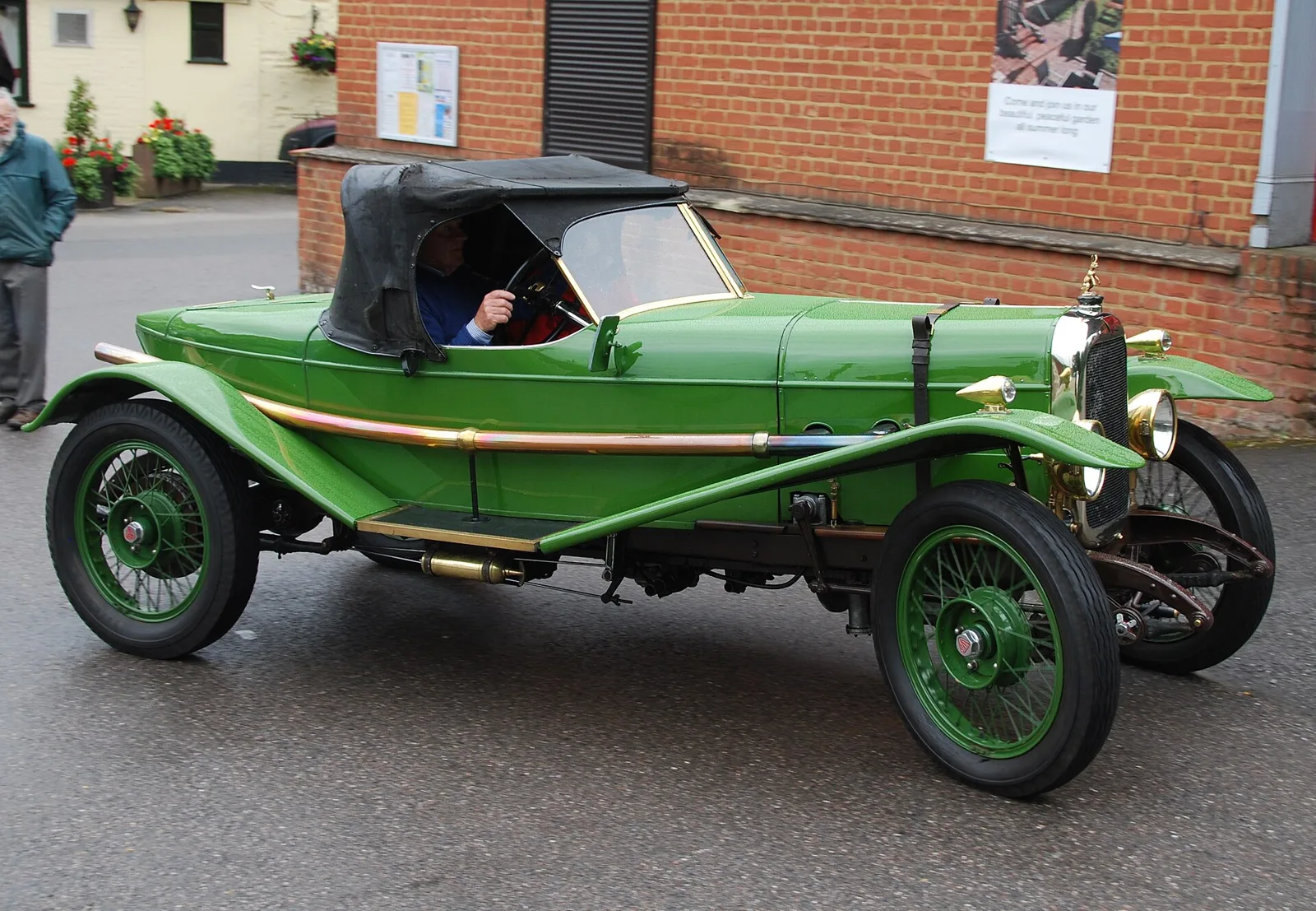
The original side-valve engine was reworked into an overhead-valve unit, and by 1923 it had become the 12/50, a sports car that stayed in production until 1932. About 700 of the 12/50 models and 120 of the later 12/60 models are thought to survive today.
Which Alvis cars defined the 1920s and 1930s?
The six-cylinder Alvis 14.75 arrived in 1927 and became the foundation for a long run of luxurious six-cylinder cars that lasted until the Second World War. The cars were elegant and technically inventive, and they set the tone for the marque's reputation.
The 12/75 of 1928 was even more adventurous, with front-wheel drive, inboard brakes, an overhead camshaft and an optional Roots-type supercharger. In 1933 Alvis brought in independent front suspension and what was then the world's first all-synchromesh gearbox, followed by servo-assisted brakes.
Did Alvis build its own bodies?
No. Like many upmarket engineering firms of the period, Alvis did not make its own coachwork. It relied on the many coachbuilders in the Midlands, including Carbodies, Charlesworth, Cross and Ellis, Holbrook, Gurney Nutting, Hooper, Mulliners, Tickford, Vanden Plas and Arnold of Manchester.
Several surviving cars carry one-off bodywork by other designers, so no two Alvis cars of the period are necessarily alike. That variety is part of why collectors value the cars today.
How did the Second World War affect Alvis?
In 1936 the company name was shortened to Alvis Ltd, and by the outbreak of war it had added aircraft engine and armoured vehicle divisions. Smith-Clarke designed several models in the 1930s and 1940s, among them the six-cylinder Speed 20, the Speed 25 and the 4.3 Litre.
Car production stopped in September 1939 but resumed for a time, with the 12/70, Crested Eagle, Speed 25 and 4.3 Litre still being built into 1940. On 14 November 1940 the car factory was badly damaged in German raids on Coventry, and much valuable cutting gear was lost. Car output did not restart until the latter part of 1946. Throughout the war the company made aircraft engines as a subcontractor to Rolls-Royce.
What did Alvis build after the war?
Car production returned with the TA 14, a four-cylinder model based on the prewar 12/70. It suited the austere mood of postwar Britain, but interest in the prewar cars had faded, and the postwar years were hard for a specialist maker. Many prewar coachbuilders closed or were absorbed, and the postwar story of Alvis became a search for reliable coachwork at a sensible price.
Smith-Clarke built a 3-litre prototype in 1947, and after his retirement he used it as his own car. The six-cylinder 3-litre engine became the heart of every Alvis model until production ended in 1967.
Why was the Three Litre so important?
In 1950 a new chassis based on the TA 14 and carrying the six-cylinder 3-litre engine was announced. Called the TA 21, it became the basis of the Three Litre family, and the same engine powered the company's cars until 1967.
Mulliners supplied the saloon bodies, as it had for the TA 14, and Tickford made the drophead versions. Mulliners moved to supplying only Standard Triumph in October 1954, and Triumph bought Mulliners outright in 1958. Tickford was acquired by David Brown, who owned Aston Martin Lagonda, in late 1955.
Who designed Alvis bodies in the 1950s?
Some Three Litre bodies came from Carrosserie Hermann Graber of Switzerland, a master coachbuilder that had started using TA 14 chassis soon after the war. Graber built three admired Tropic coupes on those chassis and displayed Three Litre bodies at the Geneva shows of 1951 and 1952.
Graber's displays led to a standing order for 30 chassis a year, and Swiss-built coupes appeared on the Alvis stand at the Paris and London motor shows in October 1955. From late 1955 all Alvis bodies were based on Graber designs under licence.
Output stayed small. Willowbrook of Loughborough built around 15 or 16 TC108/G cars, and Willowbrook was later taken over by Duple Coachbuilders. Graber himself built 22 TC 108G cars and complained that he would have bought 20 chassis a year had he received them.
How did the TD 21 and its successors change the range?
The TD 21 arrived in late 1958, and Park Ward, a Rolls-Royce subsidiary, built its modified bodies. The TD 21 and its later variants, the TE 21 and TF 21, were offered in many small variations. Their price was nearly double that of the mass-produced Jaguar, which made it hard for the company to compete on value.
Did Alec Issigonis work at Alvis?
Yes. Alec Issigonis, who later created the Mini, worked for Alvis from 1952 to 1955. During that time he designed a new model with a V8 engine, but the design proved too expensive to produce.
Why did Alvis car production end in 1967?
Rover took a controlling interest in Alvis in 1965. A Rover-designed mid-engined V8 coupe prototype, the P6BS, was rumoured as the next Alvis, but it was shelved once British Leyland took over. The TF 21, launched in 1966, came as a saloon or drophead with manual or automatic transmission.
The TF 21 claimed 127 mph, the fastest top speed of any Alvis, yet it was showing its age. Only 109 were sold, and the troubles of the British car industry at that time made the position untenable. Car production ended in 1967.
What happened to Alvis after the car range closed?
In 1968 a management buyout took over the car operations. The design plans, customer records, parts stock and remaining staff passed to Red Triangle, a company set up by former Alvis employees to supply parts and service for the cars.
Within the group the car name was less important than the armoured business. In the early 1980s United Scientific Holdings bought Alvis, which then became Alvis plc, and the company went on to buy Universal Power Drives in 1994 to form Alvis Unipower.
How did Alvis move into armoured vehicles?
In 1998 Alvis plc bought the armoured vehicle business of GKN, and the main UK manufacturing moved from Coventry to Telford. The old Holyhead Road works is now a retail park that keeps the Alvis name. In 2002 Alvis plc bought Vickers Defence Systems to form Alvis Vickers Ltd, which BAE Systems acquired in 2004. BAE then ended the use of the red triangle trademark.
Did Alvis race its cars?
Yes. Alvis, Bentley and Sunbeam all raced locally between 1920 and 1930, and Alvis and Sunbeam were the only British makers at that time building cars to Grand Prix formula. Alvis stood out because its racing cars used front-wheel drive and fully independent suspension.
Alvis was an early champion of front-wheel drive. The first front-wheel drive racing car came from J. Walter Christie and ran in the 1906 Vanderbilt Cup. The next notable example was a supercharged Alvis 12/50 racer, designed by Smith-Clarke and Dunn, which took part in the Kop Hill Climb near Princes Risborough on 28 March 1925. A Miller 122 front-wheel drive car followed on 30 May 1925, entered for the Indianapolis 500.
What aero engines did Alvis make?
Early Alvis aero engines were built under licence from Gnome-Rhone. The first engine the company designed itself was the 14-cylinder Pelides radial of 1936, which was followed by related designs. Work on them stopped when the Second World War began, with only a handful built.
The smaller 9-cylinder Leonides radial was developed during the war and used in aircraft and helicopters until production ended in 1966. In 1952 Alvis returned to the 14-cylinder layout with the Leonides Major, which powered the Westland Whirlwind helicopter.
What armoured vehicles did Alvis build?
The Hungarian engineer Nicholas Straussler designed an armoured car, the AC1, in 1932. It was built under licence by Manfred Weiss in Budapest, but when Hungary aligned itself with Germany, Straussler moved to England. His small company lacked the capacity to build vehicles in volume, so he approached Alvis, and Alvis-Straussler Ltd was formed in July 1936.
The AC2 prototype was built on the AC1 chassis, and the AC3 followed in 1937 as the first purpose-built armoured car. Production came to twenty-seven units, with 12 going to the Royal Air Force, 3 to the Portuguese Army and 12 to forces in the Netherlands East Indies. The AC2 also formed the basis of the 39M Csaba scout car for the Royal Hungarian Army in the Second World War.
In 1938 the business was reorganised as Alvis Mechanisations, which took on the commitments of Alvis-Straussler. The same year Alvis built an armoured reconnaissance prototype, the Dingo, but it lost to a design from BSA Cycles, which became the Daimler Dingo.
Following the war, a run of six-wheeled designs came from Alvis. The Saladin armoured car and the Saracen personnel carrier were the first two, and the Saracen appeared in several forms, including the FV604 Regimental Command Vehicle and the FV610 Armoured Command Post. The Salamander airfield crash tender led to the Stalwart amphibious truck.
GKN Sankey developed the tracked FV432 personnel carrier in the early 1960s, and Alvis took it on in 1998. Among the tracked reconnaissance vehicles of the 1960s was the FV101 Scorpion, the first tank built with an aluminium hull. In February 1969, seventeen Scorpion prototypes went out for field trials.
How has the Alvis car name been revived?
The Red Triangle company negotiated the transfer of the Alvis car trademarks in 2009. The following year the 4.3 Litre Short Chassis tourer returned as the Continuation Series, which reflected the 73-year gap in car production between 1937 and 2010. The cars follow the original plans but add electronic fuel injection and ignition, hydraulic brakes and a collapsible steering column.
By 2012 five versions were on offer, covering derivatives of the 4.3 litre and 3 litre chassis. A sixth model arrived in 2019, timed with the Asian distribution deal with Meiji Sangyo. In 2021 the company featured in a BBC Four programme on Coventry-built classics, and that year it also unveiled the Graber Super Coupe continuation car. By 2023 its successor company was building classic models again.
Key dates in the Alvis story
| Year | Event |
|---|---|
| 1919 | T. G. John and Company founded in Coventry |
| 1921 | Renamed Alvis Car and Engineering Company on 14 December |
| 1922 | Smith-Clarke joins from Daimler as chief engineer |
| 1923 | 10/30 engine reworked into the overhead-valve 12/50 |
| 1927 | Six-cylinder 14.75 introduced |
| 1936 | Company name shortened to Alvis Ltd; Alvis-Straussler formed in July |
| 1940 | Car factory damaged in air raids on 14 November |
| 1950 | TA 21 announced with the six-cylinder 3-litre engine |
| 1958 | TD 21 launched with Park Ward bodies |
| 1965 | Rover takes a controlling interest |
| 1967 | Car production ends after 109 TF 21 sales |
| 1998 | GKN armoured business acquired |
| 2010 | Continuation Series returns after a 73-year gap |