A Rolls-Royce-engined military oddity, the taxi that defined London for 39 years and the limousines that carried the Beatles.
The Austin Champ was a Rolls-Royce-engined, Jeep-like army vehicle made from 1951. The Austin FX4 was the London taxi built from 1958 to 1997. The Austin Princess was a large Vanden Plas-built luxury saloon and limousine sold from 1947 to 1968.
In 1951 the British Army paid around 1,200 pounds for each Austin Champ. By 1966, surplus ones were changing hands for about 150. That slide from prized military asset to bargain-bin toy says a lot about the three Austins here, which could hardly be more different: a Jeep rival for the infantry, a taxi that defined London, and a limousine that carried the Beatles.
What was the Austin Champ?
Built in the 1950s by the Austin Motor Company, the Champ came in military and civilian forms and was styled on the Jeep. The Army officially called it the Truck, 1/4 ton, CT, 4x4, Cargo and FFW, Austin Mk.1, but everyone used the civilian name. Most Champs went to the British Army.
It began with a late-1940s Army requirement for a light truck, inspired by the Willys MB Jeep, but meant to work in all the places where British forces served. A British-built vehicle would cut reliance on American ones and the foreign spending that went with them. A project started in 1947 yielded three Nuffield prototypes, the Nuffield Gutty, which testing showed to have serious shortcomings.
The government's Fighting Vehicles Research and Development Establishment improved the design under Charles William "Rex" Sewell, with suspension by Alec Issigonis, who later created the Morris Minor and the Mini. Wolseley built about 30 prototypes as the Wolseley Mudlark. Austin won a contract for 15,000 vehicles and fitted out a former aircraft factory at Cofton Hackett, beside Longbridge. The first production Champ was finished on 1 September 1951.
How the Champ was built
The engine was a four-cylinder petrol unit of 2838 cc, designed by Rolls-Royce and the smallest of its B-Range of military engines. Absolute reliability came first in its design, with fuel economy second. Rolls-Royce lacked the capacity for volume production, so it lent Austin tooling and a licence, and Austin built most of the engines fitted.
The gearbox had five ratios with synchromesh on all of them, and because reverse gear sat in the rear transfer box, the Champ had five reverse gears too. A cruciform chassis left no room for a conventional transfer case, so a long shaft ran forward to a differential with a dog clutch for four-wheel drive.
The suspension is what made the car special. Longitudinal torsion bars, like those on the front of a Morris Minor, did the springing at all four wheels, with double wishbones, rubber buffers and double-acting telescopic dampers. The result was exceptional cross-country ability. Front and rear axles were built into cradles that could be swapped quickly in the field. Brakes were Girling drums with a simple single-line hydraulic layout and no power assistance.
Waterproofing let the Champ wade 6 feet (2 m) with minimal preparation, using a snorkel normally carried on the right wing, but keeping that capability proved expensive and of limited value, and the policy was abandoned in 1956. The body was an open four-seat tub of welded pressed steel with a PVC-coated hood, and a 20-gallon (91 litre) fuel tank gave a range of roughly 300 miles.
Why the Army walked away
As the Champ entered service its cross-country performance impressed, but it was too expensive at 1,200 pounds at 1951 prices, too complex, and of limited use outside the narrow combat role it was designed for. The Army cancelled the contract about 4,000 vehicles short of the 15,000 ordered.
The Land Rover, in Army service from as early as 1949, cost half as much, was simpler to maintain and could do 80% of the Champ's tasks. Troops preferred its enclosed cab. As the post-war Army shrank, many Champs went into bulk storage, and in the mid-1960s the type was withdrawn, with all military examples sold by 1968, though one went at government auction as late as 1973. Many buyers treated the cheap vehicles as toys and skipped the maintenance the complex design demanded.
Other users were few: the Royal Marines had 30, the Australian Army bought 400 new and about the same number second-hand, and one or two served with a mercenary unit in the Congo in the mid-1960s.
The civilian Champ
To earn some commercial return from the contract, Austin was allowed to sell a simplified civilian version, the WN3. Most had a modified Austin A90 engine of 2660 cc in place of the Rolls-Royce unit, a fixed windscreen and 12-volt Lucas electrics. Few customers came forward: about 500 were built, the great majority exported, many to Australia. The price was 750 pounds in November 1952 and 1,000 pounds in November 1954. Two are known to survive in the UK.
Some of its design carried over to the Austin Gipsy, of which some 21,000 were built from 1958 to 1967, and Fire Armour Ltd of London adapted the WN3 as the Firefly, a small fire engine with a 60-gallon water tank, pump and ladders.
The Army paid 1,200 pounds for a Champ in 1951; by 1966 they cost about 150.
What was the Austin FX4 London taxi?
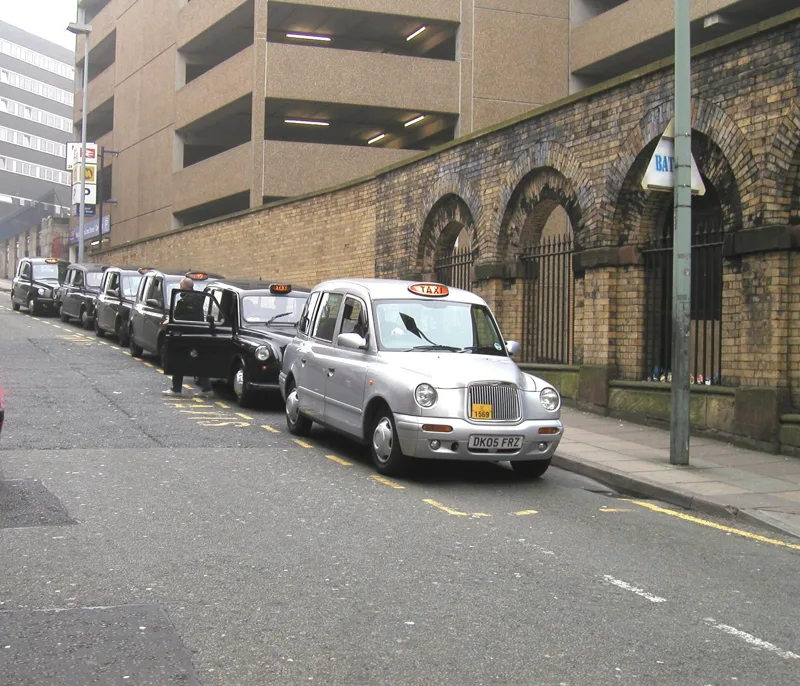
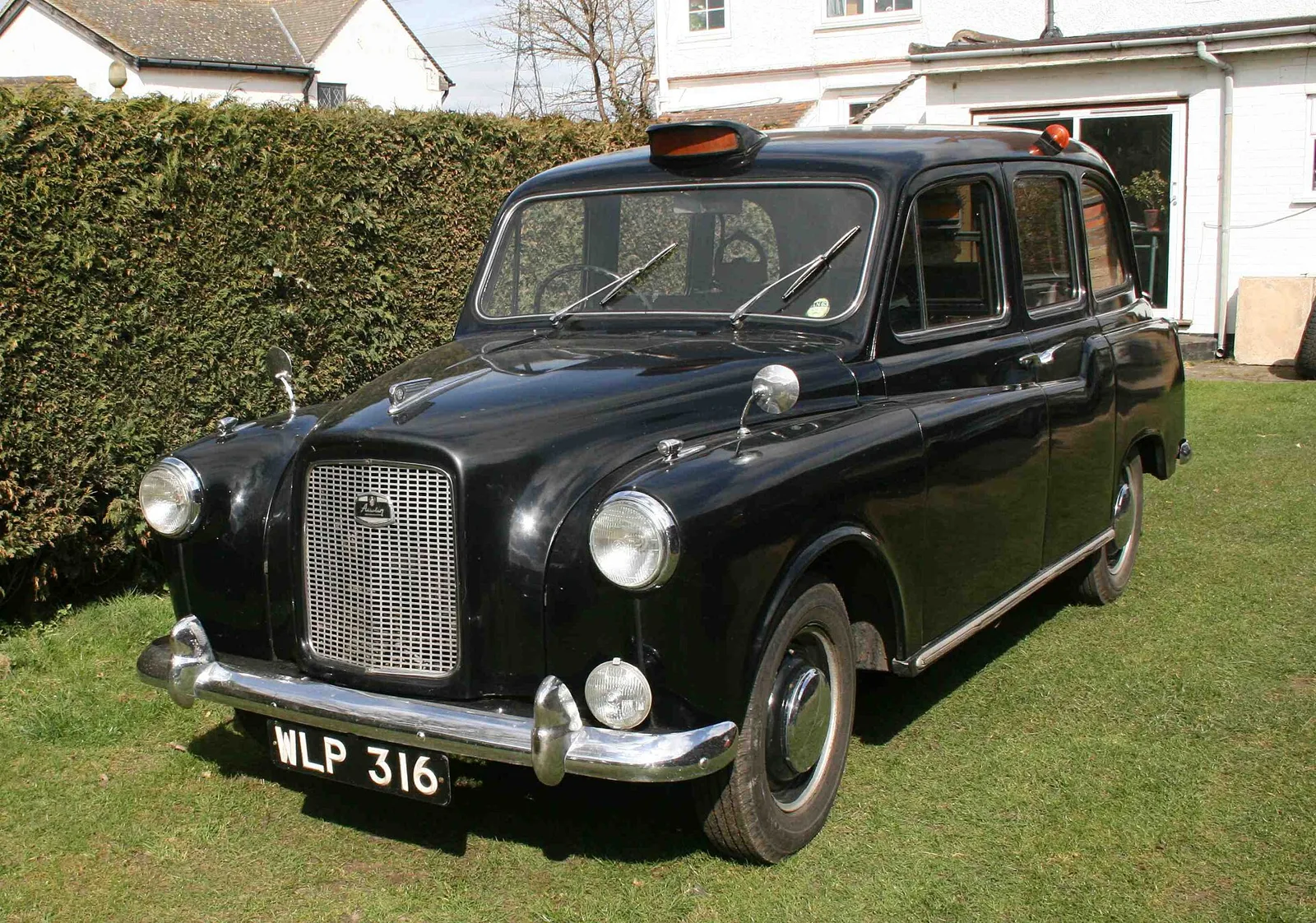
The Austin FX4 was a hackney carriage produced from 1958 until 1997, and more than 75,000 were built. Austin sold it until 1982, when Carbodies, which had been building it, took over the rights; London Taxis International took over in 1984 and carried on until 1997. Its shape is so familiar that its successors, the TX-series and today's LEVC TX, still follow its basic styling cues.
Design and launch
The FX4 replaced the FX3 of 1948 to 1958. Austin designed it with Mann and Overton, the London taxi dealership that commissioned the car and paid half of the cost, and with Carbodies, the coachbuilder that built the body. Eric Bailey of Austin drew the original design, and Jake Donaldson of Carbodies engineered it for production.
It was the first London taxi in production with four doors. Earlier cabs had an open luggage platform on the kerb side in place of a front passenger seat. It kept a separate chassis but added independent front suspension and dual-circuit hydraulic brakes, and its Ackermann steering geometry let it U-turn in 7.6 m (25 ft), a requirement for London's narrow roads.
The first car, registration VLW 431, was delivered in July 1958. At the Commercial Motor Exhibition at Earls Court later that year, buyers placed an order for 2,000 FX4s worth 24 million pounds.
The Austin years
The first FX4 had a 2178 cc BMC diesel based on the petrol Austin A70 engine, with a Borg-Warner automatic. A manual gearbox from the Austin Gipsy became an option in 1961, and a 2199 cc Austin petrol engine from 1962, though almost all taxis were diesels.
When the intended replacement suddenly collapsed in 1969, the cab was revised. The small rear light cluster and roof-mounted indicators, nicknamed bunny ears, gave way to modified rear wings with smaller tailfins carrying lamps from the Mk II Austin 1100 and 1300. Inside, sound deadening, black vinyl seats and a partition with another 4 inches of legroom were warmly welcomed by drivers.
The FX4D, from 1971 to 1982, had a larger 2520 cc diesel that suited automatic transmissions better, so fewer manual cabs sold. The petrol engine ended in 1973, the year Carbodies' owner, BSA, faced bankruptcy and was bought by Manganese Bronze Holdings, which kept the FX4 going with burst-proof door locks, push-button handles and safety steering.
Carbodies, then London Taxis International
In 1982, with British Leyland having lost interest, Carbodies took over the rights and built the cab under its own name. The old Austin engine was gone because British Leyland's Courthouse Green plant had closed, so Carbodies chose a Land Rover 2286 cc diesel and called the car the FX4R, R for Land Rover engined. It brought power steering, full servo brakes, an 85 mph (137 km/h) top speed and driver-controlled rear door locks, but poor performance and reliability gave it a bad reputation. Some owners fitted the Perkins/Mazda 2977 cc diesel instead, which transformed performance but was noisy at idle and, wrongly, blamed for chassis cracks.
To win back sales, Carbodies refurbished old chassis and suspension, added new bodywork and fitted the original-type 2520 cc diesels re-imported from India. The refurbished chassis meant a Q registration, which gave the FX4Q its name. All had automatic gearboxes but no power steering.
London Taxis International (LTI) was formed in 1984 after Manganese Bronze Holdings bought Mann and Overton. The FX4S used a new 2495 cc Land Rover diesel. It was a stopgap, because Carbodies was developing a replacement, the CR6, until it was abandoned in 1985. The FX4S-Plus of 1987 seated five passengers in the back and had Austin Metro instruments. The FX4W wheelchair conversion, from early 1986, let the kerb-side door open 180 degrees.
The Fairway and the end
| Model | Period | Engine |
|---|---|---|
| FX4 | 1958 onwards | 2178 cc BMC diesel |
| FX4D | 1971 to 1982 | 2520 cc diesel |
| FX4R | From 1982 | Land Rover 2286 cc diesel |
| FX4S | From 1984 | Land Rover 2495 cc diesel |
| Fairway | From February 1989 | Nissan TD27 2,664 cc diesel |
| Fairway Driver | From February 1992 | Nissan diesel, front disc brakes |
The Fairway of February 1989 used a 2,664 cc Nissan TD27 diesel, though buyers could briefly still choose the Land Rover unit. It made the cab faster and more reliable, and gave full wheelchair access in line with a new law of January 1989, which also let LTI sell overseas and in provincial UK markets. The Fairway Driver of February 1992 added front disc brakes by AP Lockheed, with a GKN suspension that kept the 7.6 m turning circle. The last Fairway, registered R1 PFX, was built on 1 October 1997 and given to the National Motor Museum, Beaulieu.
The TX1 replaced the Fairway in late 1997, the TXII followed in 2002 and the TX4 in 2007. Transport for London required all licensed taxis to meet Euro 3 emission rules by 2006, but the Fairway and TX1 used a Nissan engine that met only Euro 2. Proprietors who loved their reliable, economical Fairways persuaded TfL to allow conversions from STT Emtec and Van Aaken, and many paid almost 2,000 pounds to convert rather than buy a TXII, which was considered very unreliable. In late 2009 only six of the earlier Austin or Rover-engined cabs still worked the street, most with over a million miles.
The FL2 limousine
The Austin FL2 Hire Car, launched with the FX4, was the limousine version for private hire and funeral work, which is why a petrol engine was offered. It had a second front seat and occasional seats facing forward, and no roof sign. In 1982 it was relaunched on the FX4R as the FL2 London Limousine, developed with Tickford, and offered air conditioning, a cocktail cabinet and a colour television. The best-known Fairway limousine belonged to the Crown Prince of Tonga. Customers included Prince Philip and Laurence Olivier, and an FL2 was the official car of Falklands governor Rex Hunt during the Argentine invasion.
What was the Austin Princess?
The Austin Princess was a series of large luxury cars made from 1947 to 1968 by Austin and its Vanden Plas subsidiary, and also sold under the Princess and Vanden Plas names. The Princess name was later given to a deluxe BMC executive car in October 1959, a deluxe 1300 in October 1962 and Leyland family cars from September 1975.
Princess I, II and III
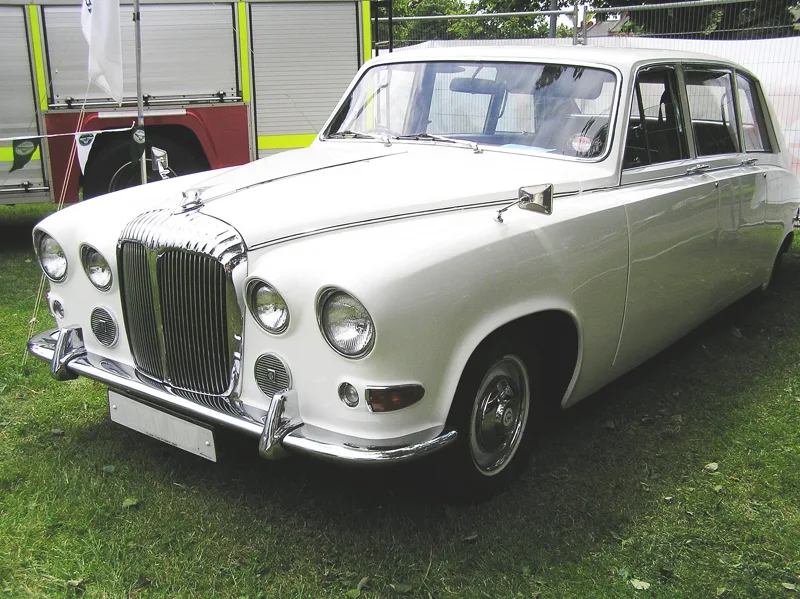
The first Austin Princess, the A120, was launched in 1947 as Austin's most expensive flagship, alongside the A110 Sheerline, which used the same chassis, had a single carburettor and made 10 hp less. Vanden Plas built the Princess at Kingsbury in north London to a higher specification, with a leather, wool and burr walnut interior. It came as the DS saloon or as the DM limousine with a sliding glass partition and picnic tables, and the saloon weighed almost two tons.
It went through Mark I, Mark II (A135) and Mark III versions, with the biggest change a seven-seat long-wheelbase version in 1952. The 4-litre D-Series straight-six hardly changed. The upright radiator looked old-fashioned, yet the car was more modern than a Bentley Mark VI or Rolls-Royce Silver Cloud of similar size, and the saloon cost not much over two-thirds of the Rolls-Royce. Many Princesses served civic duties or hire firms.
The first engine was a 3.5-litre straight-six, later enlarged to 4.0 litres. The car was often built to order, with a choice of triple or single carburettors and twin or single exhausts. The sportier triple-carburettor car managed only 12 to 14 mpg. Top speed was 90 mph (140 km/h) and 0 to 60 mph took 20 seconds. Perkins diesels were fitted when many saloons became taxis. In 1957 the Austin name was dropped so Nuffield dealers could sell the car as the Princess, and from May 1960 Vanden Plas was added.
Princess IV and the long-wheelbase limousine
The Princess IV of 1956, a saloon (DS7) or touring limousine (DM7), stayed in the catalogue only until 1959, and just 199 were built. Its Austin straight-six had 150 bhp, with a GM Hydramatic gearbox and Girling power steering standard. The last A135 Mark 3 cost five times an Austin A30; the IV cost 6.5 times, and almost no one wanted it at that price. The much smaller Princess 3-litre replaced it at little more than 40 per cent of the price.
The long-wheelbase saloon (DS6) and limousine (DM4) carried on from 1952, and the handbuilt Vanden Plas Princess 4-litre Limousine, made in small numbers, lasted until 1968. The Daimler DS420, based on the Jaguar Mark X, then took over at Kingsbury, a move foreseen in 1966 when British Motor Holdings joined BMC and Jaguar. The limousine had polished wood, optional mohair rugs, a telephone to the driver, and monograms and a flagstaff among the extras.
Beatles, funerals and a kidnap attempt
At the height of Beatlemania the Beatles preferred Austin Princess limousines. According to their chauffeur and roadie Mal Evans, the wide coach doors let the band dive in and escape fans. John Lennon bought a 1956 Austin Princess hearse in 1971 for his own use, and it appeared in the 1972 Imagine film. A 1964 Austin Princess hearse carried Winston Churchill's coffin from Festival Pier to Waterloo Station at his state funeral.
On 20 March 1974 Princess Anne was heading back to Buckingham Palace from a film premiere in a 1969 Vanden Plas Princess Limousine when a lone gunman tried to kidnap her. Her bodyguard and chauffeur were shot and injured; she was unharmed. The car was one of the last Princess limousines built, delivered to the Royal Mews in 1972.
The smaller and later Princesses
The Vanden Plas Princess 1100 arrived in 1963 as a luxury version of the BMC ADO16, and with the 1275 and 1300, 43,741 were produced before production ended in 1974. The name made its last appearance on the Princess 1800/2200 of 1975 to 1978 and the Princess 2 of 1978-81. It was not badged as an Austin at home. The Austin Ambassador succeeded it in 1982, ending the Princess marque, although Vanden Plas survived as the most luxurious trim on the Rover SD1.
Is any of the three still in production?
None of the three is in production. The Champ left military service by 1968, the FX4 ended in 1997 and the Princess marque ended in 1982. The FX4's line continues in a form through the LEVC TX, which keeps its basic styling cues.