A truck-based SUV from 1985 that was sold as the Terrano outside North America, went unibody in 2012 and reached its fifth generation in 2021.
The Nissan Pathfinder is a sport utility vehicle built by Nissan since 1985, sold as the Terrano outside North America until 2004. It began on a compact pickup platform, went unibody in 2012 and reached its fifth generation in 2021 with a nine-speed automatic. The model remains a global Nissan family SUV.
The Nissan Pathfinder is a range of sport utility vehicles that Nissan has built since 1985. Outside North America it was sold as the Nissan Terrano, and from 2004 the model was marketed worldwide under the Pathfinder name. The first four generations were based on Nissan's compact pickup platform or a unibody that followed it, and the fifth generation arrived in 2021.
What is the Nissan Pathfinder?
The Pathfinder is a sport utility vehicle that began as a two-door body-on-frame model and later grew into a family SUV. Until the third generation it sat on Nissan's compact pickup platform, which it shared with the Navara and the Frontier. The same mechanical family underpinned the Terrano name used in other markets.
The vehicle has always had two identities: a rugged off-road model in some regions and a more refined family SUV in others. Its naming, body and engine choices all changed with those roles, and the Terrano name remained in use outside North America until 2004.
A truck-based off-roader from 1985 that became a unibody family SUV, with the Terrano name carrying it far beyond North America.
Where did the first Pathfinder come from?
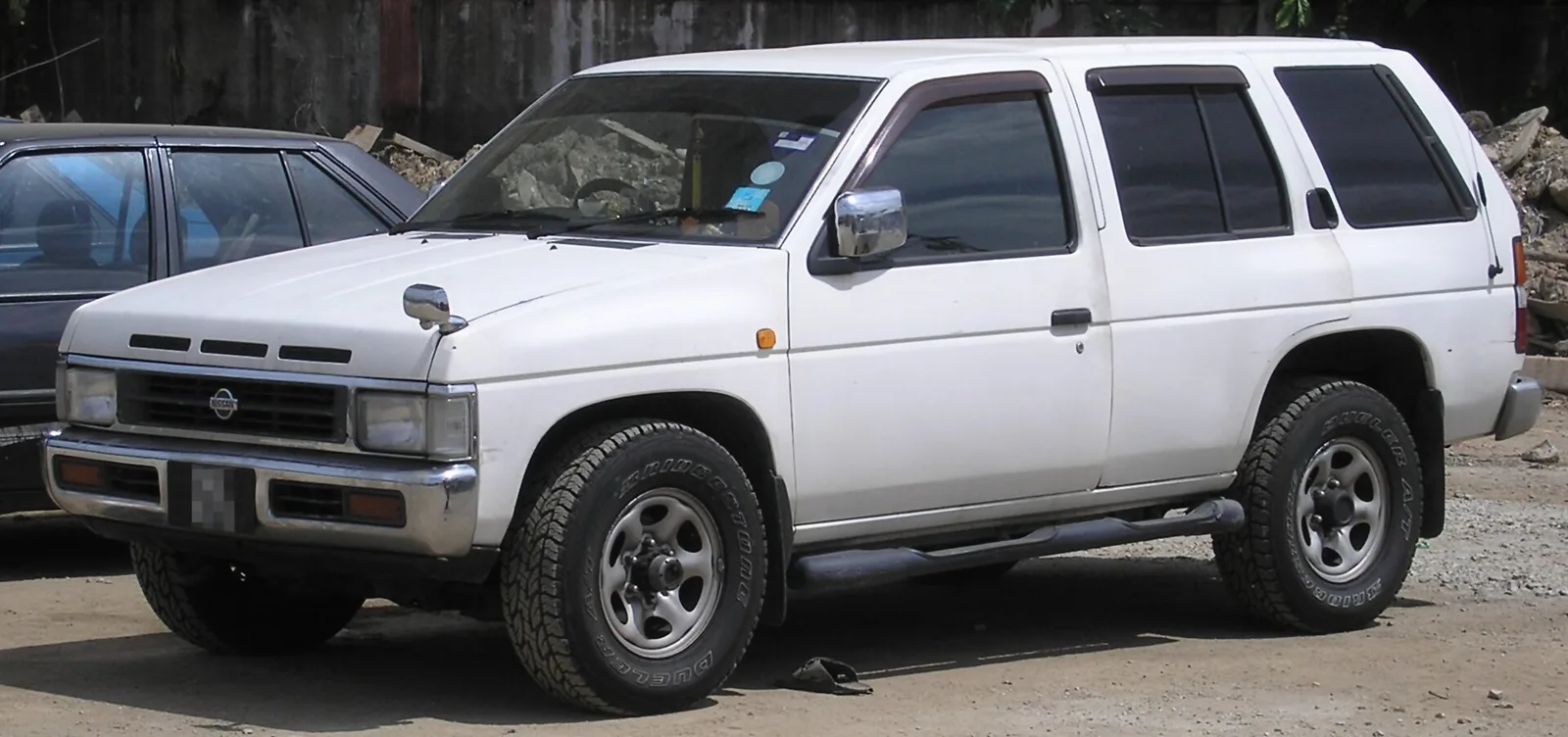
Unveiled in May 1985, the first Pathfinder reached buyers as a two-door truck-style SUV in July 1986, which made it a 1987 model in the United States. Much of its styling and hardware came from the Nissan Hardbody Truck, and its ladder frame set it against the Chevrolet Blazer and Ford Bronco II.
Rivals included the Jeep Cherokee, the Toyota 4Runner, the Honda Passport and the Isuzu MU. Before the Pathfinder came the Nissan Bushmaster, an aftermarket conversion of the Datsun Truck. The Pathfinder was a more polished product, built to compete with the best of the American and Japanese off-roaders.
How was the Terrano sold in Japan?
Japanese customers could buy the Terrano only at Nissan Shop outlets. It was positioned beneath the bigger Nissan Safari, and borrowed the Safari's rear five-link coil suspension for better off-road work.
Japanese buyers saw the Terrano as a luxury vehicle with an emphasis on outdoor leisure. The Japanese model offered options that budget vehicles rarely had, including climate-controlled air conditioning, electric windows and seats, and in 1993 Recaro seats. Nissan's sports division Autech added packages such as the Wide R3M Urban and the AJ Limited.
Wide versions wore overfenders and bigger bumpers, pushing them beyond the size rules and into a higher annual road tax band. Their model codes started with L. The luxury push matched the Japanese economy of the day, the so-called bubble years.
Which engines powered the first generation?
From 1987 to 1989 the Pathfinder used either the VG30i 3.0 L V6, with 143 hp (107 kW) and 162 lb ft of torque, or the Z24i 2.4 L four, with 106 hp (79 kW). For 1990 the V6 was upgraded from throttle-body injection to multi-point fuel injection as the VG30E, rated at 153 hp (114 kW) and 180 lb ft. The Z24i was replaced by the KA24E the same year.
In some countries the first generation also came with a 2.7-litre four-cylinder diesel known as the TD27, and a turbocharger was added to it in November 1988. Base models of the early Pathfinder all used a 2.4 L four-cylinder engine, and four-wheel drive could be engaged manually.
All first-generation models were offered in two-wheel drive or with manually engaged four-wheel drive, and the first generation continued until 1995.
How did the four-door Pathfinder arrive?
The four-door Pathfinder was introduced in October 1989 to widen its appeal. The wheelbase and overall length were not extended to fit the rear doors, which meant the front doors were slightly shortened to make room. At its introduction to North America, 1985 to 1989 Pathfinders all had two doors, and from 1990 the car was four-door only, with a few two-door examples in the first year.
Nissan hid the rear door handles inside the C-pillar trim, so the vehicle still looked like a two-door truck with a camper shell. The conventional handles were kept on the front doors. The same design approach was used on later Nissan SUVs, including the Armada, the Juke, the Terrano II and the Xterra.
A facelift in 1990 introduced the four-door model with a revised front grille, more interior trim options and extra exterior packages. The 1993 models gained a third brake light, and the 1994 models received a curved dashboard.
What was the Terrano in Indonesia?
Indonesia took the first-generation car from 1995 to 2006, badged as the Nissan Terrano. Buyers got four doors only, a 2389 cc Z24 carburetted petrol engine rated at 103 hp, and a five-speed manual, with four-wheel drive only on the top trim in 1995 and 1996.
Only 17,801 units were sold over the 11 years of Indonesian production. Two more facelifts were made for Indonesian production in 1997 and 2003.
How did the second generation change the Pathfinder?
The second-generation Pathfinder, the R50, was introduced in late 1995 with revised styling. Its engine was upgraded to the VG33E, which produced 168 hp (125 kW) and 196 lb ft of torque. A 2001 model year brought a new V6, the VQ35DE, rated at 240 hp (179 kW) in automatic models and 250 hp (186 kW) with the manual.
As of the 2002 model year, the Terrano and Pathfinder were no longer sold in Japan. The Japanese market position was taken over by the Nissan Murano in 2002, while the Pathfinder remained on sale in North America, Europe and the Middle East. Nissan offered a smaller off-road vehicle to Japanese buyers with the X-Trail, which arrived in 2000.
A 1998 refresh, aimed at the 1999.5 model year, updated the fascias and the interior. A further facelift for the 2002 model year brought the updated Nissan logo, a new grille and a different steering wheel.
What was the Infiniti QX4?
Infiniti's first SUV, the QX4, arrived in September 1996 on Pathfinder underpinnings, following Acura's SLX and Lexus's LX 450 into the luxury mid-size market. In Japan the same car was sold as the Terrano Regulus.
The QX4 used the same 3.3-litre V6 as the Pathfinder, producing 168 hp (125 kW) and 196 lb ft. That was generally considered underpowered for its segment, and it took 12.4 seconds to reach 60 mph (97 km/h) in period testing. The Terrano Regulus offered 8.3 inches (211 mm) of ground clearance, with a low-range four-wheel-drive system.
March 2000 brought the first major change, on what was an early 2001 model. Output climbed from 168 hp to 240 hp (125 to 179 kW) once the VQ engine grew to 3.5 L, and the car gained a new grille, reworked xenon headlamps, a new dashboard and 17-inch alloy wheels. A rear-wheel-drive QX4 joined the range, while earlier cars had only been available in four-wheel drive.
How did the third-generation Pathfinder reach the market?
A Dunehawk concept shown in Frankfurt in 2003 previewed the next Pathfinder. The production car was revealed at the 2004 North American International Auto Show as a 2005 model, built on the Nissan F-Alpha platform.
The turbodiesel option was a 2.5 L YD25DDT, delivering 169 hp (126 kW) and 297 lb ft (403 N m). The 2005 model brought a third row for the first time. The bigger Armada, built on the Titan pickup, had arrived in late 2003.
The 2008 facelift for the United States added the Titan's 5.6-litre V8, with 310 hp (231 kW) and 388 lb ft (526 N m).
What changed with the 2012 fourth generation?
The fourth generation reached showrooms in late October 2012 as a 2013 model. Inside, the layout echoed the second-generation Murano, and the third row offered more legroom than the Rogue's.
The fourth generation used a VQ35DE 3.5-litre V6 producing 260 hp (194 kW) and 240 lb ft (325 N m). Fuel economy was rated at 22 mpg combined for the front-wheel-drive model and 21 mpg for the four-wheel-drive version. The Pathfinder was significantly lighter than its predecessor, and it dropped the hidden rear door handles that had marked the first three generations.
The Pathfinder Hybrid arrived for the 2014 model year, using a supercharged 2.5-litre four-cylinder engine with an electric motor and a lithium-ion battery under the third-row seat. It was discontinued after the 2014 model year because owners could not reach the advertised fuel economy and sales were weak.
What did the 2017 update bring?
For the 2017 model year the Pathfinder received an exterior update with a new fascia, restyled headlights and tail lights and a new direct-injected V6 with a CVT. That engine produced 284 hp (212 kW) and 259 lb ft (351 N m). LED projector headlights and daytime lights were standard on Platinum trims, and the car gained a Midnight Edition trim above Platinum.
The 2019 model year brought the Rock Creek Edition, an appearance package for the SV and SL trims with 18-inch dark alloy wheels, black overfenders and special interior trim.
What is the fifth generation like?
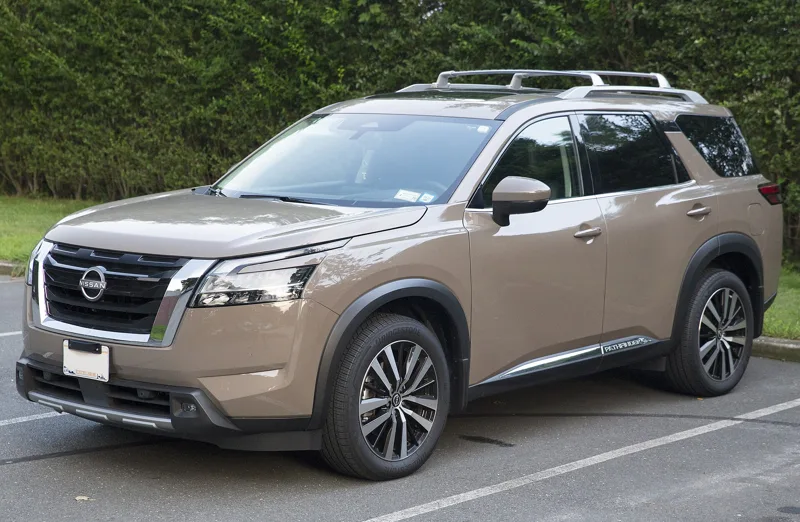
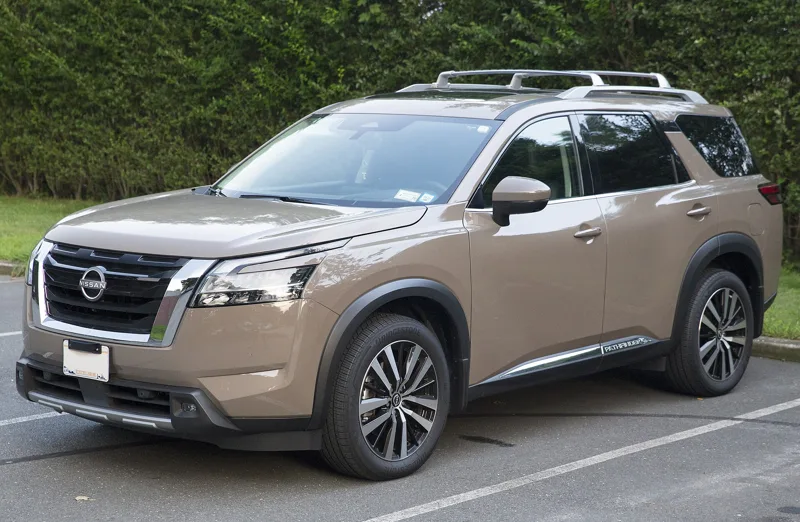
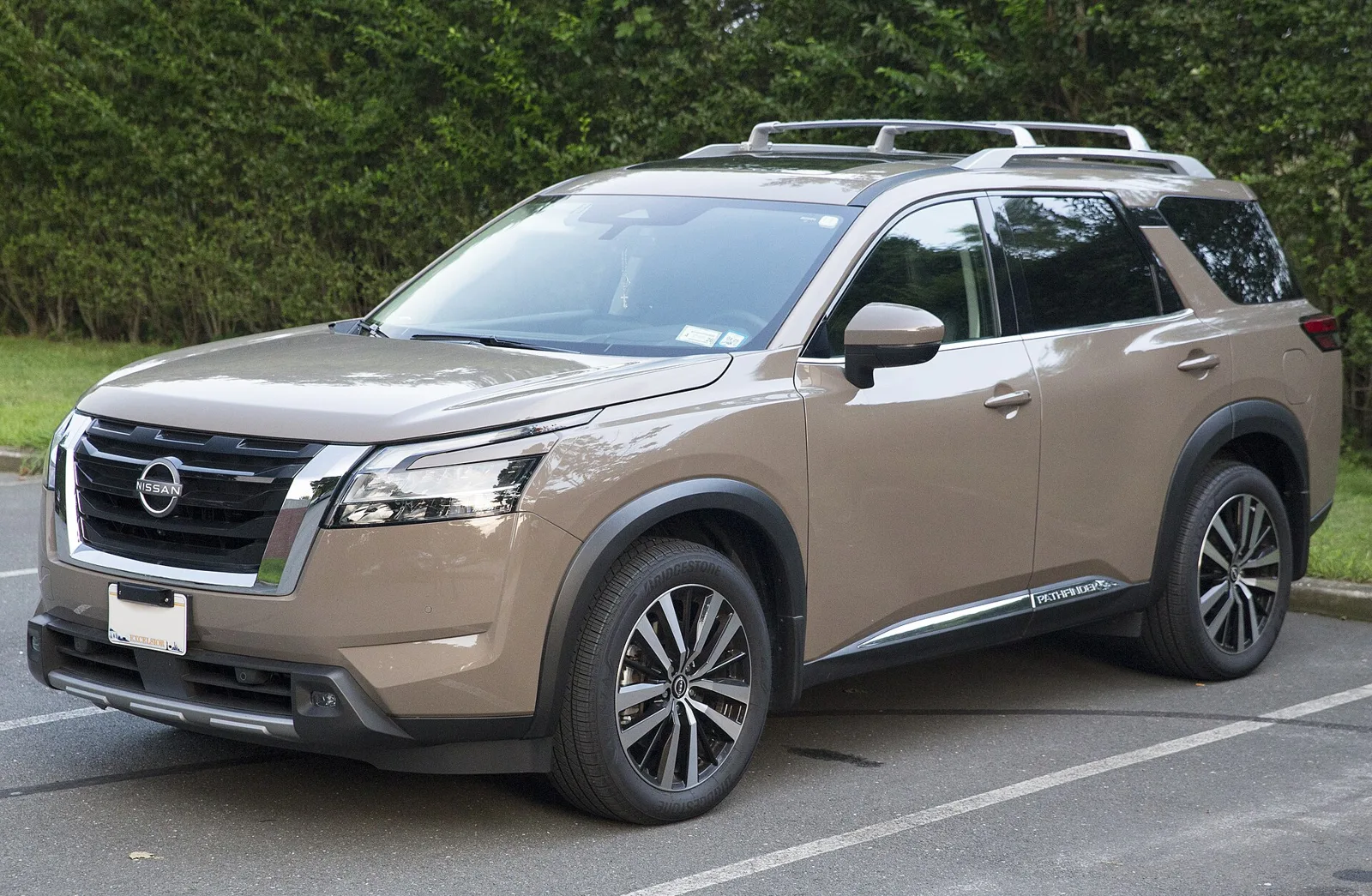
The fifth-generation Pathfinder was unveiled on 4 February 2021. It stayed a unibody crossover on the same platform, with a more squared-off look that borrowed cues from earlier Pathfinders as well as the Rogue and Armada. It is 1.5 in longer, 0.6 in wider and 0.5 in taller than its predecessor.
Power stayed at 284 hp (212 kW) and 259 lb ft (351 N m), but the CVT was replaced by a nine-speed automatic from ZF. A new Intelligent 4x4 system with seven settings joined trailer sway control and the Safety Shield 360 suite as standard. The interior adopted an electronic shifter and a floating bridge, and an 8-inch touchscreen with Apple CarPlay and Android Auto came as standard.
The fifth generation comes as standard with eight seats, and second-row bucket seats are available. Trim levels run from S and SV through SL to Platinum, with quilted leather on the Platinum.
How did the 2026 facelift change the car?
The Pathfinder facelift was unveiled on 13 November 2025. It introduced revised front and rear fascias, a more prominent grille and black roof rails on the SL and Platinum. A standard 12.3-inch touchscreen replaced the earlier 8- or 9-inch units across all trims, with wireless Apple CarPlay and Android Auto.
Nissan announced in 2026 that the Pathfinder would be discontinued in Australia and New Zealand, citing exchange rates, declining sales and the lack of a hybrid option. The Chinese market received its own Pathfinder in 2023, based on the US-made car and powered by a 2.0-litre turbo.
Key specifications at a glance
| Item | Figure |
|---|---|
| First unveiling | May 1985 |
| First-generation V6 | VG30i 3.0 L, 143 hp (107 kW) |
| Second-generation V6 | VG33E, 168 hp (125 kW) |
| Fourth-generation V6 | VQ35DE 3.5 L, 260 hp (194 kW) |
| 2017 V6 | 284 hp (212 kW), 259 lb ft (351 N m) |
| Fourth generation launch | Late October 2012, unibody |
| Fifth generation debut | 4 February 2021 |
| Indonesian Terrano | 1995 to 2006, 17,801 units |
Is the Pathfinder's legacy the Terrano name?
The Pathfinder's legacy is a long run of Nissan SUVs that moved from a truck-based off-roader to a unibody family vehicle. The Terrano name carried the same platform through markets outside North America until 2004, when the global Pathfinder name took over.