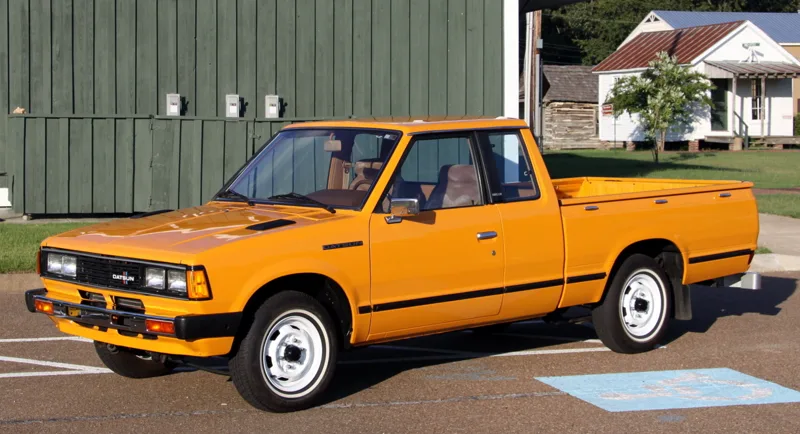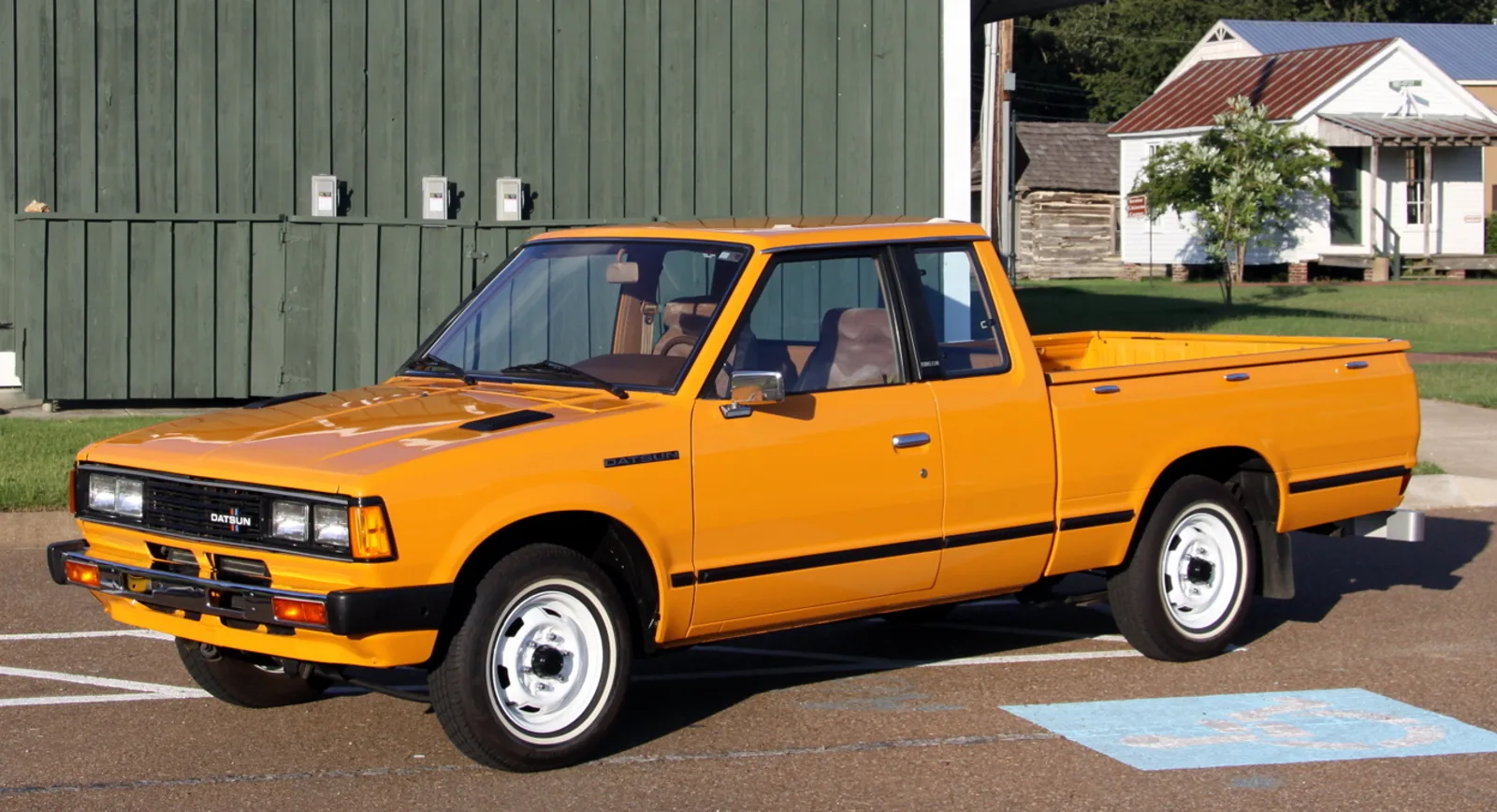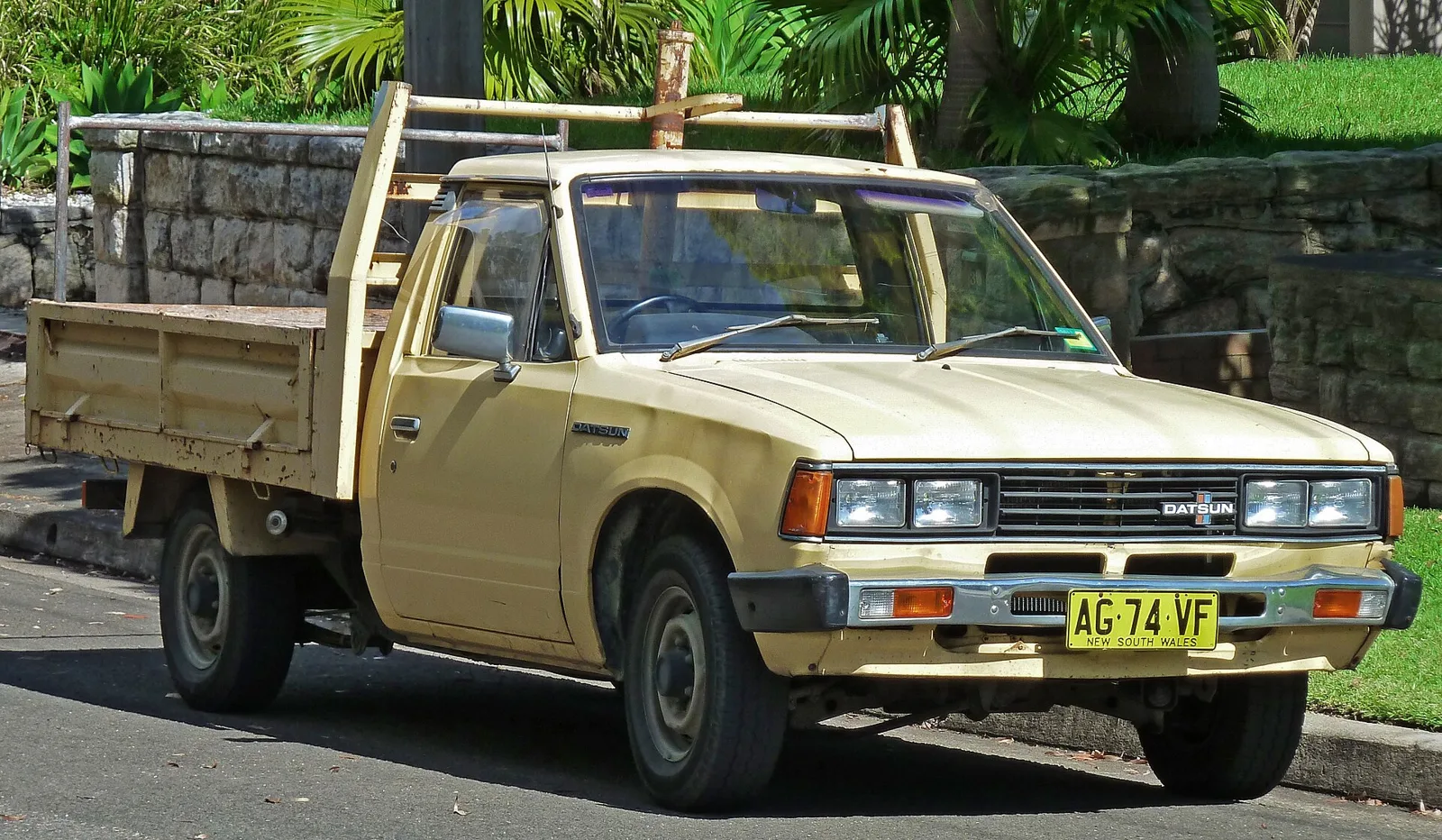
Forty-two years of small Nissan pickups, from sidevalve trucks in post-war Japan to the Hardbody that rivalled Toyota in America.
Nissan's small pickup line ran from 1955 to 1997 after roots in pre-war work trucks. The 620, the 720 and the Hardbody D21 followed the 120 and 220 series, and the durability of these trucks helped establish Datsun's reputation in North America.
The Datsun Truck was a compact pickup built by Nissan in Japan from 1955 to 1997. Its roots reached back to the 1930s, and the model grew from a simple post-war work truck into the Hardbody, a rugged small pickup sold around the world. The name changed from Datsun to Nissan in 1983, and the Frontier and Navara replaced it in 1997.
Where did the Datsun truck begin?
The Datsun truck line started with the Type 13 in April 1934, and small trucks based on passenger car counterparts followed, including the 14T, 15T and 17T. Those pre-war trucks continued to be built until early 1944, and they formed the basis for everything that came afterwards.
After the war, the 1121 arrived in 1946 with a technically similar layout but a far simpler body. It used pressed metal with almost no chrome, and many of its body parts were made from wood. Those choices allowed production in early post-war Japan, where materials were scarce, and the first trucks even used leftover pre-war parts.
The 2124 and 2225 followed in 1947, and the 2125 returned to the more ornate pre-war grille in 1948. Each new number told a story about which parts had been reused and which had been redesigned.
Small, simple and tough, the Datsun truck built a reputation in America long before the Nissan name took over.
How did the Datsun truck numbering system work?
The first digit of each model number showed the chassis and engine iteration, with 1 marking the pre-war 17T design. The second digit covered the bonnet and grille, the third covered the cab, and the fourth covered the rear body. Some numbers were assigned but never used, which made the sequence look more complicated than it was.
The 3135 took over in January 1949, followed by the 3145 in January 1950. In August 1950 the 4146 introduced the 860 cc Type 10 engine, which produced 15 kW (20 hp; 20 PS). The extra power allowed a bigger cargo area, but top speed only rose from 67 to 70 km/h (42 to 43 mph).
The 5147 of 1951 brought a longer wheelbase of 2,150 mm (84.6 in), replacing a 2,005 mm (78.9 in) chassis that had served for seventeen years. Its most important change was hydraulic brakes in place of mechanical units. The final 6147, two years later, used the 25 PS (18 kW; 25 hp) D-10 version of the old sidevalve engine, and it raised payload from 500 to 600 kg (1,100 to 1,300 lb).
What were the 120 and 220 trucks?
The 120 series arrived in January 1955 as the latest Datsun truck with up-to-date styling. It was a load-carrying version of the Datsun 1000 sedan, offered as a delivery van, panel van and double cab. Early models ran the 25 PS, 860 cc Type 10 engine with a four-speed floor-shift manual, and a larger commercial vehicle called the Nissan Junior sat alongside it.
The 120 was also one of the first Nissan products sold in Europe. An order of 200 units went to Spain in 1956. Nissan skipped the 121 designation for reasons unknown, and the L123 became the first left-hand drive version the company built, for importers in the Middle East.
The 220 arrived in November 1957 with a payload of 850 kg (1,874 lb), and it was the first Datsun truck exported to the United States. The 220 was shown at the 1958 Los Angeles Auto Show, and it officially established Datsun in the American market.
Why did the 220 matter in America?
The 220 was the first Datsun truck to reach the United States, and it was also the first with a 12 volt electrical system. It was based on the chassis of the 210 sedan, with which it also shared its engines.
Exposure to the American market shaped the detail of later models. On the 221 of October 1958, the front turn signals moved from the fenders to positions beside the grille, because US regulations did not permit the original layout. A strengthened rear axle able to handle long highway runs was another American-driven change.
The 223 of July 1959 brought the new E-1 1.2-litre engine, rated at 60 PS, along with independent front suspension with torsion bars. Steering moved to a worm-and-roller system, and the brakes gained power assistance. Those systems borrowed from parts developed for the Nissan Cedric.
How did the 320 and 520 series differ?
The 320 series was released in August 1961 and built until 1965 in three series, 320 to 322. It inherited much of the 120 and 220 underpinnings but added body panels from the 310-series Bluebird. It used the E-1 engine from the 223, producing 60 PS, and it kept a half-ton load capacity.
Gearing was low at 4.875:1 with a four-speed transmission, so the 320 was not freeway friendly above 60 mph. Body options included a single cab, a long wheelbase single cab, a double cab pickup with flush sides and a three-door van. The van was essentially a two-door station wagon, though Japanese tax rules treated it as a van.
The rarest 320 was the N320 Sports Pick-Up of 1963 to 1965, with a one-piece cab and bed. Only around 1,000 were produced, and its rear sheet metal and tail lights came from the V320 Light Van.
The 520 was built from May 1965 to May 1968, when it was facelifted into the 521. It used the new 1.3-litre Nissan J13 engine, rated at 67 hp. The 520 had a single headlight per side in 1965 and 1966, and quad headlights, two per side, arrived for 1967 and stayed until production ended.
Why was the 521 significant?
The 521 was the first compact half-ton pickup sold in the American market, arriving in 1968. Its flat-deck styling gave it a flattened bonnet, flatter front fenders and a new grille. The J15 engine rated at 77 hp was an option, and later models used the 70 kW (94 hp; 95 PS) L16 with a straight rear axle.
In 1967 Nissan had also added the Sunny Pickup Truck, sold through its Saito Store locations, which shared many of the 520's dimensions and engine size. In 1968 the Datsun Cabstar took over larger load-carrying duties, as a cabover truck built on the chassis of the third generation Nissan Junior.
What made the 620 a hit in North America?
The Datsun 620 went on sale in February 1972 and stayed in production until 1979. Buyers could choose a regular cab in two wheelbases, a delivery van offered only in Japan, and the U620 crew cab, which had a shorter bed for four passengers. The King Cab arrived in 1977, stretching the cabin by 24 cm (10 in).
In North America the 620 used Nissan's L engine family. The 1972 and 1973 models produced 96 hp from the L16, the 1974 model used the L18 at 100 hp, and the 1975 to 1979 models had the L20B at 110 hp SAE gross, which equalled 97 hp (72 kW) SAE net. It met California's emissions standards with an EGR system alone.
The 620 offered the first automatic transmission in the Datsun truck range, the 3N71 three-speed, from mid-1972. Standard transmissions were four-speed manuals, and a five-speed manual became optional in 1977. Final drive gearing was 4.375:1.
Buyers mostly treated the truck as transportation rather than work equipment. Around 40 percent of buyers said they never used it for work. Its durability and weather resistance were also praised, and it competed with the larger American pickups while building Datsun's reputation for reliability.
What innovations did the 620 introduce?
The 620 introduced several firsts in the North American market, including a long bed in 1975, an extended cab in 1977, front disc brakes in 1978 and electronic ignition in 1978. Those additions widened the appeal of a model that was already known for toughness.
The 620 was redesigned slightly for 1978, with new grille and front bumper treatments. Track increased by 30 mm (1.2 in) at both ends, and in South Africa the truck was renamed from the One-Ton Pick-Up to the Datsun 680. Some markets also offered a four-door crew cab version.
What was the Datsun 720?
Nissan introduced the Datsun 720 in October 1979 as the successor to the 620. A four-door crew cab was offered in most markets, though not in North America. Overseas buyers could still choose older-style beds in later years, together with the lower-cost round headlamps.
In Japan the standard engine was originally the J16, but in 1982 it changed to the more modern Z16 derivative. The 1983 front end received a larger grille, a bigger bumper and new corner lights, and the dashboard gained round gauges in place of square ones.
In North America the 720 came as a regular cab or King Cab, with regular and long beds. Trim packages were GL, DX and the ST sport truck, and the MPG was a stripped-down economy model. A Bushmaster covered utility conversion by Matrix3 was offered from 1984 to 1986.
Which engines did the 720 use?
US models began with the carbureted L20B. For 1981 Nissan switched to its NAPS-Z engine line, with the Z22S 2.2-litre unit. NAPS was Nissan's name for its pollution control technology, used as emission laws were enacted in Japan from 1975. Diesel options came from the Nissan Diesel division, which Nissan Motors had acquired in 1960.
In mid-1983 Nissan introduced the Z24, a 2.4-litre twin spark four-cylinder rated at 77 kW (103 hp; 104 PS). The 2.3-litre SD23 OHV diesel and the SD25 diesel were also offered, and the diesel dominated 720 sales in many markets.
The 720 MPG was a special case. Its Z20 carburettor engine had a compression ratio of 9.4:1 and produced 95 hp (71 kW) with 112 lb ft (152 Nm) of torque. A knock sensor retarded the timing by about 10 degrees, which gave excellent economy at the cost of emissions. It was not sold in California.
| Specification | Detail |
|---|---|
| Production span | 1955 to 1997 |
| Early engine | 860 cc Type 10, 25 PS (120 series, 1955) |
| 220 payload | 850 kg (1,874 lb); G220 1,000 kg (2,200 lb) |
| 320 engine | E-1, 60 PS |
| 520 engine | J13 1.3-litre, 67 hp |
| 620 North American engine | L20B, 110 hp SAE gross, 97 hp (72 kW) SAE net |
| 620 diesel | 2.2-litre, 49 kW (66 hp; 67 PS) |
| 720 engines | L20B, Z22S, Z24 2.4-litre, SD23 and SD25 diesels |
| D21 Z24i | 79 kW (106 hp; 107 PS) in US trim |
| D21 KA24E | 100 kW (134 hp; 136 PS) from 1990 |
| D21 V6 | 3.0-litre VG30; dropped from US sales after the 1996 model year |
| Successors | D22 Frontier (1997), Navara in some markets |
How did the Datsun truck reach Europe and other markets?
In most European markets the 720 was sold as the Datsun PickUp or the Datsun King Cab. The name gradually gave way to Nissan in 1983 and 1984, as it did elsewhere. The United Kingdom received only the longer wheelbase, either a standard bed 1-tonner with the L18 engine or a four-wheel drive 2.2-litre King Cab with 96 hp (72 kW; 97 PS).
Australia received only the SD25 diesel and the Z22S petrol engine. European diesel SD22 units produced 64 PS (47 kW; 63 hp), while the 1.8-litre L18 offered 80 PS (59 kW; 79 hp). The first vehicle from Nissan's TEOKAR assembly plant in Volos, Greece, arrived in February 1980 with a 1.6-litre engine.
What replaced the 720 with the D21 Hardbody?
The D21 generation succeeded the Datsun 720 and was sold as the Nissan Datsun truck in Japan, with the Navara name used in markets such as Australia. The D21 was offered worldwide in two body styles, the Japanese-designed A body and the S body King Cab that was styled in San Diego.
In North America Nissan used the Datsun name for the 1980 to 1984 model years, then switched to Nissan for 1985. The D21 was called the Hardbody in the United States, a name that came from its double-wall bed and overall styling. The Hardbody ran from November 1985 to 1997 and competed directly with the Toyota compact pickup.
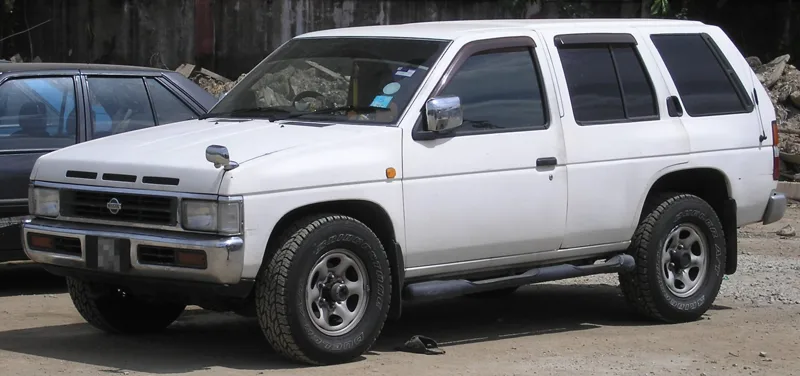
The model change in January 1986 brought the switch from the 720 body, with two larger headlights replacing four smaller ones. The same year introduced the Nissan Pathfinder, derived from the Hardbody and launched with chassis code WD21.
What did the Hardbody change through its life?
US Hardbodies came in standard and King (extended) cabs, with 6-foot and seven-foot beds. Outside North America buyers could also choose a Crew Cab with a short four-and-a-half-foot bed. Engines ranged from 1.6-litre petrol fours to a 2.7-litre diesel four, with the SD25 and TD25 diesels among the choices.
In North America the 2.4-litre Z24i lasted until 1989. From 1990 the KA24E replaced it, a SOHC engine with three valves per cylinder that produced 100 kW (134 hp; 136 PS). The 3.0-litre V6 was the only option for the one-tonne long bed, but it left US sales after the 1996 model year because it could not meet the new OBD-II emissions rules in time.
Trim levels were base, XE and the better equipped SE. A value package for the XE started in 1994, and the SE could be ordered with a sport power package including a sunroof and 15x8 inch alloy wheels. Rear wheel ABS came on both 2WD and 4WD models from 1990.
Safety and comfort changed in the final years. The 1993 model year adopted R-134a air conditioning refrigerant, the 1994 refresh brought a much improved interior and a new ergonomic dashboard, and 1995 introduced the high mount brake light required by US rules. A driver's side airbag arrived in late 1995.
Where was the Datsun truck built after 1997?
Hardbody production continued in Latin America for longer than in the United States. The D21 was built in Mexico until the 2008 model year, and Nissan Mexicana ended production of its camiones, the Spanish word for trucks, on 15 March 2008 after 15 years at its Cuernavaca plant. Venezuela kept selling the D21 until at least 2014.
In China the D21 story started with Sammitr, a Thai vehicle assembler that set up a joint venture in Changchun in 1992. Its Sanyou CY1020 pickup sold for CNY 70,000 and the CY6500 van for CNY 72,000. Later, a Dongfeng and Nissan joint venture called Zhengzhou Nissan began building purely local D21 pickups, starting in April 1995 for a six-year run.