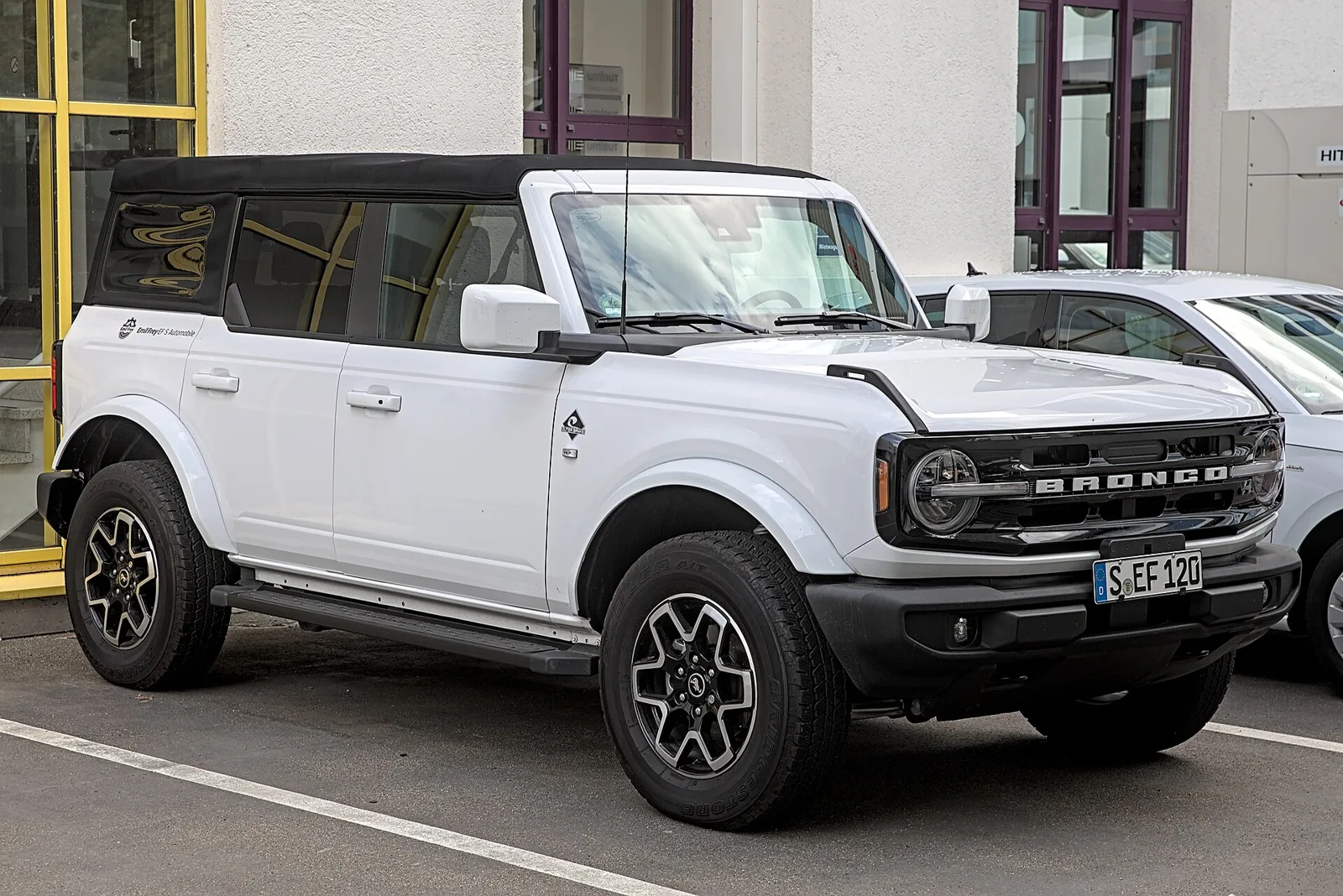
Ford's first SUV began as a compact off-roader, grew into a full-size F-Series-based model and came back in 2021 to challenge the Jeep Wrangler.
The Ford Bronco is an SUV line first sold by Ford for the 1966 model year. Five generations were built until 1996, and a sixth generation returned for 2021 as a two-door and four-door competitor to the Jeep Wrangler.
The Ford Bronco is a line of SUVs that Ford has sold in six generations. It started in 1966 as a compact off-road vehicle on its own chassis, grew into a full-size model built on the F-Series in 1978, and came back in 2021 in mid-size two-door and four-door form to take on the Jeep Wrangler. The name has also been attached to smaller and export-only vehicles, which gives the line an unusually wide history.
Where did the Ford Bronco come from?
Donald N. Frey, a Ford product manager, came up with the concept in the early 1960s, and Paul G. Axelrad handled the engineering. Lee Iacocca signed off on production in February 1964, and the car was built to compete with the Jeep CJ-5 and the International Scout.
Developed as an off-road vehicle, the first Bronco carried its own chassis rather than borrowing one from a passenger car or a pickup. That independence set it apart from the larger full-size trucks that Ford sold alongside it, and it gave the early car a compact footprint suited to rough ground.
The first Bronco was a niche product. It competed in a small market for purpose-built off-roaders, and the idea of a sport-utility vehicle was still new to American buyers when it reached showrooms in 1966.
Ford's first SUV began as a compact off-roader and has since returned from a 25-year hiatus to challenge the Wrangler.
What did the first-generation Bronco look like?
The 1966 model was offered as a wagon with two doors, a pickup with a half cab, or an open-body roadster. It listed at $2,194, which is $22,415 in 2025 money, and the car came with few standard features. A long list of options was available from Ford and its dealers.
The Sport option package arrived for the 1967 wagon. It was mostly a matter of chrome exterior trim and wheel covers, with red-painted FORD lettering on the grille. From 1970 the Sport was sold as its own model instead of as a package of options.
Styling was kept deliberately simple, with flat glass and straight bumpers. The lack of ornament matched the car's purpose, and the roadster was dropped once sales proved weak, leaving the wagon as the core of the range.
What chassis did the first Bronco use?
The first-generation Bronco used a chassis built for this model alone, one that no other Ford or Lincoln-Mercury car used. It rode on a 92-inch wheelbase and used box-section body-on-frame construction, which kept the structure strong for off-road use.
Every example was sold with four-wheel drive, which simplified production. The front axle was located by radius arms and carried a coil spring, and the layout allowed a 34-foot turning circle. That turning circle was tight enough for the work the car was designed to do.
What engines and transmissions did the first Bronco use?
The launch engine was a 170-cubic-inch inline six rated at 105 hp. It was derived from the Ford Falcon and modified for the Bronco with solid valve lifters, a larger oil pan and a heavy-duty fuel pump.
A 289-cubic-inch V8 rated at 200 hp became an option in March 1966. For 1969 the V8 was enlarged to 302 cubic inches and stayed in the line through the 1977 model year. The front axle was a Dana 30 until it was replaced by a Dana 44 in 1971.
Out back sat a Ford 9-inch unit on leaf springs. That arrangement was carried over into later Broncos, which is one reason the first and second generations share so many traits despite their different chassis.
Why did Ford change the Bronco for 1978?
For 1978 Ford adapted the Bronco from the F-Series, making it a shortened F-100 4x4 and a full-size SUV. The second generation had been planned for a 1974 launch, but it was postponed in response to the 1973 fuel crisis and fuel economy concerns.
The move to the F-Series added 12 inches of wheelbase. The body also grew by about 28 inches in length, 11 inches in width and 4 inches in height. Depending on the powertrain, the 1978 Bronco carried between 1,100 and 1,600 pounds more than its 1977 predecessor.
The project had been known internally as Project Shorthorn. Despite a short two-year run, the design change proved successful, and the model line overtook both the Chevrolet Blazer and the Dodge Ramcharger in sales for the first time.
What changed in the second generation?
The second generation was based on the Ford F-100 pickup chassis and carried a 104-inch wheelbase, which was 12 inches longer than the previous Bronco. It was still sold only with four-wheel drive, and the chassis used a coil-sprung Dana 44 front axle with a leaf-sprung Ford 9-inch rear axle.
The engine line-up was rebuilt around two V8s. The 5.8L 351M was standard, and the 6.6L 400 V8 was optional. The two engines produced similar peak power, but the 400 delivered more torque, which mattered for towing and low-speed work.
Ford shifted the Bronco to a lift-off hardtop, which was a more practical configuration for a truck-based SUV. The body was offered only as a three-door wagon, and it shared its doors and forward sheet metal with the F-100 to keep costs down.
What was the third-generation Bronco?
The third-generation Bronco arrived for 1980 and was based on the F-150 chassis, which kept it at full size. It retained a 104-inch wheelbase but was designed to use a more efficient powertrain and a lighter structure than its predecessor.
For 1980 and 1981, Ford engineers gave the frame holes stamped out at the factory, which cut curb weight by 375 lb (170 kg). The lighter frame gave way in 1982 to a stronger one, which added 31 lb (14 kg) back to the car.
The 1982 model year also brought two changes that mattered. The Bronco II debuted as a separate compact on a shortened Ranger pickup, and the 351 Windsor V8 replaced the 351M in the full-size car. A 210-hp high-output version of the 351 followed in 1984, and the car was assembled in Australia from March 1981 through 1987.
Were there four-door Broncos before 1996?
Ford did not sell a four-door Bronco until the Expedition arrived for 1997. Centurion Vehicles, a converter in White Pigeon, Michigan, built four-door Centurion Classic models on Bronco bodies from 1987 to 1996, and they used a 140-inch wheelbase.
The C-150 was based on the F-150 chassis and could be ordered with four-wheel drive. The C-350 was based on the F-350, with four-wheel drive as standard, and it was the only one of these conversions to run on a larger chassis.
The C-350 offered a 7.3L diesel V8 alongside a 7.5L gasoline V8, while the C-150 offered 5.0L and 5.8L V8 engines. Those powerplants made the Classic one of the few Bronco-related vehicles to use the bigger engines.
What did the fourth and fifth generations change?
The fourth generation, which appeared for 1987, was a shorter-wheelbase take on the eighth-generation F-150. It took a reshaped front bumper and grille, composite headlamps in place of sealed-beam units, and redesigned seats and dashboard. Rear-wheel anti-lock brakes became standard that year.
Ford added a 5-speed manual from Mazda for 1988, and fuel injection came to the inline six in 1987 and to the 5.8L engine a year later. For the 1991 model year Ford marked 25 years of production with the Silver Anniversary Edition, which used Currant Red paint and gray leather seats.
The fifth generation was introduced for the 1992 model year. Four-wheel anti-lock brakes replaced the rear-wheel system for 1993, and a driver-side airbag arrived in 1994. The hardtop could no longer be marketed as a lift-off once the safety upgrades were in place, and by 1994 the Bronco was V8-only.
In 1996 the Bronco became the first Ford vehicle to put its turn signal lights in the side mirrors. That detail was among the last changes to a model line that was then in decline.
Why did the fifth-generation Bronco end in 1996?
The last fifth-generation Bronco rolled off the Wayne, Michigan line on June 12, 1996. Ford introduced the Expedition for 1997 to replace it. The Expedition was a bigger model that sat above the Ranger-based Explorer, and it took over the job the Bronco had been doing.
Ford said sales had already been falling before the June 1994 police chase involving a Bronco, so the decision was not caused by that event. The company wanted a model that would compete more directly with the Chevrolet Suburban and the Chevrolet Tahoe.
Which Bronco trims were offered?
The sixth generation was sold in Base, Big Bend, Black Diamond, Outer Banks, Badlands, First Edition, Wildtrak, Everglades, Raptor and Stroppe Edition trims. Several came as two-door or four-door cars, while the Raptor and Everglades were four-door only.
The First Edition was based on the Badlands and was offered for the 2021 model year. Output started at 7,000 cars, but Ford later raised the limit because demand was high. Its 33-inch tires and HOSS 2.0 suspension set it apart from the lower trims.
The Stroppe Edition arrived for 2025 as a two-door and honoured the racer who built roughly 400 Baja Broncos from 1971 to 1975. It sold for $77,665 in 2025, and for 2026 it moved to the four-door model at a reduced price of $69,995.
How did racing shape the Bronco's image?
Bill Stroppe, a race car builder, put together a Bronco team in 1965 for endurance off-road events. Working with Holman-Moody, his team of Broncos raced the Mint 400, the Baja 500 and the Mexican 1000, the last of which later became the Baja 1000.
The 1969 Baja 1000 field included six Broncos from the team. The 1971 Baja Bronco package, sold through dealers, cost US$5,566, against $3,665 for the standard V8 Bronco. Dealers moved just 650 of them over the following four years, so the package is rare today.
Racing went beyond the desert. A 1966 Bronco funny car built for the quarter-mile finished with low 8-second times, although it was sidelined when the sanctioning bodies outlawed pickups and aluminium frames. In 2019 a Bronco R prototype covered 1,000 miles (1,609 km) in the Baja 1000, carrying a 70-US-gallon fuel tank.
Why is the O.J. Simpson chase linked to the Bronco?
The Bronco gained a lasting place in news history on June 17, 1994. A 1993 Bronco XLT carried O.J. Simpson in its rear seat during a police chase at low speed along Interstate 405, which ended with his surrender. The chase was shown live on television, and approximately 95 million North Americans watched.
The event is often mentioned alongside the model's decline, but Ford's own account put the drop in sales before the chase. The link is more about media attention than about the car's engineering or its market performance.
What brought the Bronco back in 2021?
Ford's sixth generation reached showrooms as a 2021 model, 25 years after the nameplate had lapsed. The Jeep Wrangler was the rival it was built to beat, and it comes in two-door and four-door bodies, both of which can be turned into convertibles.
The reveal was scheduled for a spring 2020 date and then moved to July 13, 2020, after delays linked to the pandemic. Ford accepted $100 reservations when the reveal premiered. The first cars left the line on June 14, 2021, at the Michigan Assembly Plant in Wayne, where the earlier generations were also made.
Ford reported that the seven-speed manual was taken on around 15% of the initial orders. The car is a mid-size SUV, and its chassis and powertrain bring it closer in size to the Ford Ranger.
What engines power the modern Bronco?
The base engine, a 2.3-liter EcoBoost inline-four with a turbocharger, makes 300 hp (224 kW) and 325 lb-ft, or 441 N-m, of torque. The optional engine is a 2.7-liter EcoBoost V6 with twin turbos, making 330 hp (246 kW) and 415 lb-ft, or 563 N-m, of torque.
That V6 is paired only with a ten-speed automatic, while the 2.3-liter can take either that automatic or a Getrag manual. The manual is called seven-speed, but it is really a six-speed with a dedicated crawler gear serving as the seventh.
The Bronco Raptor, introduced for 2022 as a four-door model, uses a 3.0 EcoBoost V6 with a Baja Mode. It produces 418 hp (312 kW) and 440 lb-ft of torque, which is 597 N-m, and it can tow 4,500 pounds (2,000 kg).
What are the Ford Bronco specifications?
| Specification | Detail |
|---|---|
| Type | Two-door or four-door SUV, body-on-frame |
| Years | 1966 to 1996, then 2021 onward |
| Wheelbase, first generation | 92-inch |
| Wheelbase, second generation | 104-inch, based on the F-100 |
| Launch engine (1966) | 170-cubic-inch inline six, 105 hp |
| Standard engine (2021) | 2.3-liter EcoBoost inline-four, 300 hp (304 PS; 224 kW) |
| Optional engine (2021) | 2.7-liter twin-turbo V6, 330 hp (335 PS; 246 kW) |
| Raptor engine (2022) | 3.0 EcoBoost V6, 418 hp (424 PS; 312 kW) |
| Ground clearance (2021) | 11.6 in (295 mm) |
| Raptor width | 85.7 inches (2,180 mm) |
| Raptor towing | 4,500 pounds (2,000 kg) |
| Successor line | Ford Expedition, 1997 |
How were the Bronco concepts received?
Ford's concept work stretched back well before the sixth generation. A special Bronco roadster was built for the 1965 Detroit show, and in 1973 Ford's advanced truck engineers produced four prototypes, among them Project Shorthorn, Longhorn, Midhorn and Widehorn.
The 2004 Bronco concept was unveiled at the North American International Auto Show. It adapted a short wheelbase and round headlamps, and it was among the first Ford vehicles to use a three-bar grille. The concept was never built as a production car, but its shape kept the idea alive.
The Bronco R prototype appeared at the 2019 Baja 1000. It carried the drivetrain of the then-unreleased 2021 Bronco, so Ford could check the powertrain before the production car arrived.
_1X7A0874.jpg)