How an iPhone takes over a car's screen, why wired and wireless versions differ, and how CarPlay grew from an iPod feature into a platform.
CarPlay is Apple's standard for connecting an iPhone to a car, letting the head unit show and control iOS apps such as Maps, Music and Messages. It works over USB or, on some newer cars, wirelessly. Siri handles most interactions to keep the driver's attention on the road.
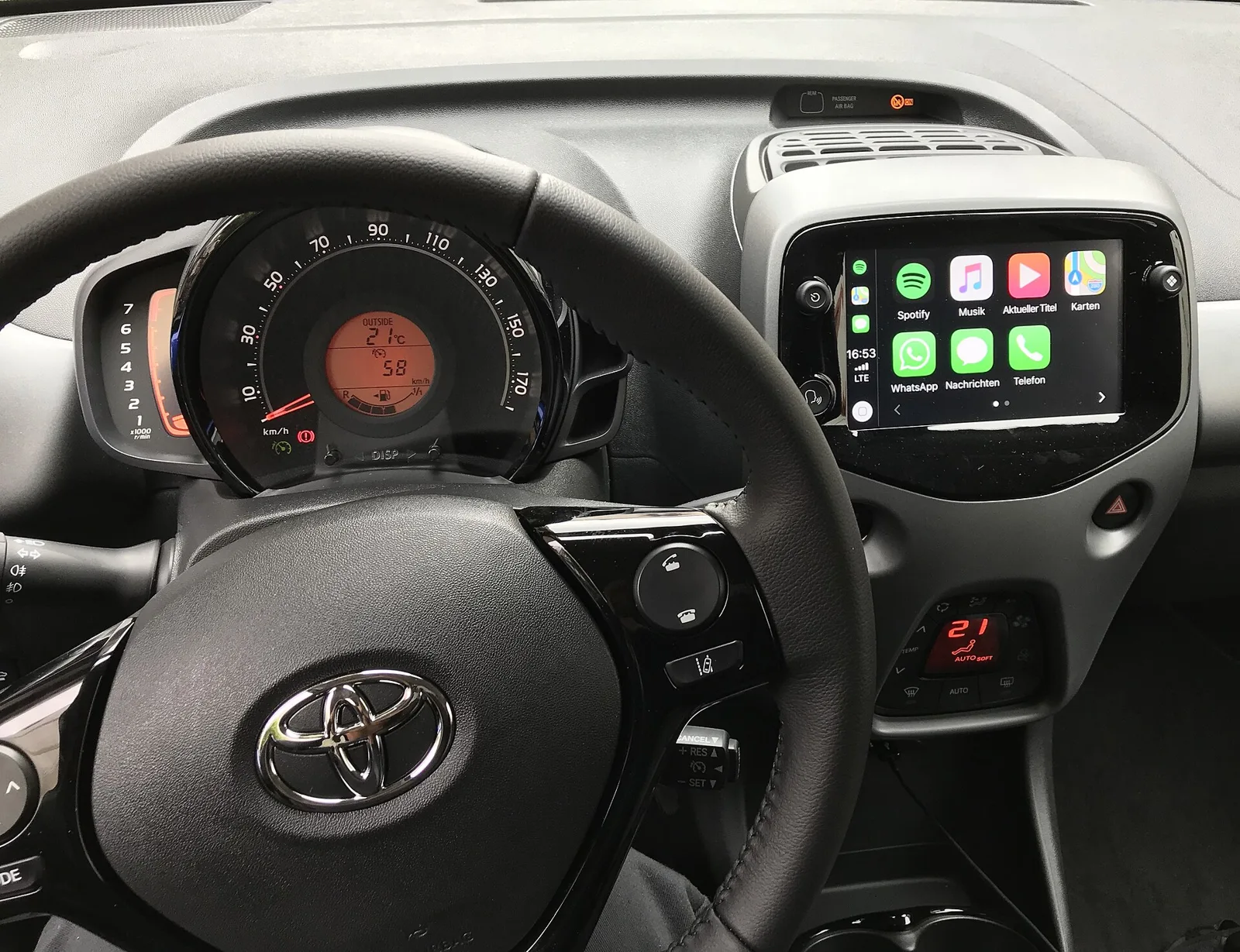
Apple CarPlay is a standard that lets a car's head unit act as a display and controller for an iPhone. The phone does most of the work, and the car's screen, dials and steering-wheel buttons present its apps. More than 800 car and motorcycle models support it, and it works over a USB cable or, on newer vehicles, wirelessly.
What is CarPlay?
CarPlay is an Apple standard that turns a car's infotainment screen into a window onto an iOS device. Compatibility starts with the iPhone 5, provided the phone runs iOS 7.1 or later. The head unit provides the audio output and the visual display, while the iPhone runs the software and handles the apps.
Apple's own count runs past 800 cars and motorcycles. Owners of older vehicles can bring the feature in with certain aftermarket audio products, which means it is not limited to new cars. The standard's design means a driver sees familiar iPhone apps in the car, adapted to the vehicle's controls and to the rules of driving.
CarPlay began as an iPod feature in a BMW and became the dashboard standard most drivers now expect.
How does CarPlay connect to a car?
Most CarPlay systems connect to iOS through a USB cable, and some connect wirelessly. Wireless support can also be added through aftermarket dongles. A wired connection supplies power to the phone as well as a stable data link for audio, video and control input.
A wired connection is supported by a broad range of factory systems and aftermarket head units. Some third-party products marketed as wireless adapters work by emulating a wired connection. They plug into the car's USB port and present themselves as a wired interface, while separately linking to the phone over Wi-Fi. Those adapters still need the car or head unit to support standard wired CarPlay.
True wireless CarPlay works differently. During the first pairing, the iPhone and the receiver exchange network credentials over Bluetooth. After that, CarPlay data runs over a two-way Wi-Fi connection. Support depends on both the vehicle hardware and the iPhone model, and it is generally limited to newer factory systems and selected aftermarket receivers.
Which apps and features come with CarPlay?
Built-in CarPlay apps include Phone, Apple Music, Apple Maps, Calendar and Messages, along with Audiobooks from Apple Books, Podcasts, Settings and News. Apps installed on the iPhone appear on the CarPlay home screen unless the user disables them, and the order of apps can be changed on a per-vehicle basis.
Third-party apps need permission from Apple before they can join CarPlay. Developers work within five categories: audio apps for music and podcasts, navigation apps for turn-by-turn guidance, automaker apps for vehicle controls, messaging and voice-over-IP apps, and food-ordering and parking-services apps. Each category has a different set of rules about what the app may show on the car's screen.
Automaker apps stand out because they let a driver control vehicle-specific features such as climate settings, fuel levels or the radio through CarPlay. Messaging and calling apps use Siri for dictation and reply in an audio-only interface, while voice-over-IP apps link into the iOS calling interface.
How does CarPlay keep drivers focused?
CarPlay relies heavily on Siri to reduce the need to look at the screen. Siri provides voice turn-by-turn navigation and voice input for text messages. Weather and stock results are read aloud rather than displayed, and most native apps deliver audio with minimal interaction.
Some requests that would bring up visual information are blocked while the car is in gear. The aim is to discourage distracted driving, so the screen shows less while the vehicle moves. Apple's guidelines shape which app categories are allowed and what they can display, which is why messaging, calling and navigation apps follow different rules from one another.
Where does the CarPlay software run?
Most of the CarPlay software runs on the connected iPhone rather than on the car. The head unit supplies audio output and a visual display, and it adapts that display to the vehicle's control methods, whether touch screens, rotary dials, physical buttons, steering-wheel controls or hands-free microphones.
This split explains why an iPhone upgrade can add features without a new car. It also explains the limits: the vehicle's screen size and controls set the boundaries of the experience, while the phone supplies the apps, maps and music. Aftermarket head units frequently support both CarPlay and Android Auto, so drivers can use whichever phone they carry.
Where did CarPlay come from?
CarPlay grew out of earlier attempts to bring iPhones into cars. In 2008 Mercedes vehicles became the first to sell an audio system with both iPod and iPhone input. That Harman Kardon NTG 2.5 system offered audio streaming, syncing and control through the steering wheel and head unit, and it predated CarPlay and every other manufacturer's iOS integration.
The concept drew directly on an iOS 4 feature called iPod Out. Apple and the BMW Group's Technology Office USA developed it over several years. iPod Out allowed compatible vehicles to host the analogue video and audio from an iOS device, while passing button presses and knob turns back to the phone. Apple announced it at WWDC 2010, and it first shipped in BMW Group vehicles in early 2011. BMW and Mini called their version PlugIn, which pointed toward the car-specific interfaces that later platforms would require.
How did the CarPlay launch unfold?
Internally, CarPlay was known by the codename Stark. Eddy Cue announced the project as iOS in the Car at WWDC 2013, but an early version never reached the public. In January 2014 reports said Apple's hardware-minded corporate culture had caused delays. The project was then rebranded as CarPlay, with significant design changes, and launched at the Geneva Motor Show in March 2014.
Ferrari, Kia, Mercedes-Benz and Volvo were among the first carmakers to back it. The first car with a full version of CarPlay was the Ferrari FF in September 2014. BMW had initially said its cars would not support iOS in the car, but it later changed its position and added support.
What were the main CarPlay milestones?
Adoption accelerated quickly after the launch. The table lists several of the milestones that showed how far the standard had spread across cars, trucks and motorcycles, and the years in which major brands and categories joined.
| Year | Milestone |
|---|---|
| 2014 | Ferrari FF becomes the first car with a full version of CarPlay |
| 2015 | Volvo XC90 becomes Volvo's first CarPlay vehicle, in December |
| 2017 | Harman introduces wireless CarPlay in the 2017 BMW 5 series |
| 2017 | Scania becomes the first heavy duty truck in Europe to support CarPlay |
| 2017 | The 2018 Honda Gold Wing becomes the first motorcycle to support it |
| 2018 | Toyota begins CarPlay with the 2019 Toyota Avalon |
| 2019 | BMW no longer requires a subscription to use CarPlay |
| 2023 | General Motors plans to phase out CarPlay in its electric vehicles |
| 2025 | CarPlay Ultra is announced, starting with Aston Martin |
Which carmakers adopted CarPlay first?
Early automaker support came from brands such as Hyundai, which made the Sonata its first CarPlay model in early 2015. Volkswagen promised support later that year, and General Motors announced CarPlay for 14 different 2016 Chevrolet vehicles. Honda added it from the 2016 Accord, while Ford made it available on all 2017 Ford and Lincoln models with the Sync 3 infotainment system.
Other groups followed. FCA, now part of Stellantis, added it to its UConnect systems from select 2016 models. Subaru began with the 2017 Impreza, and Nissan introduced it on the 2017 Maxima. Mazda began with the 2018 Mazda6 and offered a retrofit for earlier vehicles with the MZD-Connect system. Toyota was a notable holdout for a long time before adding CarPlay from the 2019 Avalon.
How did iOS updates change CarPlay?
Each iOS release shaped what CarPlay could do. iOS 8 added a dark mode to Maps, and iOS 8.3 let a manufacturer allow wireless connection. iOS 9 brought Podcasts and the ability to download automaker apps, while iOS 10 added dictated message replies in an audio-only interface. iOS 11 introduced turn-by-turn guidance and points of interest in Maps.
Later releases expanded the platform further. iOS 12 supported third-party navigation apps such as Google Maps and Waze, while iOS 13 redesigned the layout and added Calendar, News and Settings to the home screen. iOS 14 allowed food-ordering and parking apps, and iOS 15 replaced Do Not Disturb with Focus mode. iOS 17 added SharePlay in the car, and iOS 18 added Sound Recognition for car horns and sirens. iOS 26 brought the Liquid Glass design language to CarPlay and CarPlay Ultra.
What is CarPlay Ultra?
CarPlay Ultra is the next-generation version of the standard, first announced by Apple in 2022 as a new CarPlay that could control vehicle functions and take over several screens. Apple originally targeted late 2024 for the rollout, then removed the date from its website in January 2025 amid delays. The company announced CarPlay Ultra on May 15, 2025.
The first launch partner is Aston Martin, which will include CarPlay Ultra on all of its new vehicles, starting with the DBX707. Existing vehicles will receive the feature through a future software update. Porsche had earlier previewed tighter integration through its My Porsche app, but that was not yet the all-new system Apple had shown. For now, CarPlay Ultra is limited to the US and Canada.
Who competes with CarPlay?
MirrorLink is a rival car-smartphone standard, used by several automakers including Honda and Volkswagen, along with SEAT, Buick and Skoda. It mirrors what appears on the phone's screen, while CarPlay requires a car-specific interface for each app. Android Auto plays the equivalent role for Android phones, and Huawei's HiCar serves EMUI and HarmonyOS devices.
Some automakers have chosen to avoid third-party systems altogether. Tesla and Rivian infotainment systems do not support CarPlay or Android Auto. Others depend on in-house platforms for phone syncing, among them BMW ConnectedDrive, Ford SYNC, OnStar and Toyota Entune.
Why did GM decide to drop CarPlay from EVs?
In March 2023 General Motors announced plans to phase out CarPlay in its electric vehicles in favour of a new Android Automotive system, starting with the 2024 Chevrolet Blazer EV. Gasoline models and earlier electric models kept CarPlay for the time being. The move followed an April 2023 statement that GM would gradually stop including CarPlay and Android Auto in its EVs.
GM said the change would let it collect and monetise more driver data and offer a better user experience. Consumers were unhappy with the decision. According to the Detroit Free Press, some long-standing GM buyers said losing CarPlay would send them to Ford instead. Some observers argued that the move favoured GM's partnership with Google and cut revenue for Apple, while others said it reduced customers' data privacy.