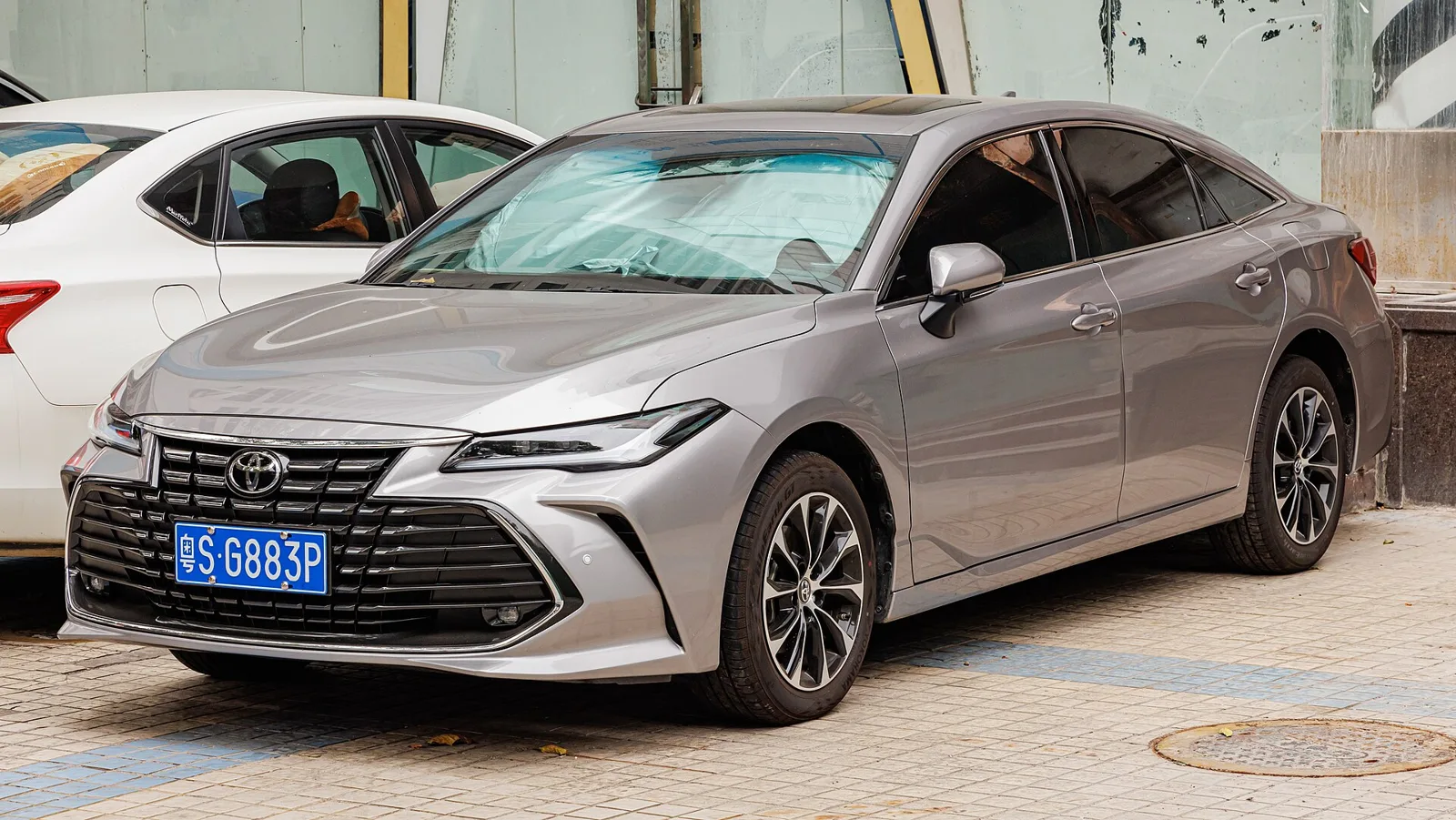
Built from 1994 in Kentucky, the Avalon replaced the rear-drive Cressida, spent time in Australia and ended US production in 2022, while the nameplate lives on in China.
The Toyota Avalon is a full-size, front-wheel-drive sedan that Toyota built in Kentucky from 1994. It replaced the rear-drive Cressida and was sold as the flagship in several markets. US production ended after the 2022 model year, and the Avalon continues in China.
The Toyota Avalon is a full-size sedan that Toyota built as its largest front-wheel-drive saloon. It was the flagship in the United States, Canada, China and the Middle East, and it was made at Toyota's Georgetown plant in Kentucky from 1994. US production ended after the 2022 model year, but the nameplate continues in China.
The Avalon was a successor to the rear-drive Cressida, which had been dropped from the American market in 1992. Its front-drive layout, interior space and generous equipment made it a long-running alternative in the premium family sedan segment.
Why did Toyota create the Avalon?
Toyota marketed the front-drive Avalon as the replacement for the Cressida, a mid-size rear-drive sedan. The Avalon's name refers to a legendary island in Arthurian legend, which fits Toyota's habit of naming its sedans after crowns, royalty and related words, such as Crown, Corona, Camry and Corolla.
Over its life the Avalon overlapped with other Toyota models built on similar underpinnings. It shared technology with the Camry V6 and the Lexus ES, and from 2013 the ES moved onto the same extended platform to match the Avalon's dimensions.
A front-drive flagship that began in Kentucky, spent years in Australia and carried on in China after the US exit.
How did the first-generation Avalon arrive?
The first Avalon was introduced at the February 1994 Chicago International Auto Show and launched in late 1994 as a 1995 model. Development began in 1990 under the 299T project code, and the design was approved internally in 1991. Design patents were filed in Japan on 17 February 1992.
The car was based on a stretched XV10 Camry platform. Its 3.0-litre 1MZ-FE V6 produced 192 hp (140 kW) and 210 lb ft (285 N m), and it shared its production line in Georgetown with the Camry.
The Avalon claimed almost 121 cu ft (3,426 L) of interior space, which made it the roomiest six-passenger car from a Japanese maker sold in America at the time. Compared with the Mazda 929 it was three inches shorter, while the Dodge Intrepid was 11 inches longer. Its exterior size matched rivals such as the Nissan Maxima.
What features did the first Avalon offer?
The Avalon could be ordered with a front bench seat for six passengers, and its column shifter was the first of its kind in an American Toyota since the T130 Corona. The trim levels were broadly similar to Toyota's LE and XLE models, with the XL and XLS sitting in the range.
Traction control was optional at launch. For the 1997 model year ABS became standard, power rose to 200 hp (150 kW) and torque to 214 lb ft (290 N m). A mid-cycle refresh for the 1998 model year updated the front and rear fascias and improved the structure for safety.
Toyota also introduced a concept convertible sedan under the Avalon name at the 1991 Tokyo Motor Show, which showed the company's early thinking on the nameplate.
How did the Avalon sell in Australia?
Toyota Australia recycled the old tooling for the first Avalon in 1999 and launched it as an all-new model in June 2000. It was built at the Toyota Altona plant in Melbourne, in right-hand drive for Australia and New Zealand and in left-hand drive for the Middle East.
The Australian Avalon struggled in the market. Critics called it boring, and it was front-drive and only available as a sedan with a 3.0-litre V6 and automatic transmission. Its intended rivals, the Ford Falcon and Holden Commodore, were rear-drive and offered far more choice.
Toyota had planned to rename the car the Centaur for Australia. The company dropped that name after learning of the hospital ship AHS Centaur, which had been sunk by a Japanese submarine during World War II, and the Avalon name stayed.
Updates followed in 2001 as the Mark II and in 2003 as the Mark III facelift. Toyota then marketed the car to taxi fleets with a dual-fuel LPG and petrol engine. Production ceased in mid-2005, and the Aurion replaced it in November 2006.
Toyota Australia showed the X-Runner Concept at the 2003 Melbourne and Sydney motor shows, a coupe-style utility derived from the Avalon. It was intended for production, but the parent company did not approve it.
What changed in the second generation?
The second-generation Avalon arrived in 1999 and grew in almost every dimension except its wheelbase. It kept the stretched Camry platform and used the 3.0-litre 1MZ-FE V6 with VVT-i, which made 210 hp (157 kW), with 220 lb ft (298 N m) of torque, paired to a four-speed automatic.
Its drag coefficient fell to Cd 0.28. The range was split into the basic XL and the upscale XLS, and options included a JBL sound system, vehicle stability control and an optional front bench seat for six passengers.
The second generation was also the first car with a built-in 115 V AC power inverter, a feature that was dropped on the third generation but later appeared on Toyota models such as the Highlander and Sienna. Its IIHS frontal test earned a Good rating in all six measured categories.
The Japanese market received a version called the Pronard from 2000 to 2004, sold through the Netz network and slotted between the Aristo and the smaller Verossa and Altezza. Poor sales meant the third-generation car was not exported to Japan.
How was the third-generation Avalon built?
Toyota unveiled the third-generation Avalon at the January 2005 Detroit show, and it went on sale in February 2005. Toyota reportedly cut development time from 29.5 months to 18 months. The car was not sold in Europe or Japan.
The car used Calty styling with a drag coefficient of Cd 0.29. It was the first Toyota to use a single-piece wiper blade, and the front bench seat option was dropped in favour of a semi-flat rear floor that helped rear passenger comfort.
Its 3.5-litre 2GR-FE V6 was the first Toyota in the US to use Dual VVT-i, with 280 hp (209 kW) and a 0-60 mph time of 6.0 seconds. The engine was linked to a five-speed sequential shift automatic, and for the 2006 model year the rating was revised to 268 hp (200 kW) and 248 lb ft (336 N m) after SAE testing changes.
The Avalon came in four trims: XL, Touring, XLS and Limited. The XL used 16-inch alloy wheels, while the other trims had 17-inch wheels. Limited models added a 12-speaker JBL audio system, rain-sensing wipers and a wood-trimmed steering wheel.
Yearly changes added Vehicle Stability Control to more trims, a six-speed automatic in 2007 and a mild facelift for the 2008 model year. The Touring trim was dropped in 2008, and the 2011 model year brought revised styling and only two trims.
The Avalon also earned strong reviews and safety honours. Car and Driver placed it first among large premium sedans in 2005, and IIHS gave the 2009 model year its Top Safety Pick award, with further honours for 2010 and 2011.
What did the fourth generation bring?
The fourth generation first appeared in partial form at the April 2012 New York show. It was based on the same platform as the Lexus ES and had new lights and a new grille, and its interior controls used tap-touch technology instead of buttons.
In June 2012 Toyota confirmed a hybrid version. The Avalon Hybrid went on sale in the United States in December 2012, using a revised version of Toyota's Hybrid Synergy Drive. Its 2.5-litre four-cylinder combined with an electric motor for a total output of 200 bhp (149 kW), and the EPA rated it at 40 mpg-US combined.
The Avalon Hybrid used a sealed nickel-metal hydride traction battery of 1.6 kWh, the same as the Camry Hybrid. The 2016 facelift brought a new grille, revised wheels and standard Toyota Safety Sense P, and it reintroduced the Touring trim as a sportier version of the Limited.
How did the fifth-generation Avalon differ?
The fifth-generation Avalon debuted at the January 2018 Detroit show and went on sale in the US in May 2018. It was built on the GA-K platform shared with the Lexus ES, and North American trims were XLE, XSE, Touring and Limited, with the XLE, XSE and Limited also offered as hybrids.
Four engines were offered: a 2.0-litre M20A-FKS four for China only, a 2.5-litre A25A-FKS four rated 207 hp (154 kW), a 3.5-litre 2GR-FKS V6 rated 301 hp (224 kW) and a 2.5-litre hybrid with combined output of 215 hp (160 kW). The V6 was rated at 25 mpg-US combined by the EPA, and the hybrid at up to 44 mpg-US on the highway.
Production took place in Georgetown, Kentucky, and at Tianjin FAW Toyota in China from 2019 to 2022. The China-market Avalon was later also built by Sichuan FAW Toyota from 2021.
Why did the Avalon leave the US market?
On 4 August 2021 Toyota said US assembly would stop after the 2022 model year. The company said the market had shifted towards SUVs and electrification, and the Avalon was replaced by the S235 Crown crossover, which brought the Crown name back to North America.
The Avalon continued in China, where it has since had several facelifts. The first China facelift arrived on 28 March 2022 and kept five trims, while the second in July 2024 added a 12.3-inch touchscreen and a new steering wheel.
What are the Toyota Avalon specifications?
| Generation | Years | Engine | Output |
|---|---|---|---|
| First (XX10) | 1994 to 1999 | 3.0-litre 1MZ-FE V6 | 192 hp (140 kW), later 200 hp (150 kW) |
| Second (XX20) | 1999 to 2004 | 3.0-litre 1MZ-FE V6 with VVT-i | 210 hp (157 kW), 220 lb ft (298 N m) |
| Third (XX30) | 2005 to 2012 | 3.5-litre 2GR-FE V6 | 280 hp (209 kW), later 268 hp (200 kW) |
| Fourth (XX40) | 2013 to 2018 | 2.5-litre four and hybrid | 200 bhp (149 kW) hybrid |
| Fifth (XX50) | 2019 to 2022 | 2.5-litre four, 3.5-litre V6, hybrid | 301 hp (224 kW) V6; 215 hp (160 kW) hybrid |
.jpg)