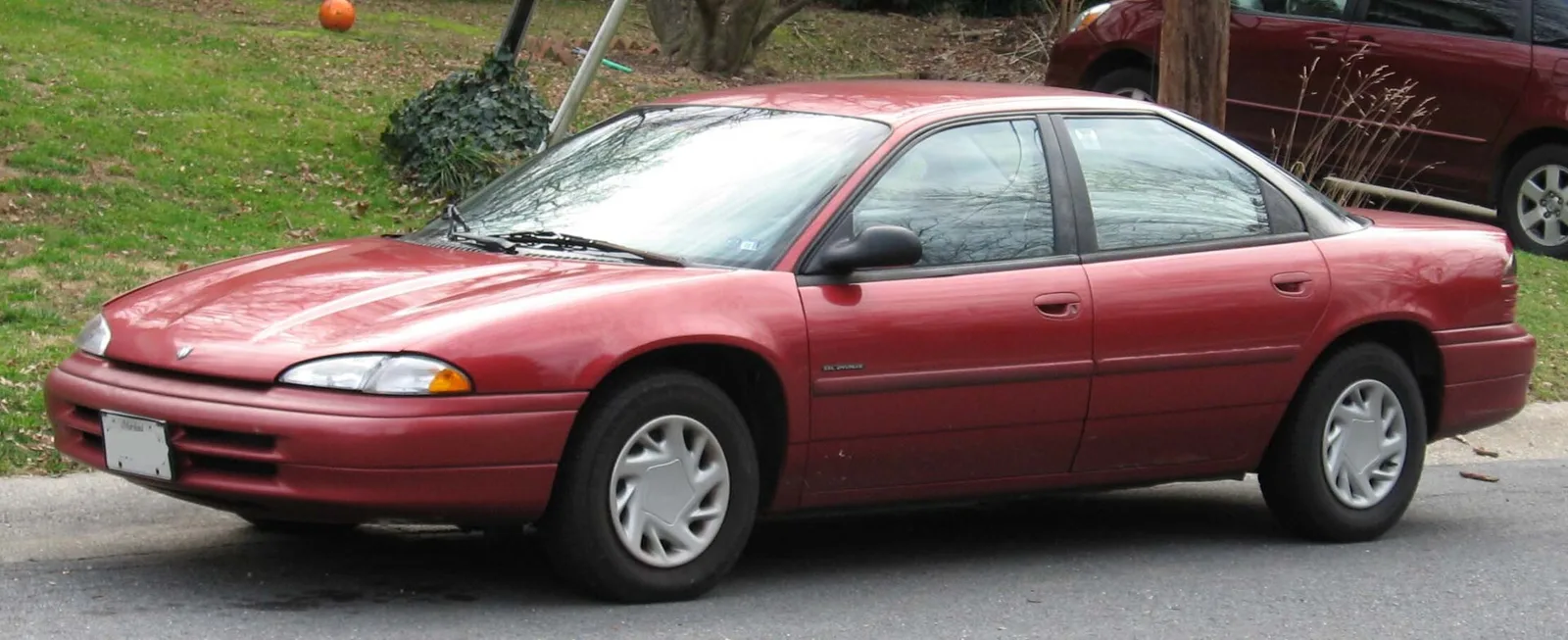
A full-size front-drive sedan from Chrysler's LH platform, shaped by Lamborghini-inspired design and remembered for its 3.5 L V6 and early hybrid research.
Built from 1993 to 2004 on Chrysler's LH cab forward platform, this large Dodge replaced the Monaco as the brand's biggest car and found a following with fleet buyers. It also raced in NASCAR from 2001 to 2005, when Dodge moved its effort to the Charger.
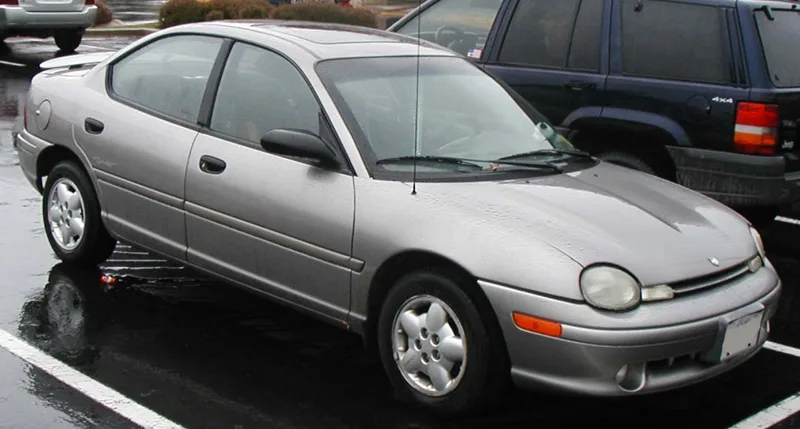
The Dodge Intrepid was a full-size front-wheel drive four-door sedan built for the 1993 to 2004 model years. It sat on Chrysler's LH platform, which also carried the Chrysler Concorde, Eagle Vision and 300M. The Intrepid replaced the Monaco as Dodge's largest passenger car and became a familiar sight in fleets, on race tracks and in research labs.
Where did the Intrepid design come from?
The design traces back to 1986, when designer Kevin Verduyn completed the exterior of an aerodynamic concept called Navajo. The Navajo never passed the clay model stage, but its shape was reworked into the Lamborghini Portofino, which Chrysler showed at the 1987 Frankfurt Auto Show after buying the bankrupt Italian maker in 1986.
The Portofino was praised as a design triumph, and it set Chrysler on the path to a production sedan with the same exterior approach, which became known as cab forward. That layout pushed the wheels out to the corners of the car and gave a much larger passenger cabin than rivals of the period.
A cab forward sedan that started as a Lamborghini-inspired shape and finished its days as a fleet favourite with a 3.5 L V6.
What made the cab forward design different?
The cab forward look was defined by a long, low windshield and relatively short overhangs. Pushing the wheels to the corners freed up interior room, and the approach was revolutionary when the Intrepid arrived in 1993. The car was often compared with the Chevrolet Lumina and Ford Taurus.
Chrysler's designers also carried the look into the interior and the trim, which included hoodline detailing and chrome-accented daytime running lights with body-coloured accents on every version.
How did Chrysler engineer the LH chassis?
Chassis design began in the late 1980s, after Chrysler bought American Motors Corporation in 1987. Initial proposals looked like the Dynasty, but the approach was scrapped in 1988 by Francois Castaing, the former AMC vice president of product engineering. Castaing organised Chrysler's departments into AMC-style cross-functional teams and brought in simultaneous engineering.
The new vehicle began with the Eagle Premier platform, inheriting its longitudinal engine mounting, front suspension geometry and parts of the braking system. The chassis was flexible enough to run front-wheel drive, designated LH, or rear-wheel drive, designated LX. Prototypes including the 1989 Chrysler Millennium and the 1990 Eagle Optima used the same base.
- Transmission: the A606, also called 42LE, which grew from the A604 Ultradrive
- Early engine: a 3.3 L pushrod V6
- 1990: 3.5 L SOHC V6 with four valves per cylinder joined the range
- Second generation R/T: aluminium block recast as part of a comprehensive upgrade
What was the first-generation Intrepid like?
Chrysler unveiled the first generation at the Detroit show of 1992, where three 1993 models appeared: the Concorde, the Intrepid and the Eagle Vision. The Intrepid came in base and ES trims, with the ES adding four-wheel disc brakes, 16-inch wheels and firmer touring suspension.
Every Intrepid received driver and front passenger airbags, a rarity at the time. Buyers could add anti-lock brakes, traction control or the stronger 3.5 L SOHC unit, which made 214 hp. The car was built at American Motors' Brampton assembly facility in Ontario and at the Chrysler plant in Newark, Delaware.
Changes were few during the first five years. A variable-assist power steering rack arrived for 1994, anti-lock brakes became standard on the ES in 1995, and Autostick manual shifting arrived in 1996. Dodge also introduced an advertising push that cast actor Edward Herrmann as the face of the New Dodge image.
How did the second generation change the Intrepid?
Robert Boniface led the design of the 1998 redesign, a project that took 31 months from design freeze to production start. The engines were replaced by two all-aluminium units, a 2.7 L DOHC V6 with 200 hp (150 kW) for the base cars and a 3.2 L SOHC V6 with 225 hp (168 kW) for the ES.
A new top-of-the-line R/T arrived in 1999 with a redesigned 3.5 L V6 producing 242 hp (180 kW), while the ES version made 234 hp (174 kW). Body shells were stiffer and used double-shear suspension mounts with integrated side impact protection, and the car was marketed to fleet buyers as well as private owners.
- 1999: Chrysler Sentry Key theft system disabled the ignition without the correct key
- 2000: variable-assist steering and an optional four-disc in-dash CD changer
- 2002: 3.2 L engine discontinued, and the R/T rated 244 hp (182 kW) on 89-octane fuel
- 2002: cost cutting removed illuminated switches, door courtesy lights and the trunk lid liner
- 2003: R/T discontinued, and the new SXT carried a 250 hp (186 kW) 3.5 HO engine
- 2004: the Intrepid was cancelled after its twelve-year run
Why did the Intrepid lose ground in the early 2000s?
The cab forward design had become ubiquitous by the time the Intrepid was cancelled, and it no longer looked like a revolution. Cost cutting from 2002 removed features that buyers noticed, and sales slumped as a result. The 2004 model year was the last, and every car was built at the former AMC plant in Brampton.
Fleet business held up better. An Intrepid Police Package sold from 2002 to 2004, with small hub caps, extra wiring for strobes and flashers, and plastic front intake vents that routed air onto the rotors. The 3.5 V6 from the R/T and SXT was standard in those cars.
How did the Intrepid perform in NASCAR?
The Intrepid made its NASCAR debut in 2001, signalling Dodge's return to the series after a 16-year hiatus. Drivers in the first Dodge campaign included Bill Elliott, Kasey Kahne, Jason Leffler, Ward Burton and Sterling Marlin, among others.
Marlin was the first driver to win in an Intrepid, and it was Dodge's first NASCAR victory since Neil Bonnett took the 1977 race at Ontario. The car raced until 2005, when Dodge moved its effort to the Charger.
What were the ESX hybrid experiments?
In the late 1990s Chrysler used the Intrepid as a research platform for hybrid electric vehicles, building three variants called the ESX, ESX II and ESX III. The first was a series hybrid in diesel-electric form, while the next two were mild hybrids built between 1997 and 1998.
The ESX team aimed for 80 miles per US gallon, but the car achieved an estimated 55 miles per US gallon. Its exotic materials pushed the cost to about 80,000 dollars, roughly 60,000 dollars more than a standard Intrepid, and part of that was caused by lead-acid batteries.
The ESX II set a more modest target of 70 miles per US gallon, using an aluminium frame and carbon fibre composite panels, plus nickel metal hydride batteries. It cost around 37,000 dollars, about 15,000 dollars more than a standard car. The ESX III aimed for 72 miles per US gallon with cheaper thermoplastic panels and lithium ion batteries, at an estimated 7,500 dollars more.
How did the Intrepid's reputation hold up?
The Intrepid and Concorde made Car and Driver's Ten Best list for 1993 and 1994, and the second-generation Intrepid returned to the list for 1998 and 1999. Consumer Guide's Best Buy award went to both generations, a result that helped the car build a loyal following among careful buyers.
Reliability was the weak point. Some second-generation 2.7 L V6 engines suffered oil sludge contamination that clogged fine oil passages and could lead to catastrophic failure. In February 2009 five separate class action lawsuits were consolidated in New Jersey, and fixes ranged from synthetic oil and inspection to full engine replacement.
Did the cab forward design outlast the Intrepid?
The cab forward look spread through the industry during the Intrepid's life, so by the early 2000s the car no longer looked revolutionary. A design that had seemed like the future in 1993 had become one of many sedans with a long windscreen and short overhangs by 2004.
The Intrepid was replaced by rear-wheel drive LX cars, the 2005 Dodge Magnum and the 2006 Dodge Charger. The Charger went on to become a familiar Dodge model, and its architecture marked a clean break from the front-wheel drive large sedan.
How did the 3.5 HO engine develop over time?
The 3.5 HO V6 began life in the R/T at 242 hp (180 kW) in 1999, rising to 244 hp (182 kW) in 2001 and then to 250 hp (186 kW) for 2003. A small gain in 2002 came from revised engine control programming, which let the R/T run 244 hp on 89 octane fuel.
By 2003 the same engine powered the SXT, a value trim classed as an ES that carried a sunroof and spoiler. It had fewer features than the ES but a stronger engine, which made it a different sort of buyer's car.
What did the Intrepid's trims say about its position?
Dodge sold the Intrepid across a ladder of trims that moved from fleet practicality to sporting intent. The base car was the entry point from 1993 to 2000, while the ES brought four-wheel discs, larger wheels and firmer damping, staying in the range until 2004.
The later years added a Motorsports Edition in 2001, the SE from 2001 to 2004, and the R/T from 1999 to 2002 as the performance flagship. Each trim served a different buyer, which kept the Intrepid relevant across more than a decade on sale.
Specifications at a glance
| Specification | Detail |
|---|---|
| Production | 1993 to 2004 model years |
| First generation engine | 3.5 L SOHC V6, 214 hp |
| Second generation base engine | 2.7 L DOHC V6, 200 hp (150 kW) |
| Second generation ES engine | 3.2 L SOHC V6, 225 hp (168 kW) |
| Top engine | 3.5 HO V6, 250 hp (186 kW), 2003 to 2004 |
| Platform | LH cab forward, front-wheel drive |
| ESX hybrid target | 80 miles per US gallon |