A connector family that adds two DC pins to the familiar Type 1 and Type 2 plugs, and the standard now facing NACS in North America.
The Combined Charging System is a plug-in vehicle charging standard that adds two DC contacts to the Type 1 or Type 2 connector. Its chargers can reach 500 kW. In North America it now faces Tesla's NACS, which many automakers adopted from 2025.
The Combined Charging System, usually called CCS, is a charging standard for plug-in electric vehicles that adds two direct current contacts to the familiar Type 1 or Type 2 connector. In its high-power form it can supply up to 500 kW. The standard is now contested in North America by Tesla's NACS connector, which is changing the choice of plug for many new models.
What is the Combined Charging System?
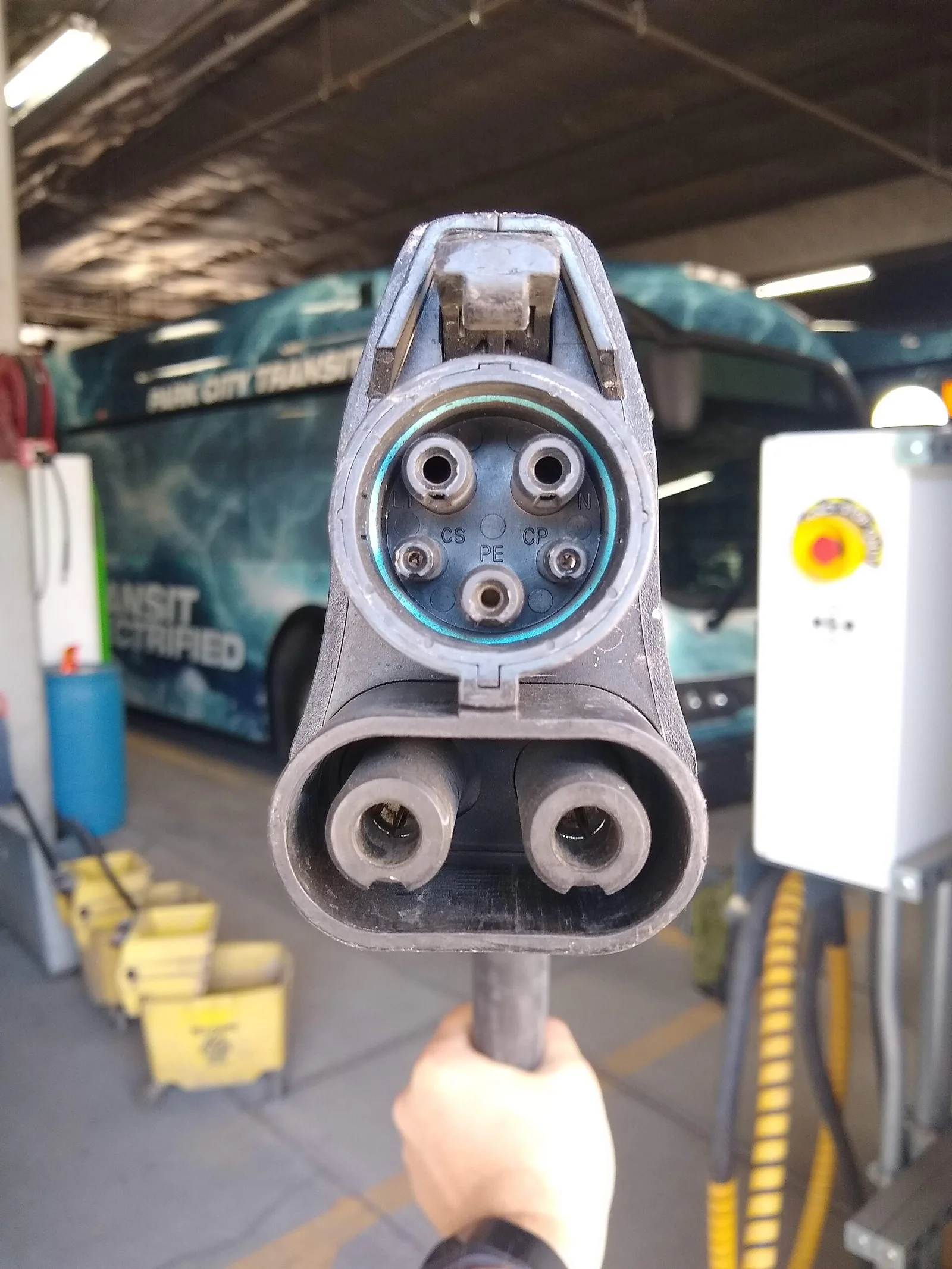
CCS is a family of connectors and communication rules for plug-in cars. The CCS1 version pairs the Type 1 plug with DC contacts, while CCS2 does the same for Type 2. Chargers can supply up to 500 kW at up to 1000 V and 500 A, and the standard covers AC as well as DC charging.
The name refers to combining AC and DC on one inlet. Electric vehicles and supply equipment count as CCS-capable when they support either AC or DC charging under the CCS standards. The wider charging environment also includes load balancing and charge authorisation, which the standard addresses.
Two extra pins below the familiar plug turned a home socket standard into a fast-charging system, and then a contest.
How did CCS come about?
CCS grew from a 2011 plan to add shared DC wires to existing AC connectors, so one envelope could fit every DC station. The proposal was published at a VDI congress in Baden-Baden on 12 October 2011. Seven carmakers signed up in late 2011 to bring CCS in during mid-2012, and ACEA endorsed Combo 2 in May 2012.
Early roll-out was slow. Prototype stations reached 100 kW in May 2012 at EVS26 in Los Angeles, and Volkswagen opened the first public CCS quick-charge station, a 50 kW unit in Wolfsburg, in June 2013. BMW opened its first CCS rapid charger two weeks later to support the BMW i3.
The industry body CharIN, founded in Germany, promoted CCS and set the power ladder. It showed 150 kW station standards in October 2015 and looked toward a future system with 350 kW output. Members who joined included Tesla in March 2016, Volvo in 2016 and Toyota in March 2017.
Which car makers support CCS?
Many brands support CCS, including BMW, Daimler, Hyundai, Kia, Nissan, Polestar, Renault, Rivian, Tesla, Volkswagen Group and Mazda. Ford and General Motors also offered CCS on their 2024 North American EVs, before switching to NACS. Chinese makers BYD, Chery and Zeekr export CCS2 vehicles to overseas markets.
Tesla is a special case. Its earlier cars used a proprietary connector in the United States, and newer ones support CCS through a separately sold adapter. Until 2024 most electric vehicles sold in the United States were Teslas, and they did not natively support CCS.
How do the Combo 1 and Combo 2 connectors differ?
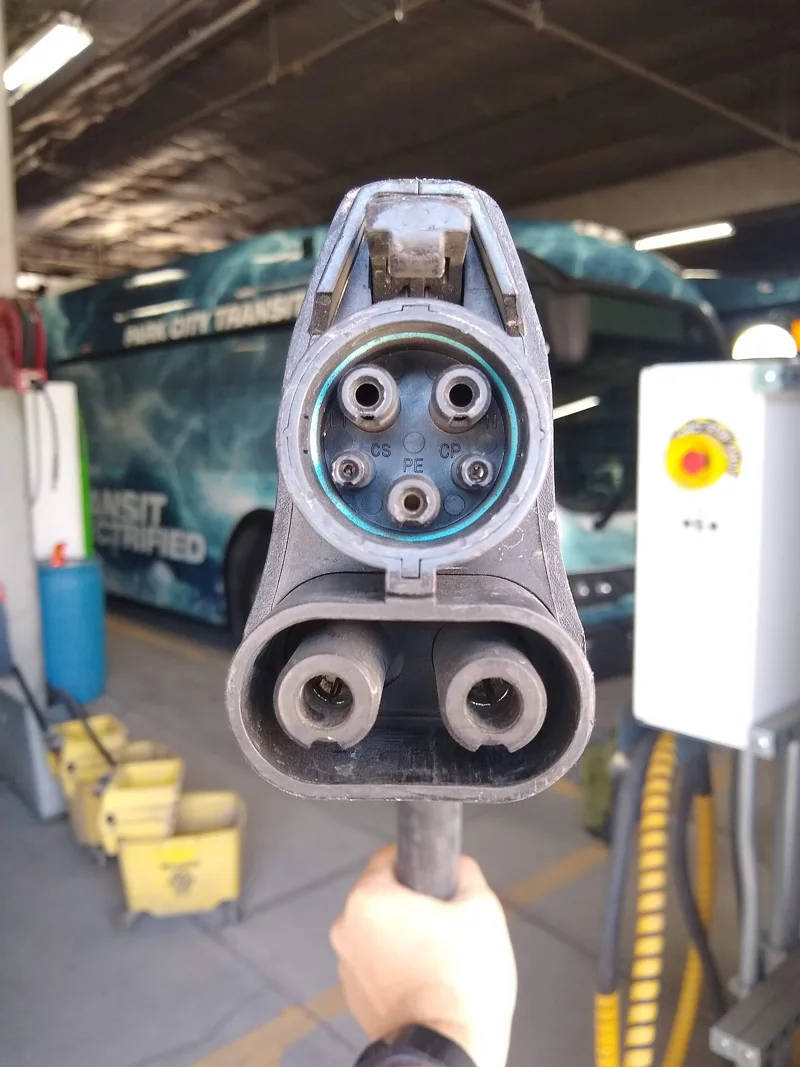
Both Combo connectors keep the original Type 1 or Type 2 functions for communication and earth, and add two DC contacts below them. Combo 1 leaves its AC power pins unused in DC mode, while Combo 2 removes the AC power contacts from the connector. IEC 62196-3 names them the EE and FF configurations.
The vehicle inlet can keep its AC contacts, so non-CCS AC charging still works and one socket serves both modes. The DC part is what changes, while the protective earth and communication contacts are carried over from the Type 1 or Type 2 portion.
High current is the harder problem. The 2014 edition of IEC 62196-3 allowed DC charging only up to 200 A, and a later edition supports up to 500 A. Cables for that current are heavy unless they are cooled, so IEC TS 62196-3-1 describes high-power couplers with thermal sensing, cooling and silver-plated contacts. CharIN has also investigated versions above 2 MW for electric trucks, with equipment under test.
How has CCS charging power grown?
CCS power has climbed in steps, from 50 kW stations in 2013 to 400 kW chargers and beyond. The early stations were limited by cars, since most electric cars were restricted to 50 kW, which set the first common output. Later sites have pushed well past that level.
| Year | Milestone | Power |
|---|---|---|
| 2013 | First public CCS quick-charge station, Volkswagen, Wolfsburg | 50 kW |
| 2015 | First common CCS station output | 50 kW |
| 2015 | CharIN 150 kW station standard shown in October | 150 kW |
| 2016 | IONITY network announced for Europe | 350 kW planned |
| 2019 | Repsol chargers near the A-8, Abanto-Zierbena, Biscay | 400 kW |
| 2023 | Nxu battery-backed charger, Mesa, Arizona | 700 kW |
| 2023 | XC Power station, Puebla City, Mexico | 990 kW |
IONITY, the consortium of Ford, Mercedes, Audi, Porsche and BMW, planned around 400 stations of 350 kW each in Europe, at a cost of EUR 200,000 ($220,000) per station. Most electric cars have battery pack voltages below 400 volts, so the 500 A ceiling works out to roughly 220 kW for them.
Hardware makers have pushed further. The ABB Terra 360 reaches 360 kW, and several 400 kW models come from Ekoenergetyka, Alpitronic, EVBox, Circontrol, SK Signet and Kempower. EUROLOOP announced a 720 kW unit for deployment across Belgium in 2023, and XC Power opened a station with chargers up to 990 kW in Mexico.
High-power sites have also reached ordinary roads. Fastned, a fast-charging network, put 400 kW EVBox chargers beside the A8 near Oostzaan in the Netherlands in December 2022. In May 2023 Shell opened a station outside Kristiansand in Norway with 400 kW Kempower chargers, showing that the top tier was spreading beyond motorway hubs.
How do plug and charge and payment work?
CCS supports two approaches to authorisation. Plug and charge starts an automated authentication when the vehicle is connected, and payment is taken without further steps. External payment requires the driver to identify themselves first, using an RFID card, a payment card or an app, which sits outside the CCS protocol.
Communication is the same around the world even where connectors differ. Basic signalling uses a pulse-width modulated signal on the control pilot to confirm that the plug is seated and that both sides are ready. A pulse width of 5% tells both sides to switch to high-level communication, a method rooted in the DIN SPEC 70121 and ISO/IEC 15118 family of specifications. The protocol leaves the identification method to the operator, so the same signalling can serve different payment schemes.
Load balancing comes in two forms. Reactive load balancing sets an instant limit on energy flow, while scheduled load balancing plans the flow over time with different limits and cost indicators. That second form can help optimise distribution on a smart grid.
Which rivals compete with CCS?
CHAdeMO is widely used in Japan, GB/T is the DC standard in China, and NACS is the connector Tesla opened to other makers for North America. CHAdeMO was once used in North America and Europe, and the CHAdeMO association, Volkswagen and Nissan have all backed multi-standard DC chargers, since the extra cost of a dual-protocol station is small.
The car makers behind CCS chose HomePlug GreenPHY as their communication protocol in 2011. That choice competed with a CAN bus proposal from Japan, which included CHAdeMO, and with China's GB/T approach, which used a separate DC connector.
Why is NACS challenging CCS1 in North America?
Tesla opened its connector as NACS in November 2022, and Ford, General Motors and Rivian announced in 2023 that they would use it on future North American models. Many other makers followed, and the standard was later ratified as SAE J3400. Some predictions say CCS1 will soon be obsolete, because its connector is larger and costlier than NACS.
Tesla's Supercharger network has been the main draw. Ford, General Motors and others planned to fit NACS ports and offered adapters from 2024, which lets their cars use Tesla's chargers. ECO Movement figures put Tesla connectors at about 58% of DC chargers, a share that makes the network hard to ignore.
Hilton Worldwide has agreed with Tesla to install 20,000 connectors across 2,000 of its North American properties by 2025. Such deals show how charging networks are deciding which plug to standardise on, even where the wider standard is still being settled.
How does CCS compare with CHAdeMO and GB/T?
CHAdeMO is the main DC fast-charging system in Japan and has been fitted to some vehicles in North America and Europe. Its backers pushed a CAN bus communication proposal that competed with the approach CCS adopted. China's GB/T 20234-2015 is the DC standard used there, and it relies on a separate DC connector.
Global acceptance remained open for years. The European directive required Combo 2 on high-power DC points installed after 18 November 2017, but it did not prohibit CHAdeMO or AC rapid chargers. In many other countries no standard was preferred, CharIN urged the use of advanced Type 2 and Combo 2 back in 2018.
How did CCS spread across the United States?
In April 2016 BMW and Volkswagen said that CCS networks were complete along the East and West Coast corridors. Volkswagen then committed US$2 billion over ten years through its subsidiary Electrify America, with stations of up to 150 kW at community sites and up to 350 kW on highways.
That plan came out of the settlement of the Volkswagen emissions scandal. Electrify America also planned CHAdeMO charging alongside CCS, so the network was designed to serve both standards from the start.
How did CharIN respond to the NACS move?
CharIN, the association that promotes CCS, criticised the move in June 2023. It argued that NACS was not yet a published or recognised standard, because no standards body had approved it. A week later, SAE said it had standardised the NACS connector, which overtook much of that argument.
The association argued that a standard should pass through a standards body such as ISO, IEC or SAE before it is recognised, and that the process should be collaborative. For drivers the practical question was simpler: which plug would fit the chargers they met on the road.