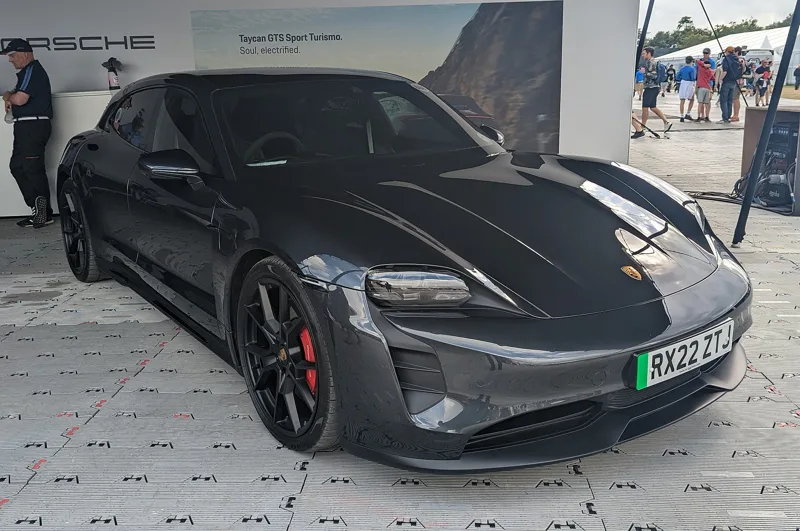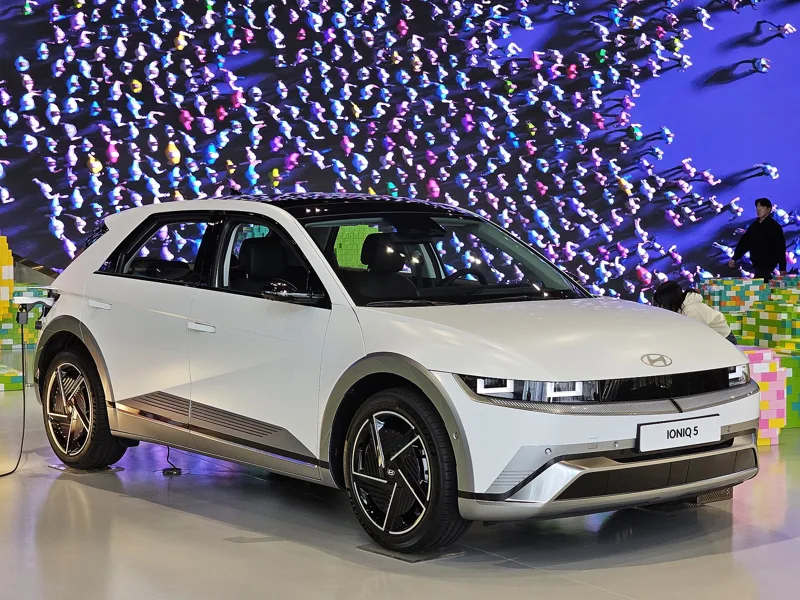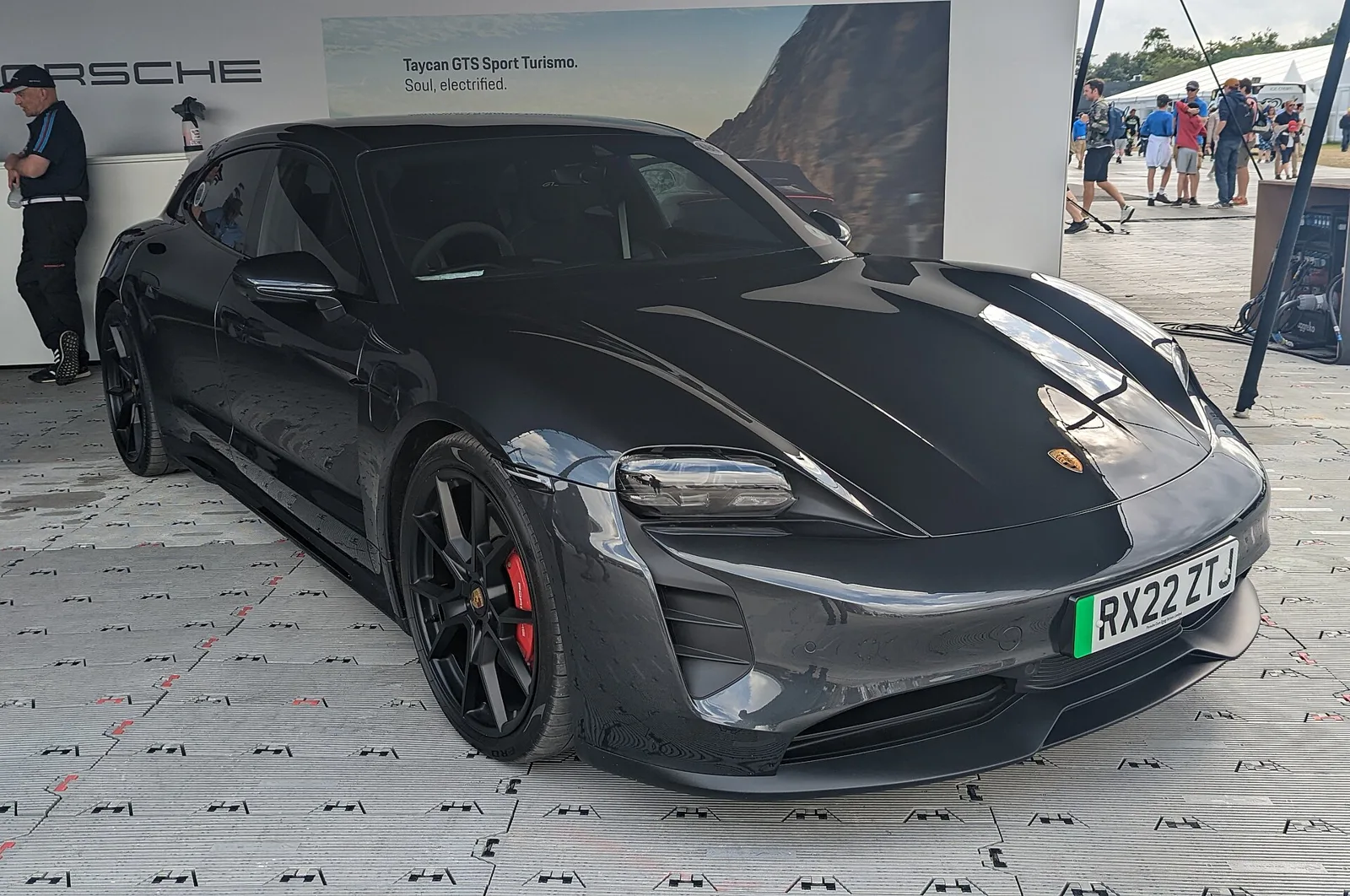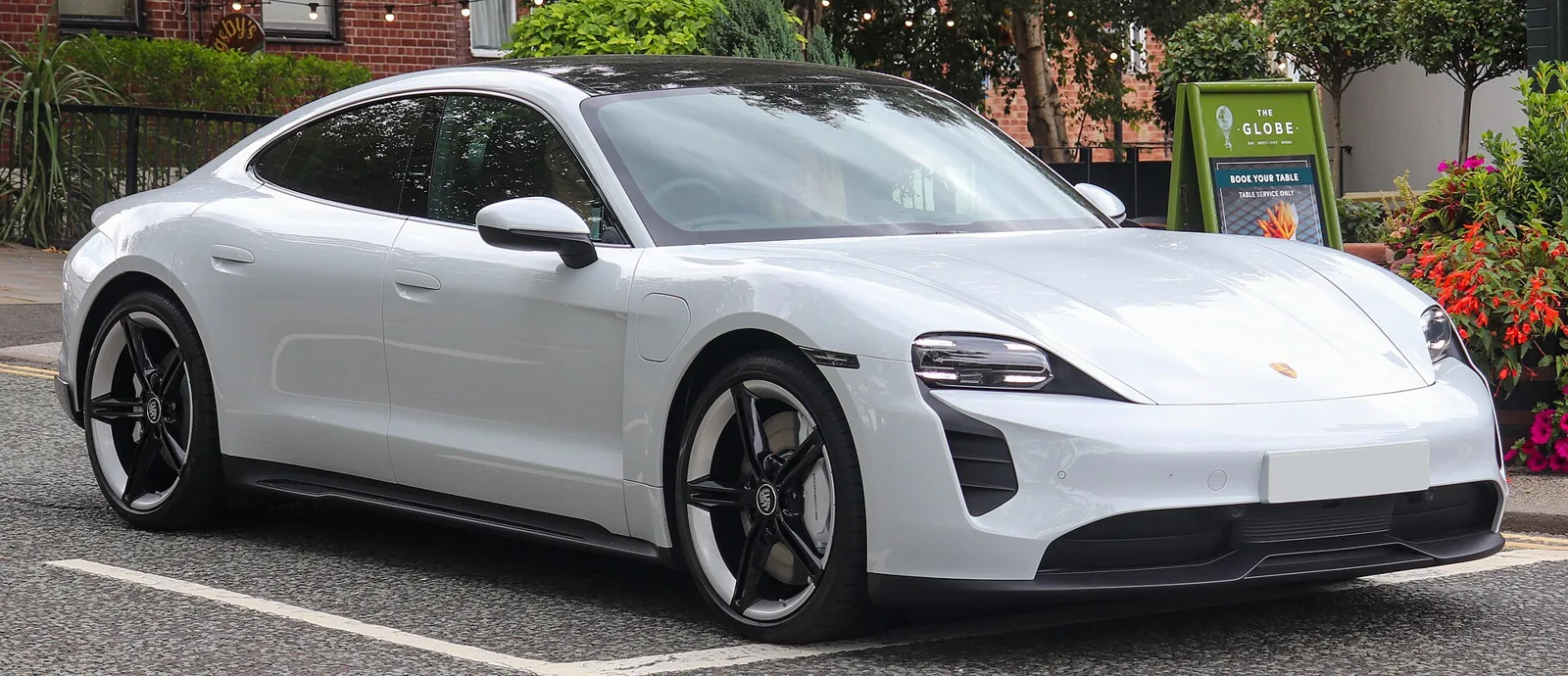
The Porsche Taycan's 800-volt pack is not an 800-volt pack, and doubling voltage is only part of why some EVs charge so quickly.
An 800-volt EV runs its electrical system at roughly twice the usual voltage, so it can take high power with less current and less cable heat. Porsche estimates its Taycan charges from 5 to 80 percent in 22.5 minutes at 270 kW, but on a 400-volt charger the car is limited to 150 kW.
The Porsche Taycan's famous 800-volt battery is not an 800-volt battery. Its pack is described as a 723-volt unit, sitting at 610 volts when empty and 835 volts when full, and the car is still marketed as the standard bearer of 800V charging. The name is a label for an architecture, and the architecture matters more than the number.
What does 800 volt mean on an EV?
Voltage is the electrical pressure in a car's high-voltage system. Picture a garden hose: pressure is the voltage, the rate of flow is the current in amps, and the power reaching the battery is the two multiplied together. A car that is built around roughly twice the pressure can take the same flow and receive far more power.
The Taycan was engineered around a purpose-built 800-volt charging system, and the 2015 Mission E concept that previewed it was already specified at 800 V DC. The Hyundai Ioniq 5, presented on 23 February 2021 as the first car on the company's E-GMP platform, is built the same way, with an 800 V inverter sourced from Vitesco Technologies, a subsidiary of Continental.
These are not the only possible pack sizes. The smaller Taycan battery, at 79.2 kWh gross, operates between 520 and 720 volts, and the larger 93 kWh pack is built from 33 modules, each holding 12 pouch cells, for 396 cells in total. The point is that the pack's working voltage swings with its state of charge, and the 800 figure is shorthand for a system designed to handle voltages in that region.
Power is voltage times current, so a car built for roughly double the pressure can reach the same power with far less current heating the cable.
Why does doubling the voltage speed up charging?
The reason is heat. When the IONITY network was announced in November 2016 by Ford, Mercedes, Audi, Porsche and BMW, the account of the launch pointed out that the typical electric car carried a battery rated below 400 volts. Capped at 500 amps, such a car could take up to 220 kW, even though the network itself was specified for 350 kW at up to 500 A and 920 V.
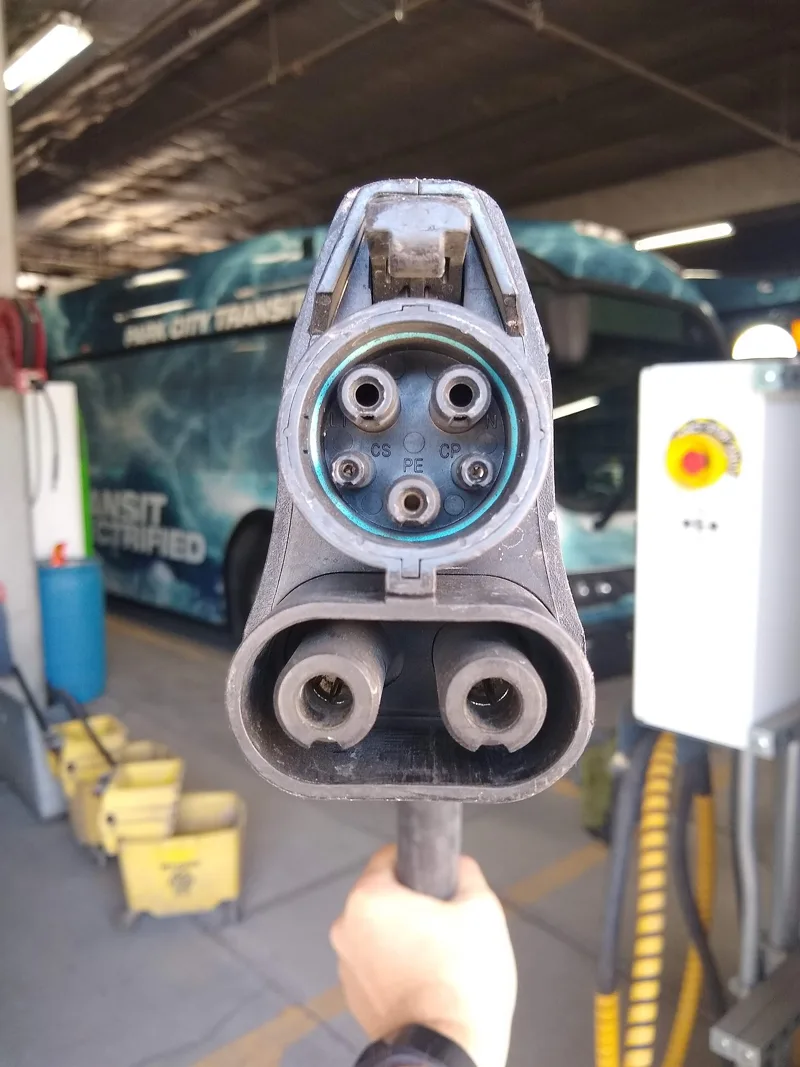
Pushing more current is not an easy answer. High currents demand thick cables, which become heavy and stiff, or thinner cables that need cooling. Contact resistance adds heat at the connector. The standard that covers high-power DC couplers, IEC TS 62196-3-1, spells out what is needed: thermal sensing, cooling and silver-plated contacts. The earlier 2014 edition of the coupler standard allowed DC only up to 200 A, and a later edition raised the ceiling to 500 A.
Raise the voltage and the equation changes. Power is voltage times current, so a car designed for roughly double the pressure can reach a given power with a lot less current in the cable. Less current means less heat, and a lighter charging cable becomes viable. That is the engineering case for 800V charging.
How fast do 800-volt cars actually charge?
Porsche estimates that a Taycan can charge from 5 to 80 percent in 22.5 minutes in ideal conditions, using an 800-volt DC charger delivering 270 kW. The mid-cycle update shown in February 2024 raised the maximum DC rate to 320 kW, while capacity grew to 89 kWh for the smaller pack and 105 kWh for the larger one thanks to an improved battery chemistry.
Hyundai frames the Ioniq 5's figure differently: five minutes on a charger adds 100 km (62 mi) of range by WLTP standards. For the Mission E concept, Porsche once claimed charging at up to 350 kW and 80 percent in 15 minutes, but that was a concept-car target, not a showroom specification.
Pack size sets what those minutes mean in practice. The Ioniq 5 has been sold with 58, 72.6 and 77.4 kWh batteries, and its 2025 model year line-up in the United States uses a 63 kWh pack rated by the EPA at 245 miles (394 km) or an 84 kWh pack at up to 318 miles (512 km) in rear-wheel-drive form. A given number of minutes at the plug therefore buys a different amount of driving in each version.
The shortest production figure, the Taycan's 22.5 minutes, is not under twenty minutes. For perspective, charging networks describe both CHAdeMO and CCS as reaching 80 percent in roughly 20 minutes, though the two standards cannot plug into each other.
800V vs 400V: what happens at an older charger?
Plug an 800-volt car into a 400-volt station and the car has a solution, but it comes with a cap. The Taycan can still use existing 400-volt stations, at up to 150 kW, because an onboard step-up converter lifts the supply to the car's own system voltage. Porsche notes that charge times depend on weather and infrastructure.
It is a useful reminder that two ends of a cable are involved. Tesla's Superchargers deliver 480 V DC and, depending on the version, 72, 150 or 250 kW. Many early CCS stations were far slower. When the Charging Interface Initiative reported in 2015, the typical car could not go beyond 50 kW, which set the output of the first stations built that year. A 150 kW station was shown in October 2015 with 350 kW as the next goal.
What the standards and plugs allow
| System | Voltage | Current | Power |
|---|---|---|---|
| IONITY network design | Up to 920 V | Up to 500 A | 350 kW |
| SAE DC Level 1 | 50 to 1000 V | Varies by unit | Up to 80 kW |
| SAE DC Level 2 | 50 to 1000 V | Varies by unit | Up to 400 kW |
| CCS maximum | 1000 V | 500 A | Up to 500 kW |
| Tesla Supercharger | 480 V DC | Varies by unit | 72, 150 or 250 kW |
| Megawatt Charging System (trucks) | 200 to 1500 V | 0 to 3000 A | 4.5 MW theoretical maximum |
Is voltage the only reason some EVs charge fast?
Voltage is not the only factor. A fast charger and a high-voltage car are necessary, not sufficient. The battery itself has to accept the power, and its temperature has a big say. The Taycan lets owners set a departure time in a charging planner, after which the car warms or cools the battery so it is ready, because charging in either hot or cold weather goes better once it is in the right range.
Pack design matters too. Porsche's 2024 update did not only raise the charging rate to 320 kW; it also introduced a new chemistry that increased power density and capacity. Hyundai's 2024 facelift lifted the Ioniq 5's largest pack from 77.4 kWh to 84 kWh. Both changes show that pack design and charging rate move together.
Then there is the charger. DC stations place the AC-to-DC converter inside the station, so the car avoids carrying that size, weight and cost, and the station can supply higher power than an onboard converter could. AC charging, by contrast, is slow by design: Level 1 supplies between 0.7 and 1.92 kW from a 120 volt outlet, while Level 2 reaches 1.4 to 19.2 kW. Porsche's home charger, rated at 9.6 kW, takes 11 hours for a Taycan.
How the charging networks got here
The Combined Charging System was proposed on 12 October 2011 at a congress of German engineers. Seven makers, Audi, BMW, Daimler, Ford, General Motors, Porsche and Volkswagen, agreed late that year to introduce it from mid-2012, and the European Union has required Type 2 or Combo 2 connectors in its network since 2014. The idea was one connector pattern on the car that could take either an AC plug or a pair of extra DC contacts.
Building out hardware is costly. The IONITY plan envisaged 400 stations across Europe at a cost of 200,000 euros ($220,000) each. Backers of multi-standard DC chargers have said that a station serving more than one protocol adds only 5 percent to the price. In the United States, Volkswagen committed US$2 billion over ten years after its 2016 emissions settlement to charging infrastructure through Electrify America, with up to 150 kW at community sites and up to 350 kW on highways.
The chargers and plugs are moving too
CCS, the standard at the heart of most 800-volt charging in Europe and many other markets, can supply up to 500 kW at a maximum of 1000 V and 500 A. In practice, networks have rolled out 400 kW chargers, and 990 kW chargers have been demonstrated. Hardware examples include the ABB Terra 360 at up to 360 kW, and 400 kW units from Alpitronic, Kempower, EVBox and others. Shell opened a station with 400 kW Kempower chargers in Norway in May 2023.
Connector politics add a wrinkle. Tesla published the specification for its North American Charging Standard in 2022. Ford and General Motors said in the first half of 2023 that they would move their North American EVs from CCS1 to NACS from the 2025 model year, and by November 2023 a long list of makers including Hyundai, BMW, Toyota and Mercedes-Benz had committed to NACS in North America. In June 2023 CharIN, the group that promotes CCS, pointed out that NACS was not then a published standard from a recognised body, and SAE announced a week later that it had standardised the connector. In September 2025 Porsche brought out its own CCS-to-NACS adapter for the Taycan, and 2025 model year Ioniq 5s built for the US have a native NACS port.
Where this goes next
The published plans point to more power at the charger. A 720 kW unit, the WILLBERT Amber II S-HUB, was announced in May 2022 for deployment in Belgium in 2023, and a battery-backed 700 kW CCS charger was demonstrated in Arizona in April 2023. For heavy trucks, the Megawatt Charging System's connector specification was adopted in December 2021 as version 3.2, with a theoretical maximum of 4.5 MW.
For CCS itself, version 3.0 was not yet precisely defined. Ideas floated for it include sending power back out of the car, inductive charging, wireless charging communication and an overhead current collector for buses, with earlier features kept so that older equipment still works.
What it means if you are choosing an EV
Treat the voltage as a clue, not a promise. An 800-volt architecture signals that a car was designed to accept high power with manageable cable heat, but the claims that matter are the manufacturer's charge time and power figures, plus the conditions behind them. Look for the word ideal, and for the charger rating assumed.
Practical checks follow from the numbers above. Know which connector your market uses and whether an adapter is available. Know what rating the chargers on your regular routes actually have, because a 400-volt station will cap an 800-volt Taycan at 150 kW. And remember that weather matters: preconditioning, where a car prepares its battery before arrival, is there for a reason. A new Taycan also comes with three years of free access to the speed-charging networks run by Porsche's joint venture partners, which is handy if you want to test the claims yourself.