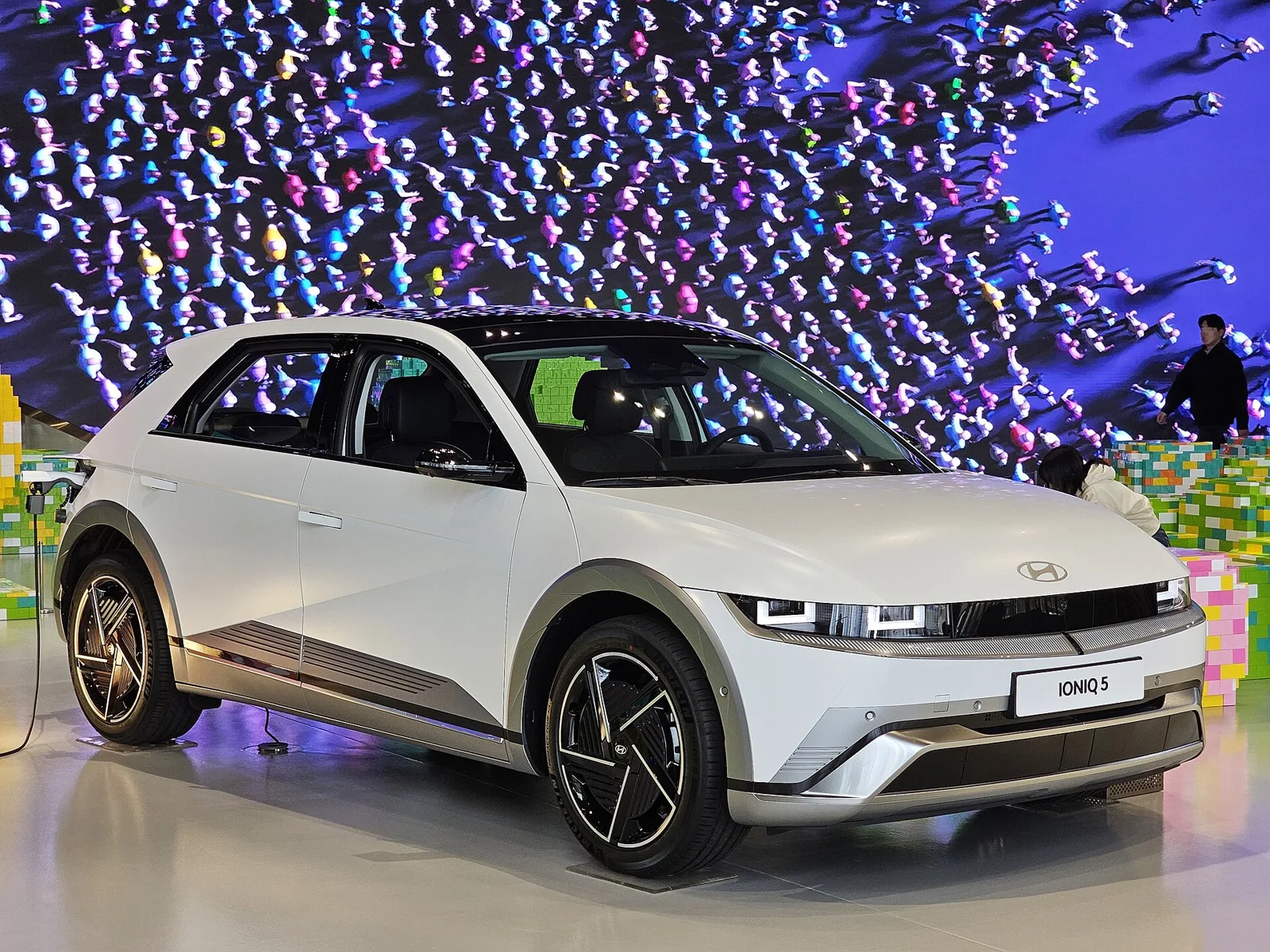
A flat-floor electric crossover on the E-GMP platform, from the 2021 launch to the 84 kWh facelift and the 609 PS Ioniq 5 N.
The Hyundai Ioniq 5 is a battery electric compact crossover that Hyundai launched in 2021 as the first model under its Ioniq sub-brand. It was the first vehicle built on the E-GMP platform and was later joined by the N performance model and the off-road XRT.
Hyundai's Ioniq 5 is an electric crossover that opened the Ioniq sub-brand and was built on the E-GMP platform. The range grew from a 58 kWh base car to the 609 PS Ioniq 5 N. The sections below cover its origins, interior, powertrains, the 2024 facelift and the special versions.
Where did the Ioniq 5 come from?
Hyundai presented the Ioniq 5 globally on 23 February 2021, after previewing its design with the Hyundai 45 EV Concept at the Frankfurt Motor Show in September 2019. It was the first model sold under the Ioniq sub-brand and the first to use the E-GMP platform, which was developed under the project code NE.
The styling takes its cues from the original Hyundai Pony. The 45 in the name refers to the 45th anniversary of the Pony coupe and to the 45-degree angles on the sides of the concept. At launch Hyundai described its design language as sensuous sportiness, with a Parametric Pixel theme on the lights and wheels.
A flat-floor electric crossover that turned Hyundai's first dedicated EV platform into a range from the everyday to the N.
What does the Ioniq 5 interior offer?
The Ioniq 5 uses a flat floor from the E-GMP platform, which gives a 3-meter long wheelbase and a sliding Universal Island console. Two 12-inch screens sit under one glass panel. Cargo space is about 527-531 L (18.6-18.8 cu ft) behind the rear seats, rising to 1,587-1,600 L (56.0-56.5 cu ft) with the second row folded.
The front seats are about 30 per cent shorter than typical, which frees up room for rear passengers. The front boot holds 57 L (2.01 cu ft) on rear-wheel drive versions outside North America, but AWD and North American cars get 24 L (0.848 cu ft) because of the extra hardware under the bonnet. An optional single glass roof panel has no support beams, and the built-in V2L function can supply up to 3.6 kW to external devices.
Interior surfaces use recycled materials, including PET bottles. An optional head-up display adds augmented reality, and the car can also be ordered with a large single-panel glass roof.
How is the Ioniq 5 powered and how far does it go?
Early European cars offered 58 kWh and 72.6 kWh battery packs. From April 2022 the Long Range car used a 77.4 kWh battery with 168 kW (228 PS; 225 hp), while the 58 kWh option stayed. The standard car tops out at 185 km/h (115 mph).
A five-minute charge adds 100 km (62 mi) of range on the WLTP cycle. The 800 V inverter is supplied by Vitesco Technologies, a subsidiary of the Continental group.
US cars changed in 2025. Models sold there moved to production at Hyundai's Metaplant in Georgia and adopted a native NACS charging port. A 63 kWh Standard Range car is rated at 245 mi (394 km) by the EPA, and the 84 kWh Long Range rear-drive car is rated at up to 318 mi (512 km).
What changed with the 2024 facelift?
The facelifted Ioniq 5 was revealed on 3 March 2024. It added a rear hatch wiper and an updated infotainment system, and the battery grew to 84 kWh from 77.4 kWh. Power efficiency and aerodynamics were also refined, and an N Line variant joined the range.
The N Line sits between the standard car and the N. It has N Line specific front and rear bumpers, tweaked side skirts, 20-inch alloy wheels, metal pedals and red stitching inside. It first became available in Korea in March 2024 before spreading to other markets.
What is the Ioniq 5 N?
The Ioniq 5 N is the top-of-the-line model, sold under Hyundai's N performance sub-brand. It produces 448 kW (609 PS; 601 hp) from two electric motors, with 740 N.m (546 lb ft) of torque. Hyundai claims 0-100 km/h in 3.5 seconds, or 3.4 seconds with launch control or N Grin Boost active.
The N is 50 mm (2.0 in) wider than the standard car and 20 mm (0.8 in) lower, with extended wheel arches and a wider track. Its body shell gains 42 additional welding points, and the motor and battery mountings were reinforced. The power steering has a higher ratio and improved torque feedback.
With N Grin Boost engaged, the car can deliver 478 kW (650 PS; 641 hp) and 770 N.m (568 lb ft) of torque for 10 seconds. The N e-shift function emulates the jolt of an 8-speed dual-clutch gearbox by controlling motor torque. The N Active Sound+ system plays sound themes through eight interior and two exterior speakers, and the N Drift Optimiser Pro mode simulates a clutch kick to start a slide.
The N loses the front boot found on other Ioniq 5 models, because its larger front motor and front external speaker take up that space. Its top speed is 260 km/h (162 mph).
Which special and racing versions were built?
The Ioniq 5 eN1 Cup is a racing version of the N, unveiled on 30 March 2024 at an official practice round. It weighs about 1,970 kg (4,343 lb) and runs an adjustable two-way damper suspension, with a ride height lowered by 2.8 inches (71.1 mm).
Concept images of the eN1 Cup appeared at the Hyundai N Festival in December 2023. The car has an aerodynamic bodykit with air intakes, a rear diffuser and a rear wing, and it is about 270 kg (600 lb) lighter than the road N. Its dual-motor all-wheel drive system develops a peak of 641 hp.
Racing teams get a special version of the sound system, and drivers keep N Grin Boost and N e-shift. The eN1 Cup runs in a dedicated eN1 class, which is Korea's first electric one-make race.
The XRT is an off-road trim introduced for the 2025 model year and built for the North American market. It uses dual-motor all-wheel drive producing 320 hp (239 kW) and 446 lb ft (605 N.m) of torque, with 18-inch wheels fitted with 235/60R18 all-terrain tyres. The approach angle is 19.8 degrees and the departure angle is 30.0 degrees.
Which markets sold the Ioniq 5?
The Ioniq 5 reached Australia on 27 September 2021 and Japan in July 2022, after pre-orders in May 2022. Later launches included Brazil on 24 September 2024 and Mexico on 4 July 2024. In Indonesia it became the first mass-produced battery electric vehicle built locally, at the Cikarang plant.
Europe received a limited Project 45 edition of 3,000 units. In India the car arrived at the Auto Expo in January 2023 with a single 72.6 kWh battery and 160 kW (218 PS; 215 hp) of rear-wheel drive. Singapore marked its launch with a First 100 limited edition.
Indonesian output rose from around 137 units to 1,000 units per month from April 2023, because demand was extremely high. A 60-unit Batik edition followed in February 2024. Vietnam received the car on 31 July 2023.
In Oceania, the N arrived in Australia on 23 February 2024, and the 2026 model year cut the variant list from 16 to four. Malaysia received the N on 11 June 2026, and Thailand began local assembly of the N Line Long Range in June 2026.
How did the Ioniq 5 do in awards and safety tests?
The Ioniq 5 won Auto Express Car of the Year for 2021 and the 2022 World Car of the Year title, and the N took the 2024 World Performance Car award. IIHS named the 2022 and 2026 Ioniq 5 Top Safety Pick+, and ANCAP awarded five stars in 2021 to every variant except the N, which was not tested.
Further honours followed in 2022 with German Car of the Year and New Zealand Car of the Year, plus EV of the Year from Car and Driver. The Ioniq 5 N added Korea Car of the Year and a second Car and Driver EV of the Year title in 2024.
The car also earned Best Design at the Top Gear Electric Awards 2021, a gold prize at the 2021 IDEA Design Award, and the 2022 World Car Design of the Year title from World Car Awards.
What is the Ioniq 5 robotaxi?
The Ioniq 5 Robotaxi was unveiled on 31 August 2021 and shown at IAA Mobility on 6 September 2021. Lyft began offering driverless rides in Las Vegas on 16 August 2022, and Waymo started testing the model in US cities in November 2025.
The robotaxi was assembled at Hyundai's Singapore facility from late 2023 for export to the US. The Waymo vehicles carry the Waymo Driver autonomous system with redundant hardware and power doors, and they will be built at Hyundai's Metaplant in Georgia.
Separately, Hyundai Mobis showed the MOBION concept at CES 2024 in Las Vegas. Its e-Corner system moves all four wheels independently, which allows lateral movement, diagonal driving and pivot turns while stationary.
What are the Ioniq 5 specifications?
| Specification | Detail |
|---|---|
| Type | Battery electric compact crossover SUV |
| Platform | E-GMP, 3-meter long wheelbase |
| Standard top speed | 185 km/h (115 mph) |
| Charging | 100 km (62 mi) WLTP in five minutes |
| Ioniq 5 N power | 448 kW (609 PS; 601 hp), 740 N.m (546 lb ft) |
| Ioniq 5 N 0-100 km/h | 3.5 seconds claimed, 3.4 seconds with launch control |
| Ioniq 5 N top speed | 260 km/h (162 mph) |
| XRT power | 320 hp (239 kW), 446 lb ft (605 N.m), dual-motor AWD |
| XRT ground clearance | 7.0 in (178 mm) after a 23 mm (0.9 in) lift |
| XRT EPA range | 259 miles (417 km) |
| Battery after facelift | 84 kWh, up from 77.4 kWh |
| Front boot | 57 L (2.01 cu ft) RWD outside North America; 24 L (0.848 cu ft) AWD and North America |
.jpg)