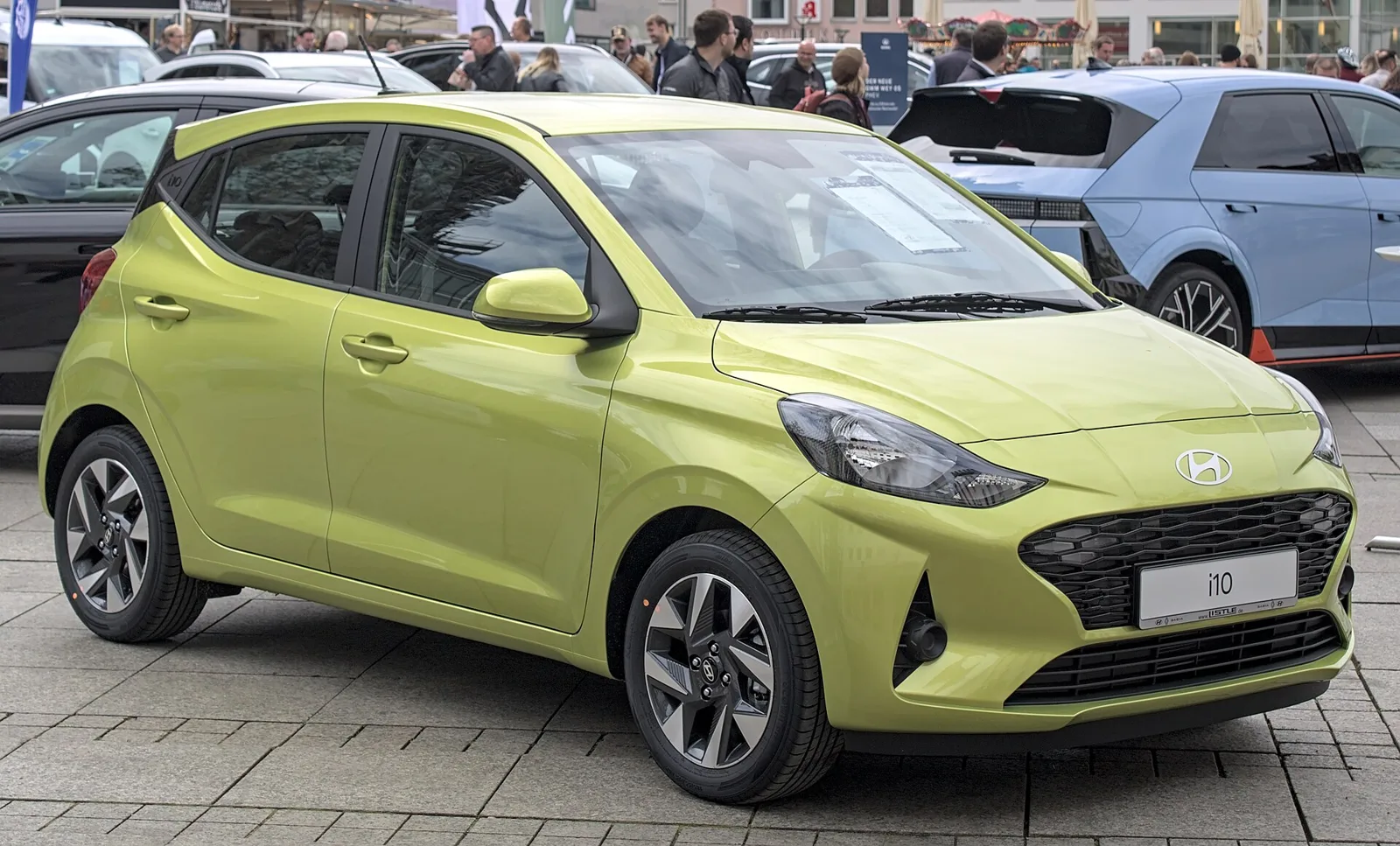
From a 2007 Atos replacement built in Chennai to the Grand i10 Nios and European AC3, a city car that kept finding new markets.
The Hyundai i10 is a small city car first sold in 2007 as a replacement for the Atos. It was designed with India in mind, and a third generation launched there in 2019 as the Grand i10 Nios, with sedan versions and Euro-market variants alongside.
Hyundai began selling the i10 city car in 2007 in place of the Atos, and the model was designed with India in mind before Europe. The third generation reached the market in 2019 under the Grand i10 Nios name in India, and the range has since spread across several continents.
Why did Hyundai develop the i10?
Development started under the codename PA to replace the Atos, with India as the main target because hatchbacks of that size were popular there. Hyundai announced the car in New Delhi on 31 October 2007, and it was built at the Chennai plant for domestic and export sales.
The car slotted between the Santro and the Getz in Hyundai's Indian line-up. The first Indian versions came as D-Lite, Era and Magna trims with a 1.1-litre engine, and in July 2008 Hyundai added Sportz and Asta trims plus a 1.2-litre Kappa unit.
Designed for Indian streets, the i10 grew into a three-generation family that reached Europe and beyond.
How big was the first i10?
The first car kept the Atos's overall length of 3,565 mm and wheelbase of 2,380 mm, but it was 70 mm wider and 40 mm lower. That gave more shoulder room without making the car longer. Boot space was 225 litres, smaller than the Getz.
Hyundai styled the car with a large air dam, pulled-back headlamps, a chrome-lined grille and a rear window with an upswept kink. Inside, a plastic dash housed an optional stereo, and a large white-faced speedometer sat between the tachometer and the gauges.
What changed with the 2010 facelift?
Hyundai revealed the facelift in India on 23 September 2010, and the updated car went on sale on 17 October 2010. The new front end took cues from the Fluidic Sculpture design language, with less angled headlights, and the engine range gained Kappa II units with variable valve timing.
Hyundai also reshaped the rear lamps and bumper with new reflectors, and the interior gained chrome and silver accents plus a gear-shift indicator on manual models. Some markets kept building the older car until late 2010, while others took the facelift in 2011.
Which engines did the i10 use?
The launch engine was a 1.1-litre I4 iRDE producing 48 kW (65 PS; 64 hp), a unit tuned for lower CO2 emissions and shared with other small Hyundai models. A 1.2-litre Kappa petrol engine met Euro 5 rules with the same CO2 figure, and a three-cylinder 1.1 CRDi diesel covered Europe and India.
In India the entry 1.1-litre made 66.7 PS (49 kW; 66 hp), and the 1.2-litre Kappa made 80 PS (59 kW; 79 hp). The 2010 Delhi Auto Expo brought an electric concept, which led to the BlueOn, a production electric car based on the i10 that appeared in South Korea the same year.
How did the second generation change the car?
The second generation was revealed in August 2013 by Hyundai's European design team, led by Thomas Burkle. It was 80 mm longer, 65 mm wider and 50 mm lower than before, and boot space grew by 10 percent to 252 litres.
The car debuted at the Frankfurt Motor Show in September 2013, and European showrooms received it in January 2014. Production started at Hyundai Assan's plant in Izmit, Turkey, at a planned capacity of 200,000 units a year.
What equipment came with the second generation?
Depending on the version, the second generation brought automatic air conditioning, daytime running lights, curtain airbags, tyre pressure monitoring and hill-start assist. Cruise control, rear parking sensors, a heated steering wheel and heated seats, or 15-inch alloy wheels were available as options.
The Indian-market Grand i10 arrived in September 2013 with a wheelbase 40 mm longer than the European car. It added dual-tone interiors, keyless entry, push-button start, auto-folding mirrors, rear air vents and 1 GB of internal memory for music, both segment firsts.
Other markets soon had their own versions. The Philippines launched the Grand i10 in February 2014 with a 1.0-litre three-cylinder base engine and a 1.2-litre automatic at the top, Mexico received only the 1.2-litre four-cylinder, and Colombia sold a taxi version called the Gran Metro Taxi Hatchback.
Did the i10 spawn a sedan?
Yes. Hyundai Motor India revealed the Xcent sedan in February 2014, designed to fit India's popular sub-4 metre segment after the government raised taxes on cars longer than 4,000 mm (157.5 in). It was exported as the Grand i10 sedan.
Hyundai also added the Grand i10X in Indonesia in 2015, a crossover-inspired version with different bumpers, black plastic cladding and 14-inch alloy wheels. In South Africa a 2019 Grand i10 Cargo offered a two-seat load area of 1,202 litres.
How did reviewers rate the European i10?
Reviewers were positive about the European i10. What Car? gave it five stars, Top Gear scored it 8 out of 10, Autocar awarded four and a half stars for a well-rounded city car, and The Daily Telegraph gave four stars.
The Indian Grand i10 won the 2014 Golden Steering Wheel in the hatchback class, and NDTV's car awards named it Car of the Year and Entry Hatchback of the Year. The Car Awards Group made it Best Mini Car of the Year for 2014 to 2015 in the Philippines.
What awards did the first i10 collect?
The first generation was named Car of the Year 2008 by several Indian automotive outlets, and it was honoured as Indian Car of the Year by industry media. In Malaysia it won the Best People's Car prize at the 2009 Asian Auto awards and the New Straits Times and Maybank entry-level award in both 2009 and 2010.
In 2008 Hyundai marked ten years in India with a drive from Delhi to Paris in two Kappa i10s, covering 10,000 kilometres (6,200 mi) in 17 days. The cars were then shown at the Paris Motor Show in October, and in 2013 an Indian automotive portal named the i10 its most popular hatchback.
How did the i10 perform in crash tests?
Euro NCAP tested a left-hand-drive five-door hatchback from the 2008 registration, while ASEAN NCAP assessed a right-hand-drive model from 2011. Electronic stability control was an order option on UK cars from August 2009, and without it the car could not reach a five-star result.
Global NCAP gave the Indian-built car 0 stars in 2014 because it had no airbags or ABS, and Latin NCAP gave the Indian-made model 0 stars in 2015 in its most basic configuration. Standard ESC arrived on all European models by the 2014 tests.
Euro NCAP's stricter 2020 protocol gave the third-generation European i10 three stars. Vulnerable road users were rated at 52 percent and the safety assist systems at 59 percent, and the testers noted that the systems performed only marginally when detecting other vehicles.
What is the third-generation i10?
The third generation debuted in India as the Grand i10 Nios on 7 August 2019 and went on sale on 20 August 2019, with 10 variants across petrol and diesel engines. Europe received its own version, the AC3, revealed a month later before the Frankfurt Motor Show in September 2019.
The European car is shorter than the Indian Nios, and both its 1.0-litre T-GDi and 1.2-litre MPi petrol engines used Idle Stop and Go as standard. The European body was 20 mm wider with a roof 20 mm lower, and an N Line version added a sportier look.
Euro-spec production ran at Hyundai Assan from January 2020 until January 2026. A European facelift was unveiled on 27 February 2023, and the Indian model received its own update on 20 January 2023 with a redesigned front fascia and new tail lights.
How did the Indian Nios sell and equip?
By May 2024 the Indian-market Grand i10 had passed 3 million cumulative sales in the country. The Nios came with an eight-inch infotainment system, a 5.3-inch multi-information display and keyless entry with push-button start, and it was offered in 10 variants.
Engines were a 1.2-litre naturally aspirated four-cylinder petrol, a 1.0-litre turbocharged three-cylinder petrol and a 1.2-litre turbocharged three-cylinder diesel. Both the 5-speed manual and the 5-speed automated manual gearboxes were offered across the range.
Where else is the i10 sold?
Vietnam received the AI3 Grand i10 in August 2021 as a hatchback and a sedan. Mexico started selling imported Indian-built hatchbacks and sedans on 16 July 2020, and South Africa launched its new-generation hatchback in October 2020.
Mexico sold the car in four trims, GL, GL Mid, GLS and NS, with only the 1.2-litre engine. South Africa cut its line-up to six derivatives in July 2024, renaming the trims Premium and Executive.
How did the newer models score in crash tests?
The Indian Grand i10 Nios received two stars for adult and child occupants from Global NCAP 1.0 in 2020, and it had no ESC or side airbags on any variant. In December 2025 the South African Grand i10 scored zero stars for adults and three stars for toddlers in Global NCAP's Africa tests.
South African cars also had dual front airbags, ABS with EBD and ISOFIX child-seat anchors, though stability control was not fitted.
How did the Nios differ from the European car?
The Indian Nios was 135 mm longer than the European AC3, and its wheelbase was 25 mm longer as well, which gave it extra rear room. The European car had a roof lowered by 20 mm and a body widened by 20 mm compared with the car before it.
The Indian model leaned toward features, with a larger screen and Arkamys audio, while the European car focused on efficiency through Idle Stop and Go. Each was built to suit its own market rather than sharing one specification.
Where did the i10 sit in Hyundai's range?
In India the first i10 sat between the Santro and the Getz, and the Getz was later succeeded by the i20 in Hyundai's line-up. That placement made the i10 a bridge between the cheapest car in the range and the more expensive hatchbacks above it.
Its later successor, the Grand i10 Nios, kept the same role in India, which shows how the line was built around one segment.
The second generation's Turkish plant at Izmit, with 200,000 units of annual capacity, gave Hyundai a large base for European sales. Production there began in late September 2013, shortly before the car reached European showrooms in January 2014.
How do the engines compare?
The table lists the engines named in the sections above, with their outputs. Figures are shown in the units each market used, so the Indian and South African values appear separately.
| Market and generation | Engine | Output |
|---|---|---|
| India, first generation | 1.1-litre iRDE | 66.7 PS (49 kW; 66 hp), 10.1 kg m (99 N m; 73 lb ft) |
| India, first generation | 1.2-litre Kappa | 80 PS (59 kW; 79 hp), 11.4 kg m (112 N m; 82 lb ft) |
| South Africa, third generation | 1.0-litre three-cylinder petrol | 49 kW (66 hp), 94 N m (69 lb ft) |
| South Africa, third generation | 1.2-litre four-cylinder petrol | 61 kW (82 hp), 114 N m (84 lb ft) |
_Autofr%C3%BChling_Ulm_IMG_9349.jpg)