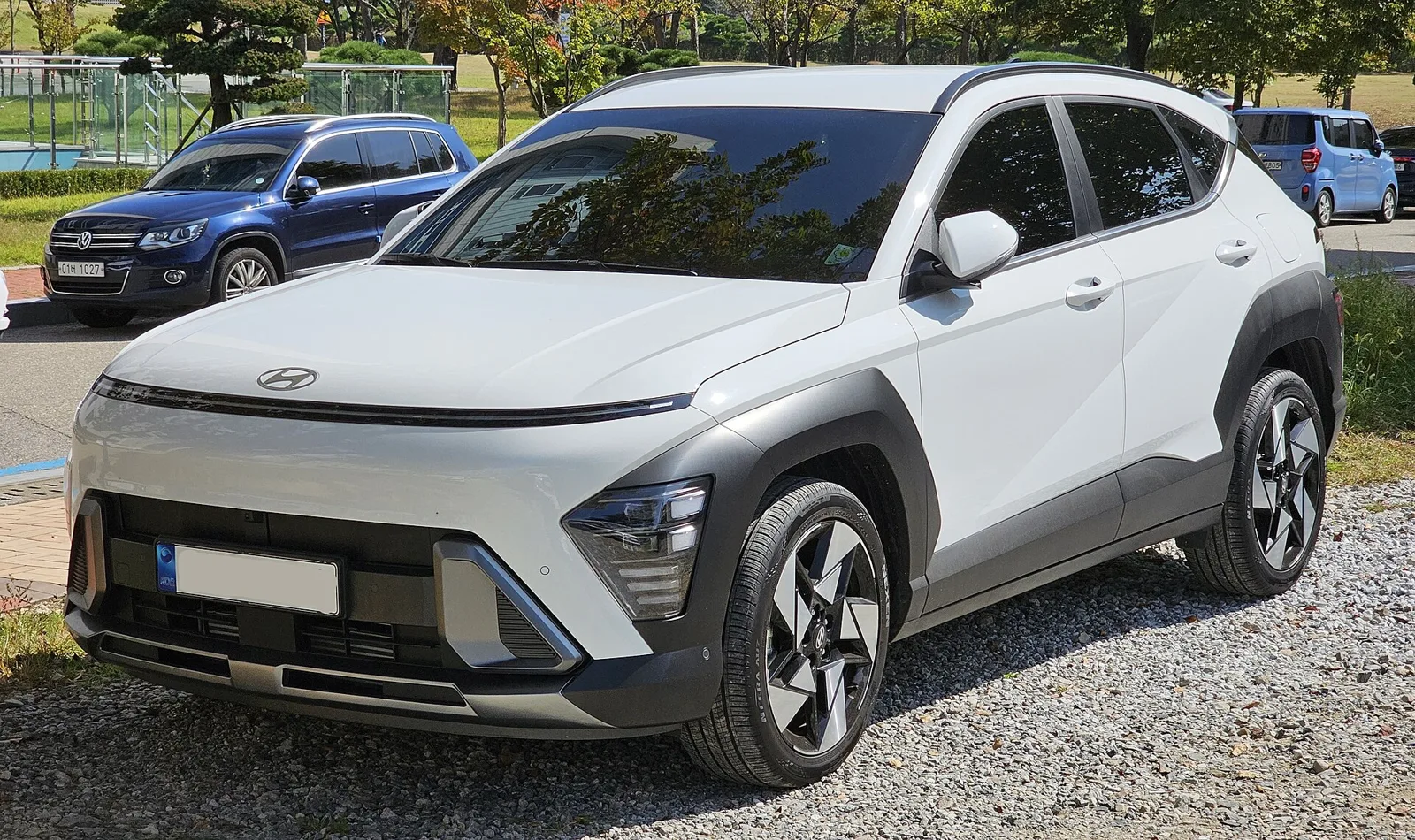
From a 2017 debut to a second generation with petrol, hybrid and electric versions, plus the N performance model and its recall history.
The Hyundai Kona is a subcompact crossover SUV first revealed in June 2017 in Seoul. It was developed as a battery-electric model before petrol and hybrid versions followed. The second generation was revealed in December 2022, and the Kona N brought high-performance styling and power to the range.
Hyundai's Kona is a small crossover built in South Korea. It arrived in 2017, and a second generation took over in late 2022. The first car was engineered as a battery-electric vehicle, with petrol and hybrid versions following from the same work, so the range now spans electric, hybrid and high-performance N models.
Where does the Kona sit in Hyundai's line-up?
Depending on the market, the Kona slots above the Venue or Bayon and beneath the Tucson. The company said its name mirrors how modern buyers live, in keeping with a progressive styling approach. The first car was unveiled in Seoul in June 2017, and the production model came out later that same year.
The name points to a western district on the island of Hawaii. In Portugal the car went by Kauai, since Kona sounded uncomfortably like a local slang term. In China it was sold as the Encino, a separate identity that carried the same basic idea.
A subcompact crossover that started electric and grew into a family of petrol, hybrid and performance versions.
Why did Hyundai begin with an electric version?
Hyundai developed the Kona as a battery-electric model first, and only afterwards adapted that work for petrol and hybrid variants. The sequence shows how the platform was planned around electrification from the outset, so electric drive was part of the plan from the start.
That order also explains why the electric version reached South Korea during 2018, the year before it reached Thailand in March 2019.
How was the first-generation Kona built?
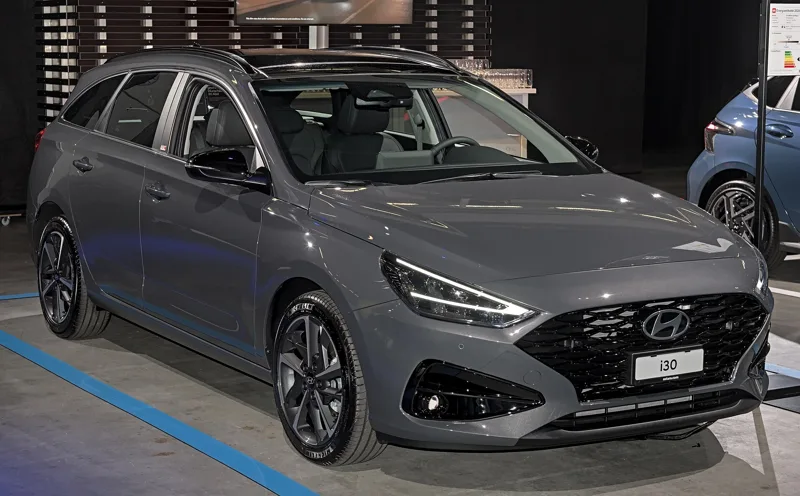
Underneath, the first Kona used a fresh B-segment SUV base that borrowed its roots from the i30 platform. That base was engineered to take many powertrain types, fuel cell and electric included. Buyers could choose front-wheel drive or all-wheel drive from launch.
Body construction relied on 51% advanced high-strength steel. Front-drive examples had a torsion-beam rear axle, whereas four-wheel-drive models used a dual-arm multi-link setup. The IIHS gave the 2018 model its Top Safety Pick+ rating,.
The platform's flexibility mattered later on. Because one structure could carry petrol, hybrid and electric drivetrains, the model could be sold in many forms without a separate architecture for each.
What engines did the first Kona offer?
At launch the petrol line-up included a 1.0-litre turbocharged direct-injection unit rated at 88 kW (120 PS), along with a 1.6-litre turbo making 130 kW (177 PS). In North America a 2.0-litre Atkinson-cycle engine delivered 110 kW (149 PS) as the entry option.
Upper trims used the 1.6-litre engine with a 7-speed dual-clutch gearbox, and all-wheel drive appeared on certain versions only.
How far does the Kona Electric go?
The first electric Kona used 39.2 kWh or 64 kWh battery packs. The larger pack was rated at 415 km (258 mi), while a track trial at the Lausitzring in Germany reached as far as 1026 km with the 64 kWh battery.
In that same trial, consumption averaged 100 Wh per mile at an average of 30 km/h, a steady pace that differs greatly from ordinary commuting. Real-world range depends heavily on speed, temperature and driving style, so the trial figures should be read as a best case.
In Malaysia the facelifted electric model offered 303 km from its smaller battery and 484 km from the larger one. The gap between those two figures shows how much a bigger pack changes the usable distance.
How did the Kona Electric sell?
Global sales of the Kona Electric passed 100,000 in June 2020. Hyundai intended to turn out 30,000 units a year from its plant in the Czech Republic. In 2021 the model placed sixth among UK electric cars, with 7,199 registrations.
South Korea was the first market for the Kona Electric in 2018, followed by Thailand in March 2019. An Electric Lite variant reached India in July 2019, though production there ended in June 2024 and the Creta Electric took its place.
What was the Encino EV in China?
China received the car as the Encino, and its electric form used a 150 kW motor rated 204 PS (201 hp). That motor delivered 310 N m of torque, with power drawn from a 64.2 kWh battery whose NEDC range is 500 km.
Because the Encino EV was the Chinese counterpart of the Kona Electric, it reached buyers under a separate name and identity rather than the Kona badge used elsewhere.
What did the Kona N add to the range?
The high-performance Kona N debuted on 27 April 2021 during Hyundai N Day, marking the first performance SUV from the company's N division. Its turbo engine makes as much as 206 kW (280 PS), with torque around 392 N m (289 lb ft).
For short bursts in N Grin Shift mode, output climbs to about 213 kW (290 PS). Visual changes include a front lip spoiler, a double-wing rear spoiler and a triangular third brake light reserved for N models, plus Sonic Blue paint that marks the N colour palette.
Because the N model keeps the standard crossover body, buyers can judge the performance upgrades against the regular car on the same shape.
How big is the second-generation Kona?
The second generation, revealed in December 2022, measures roughly 150 mm more in length, depending on the version. Its wheelbase has been stretched by 60 mm, and the drag coefficient sits at 0.27. Back-seat room improved by 31 mm, reaching 925 mm.
Boot capacity with the rear seats folded comes to 466 litres (16.5 cu ft) using the VDA method, or 723 litres (25.5 cu ft) under the SAE method. The two methods produce different headline numbers, so comparing them directly needs care.
Those dimensions make the second generation noticeably larger than the first, and the extra length shows most clearly in rear legroom and boot capacity.
Which powertrains does the second generation offer?
Europe's second generation can take a 1.0-litre T-GDi petrol paired with a 48-volt mild-hybrid system. A 1.6-litre hybrid petrol is also available, and battery-electric variants sit alongside them in the same range. Those choices give European buyers a clear path from entry petrol to hybrid and electric.
All-wheel drive is only offered with the 1.6-litre T-GDi unit, so buyers who want four-wheel traction must pick that version rather than the mild hybrid or the hybrid.
How does the second-generation Kona Electric charge?
The second-generation electric Kona runs on a 400-volt electrical system. Hyundai quotes a 10 to 80 percent top-up of around 41 minutes for the Long Range battery, and the car includes vehicle-to-load capability. Charging times are quoted for the Long Range model specifically.
There are two packs: 48.4 kWh for the Standard Range version, and the Long Range pack is 65.4 kWh. The larger pack provides up to 490 km on the WLTP cycle, which is 304 miles.
Where is the second-generation Kona sold?
Europe received the second generation in April 2023, and Australia followed on 7 July 2023. North America came in September 2023 as a 2024 model, while Indonesia launched an electric-only version on 17 July 2024. Launch dates vary widely between markets, so the sequence reflects different rollout timing.
Indonesian production started on 16 July 2024, making the electric model the first battery-powered car assembled there with local cells. Those cells came from a domestic plant that began operating on 3 July 2024.
Brunei received an N Line variant on 17 May 2024, with a 1.6-litre turbo petrol engine. The Philippines introduced GLS and Premium trims in June 2025, and Brazil followed with Ultimate and Signature trims in May 2025.
Did the Kona face recalls?
Yes. Hyundai Australia recalled 1,726 second-generation cars built from the 2023 model year and fitted with the 1.6-litre T-GDi, in April 2024. In the United States, campaign 23V901 covered 10,984 model-year 2024 vehicles. Both campaigns concerned the 2023 and 2024 model years.
The US problem involved a battery cable that could be damaged in a frontal crash, creating a fire risk. Recalls of this kind show how a single component can affect a whole model year.
What awards did the Kona win?
The utility category at the 2019 North American awards named both the electric and combustion versions as joint winners, the first such result for a subcompact crossover. U.S. News put the car first among subcompact SUVs for 2022, giving it 8.4 out of 10.
Auto Express gave the Kona its Car of the Year honour in 2023. That made it a double-award car within a few years, with recognition on both sides of the Atlantic.
Awards that cover both electric and petrol versions reward a model that works in more than one form, which is why the 2019 result drew attention.
Special editions and the Iron Man model
Hyundai produced a limited Iron Man edition in 2019, co-branded with Marvel to tie in with the Avengers film. Its matte grey paint and red highlights were paired with a planned run of 300 cars for Britain.
Owners can check whether a vehicle is covered by looking up its model year and campaign number through the manufacturer or the national safety regulator.
Hyundai Kona specifications at a glance
| Item | Detail |
|---|---|
| First-generation debut | June 2017, Seoul |
| First-generation 1.0-litre turbo | 118 hp (120 PS; 88 kW) |
| First-generation 1.6-litre turbo | 175 hp (177 PS; 130 kW) |
| North American 2.0-litre Atkinson | 147 hp (149 PS; 110 kW) |
| Kona Electric batteries | 39.2 kWh or 64 kWh |
| Kona N output | 280 PS (276 hp; 206 kW) |
| Kona N torque | About 392 N m (289 lb ft) |
| Second-generation reveal | December 2022 |
| Second-generation drag coefficient | 0.27 |
| Second-generation boot, SAE | 723 litres (25.5 cu ft) |
| Second-generation Long Range Kona Electric | 65.4 kWh, up to 490 km (304 mi) WLTP range |
| Encino EV motor | 150 kW; 204 PS (201 hp) |
_(cropped).jpg)