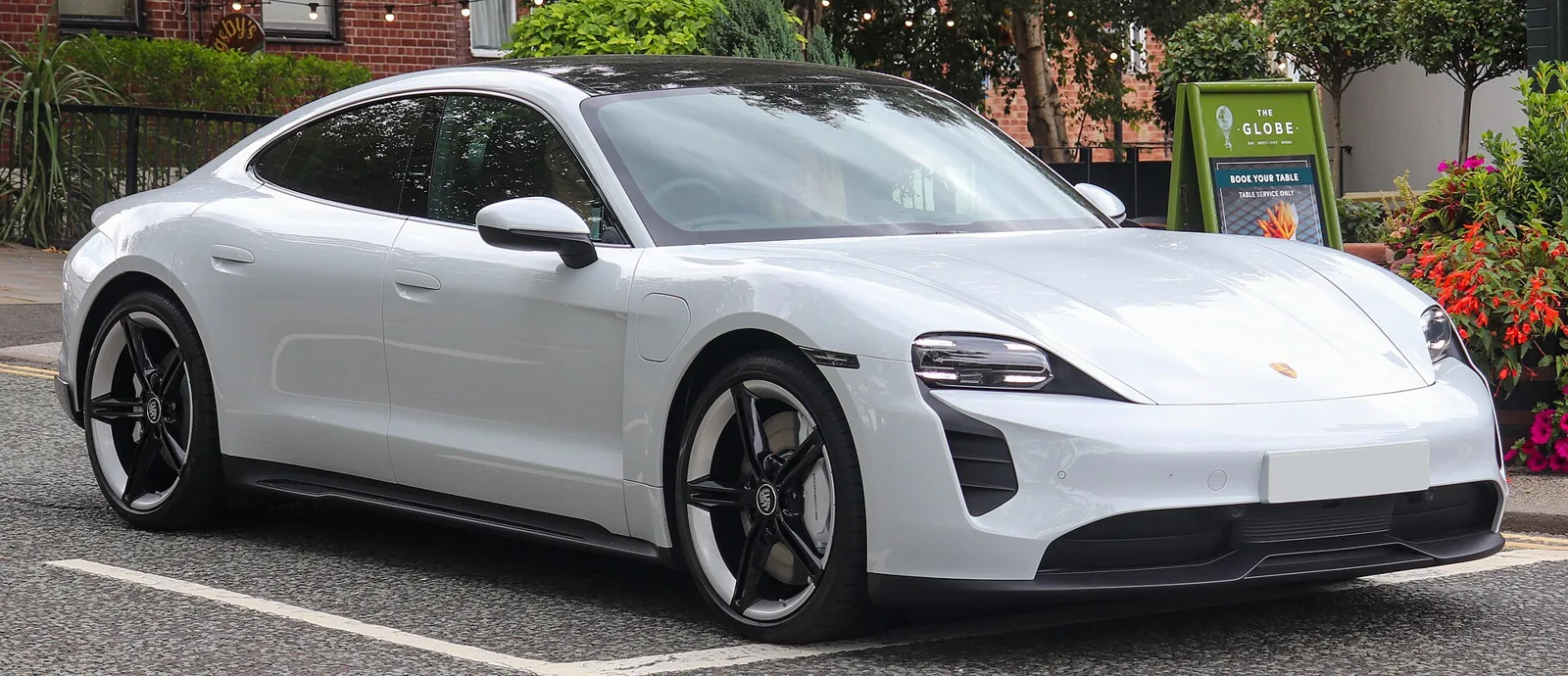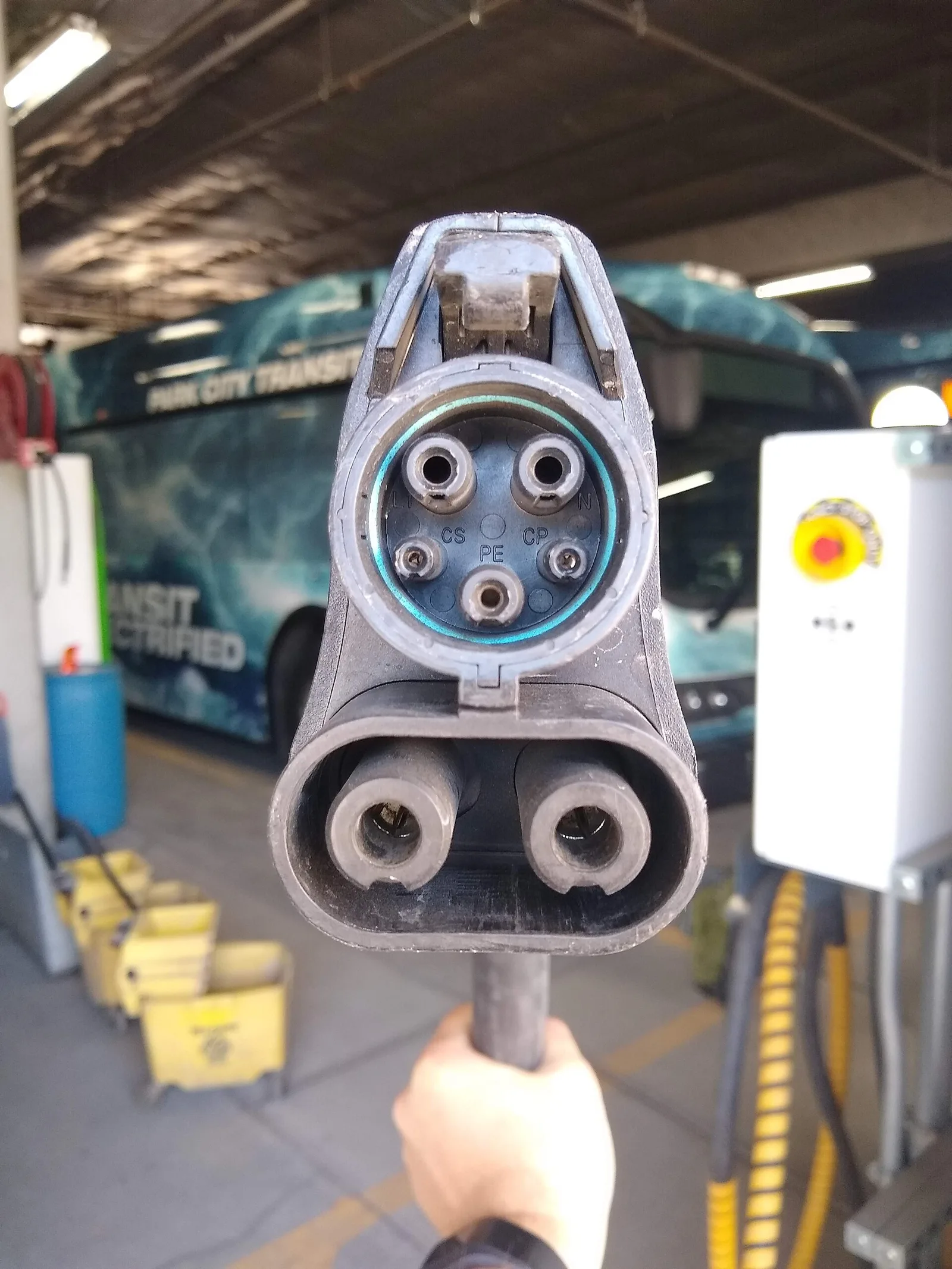
A connector designed for the 2012 Model S is now the planned inlet for most new American electric cars, while Europe and Oceania stay on CCS2.
American carmakers switched because Tesla's connector arrived with the Supercharger network, which observers regard as more reliable and extensive than rivals. Ford led in May 2023, SAE standardised the plug as J3400, and most brands plan NACS ports from the 2025 model year. Europe and Oceania remain on CCS2.
From May 2023 to February 2024, the majority of big carmakers selling electric vehicles in North America made one announcement: from the 2025 model year they would stop fitting the Combined Charging System Combo 1 (CCS1) inlet and build their cars around the plug Tesla had put on the Model S back in 2012. Ford went first, in May 2023. The rest followed in a rush.
What is the NACS connector?
NACS is a charging plug that handles both everyday AC charging and DC fast charging through one small connector, with pins shared between the two jobs. Rival systems need a bigger plug, or extra contacts, to add DC. Tesla introduced the physical design on the Model S in 2012, calling it simply the Tesla charging connector, and every Tesla since, from the Model X to the Cybertruck, has used it.
The name has a tangled history, and it explains much of the argument that followed. The connector began life as a proprietary Tesla design. In November 2022 Tesla opened it to other manufacturers and renamed it NACS, for North American Charging Standard. SAE International then took it through formal standardisation: it announced its plan on 27 June 2023, published a technical information report on 18 December 2023, and issued the recommended practice on 30 September 2024, redefining NACS as the North American Charging System along the way.
One engineering change matters for compatibility. The original Tesla connector talked to the car over CAN bus. NACS uses the ISO 15118 protocol that CCS1 also relies on, which is what lets a CCS1 car charge at a NACS station through an adapter and a Tesla charge at a CCS1 station. Teslas built before 2021 need an ECU retrofit before they can do the latter.
The plug war was decided in North America, and a driver in Sydney sees no sign of it at the charging station.
How does the NACS plug work?
Picture CCS as a house with an extension bolted on: the original AC plug stays, and two chunky DC contacts are added underneath. NACS is closer to a house designed with one front door. It has five pins. Two carry the power and do double duty. In DC mode they are the positive and negative sides of the supply; in AC mode they become the two lines of a split-phase connection, or the line and neutral on a single-phase one.
The other three pins are for safety and conversation. A ground pin ties the chassis to earth and acts as a reference for the two signal pins. The control pilot carries digital messages about charging state and current. The proximity pilot tells the system whether the plug is seated, and pressing the release button on the handle opens a switch in that circuit, cutting the flow of electricity before you pull.
That button has a second trick. It sends out a UHF signal. If the connector is locked in place, the car lets go of the latch; if it is not, the car opens the inlet door instead. One control, two jobs.
How much power can NACS carry?
NACS exists in two DC versions, one rated up to 500 volts and a higher-voltage one up to 1000 volts that works with the lower. The standard sets no current ceiling. Any current is permitted as long as the temperature at the connector interface stays at or below 105 degrees Celsius (221 degrees Fahrenheit), and Tesla says it has run the plug at continuous currents up to 900 amps.
The headline figure is the version 4 (V4) Tesla Supercharger, which delivers up to 500 kW. That needs both a V4 dispenser and a V4 back end, found at only a select few locations, and the unit can hold 500 kW for just a few minutes before heat forces it to throttle back. On the AC side, NACS can deliver as much as 80 amps at 277 volts from a 480-volt three-phase commercial supply, which gives 22.16 kW. In typical set-ups the figure is up to 48 amps at 240 volts, or 11.5 kW. The AC pin layout matches the older SAE J1772 plug, so simple pass-through adapters work between the two.
NACS vs CCS: what is the real difference?
The Combined Charging System takes the AC connector a region already used and adds two DC contacts to it. Take the Type 1 plug common in North America and you get Combo 1, or CCS1. Take the Type 2 plug common elsewhere and you get Combo 2, or CCS2. On Combo 2 the AC contacts are removed from the connector altogether, leaving three contacts for communication and protective earth.
CCS chargers can deliver up to 500 kW (a maximum of 1000 volts and 500 amps). Networks have deployed 400 kW units, and a 990 kW installation has been demonstrated. So on raw power the two plugs are not far apart; the difference is in packaging, history and who stands behind them.
CCS came out of a carmaker alliance. A proposal for it was presented in Baden-Baden on 12 October 2011, and seven carmakers, among them Ford, General Motors, BMW and Volkswagen, agreed that year to introduce it from mid-2012. The European Union has required Type 2 or Combo 2 on its charging network since 2014. Volkswagen opened the first public CCS station, a 50 kW unit in Wolfsburg, in June 2013, and BMW followed two weeks later. In the United States, the deal Volkswagen reached in 2016 over its emissions scandal committed the company to spend US$2 billion over 10 years on charging through Electrify America.
Where does CHAdeMO fit in?
CHAdeMO was first. The Tokyo Electric Power Company formed the CHAdeMO Association in March 2010 with Toyota, Nissan, Mitsubishi and Subaru, and Hitachi, Honda and Panasonic joined later. The name abbreviates CHArge de MOve, and it plays on a Japanese phrase that translates as 'How about a cup of tea?', which refers to the wait while a car charges. First-generation units delivered up to 62.5 kW, adding about 120 km (75 miles) of range in half an hour. The second generation reaches 400 kW.
Then the politics turned. In 2013 the European Commission designated Combo 2 as the required plug for high-power public DC charging in Europe. The final rule asks only that public chargers carry CCS Combo 2 at the least, so stations may offer other connectors too. Since then CHAdeMO has lost ground outside Japan. Honda was the first association member to drop it overseas, with the 2016 Clarity Electric, and Nissan left it off the Ariya outside Japan. As of 2025 the Nissan Leaf is described as the last fully electric car sold in North America with CHAdeMO, and Nissan is moving to NACS with its 2026 model year. In May 2023 the association reported 57,800 chargers in 99 countries, including 31,600 in Europe and 9,600 in Japan.
| Connector | Main regions | Power figures quoted | Notable point |
|---|---|---|---|
| NACS (SAE J3400) | North America; Tesla cars sold in Japan | V4 Supercharger up to 500 kW | Five pins, shared by AC and DC |
| CCS1 | North America, South Korea | Up to 500 kW | Type 1 AC plug plus two DC contacts |
| CCS2 | Europe, Oceania | Up to 500 kW | Legally mandated DC standard in those regions |
| CHAdeMO | Japan | 62.5 kW first generation, 400 kW second generation | Few new cars outside Japan carry it |
| GB/T | China | No figure given | Legally mandated DC standard in China |
Why did the American car industry switch to Tesla's plug?
Money started it. The Infrastructure Investment and Jobs Act of 2021 set aside US$7.5 billion in subsidies for fast chargers spaced at most 80 km (50 miles) apart along American highways, and to qualify, chargers had to be open to several brands of electric vehicle. Tesla's answer, in November 2022, was to open its connector as NACS. Some commentators saw the move as a final, desperate bid to rescue the Tesla plug while federal funding backed the spread of CCS1.
Tesla made its own case. It said NACS was more compact, that its fleet outnumbered CCS1-equipped vehicles two to one, and that the Supercharger network had 60 percent more stalls than all CCS1 networks combined. Then Ford broke ranks. In May 2023 it became the first major automaker to say that from 2025 every new electric vehicle would carry a native NACS port, with earlier models getting an adapter from 2024. General Motors announced the same switch in the first half of 2023, and by February 2024 most major brands had followed.
Observers said the stampede reflected how highly the Supercharger network is regarded: more reliable and extensive than rival networks, with a plug that is easy to use. Analysts added that charging could turn into a steady earner for Tesla. For 2024 the company itself reports 99.95 percent uptime, counted as at least half of daily capacity being available.
The standards bodies had to catch up. In June 2023 the Charging Interface Initiative (CharIN), which promotes CCS, objected that NACS was not published or recognised by any standards body and that a standard should be built collaboratively. A week later SAE announced it would standardise the connector. CharIN later acknowledged that while NACS does not share the CCS physical plug, it does use the same communication protocols. In December 2023 the US government publicly endorsed NACS, and the Federal Highway Administration said it planned to write the SAE-standard plug into the eligibility rules for federal charging money.
The practical switch came on 29 February 2024, when Tesla made more than 15,000 of its stalls available to Ford owners. The company said technicians had updated many stalls so they could speak both CAN bus and ISO 15118, and that the work would continue across the network.
What is the Supercharger network behind the plug?
The first six Supercharger stations opened in California on 24 September 2012, as the Model S entered production. By 1 October 2026 Tesla was operating 9,007 stations with more than 85,000 connectors worldwide: 3,610 stations in Asia Pacific, 3,594 in North America and 1,788 in Europe. An earlier count put the network at 7,900 stations and over 75,000 connectors as of November 2025. Charging is billed by the kilowatt-hour, with idle fees for cars left plugged in and congestion fees at busy sites once a car passes 80 percent.
Tesla has tried to bridge the gap for other brands. From February 2023 it fitted the Magic Dock at selected V3 sites, a captive adapter that converts NACS to CCS1 and unlocks when a CCS driver reserves a stall through the Tesla app. By February 2025, 92 V3 locations and 44 V4 locations supported it. Once SAE finalised J3400 in September 2024, future Superchargers no longer needed to support CCS1. As of September 2025 under 100 V3 sites had the dock fitted, and under 80 V4 sites had switched it on.
The network faces questions of its own. Reports in May 2024 said Tesla had dismissed everyone on its Supercharger team, head Rebecca Tinucci included. Elon Musk then promised US$500 million for expansion that year; former employees estimated that this was a 77 percent cut in the rate of port deployment compared with the original plans. In 2025 a Tesla executive put the cost per stall at under US$45,000 for V3.5 posts, with a target below US$40,000 for V4.
What does NACS mean for drivers outside North America?
For most of the world, very little changes. Each region settled on its own DC plug. CCS1 is common in North America and South Korea. CCS2 is the DC fast-charging plug required by law in Europe and Oceania, a region that takes in Australia and New Zealand. CHAdeMO remains popular in Japan, where Tesla vehicles are equipped with NACS. China mandates GB/T, and Teslas sold there use it.
Tesla itself follows the local rule. Its vehicles sold in Europe and Oceania since May 2019 use CCS2, as do newer Superchargers, and older cars can be fitted with an adapter. Regulators in Europe pushed Tesla in November 2018, and it announced that new cars would get CCS2 inlets and its chargers would gain CCS2 connectors. It trialled charging for other brands first in the Netherlands (2021) and then in Norway (early 2022), using 15 large, uncongested stations, and during 2022 opened sites to non-Tesla cars in the United Kingdom, France, Germany, Italy, Spain and Sweden.
Chinese manufacturers selling abroad, including BYD, Chery and Zeekr, export their cars with CCS2 for overseas markets. In short, the plug war was decided in North America, and a driver in Sydney buying an electric car sees no sign of it at the charging station.
What should an EV owner in North America know?
If you already own a CCS1 car, the plan is an adapter first and a native port later. Ford became the first automaker to offer one in February 2024, and it works at most of Tesla's V3 and V4 sites. Tesla sells its own CCS1-to-NACS and CHAdeMO-to-NACS adapters. Teslas, for their part, ship with a J1772 adapter, which opens up the many slower Level 2 AC stations fitted with that plug.
Perspective helps here. Most charging happens at home or work, something Tesla has compared with charging a mobile phone. In 2014, less than 10 percent of charging came from Superchargers. The plug war matters most on long trips, where the fast network decides whether a journey is easy.
Where this goes next
Automakers say new North American models will carry NACS ports from the 2025 model year, and Nissan has said it will adopt the plug for 2026. Charging networks have announced plans of their own. EVgo, ChargePoint, Blink, Electrify America and BC Hydro said they would add NACS connectors, and Quebec's FLO, with over 90,000 chargers, announced the same. FreeWire planned to equip its battery-integrated chargers by mid-2024. In September 2023 Hilton announced a deal with Tesla to install 20,000 NACS connectors at 2,000 of its North American hotels by 2025. Equipment makers ABB, BTC Power, Tritium and Wallbox have also announced plans, with NACS cables specified at up to 375 amps uncooled and 650 amps liquid cooled.
Tesla's own roadmap is faster hardware. It announced a V4 cabinet on 14 November 2024, first deployed in September 2025, that shares 1 MW or 1.2 MW across eight stalls and can deliver 250 kW to 400-volt cars and 500 kW to 800-volt cars. The first complete V4 station, supporting up to 500 kW for passenger cars, opened in Redwood City, California, in September 2025. For the 2026 model year, the Cybertruck is the only Tesla able to take 325 kW at V4 posts.
The rivals are not standing still. The CCS specification for a version 3.0 is not yet precisely defined, though ideas under discussion include reverse power flow, inductive charging, wireless communication with the charger and pantograph charging for buses. CharIN is investigating versions above 2 MW for electric trucks. CHAdeMO is co-developing a third-generation standard called ChaoJi with the China Electricity Council, aiming for 900 kW, and released a standard for electric bicycle charging in late 2024.