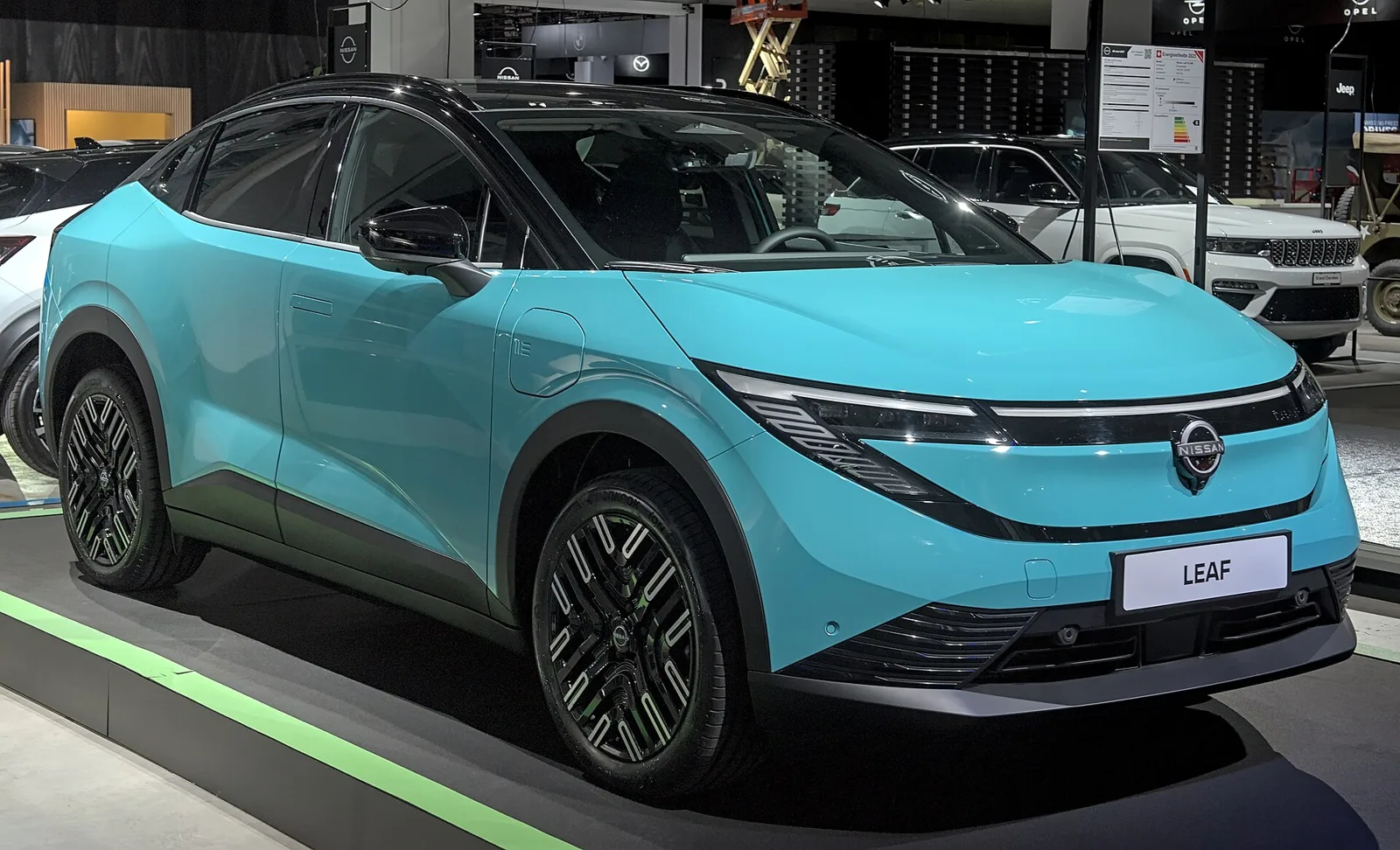
From a 2009 unveiling and a 160 km first range to a 2025 crossover with liquid-cooled packs, the Leaf is the electric car that proved the idea sold.
Nissan's Leaf has been built since 2010 as a battery electric car and sold in large numbers worldwide. Three generations have followed, with ranges rising from about 160 km to 490 km (303 miles) on select versions. The third generation, unveiled in 2025, moved from hatchback to crossover.
The Nissan Leaf is a battery electric car that Nissan has built since 2010, and it helped define the mass market electric segment. It was sold as a hatchback until 2025, and the third generation has since moved to a crossover body with liquid-cooled batteries.
This profile covers the origins, the battery and range story of each generation, trims and special models, sales and awards. Metric figures come first, with imperial values in brackets.
Where did the Nissan Leaf come from?
The Leaf was unveiled on 1 August 2009 and went on sale as a mass market electric car from late 2010. Nissan built the first cars at Oppama in Yokosuka, Japan, and later added production in Smyrna in the United States and Sunderland in the United Kingdom.
Before production started, Nissan built three prototypes called EV-01, EV-02 and EV-11. The first two were based on the Nissan Cube, and the third used the Nissan Tiida as its base.
The name is a backronym for leading environmentally-friendly affordable family car. Production began on 22 October 2010, and Nissan marked the 500,000th LEAF on 9 September 2020. By December 2020 the car was sold in 59 markets around the world.
UK assembly ended in March 2024, after 270,000 units had been produced at the Sunderland plant across both generations.
An electric hatchback that proved the mass market could take to electric driving, and then reinvented itself as a crossover.
How far could the first-generation Leaf go?
The first-generation Leaf, built from 2010 to 2017, carried a battery of 192 flat laminated cells and an 80 kW (110 hp) motor. Its range on a full charge was about 160 km (100 miles). Over the life of the model that figure rose from 117 km (73 miles) to 364 km (226 miles) through larger packs.
Charging was the weak point at launch. A 120 V socket needed 16 hours to fill the pack, a 230 V supply took 8 hours, and a fast charger could restore 80% of the battery in roughly 30 minutes.
Critics were mixed. Car and Driver disliked the cheap-feeling interior materials, which it felt belonged in a car costing half as much. It did praise the spacious boot, the standard heated seats and the heated steering wheel and leather seats fitted to higher models.
What changed in the second-generation Leaf?
The second generation, codenamed ZE1, launched in Japan in October 2017 and reached North America and Europe in February 2018. It used a 40 kWh battery with an EPA range of 243 km (151 miles), and global sales reached a record 87,149 units in 2018.
The motor was upgraded to 110 kW (147 hp) with 320 N m (236 lb ft) of torque. The car charged through a 6.6 kW regular plug or a 50 kW CHAdeMO connector, and it could send power back to the grid. The interior also gained Android Auto and Apple CarPlay.
The second generation kept the first car's basic mechanical layout, while adding range and power and changing its look. Buyers comparing the two cars would find the same kind of electric drivetrain, just with more capability.
The e+ variant, sold as the Leaf Plus in North America from 2019, carried a 62 kWh battery with 59 kWh usable. Its EPA range was 364 km (226 miles), and a 160 kW motor sat under the bonnet. CHAdeMO charging went up to 100 kW.
Driver assistance also moved on. ProPILOT Assist, a lane centering system, was optional on the two highest trims, and one-pedal braking let drivers slow the car almost to a stop without touching the brake pedal.
Did Nissan build an emergency version of the Leaf?
Yes, though only as a concept. Nissan presented the RE-LEAF in September 2020 as a UK prototype for natural disaster response, based on the 62 kWh e+ model. It was designed to act as a mobile power source for a small command centre.
The RE-LEAF had a raised ride height of 70 mm (2.8 in), underbody protection and all-terrain tyres on motorsport wheels. Its rear seats gave way to a cargo area, and the hatch opened onto a workstation with an 810 mm (32 in) LCD monitor. Roof-mounted emergency lights completed the look.
Nissan never confirmed a production version. Even so, the concept was well received in the automotive, EV and tech media.
The Leaf received a facelift in June 2022 for the 2023 model year. In the United States the EPA ranges were trimmed slightly, to 240 km (149 miles) for the 40 kWh version and 341 km (212 miles) for the 62 kWh version.
Which trims and special versions did the Leaf offer?
Trim names varied by market. Europe offered Visia, Acenta, N-Connecta and Tekna, while North America started with S, SV and SL before adding Plus versions in 2019. Japan had S, X and G, plus the e+ grades and a Nismo variant.
The N-Connecta added an intelligent around view monitor, front and rear parking sensors, heated seats and steering wheel, 43 centimetre (17 inch) alloy wheels and privacy glass. Tekna added the ProPILOT Advanced Driver Assistance System, Bose speakers and part leather seats with Ultrasuede trim.
The Japanese Nismo variant arrived in 2018 with a more sporty look and 18-inch wheels that were larger in diameter yet lighter. Autech versions of the e+ followed in 2019.
What was the Leaf Nismo RC?
The Leaf Nismo RC was a race-focused version of the second-generation car, unveiled on 30 November 2018. Only six units were allocated for promotional use. It used a CFRP monocoque body and a subframe 25% lighter than the steel version it replaced.
According to Motohiro Matsumura, the earlier model was rear-heavy because its rear was made of steel despite the low ride height. The lift-to-drag ratio improved by about 40%, and front downforce increased by 54%.
The RC looked like a race car, yet it kept the Leaf's headlights, V-motion grille and window shapes. Its long bonnet, large rear wing and wide wings set it apart from the road car, and the roll cage used CFRP wrapped around steel pipes to save weight.
What is the third-generation Leaf?
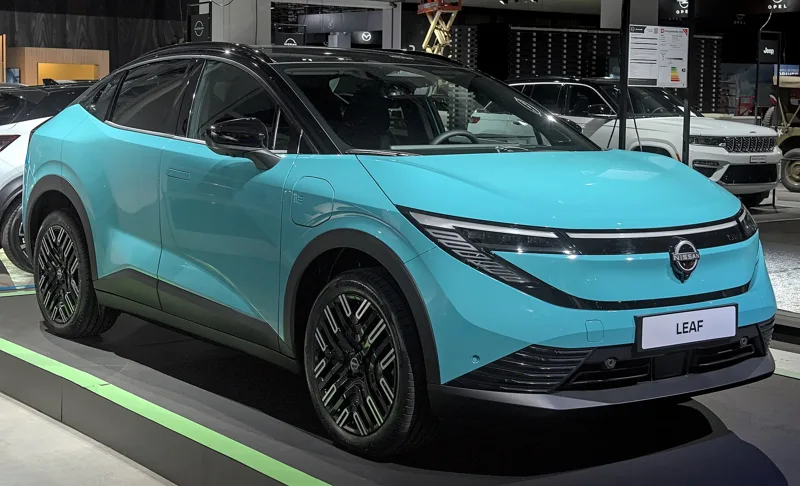
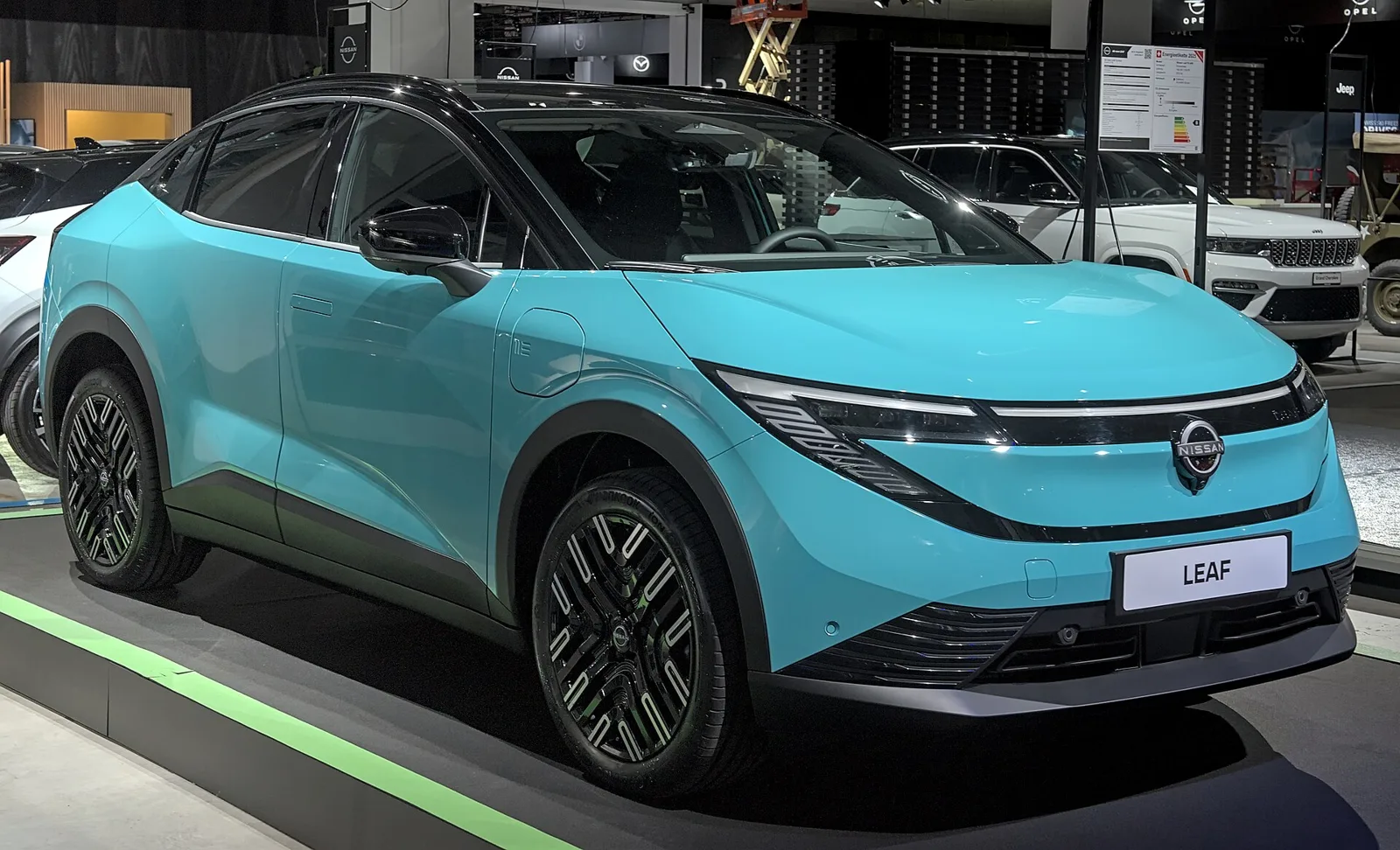
The third-generation Leaf (ZE2) was unveiled on 17 June 2025 and moved away from the hatchback to a subcompact crossover body. It rides on the AmpR Medium platform shared with the Nissan Ariya, and it is the first Leaf with liquid-cooled battery packs.
Nissan had previewed the direction as the Chill-Out concept on 29 November 2021. The production car keeps a single motor driving the front wheels, so it does not offer the all-wheel-drive setup found on the Ariya. Availability has been confirmed for North America, Europe, Japan and Australia.
Range is the headline claim. Nissan quotes an estimated 490 km (303 miles) EPA on select configurations, compared with 240 to 341 km (149 to 212 miles) for the previous model. The car's drag coefficient falls to Cd=0.25 from 0.29.
Charging has moved on too. The car supports 150 kW charging, and it is the first Nissan to adopt the North American Charging System, which gives access to Tesla Supercharger sites. Nissan claims 10-80% in 35 minutes on North American DC fast chargers.
Two liquid-cooled NMC lithium-ion options are offered, both with thermal conditioning. The 52 kWh pack pairs with a 130 kW (174 hp) motor and 344 N m (254 lb ft) of torque, while the 75 kWh pack pairs with a 160 kW (214 hp) motor and 354 N m (261 lb ft) of torque.
What are the Nissan Leaf specifications by generation?
The table below sets out the battery, motor and range figures for each generation. Where a value was not published for a version, the table says so rather than guessing, so the older cars and the newer packs can be compared directly.
| Generation | Battery | Motor | Torque | Quoted range |
|---|---|---|---|---|
| First (ZE0, 2010 to 2017) | 192 flat laminated cells | 80 kW (110 hp) | Not given | About 160 km (100 miles) |
| Second, 40 kWh (ZE1) | 40 kWh, 39 kWh usable | 110 kW (147 hp) | 320 N m (236 lb ft) | 243 km (151 miles) EPA |
| Second, e+ 62 kWh | 62 kWh, 59 kWh usable | 160 kW | Not given | 364 km (226 miles) EPA |
| Third, 52 kWh (ZE2) | 52 kWh liquid-cooled NMC | 130 kW (174 hp) | 344 N m (254 lb ft) | Not given |
| Third, 75 kWh (ZE2) | 75 kWh liquid-cooled NMC | 160 kW (214 hp) | 354 N m (261 lb ft) | 490 km (303 miles) EPA on select versions |
Range rose from about 160 km (100 miles) in the first generation to 490 km (303 miles) EPA on select third-generation versions.
How well did the Leaf sell?
The Leaf was the world's best-selling electric car from 2011 to 2014 and again in 2016. Global deliveries totalled 577,000 by February 2022. Tesla's Model 3 overtook it in early 2020 as the best-selling electric car in history.
Europe was the biggest market, with more than 208,000 units by September 2021. Norway registered 72,620 of them, making it the leading European national market. In the US, sales totalled 165,710 through December 2021, and Japan recorded 157,059 units.
Pre-orders in the United States reached 20,000 before the launch. Norway stood out, which shows how strongly the car took hold in one country.
Which awards did the Leaf win?
The Leaf won the 2011 European Car of the Year and 2011 World Car of the Year titles, plus the 2011-2012 Car of the Year Japan award. It also took the 2010 Green Car Vision Award, and IEEE named it a Top 10 Tech Car in 2018.
In 2022 the Leaf was named Best Family Electric Car in the Carbuyer Best Used Car Awards in the UK. The list of honours shows how the car was judged across a wide range of markets and categories.
Frequently asked questions
Is the Leaf still in production?
Yes, in its third generation, which was unveiled in June 2025. The older UK assembly at Sunderland stopped in March 2024, after about 270,000 units had been built across both earlier generations.
Did the battery chemistry stay the same?
No. The first generation used flat laminated cells developed with NEC, while the third generation uses liquid-cooled NMC lithium-ion packs. Both newer packs can be thermally conditioned.
Does the newest Leaf have all-wheel drive?
No. The newest car uses one motor that sends power only to the front wheels. Compared with the Ariya, which shares its platform, there is no dual-motor option.
Was there a sporty Leaf for Japanese buyers?
Yes. The Japanese Nismo variant was offered from 2018, and it was given a more aggressive look with larger, lighter wheels. A separate Nismo RC race car was also built, but only in very small numbers.
How quickly can the newest Leaf charge?
The third-generation car supports 150 kW charging. Access to Tesla Supercharger sites comes through the North American Charging System port, which sits on the passenger side front wing.
_Auto_Zuerich_2025_DSC_3011.jpg)