How moisture, mishandled propellant and missing records turned a safety device into the biggest recall in history, which cars were caught and what owners are told to do.
Takata supplied airbag inflators that could rupture and spray metal fragments into the cabin. Recalls began in 2013 and grew to more than 100 million inflators from over 20 carmakers by January 2024. Owners are told to check with the manufacturer and, where warned, stop driving until the airbag is replaced.
As of January 2024, more than 100 million airbag inflators worldwide had been recalled by over 20 carmakers, and by September 2024 faulty Takata inflators had been blamed for 28 deaths in the United States and 35 around the world. The company that made them filed for bankruptcy in 2017.
What was the Takata airbag recall?
It was a series of recalls, starting in 2013, of cars fitted with airbags that used Takata inflators. The inflators could rupture when the airbag fired and send metal fragments into the cabin. The recalls spread across brands and continents until they became the biggest in motoring history, and they have not fully ended.
Takata itself was a Japanese parts maker founded in 1933 in Shiga Prefecture by Takezo Takada, originally producing lifelines for parachutes and other textiles. It moved into seat belts in the 1960s, entered the airbag business in 1988 and had reached a 20 percent share by 2014. Its factories spread across four continents, and its European base was in Germany.
An airbag is meant to be used once and to hold together when it is. These did not.
How does an airbag work, and what went wrong with the inflator?
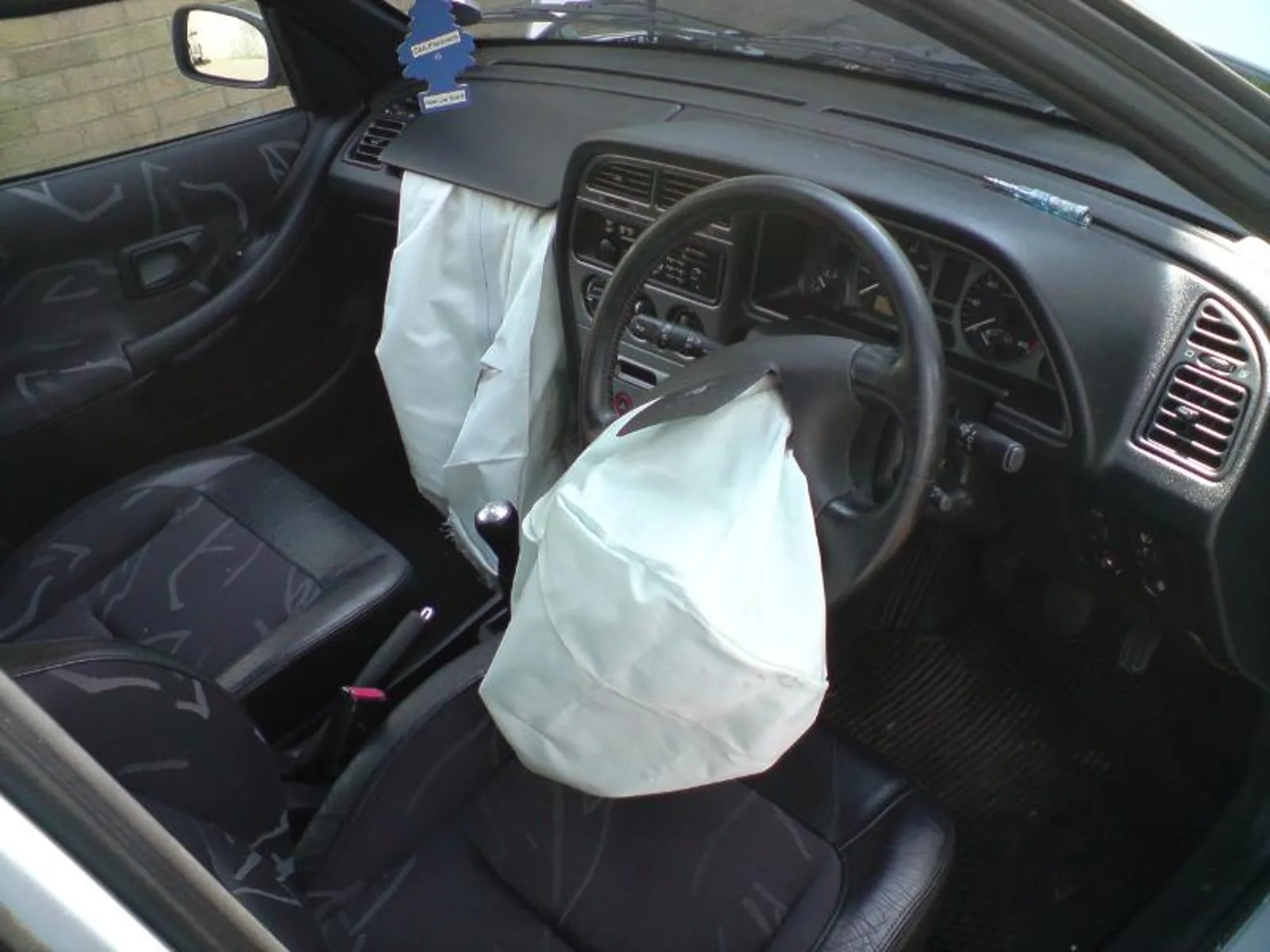
An airbag has a flexible fabric cushion, an inflation module and an impact sensor. In a crash, the sensors tell an electronic controller what kind of impact has occurred, and if the criteria are met the inflation module fires in milliseconds. The process is pyrotechnic and designed to work once. Takata's inflators failed at precisely that moment.
Think of the inflator as a small, tightly controlled explosion inside a metal container. The design relies on the propellant burning in a predictable way and the container staying whole. If the propellant is destabilised, as the moisture explanation suggests, the container can rupture, and what was meant to cushion an occupant can turn into shrapnel. Investigators warned that the airbags could burst and throw debris around the cabin.
The cause was argued over. In June 2014 Takata said it believed excessive moisture was responsible, and an official at the Japanese transport ministry said moisture and humidity could seep inside inflators and destabilise the volatile propellant. Separately, Takata conceded that the Mexican subsidiary had handled explosive propellants badly during manufacture and stored airbag chemicals incorrectly. The first 2013 recall of 3.6 million cars involved airbags made at, or using inflators from, Takata's Monclova plant in Coahuila, Mexico.
A second problem made matters worse. The Mexican subsidiary, TK Holdings, had failed to keep proper quality control records, so working out which vehicles carried defective airbags was difficult. Another wave of recalls followed in June 2014. It also helps explain why the problem was so hard to bound: reports state it may have started a decade earlier, with faulty airbags in some Honda models from 1998.
Airbags themselves are older than most drivers assume. An American, John W. Hetrick, filed an automotive airbag patent in 1952, a year after the German engineer Walter Linderer applied for his, but both designs relied on compressed air, which research in the 1960s showed could not fill a bag quickly enough. In 1967 Allen K. Breed devised a ball-in-tube crash sensor able to trigger inflation in under 30 milliseconds, and a small explosion of sodium azide replaced compressed air for the first time. That led to the chemical inflators in use today.
General Motors offered airbags in 1973, Mercedes-Benz in West Germany in 1981, and the Porsche 944 Turbo was, in 1987, the first car to fit driver and passenger airbags as standard. A US law required them for the driver and front passenger in cars built after 1 September 1998, and NHTSA estimated they had saved over 4,600 lives by 1 September 1999. That record is the backdrop to the Takata story: a device with a long safety record failed in one manufacturer's hands.
How did the recall grow so large?
Step by step, and with a rising human cost. A US safety investigation began after three injury complaints, and on 23 June 2014 seven manufacturers announced recalls covering over three million vehicles. By November 2014 the NHTSA ordered a nationwide recall, and by May 2015 Takata stood behind the biggest automotive recall ever.
| Date | Place | Scale |
|---|---|---|
| April and May 2013 | Worldwide | 3.6 million cars recalled |
| 23 June 2014 | Worldwide | Over three million vehicles from seven makers |
| 19 May 2015 | United States | 40 million vehicles across 12 brands; about 53 million eligible |
| 4 May 2016 | United States | 35-40 million further inflators, on top of 28.8 million already recalled |
| 28 February 2018 | Australia | 2.3 million vehicles in a compulsory recall |
| 4 April 2018 | New Zealand | 50,000 vehicles with Alpha-type airbags |
| January 2024 | Worldwide | Over 100 million inflators from more than 20 carmakers |
The individual cases were grim. In July 2014 a pregnant Malaysian woman, aged 42, died in a collision at about 30 km/h (18 mph) in a 2003 Honda City after a shard of metal from a burst driver's airbag cut her neck, as set out in a suit brought by her father in a Miami federal court. Her baby daughter, delivered after the mother had died, survived only three days. Honda has acknowledged awareness of over 100 injuries and thirteen fatalities, seven of them in the US and six in Malaysia.
Which cars were affected by the Takata recall?
A very wide range. By 2015 the recall had reached 12 vehicle brands in the United States alone, and the list kept growing in other markets. Honda was at the centre of the early cases, but BMW, Chrysler, Ford, Mazda, Nissan and Toyota were all named in the June 2014 announcement, and many others followed.
- Australia: a compulsory recall covered all cars with Takata airbags, with replacement due within two years of the February 2018 announcement. Holden added 330,000 vehicles on its own list, and in December 2019 the ACCC warned of around 78,000 cars made from 1996 to 2000 from Toyota, Honda, Mazda, Mitsubishi, Suzuki, Ford, BMW and Audi.
- New Zealand: a compulsory recall of 50,000 vehicles with Alpha-type airbags, which the government said presented the highest safety risk, together with a block on importing any vehicle whose faulty airbags had not been replaced.
- Canada: a recall of 222,336 Honda vehicles made between 2001 and 2007, whose front passenger airbags had been modified in the 2014 recall but with a non-desiccated inflator that could still rupture. Honda replaced them with desiccated units.
- United States: Volkswagen recalled 106,806 vehicles including the Golf, Polo, Passat, Eos, CC and Up!. Ford added 953,000 in January 2019, from the 2010 Edge to the 2014 Mustang, and in January 2024 Toyota and General Motors recalled 61,000 older Corolla, Matrix, RAV4 and Pontiac Vibe models.
Is my car affected by the Takata recall?
Only the manufacturer or your national regulator can answer for a specific car, because the lists keep changing. Those most at risk are older vehicles, particularly those that had airbag modifications, and cars whose owners have never received a notice.
Makers are obliged to notify the owner when a recall is issued, yet a second, third or fourth owner may find the letter went to someone who sold the car long ago. A study by Mojo Motors found only .005 percent of customers ask dealerships about recalls. So the safest approach for anyone who bought a used car is to ask the maker or an authorised dealer to check the exact car, rather than wait for a letter.
Some warnings are blunt. In July 2022, after a fatal inflator explosion, Stellantis told the owners of 29,000 Dodge Ram pickups from 2003 to park them, and in November it urged a further 276,000 owners to stop driving after three more crash deaths. In February 2023, following another death, Honda warned 8,200 Acura and Honda owners to leave their cars parked. By then it counted 17 deaths in the United States, plus upwards of 200 injuries, linked to the inflators.
What happened to Takata?
It was fined, charged and finally bankrupted. In November 2015 US regulators fined the company $200 million, of which $70 million was paid upfront, after Takata admitted fault. In January 2017 the United States charged three executives, and the company agreed to plead guilty and pay $1 billion: a $25 million fine, $125 million for victims and $850 million to compensate automakers. At least 16 deaths had been linked by then.
On 25 June 2017 Takata went into Chapter 11 in the United States and sought court protection in Japan, because the compensation it owed exceeded what the firm could bear. Its remaining assets were bought by Key Safety Systems, a Chinese-owned company based in Michigan, for about $1.6 billion. In April 2018 the business was renamed Joyson Safety Systems. In June 2021 Joyson announced it had found over a thousand cases where Takata falsified seat belt safety test data.
The company had been here before. A 1995 US recall covered 8.333 million mostly Japanese-built vehicles from 1986 to 1991 with Takata seat belts. Investigators found the buckles were made of an ABS plastic that went brittle under ultraviolet light, jamming the release button. Only 18% of the vehicles were repaired two years after the recall began, and NHTSA fined both Honda and Takata $50,000 for not reporting the defect in good time.
What should owners do about a Takata recall?
Follow the notice. A consumer-level recall normally asks owners to return the product for a refund, replacement or modification, and for cars that means a visit to a dealer to have the inflator replaced.
Ask the manufacturer or dealer to check the exact car, particularly if you bought it second-hand. Do not assume an earlier repair settled the issue, since Honda airbags modified in the 2014 recall were later replaced with desiccated inflators. Where a government sets a deadline, as in Australia's two-year window, treat it as a limit, not a suggestion. Toyota, Mazda and Honda have each said they will avoid inflators based on ammonium nitrate.
How does Takata compare with other big recalls?
Nothing else matches it, though the history of recalls has plenty of large entries. In 1978 Ford recalled 1.5 million Pintos to reduce the risk of fire, then the largest in automotive history. In 2000 the recall of 6.5 million Firestone tyres on the Ford Explorer ended with the resignation of Ford's chief executive, Jacques Nasser. Toyota recalled 1.12 million cars in December 2022 over occupant classification sensors that could stop airbags deploying as designed.
Recalls overall are rising. US recalls since 1966 add up to 390 million motor vehicles, with a peak of 50 million in 2016. NHTSA data show approximately 31,269,261 vehicles recalled in 2025, about 11% fewer than the 35,020,507 in 2024, with Ford issuing more recall orders than any other maker.