Solid electrolytes were found in the 1830s, yet as of 2026 the market has not reached scale. Carmakers have named dates for years, and the dates keep moving.
Solid-state batteries were not yet in scalable production as of 2026. Makers' own targets vary: Toyota said in June 2023 it would wait until at least 2027, Nissan aims for FY2028, BMW, Ford and Solid Power point to the end of the 2020s, Honda says 2030 and Hyundai the 2030s.
Michael Faraday found solid electrolytes between 1831 and 1834, long before anyone imagined an electric car, and as of 2026 the solid-state battery market has still not reached scale. Carmakers have been working on the technology since the early 2010s and have been naming dates for years.
What is a solid-state battery?
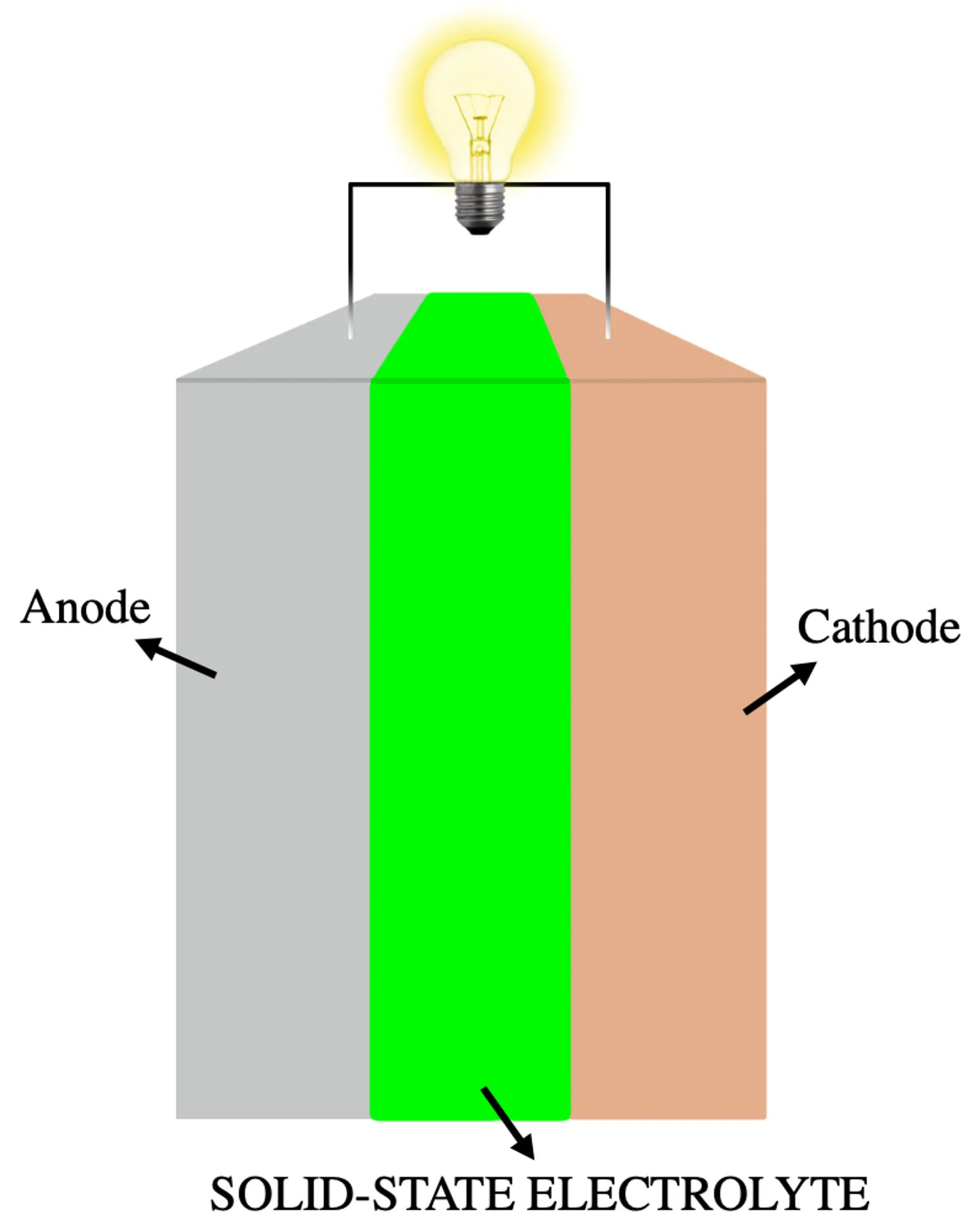
Every battery needs something between its two electrodes that lets charged particles through while forcing electrons to take the long way round, through the wiring and the motor. In a lithium-ion cell that something is a liquid: lithium hexafluorophosphate dissolved in a mixture of organic carbonates. In a solid-state battery, a solid material does the same job. Ceramics (oxides, sulfides and phosphates), glass and solid polymers are all candidates.
A swimming pool and a corridor make a fair comparison. Ions swim through a liquid with ease and it touches every surface of the electrode, but the liquid is flammable. A solid has to be a corridor that the same ions can walk down at similar speed, with walls that sit snugly against the electrodes. Getting both things right at once is the whole engineering problem.
The prize is a cell that, in theory, stores much more energy for its size and weight. A solid electrolyte can act as an ideal separator that passes only lithium ions, and that opens the door to a metallic lithium anode paired with an oxide or sulfide cathode. The same arrangement could ease several weaknesses of liquid cells: flammability, the usable voltage range, the unstable layer that forms where electrode meets electrolyte, cycling performance and mechanical strength.
Michael Faraday found solid electrolytes in the 1830s, and the industry is still waiting for one in volume.
Solid state battery vs lithium ion at a glance
| Feature | Lithium-ion today | Solid-state, as proposed |
|---|---|---|
| Electrolyte | Liquid or gel polymer | Ceramic, glass or solid polymer |
| Fire risk | Flammable electrolyte can burn or explode if mishandled | Designed to remove the flammable liquid |
| Typical anode | Graphite, often with silicon mixed in | Metallic lithium is possible |
| Energy density | Tripled in volume terms since 1991 | Theoretically much higher |
| Position in EVs | Dominates the market | Not at scalable production as of 2026 |
How does today's lithium-ion cell work?
The ions shuttle back and forth between the electrodes, which is why the design is nicknamed the rocking-chair battery. On discharge, lithium ions travel through the electrolyte from the negative electrode to the positive one while electrons take the external circuit and do useful work. Charging drives everything the other way. The electrolyte only carries ions; it takes no part in the reaction itself.
Three people shared the 2019 Nobel Prize in Chemistry for the technology. M. Stanley Whittingham built the first rechargeable lithium cell in the 1970s, though it had safety problems and never reached the market. John Goodenough improved the cathode in 1980 with lithium cobalt oxide. Akira Yoshino made the first prototype of the modern cell in 1985, swapping lithium metal for a carbon anode, and a Sony and Asahi Kasei team led by Yoshio Nishi put it on sale in 1991.
Progress since has been steep. Over the next three decades the volumetric energy density of the cells rose threefold while their cost fell tenfold. By late 2024 global demand passed 1 terawatt-hour a year, with production capacity more than twice that. Any rival has to beat a chemistry that keeps getting better and cheaper.
Its weaknesses are real, though. The electrolyte is flammable, so a punctured or badly charged cell is a fire risk. Temperature matters: fast charging is available between 5 and 45 degrees C (41 to 113 F), and between 0 and 5 degrees C the current has to be reduced. Early cells would not accept or deliver charge in extreme cold at all, and some cars still use heaters. Mining raises its own questions, since lithium is water-intensive in dry regions and cobalt can be a conflict mineral.
Will a solid-state battery give an EV more range?
That is the promise. Lighter, denser cells could extend range, trim cost and cut kerb weight, which are the three biggest complaints about electric cars. For scale, EV packs in 2023 ran from 21 to 123 kWh, with an average of 80 kWh.
The physics shows why weight is the target. One gram of lithium at 3 volts holds 41.7 kilojoules, or 11.6 kWh per kilogram of the metal, slightly more than the heat of combustion of petrol. Yet whole lithium-ion batteries remain much heavier per unit of energy, because of all the other material built around the lithium. Solid-state designs with a metallic lithium anode are one route to a better ratio.
Laboratory figures are bolder. New chemistries, solid-state among them, have shown performance above 800Wh/kg in testing. A lithium-sulfur cathode paired with a lithium anode has a theoretical capacity of 1,670 mAh/g, quoted as ten times the effective value of lithium cobalt oxide. Sulfur is a poor choice with liquid electrolytes because it dissolves in them and shortens cell life, so a solid electrolyte may unlock it.
Those numbers are research results, not showroom specifications, and with no solid-state pack in volume production there is no real-world range figure yet.
Why has it taken so long?
The story starts early. Faraday noticed that silver sulfide and lead(II) fluoride turned from insulators into conductors when heated. In 1963 Michael O'Keeffe recognised the combined ionic and electronic conduction of such materials working alongside electrodes, which is among the first records of a practical solid-state battery. By the late 1950s, silver-based systems existed, but they stored little energy, ran at low voltage and fought high internal resistance.
A breakthrough came in 1967 with the discovery of fast ion movement in beta-alumina. Ford in the United States and NGK in Japan built the first molten sodium, beta-alumina and sulfur cells. The trouble was heat: many such systems needed more than 300 degrees C (572 F) and cost a lot to make, which throttled both deployment and funding.
In the 1990s, Oak Ridge National Laboratory developed LiPON, a solid electrolyte that made thin-film lithium-ion batteries possible. Depositing the thin film was expensive, and the capacities were small.
The next real step came in 2011, when Kamaya and colleagues showed an electrolyte, Li10GeP2S12, whose bulk ionic conductivity at room temperature beat that of liquid electrolytes. That put the technology in direct competition with proven lithium-ion cells. The same year, Bollore launched a fleet of BlueCar cars with a 30 kWh lithium metal polymer battery whose electrolyte was a lithium salt dissolved in a polyoxyethylene co-polymer. Car companies then moved in: Toyota began automotive research in 2012, Volkswagen began working with QuantumScape and others, and in 2013 researchers at the University of Colorado Boulder spun out Solid Power.
What still holds the technology back is a short list. To displace lithium-ion, solid-state cells must improve on energy density and power density, last long enough, use affordable materials and stay chemically stable.
Which materials are in the race?
Oxides are the best-known family. Mainstream choices include LAGP, LATP, LLTO and a garnet-type material called LLZO, and their thermal stability against lithium rises in exactly that order, with LLZO the most stable. Sulfides conduct well but are troubled by poor oxidation stability.
Chlorides are the newer contender. They conduct ions as well as deformable sulfides do without the oxidation problem, and their cost is considered lower than oxide or sulfide types. One mixed-metal chloride developed by Zhou and colleagues reaches 2.0 mS per cm, and a cheaper zirconium version reaches 0.81 mS per cm while staying deformable and tolerating humidity. Because chlorides work with bare cathode materials rather than coated ones, manufacturing could be simpler.
Another experimental cell, built by Darren Tan and colleagues, combined a pure silicon anode, a solid electrolyte and a nickel-rich cathode. It handled a current density of 5 mA per cm2, worked between -20 and 80 degrees C, and after 500 cycles still held 80 percent of its capacity. The authors describe it as the best result yet for a silicon all-solid-state cell.
Which cars will have solid state batteries?
Nobody has a mass-market model on sale yet, but plenty of names are attached to the effort. Toyota has the biggest patent portfolio: as of 2019 it held more solid-state battery patents than any other firm, and in 2017 it widened its long partnership with Panasonic to cover the technology. BMW, Honda, Hyundai (working with Solid Power and Samsung) and Nissan announced similar research.
Mercedes-Benz invested significantly in ProLogium in January 2022 to co-develop a next-generation ceramic cell, and by December 2023 it had also invested in Factorial Energy in the United States. It has said it plans to build eight gigafactories with partners. Volkswagen has worked with QuantumScape, while Solid Power, BMW and Ford have pointed to the end of the 2020s.
| Company | Announced target |
|---|---|
| Qing Tao | GWh-scale production capacity by 2020 |
| Ampcera | Commercial availability by 2021 |
| ProLogium | GWh-scale production capacity by 2022 |
| WeLion | GWh-scale production capacity by 2022 |
| QuantumScape | GWh-scale production capacity by 2024 |
| Panasonic and Toyota | Market maturity by 2025 |
| Donut Lab | GWh-scale production in January 2026 |
| Nissan | EV with in-house all-solid-state batteries by FY2028 |
| Solid Power, BMW and Ford | Market maturity by the end of the 2020s |
| Honda | Market maturity by 2030 |
| Ionic Materials and Hyundai | Market maturity in the 2030s |
As of January 2026, many of these companies had not commercialised their products, and whether the earlier announcements were technically feasible has never been clear.
What stands in the way?
Lithium-ion is a moving target. EV battery cost per kilowatt-hour was reported to have fallen 87 percent by 2019. Lithium iron phosphate has taken a 41 percent share of global battery-electric vehicle capacity by 2023, and it is cheaper and more sustainable than the nickel-manganese-cobalt alternative, though heavier. Sodium-ion cells, which avoid critical minerals altogether, have reached mass-production cars such as the Changan Nevo A06 in 2026. A solid-state cell has to arrive not just better than the old chemistry, but better than the cheaper ones now taking its place.
Scale is the second wall. Combined global capacity for lithium-ion cells reached almost 2,000 GWh in 2023, with 772 GWh going into EVs, and most of that production is in China. Replacing a mature factory network with a new cell design is a different order of task from proving a lab prototype.
Finally, the track record of forecasts is poor. Dates have come and gone with the market still short of scale.
Where this goes next
Plans, not promises, are what the makers have published. In 2022 Honda said it intended to start a demonstration line for all-solid-state battery production in early 2024, and it lists market maturity for 2030. Nissan says it aims to launch an EV with in-house all-solid-state batteries by FY2028. Toyota, which once pointed to market maturity in 2025 with Panasonic, said in June 2023 that it would not use commercial solid-state batteries until at least 2027. Mercedes-Benz has plans for eight gigafactories with partners. Hyundai and Ionic Materials point to the 2030s.
Taken together, the makers' own statements place any wide availability from the late 2020s at the earliest, and in several cases well into the next decade. Those are targets, and earlier ones have often moved.
What it means for buyers and drivers today
If you are buying an electric car now, you are buying a liquid-electrolyte pack, and the options within that are already broad: nickel-manganese-cobalt, lithium iron phosphate, nickel-cobalt-aluminium and, in some small cars, sodium-ion. Lithium iron phosphate is the leading type in China, while its share in Europe and North America stays below 10 percent.
Day to day, care still matters. Fast charging works best within the 5 to 45 degrees C window, and studies of battery reuse commonly treat 80 percent of original capacity as the end of a pack's working life. Whether a solid-state option arrives while a car bought today is still on the road depends on timelines that have a habit of moving.