Chinese buyers took 1.18 million extended-range electric cars in 2024, and Stellantis, Scout Motors, Hyundai and Ford now plan their own.
A range-extender EV is an electric car with a small engine that only generates electricity for the battery, while the motor alone drives the wheels. Unlike most plug-in hybrids, the engine does not normally power the wheels. China sold 1.18 million in 2024, and Western makers have announced models for 2026 to 2029.
In 2024 Chinese buyers took 1.18 million extended-range electric cars. In the West, meanwhile, the two best-known examples, the Chevrolet Volt and the BMW i3 REx, had both been withdrawn years earlier. The idea of an electric car carrying its own small generator looked finished everywhere except one country. Now it is being revived, and the people reviving it are Stellantis, Scout Motors, Hyundai and Ford.
What is a range-extender EV?
A range extender is a fuel-powered auxiliary unit that drives a generator to recharge an electric car's traction battery once it runs low. The petrol engine is not connected to the wheels in the usual way. Engineers call the layout a series hybrid: the combustion source makes electricity, and the electric motor does all the driving. Cars built this way are known as extended-range electric vehicles (EREVs) or range-extended electric vehicles (REEVs), and they can normally be plugged in as well.
Most range extenders are ordinary reciprocating piston engines, but fuel cells, microturbines and free-piston generators have all been built.
In a range-extender car the engine is there for the odd long journey; the daily commute is electric.
How does a range extender work?
Think of a camping trip. You run the tent's lights and kettle from a battery, and when it gets low you start a small generator beside the tent, which tops the battery up while you carry on using the power. A range-extender car does the same thing at speed. The battery and motor handle everything the road demands, from a stop at the lights to an overtake, and the engine merely keeps the battery topped up.
That arrangement has a useful consequence. Because the motor and battery absorb the swings in demand, the engine does not have to follow the throttle. It can be sized to the car's average power need rather than its peak, and it can run at or near the speed where it is most thermally efficient. Compared with an engine that is constantly changing load in a conventional drivetrain, it burns less fuel in extender mode and wears less.
The engines are small. Passenger-car range extenders have typically displaced between 0.6 and 1.5 litres. Mazda used an 830 cc Wankel rotary in the MX-30 R-EV, drawn by the compactness of the design relative to its output, while a heavy pickup such as the Ram 1500 REV relies on a 3.6-litre V6 petrol unit to generate power. The same logic is old in other fields: marine diesel-electric vessels have long let a diesel engine turn a generator at its best speed while electric motors drive the propeller.
Range extender vs PHEV: what is the difference?
In most plug-in hybrids the combustion engine can drive the wheels directly, either alone or alongside the electric motor. In an EREV the roles flip. The battery and motor are the entire propulsion system, and the engine switches on only to generate electricity when charge falls below a threshold.
Real cars blur the line. As batteries have grown, some vehicles sold as PHEVs run mostly in series mode in daily driving, while some EREVs let the engine help directly under heavy load. China sorts vehicles by electric range and charging ability rather than by layout, so a large-battery series hybrid can be registered either way.
Is a Nissan e-Power car a range extender?
It is not, and this catches buyers out. Nissan's e-Power system uses the same series layout, with a petrol engine that only generates power and a motor that alone turns the wheels. But it cannot be plugged in. The battery is refilled by the engine and by regenerative braking alone. That is why the X-Trail, Qashqai and Kicks e-Power models count as conventional hybrids, and why they miss out on plug-in incentives and green plate schemes in China and similar programmes elsewhere.
Plug-in capability, in other words, is what separates an EREV from a series hybrid.
| Car | Engine | Electric range and notes |
|---|---|---|
| Chevrolet Volt (first generation) | 1.4-litre four-cylinder generator | Electric for the opening 40 to 80 km (25 to 50 miles) |
| Chevrolet Volt (second generation) | 1.5-litre generator | About 85 km (53 miles) on battery |
| BMW i3 REx | 647 cc two-cylinder, taken from the C650 GT scooter | Total range of 240 to 300 km (150 to 190 miles), against 130 to 160 km (80 to 100 miles) without it |
| Mazda MX-30 R-EV | 830 cc single-rotor Wankel, 55 kW (75 PS; 74 hp) | Rotary acts only as a generator |
| Ram 1500 REV | 3.6-litre V6 petrol | Generator for a heavy pickup |
| Li One | 1.2-litre turbocharged petrol | First Chinese range-extender car; deliveries from the fourth quarter of 2019 |
The history of the extended-range EV
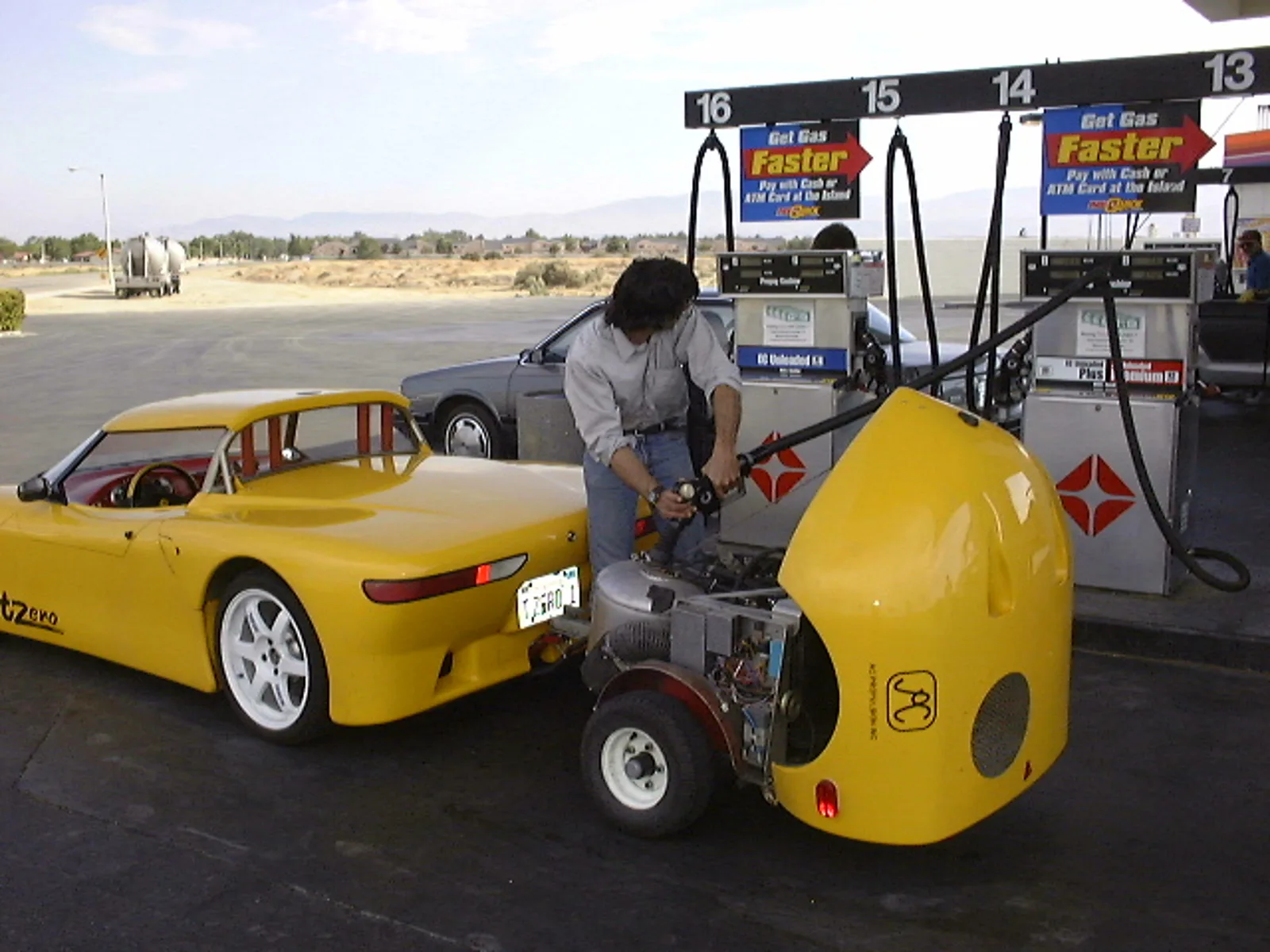
Experimental extenders turned up in research and competition from the 1990s, including generator trailers towed behind purpose-built electric cars such as the AC Propulsion tzero. The first mass-produced EREV in a major market was the Chevrolet Volt. General Motors launched it in the United States on 30 November 2010 with retail deliveries in December 2010. Its sibling, the Opel and Vauxhall Ampera, reached Europe between late 2011 and early 2012.
The first Volt ran as an electric car for the opening 40 to 80 km (25 to 50 miles), and then a 1.4-litre four-cylinder engine started generating power to hold the battery at a minimum level. Drivers who charged regularly typically covered more than 1,560 km (970 miles) between fuel stops. General Motors ended production in February 2019. It cited yearly sales under 21,000, a loss on each car, a shift in buyer taste from sedans to SUVs and crossovers, the lapse of the federal tax credit, and a decision to put its money into battery electric and autonomous vehicles.
The BMW i3 REx arrived in 2014 with a 647 cc two-cylinder petrol engine borrowed from the C650 GT scooter, and a 9-litre fuel tank, limited electronically to 7 litres in the United States. It woke up when the battery fell to 6 percent. BMW designed it purely as a backup for reaching a charger, and by 2016 fewer than 5 percent of i3s were using the option regularly. It was also the first car to win California's BEVx certification.
Why are range extenders making a comeback?
Outside China the architecture found limited commercial traction, and both the Volt and the i3 REx were gone by the early 2020s. China took a different path. Mass-market volumes arrived around 2019, with Li Auto, Leapmotor and AITO (Seres Auto) leading the way. Li Auto's first car, the Li One, appeared in March 2019 with a 1.2-litre turbocharged petrol engine used only to recharge the battery. Deliveries began in the fourth quarter of 2019 and reached 10,000 by May 2020. EREV sales in China hit 1.18 million in 2024.
From 2024, as consumer resistance to battery electric vehicles grew, manufacturers in Western markets began to look again at range extension as a stopgap. Stellantis, Scout Motors, Hyundai and Ford have each announced EREVs due between 2026 and 2029. Those are plans, not products on sale.
Chinese rules have also pushed the market. From 2026 plug-in hybrids and EREVs must offer at least 100 km (62 miles) of electric-only range to keep their purchase tax exemption, up from 43 km (27 miles). Analysts estimated that around 40 percent of the plug-in hybrids sold in 2025 sat under that line, while EREVs and premium PHEVs were unaffected. A new energy consumption standard, GB 36980.1-2025, took effect on 1 January 2026 and also requires 100 km of electric range. Cities have gone their own way too. From 1 January 2023 Shanghai no longer gives PHEV and EREV buyers a free plate, and Beijing places them in a lower sub-series than pure battery cars.
What does the Mazda MX-30 R-EV tell us about range extenders?
The MX-30 is the first electric car Mazda has built in volume, made from 19 May 2020 at the Ujina factory. The all-electric version carries a 35.5 kWh battery, makes 105 kW (141 hp; 143 PS) and is rated at 209 km (130 miles). That is a small battery, and Consumer Reports called its EPA-estimated range a scant 100 miles, competitive a decade ago but not in the current market. A range extender is one way of making a small battery less of a worry.
Mazda's answer, presented on 14 January 2023, was a plug-in variant in which a rotary engine recharges the battery and never drives the wheels. The Wankel is naturally aspirated and single-rotor, with an 830 cc chamber volume, direct petrol injection, exhaust recirculation, a three-way catalytic converter and a particulate filter, and it is rated at 55 kW (75 PS; 74 hp). The choice makes engineering sense. A rotary engine has high power for its weight and size, and it is most efficient at constant speed, which is exactly the job a generator gives it. In an ordinary drivetrain, changing speed demands cut that efficiency. Mazda has also researched hydrogen-fuelled rotary range extenders.
The car has had a patchy commercial life. Japan received the rotary plug-in in November 2023 as the Rotary Plug-in Hybrid, with an Edition R special. In the United States the electric MX-30 was sold from August 2021 in California only, and Mazda discontinued it in July 2023 after fewer than 600 sales. Canada's run ended with the 2024 model year. Australian showrooms received the MX-30 in April 2021 in Evolve, Touring and Astina trims, with a mild hybrid and a battery electric version, and was discontinued in early 2024. As of 2025 Europe had only two EREVs on sale: Mazda's rotary MX-30 and the Leapmotor C10, badged REEV Ultra Hybrid.
What other kinds of range extender exist?
Piston engines are the first of three broad generations. The second brings engines designed for steady generator duty, including Wankels and free-piston designs. The third covers microturbines and fuel cells, which promise higher efficiency and lower emissions than piston engines but at greater cost and complexity.
The free-piston linear generator drops the crankshaft entirely. A piston oscillates between chambers and drives a linear alternator directly, which removes friction losses and lets the device burn fuels including hydrogen and biofuels. In laboratory conditions it has shown higher efficiency and less noise and vibration than a conventional engine, though by 2025 none had reached production.
Microturbines run on gas, biogas or hydrogen. One estimate puts a 35 kW unit at roughly 50 percent lighter and 40 percent smaller than a piston engine of equal output, with thermal efficiency of 30 to 35 percent. Delta Motorsport, working with Cosworth, and Wrightspeed have built automotive versions, and the technology has been shown in commercial trucks, but none had reached volume passenger-car production by 2025.
Fuel cells turn hydrogen directly into electricity with no combustion. The fuel-cell version of the Mercedes-Benz eCitaro bus uses a 60 kW Toyota unit to recharge its battery and reaches about 400 km (250 miles), against 280 km (170 miles) for the battery-only bus. In passenger cars the barriers are thin hydrogen refuelling networks, expensive fuel cell stacks and the difficulty of storing hydrogen on board.
What stands in the way?
Regulators are the first obstacle. The line between a PHEV and an EREV rests on how the drivetrain is laid out, not on anything measured in a standard test, so most frameworks have no separate category for EREVs. The US Environmental Protection Agency treats them as PHEVs for fuel economy labels and emissions reporting. In the European Union they are tested and certified as plug-in hybrids under the WLTP framework, whether or not the engine ever drives the wheels. The European Parliament Research Service does define an EREV as a car in which the auxiliary engine only supplements battery charging, but that definition has not been written into binding type-approval law.
Europe's CO2 rules weigh plug-in hybrids and EREVs with a utility factor, a statistical estimate of how much of the average driver's distance is covered on electricity. After evidence that official PHEV CO2 figures were well below real-world emissions, Regulation (EU) 2023/443 changed the factors applied at approval from September 2023, and more changes are slated for 2025 and 2027. The Euro 7 framework, which takes effect in 2026, also creates no separate class for range extenders.
California is the exception. In 2012 its Air Resources Board created the BEVx class, which treats these cars as a subcategory of battery electric vehicles. To qualify, a car needs an all-electric range rating of 120 km (75 miles) or more, above the 80 km (50 miles) demanded of a zero-emission vehicle, and the generator's added range cannot exceed the battery's. The generator must not start until the battery is depleted, and the car must meet super ultra low emission vehicle requirements and zero evaporative emission rules. In return BEVx cars earn compliance credits closer to those of a pure battery car than of a PHEV.
What does this mean for someone buying or driving one?
The i3 REx story is instructive. BMW treated the engine as insurance, and most owners rarely touched it. The Volt tells a similar story from the other direction: owners who plugged in regularly went a very long way between fuel stops, which is the whole point of the layout. The daily commute is electric, and the engine is there for the odd long journey.
A badge can mislead. A car that looks like an EREV but has no plug, such as an e-Power model, is a hybrid, and incentives and registration perks that depend on plug-in status may not apply. Local rules also matter: in China a car's electric range now decides tax treatment, and in Shanghai the type of drivetrain decides whether a buyer gets a free plate.
Where this goes next
Based on announcements, the next wave arrives between 2026 and 2029, when Stellantis, Scout Motors, Hyundai and Ford have said they will launch EREV models. Ford has also patented a petrol generator mounted in the bed of its electric trucks. In Europe, further revisions to the utility factors are planned in 2025 and 2027. In China, tougher range and consumption rules are already in force from 2026.
On the technology side, the second and third generations are still largely demonstrations. Free-piston and microturbine range extenders have not entered volume passenger-car production as of 2025, and Mazda continues to research hydrogen-fuelled rotary extenders. The petrol rotary in the MX-30 R-EV remains the most prominent second-generation engine on sale.