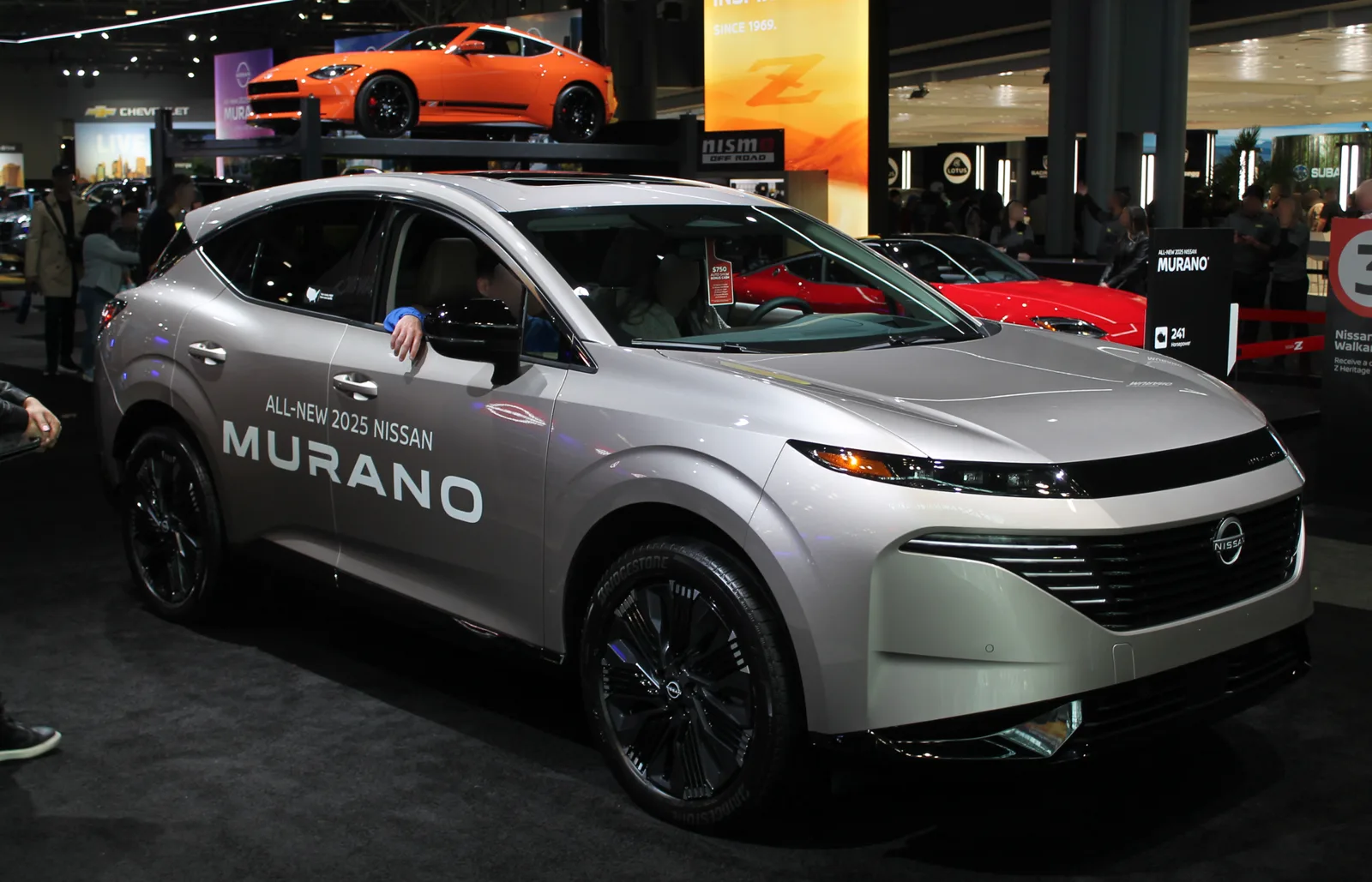
Nissan's first crossover for North America, built since 2002, with a CrossCabriolet, a hybrid and a 2025 turbo four that replaced the long-running V6.
The Nissan Murano is a mid-size crossover SUV that Nissan has built since May 2002. It was the company's first crossover for the United States and Canada, and the fourth generation, revealed in October 2024, moved to a 2.0-litre turbocharged engine with a nine-speed automatic.
Nissan built the Murano for American buyers, designing it in La Jolla, California, on the FF-L platform that the third-generation Altima also used. Its name comes from the Italian island of Murano, famous for its glass.
Where did the Murano name and design come from?
The Murano name derives from the Italian islands of Murano and the art glass for which they are known. Nissan's first crossover for the US and Canada was designed at Nissan America in La Jolla, California, and it was unveiled at the 2002 New York International Auto Show as a 2003 model.
Production began in mid-May 2002, and the first cars shipped to the United States in early June and to Canada in mid-July. European sales began in 2004 after a showing at the Geneva Motor Show.
Until the Rogue arrived in September 2007, the Murano was Nissan's only crossover SUV in the United States. In Canada the X-Trail had been on sale as a second car-based SUV since 2004.
Nissan's first crossover for North America, named after glass and reborn in 2025 as a turbocharged, all-wheel-drive family SUV.
How did the first-generation Murano perform?
The first generation used a 3.5-litre VQ35DE V6 producing 183 kW (245 hp) and 334 N.m (246 lb ft). The engine was tuned for the Murano and paired with a continuously variable transmission, one of the largest CVT applications on sale.
Independent suspension was fitted on all four wheels, and the car used disc brakes with ABS, electronic brakeforce distribution and brake assist. In the US rating, city use was 13 L/100 km (22 mpg-imp, 18 mpg-US), and highway use was 10 L/100 km (28 mpg-imp, 23 mpg-US).
Nissan's GT-C concept, developed at its Cranfield technical centre in Britain, gauged interest in a low-volume performance version. A turbocharger lifted output from 172 to 257 kW (234 to 350 PS), and the car reached 0 to 100 km/h in 7 seconds.
How was the second-generation Murano different?
The second generation debuted at the 2007 Los Angeles Auto Show and went on sale in January 2008 as a 2009 model. It was built on the Nissan D platform shared with the Altima and Maxima, and the revised 3.5-litre VQ engine gained 20 hp to reach 265 hp (198 kW).
The S and SL were front-wheel drive with optional iAWD, while the LE was all-wheel drive only. The SE model was dropped, and the car arrived with rain-sensing wipers, a power liftgate and iPod integration.
Japan received the second generation on 29 September 2008, targeted mainly at men in their thirties, forties and fifties. Nissan planned to sell the vehicle in 170 countries.
In 2010 Europe received a facelift with the 2.5 dCi diesel, rated at 190 PS (140 kW) and 450 N.m (332 lb ft). Torque peaked at 2000 rpm, which suited the car's relaxed character.
What was the Murano CrossCabriolet?
The CrossCabriolet was a convertible version of the second-generation Murano, shown at the 2010 Los Angeles Auto Show and sold from the 2011 model year. It came only in LE trim, used the standard engine and was discontinued after the 2014 model year.
The fully automatic cloth top is hydraulic and has a power latch system, a rear glass skylight and dual pop-up roll bars. Cargo space was 220 L (7.6 cu ft) with the top down and 350 L (12.3 cu ft) with it up, and the front doors were 200 mm (7.9 in) longer than those of the four-door car.
Nissan marketed the CrossCabriolet as the first all-wheel drive crossover convertible in the world. Its drag coefficient was 0.39.
What changed in the third and fourth generations?
The third generation was unveiled in April 2014 in New York, built in Canton, Mississippi, with a VQ-Series V6 producing up to 260 hp (194 kW). The fourth generation, revealed in October 2024, uses a 2.0-litre turbocharged engine with variable compression and a nine-speed automatic.
The third generation also gained a hybrid in 2016, with a 2.5-litre four-cylinder, an electric motor, an Intelligent Dual Clutch System and a lithium-ion battery under the centre console. Production moved from Canton to the Smyrna plant in Tennessee in 2020.
The Murano returned to Mexico in 2018 as a 2019 model, after an absence of about a decade. Those Mexican cars were offered only in the Advance and Exclusive trims and with a V6 engine.
What did the fourth-generation Murano bring?
The fourth generation resembles the Ariya electric crossover and adds ventilated and massaging front seats, dual 12.3-inch displays, wireless Apple CarPlay and Android Auto, and ProPilot Assist 1.0 and 1.1. Trims are SV, SL and Platinum, with the SV available in front-wheel or all-wheel drive.
The front-wheel drive version was discontinued for 2026, so every Murano now has all-wheel drive. The Murano was reintroduced in Japan on 3 June 2026, imported from the US as a left-hand drive SV with standard AWD.
The 2.0-litre engine is shared with the Altima and the Infiniti QX50, and the Murano is the first Nissan model to pair it with a nine-speed automatic.
How safe is the Murano?
The first generation earned five NHTSA stars in every category except rollover, which earned four. The second generation dropped to four stars for frontal impacts and five for side impacts, which was weaker than the first. IIHS gave Top Safety Pick+ to the 2015 and 2025 model years.
Latin NCAP tested the US-built Murano in 2016 and 2017. The 2016 test gave 2 stars for adults and 4 for toddlers, and the 2017 update reached 5 stars for adults and 3 for toddlers. Nissan's Safety Shield 360 package became standard on all trims from 2021.
Which markets sold the Murano, and how did it change?
The second generation was sold in Indonesia from September 2011, while the UK withdrawal came in April 2011 after disappointing sales. In China the car was built by Dongfeng Nissan with a 2.5-litre engine, and Russia offered five trim lines. Mexico brought the third generation back in 2018.
The Murano was not marketed in Japan, Australia or New Zealand for the third generation, because the car was not produced in right-hand drive. The nameplate was dropped in those regions due to sluggish sales, and the more compact X-Trail took its place.
What are the Murano specifications?
| Specification | Detail |
|---|---|
| Type | Mid-size crossover SUV |
| Launch | Production from May 2002; 2003 model year |
| First generation engine | 3.5 L VQ35DE V6, 183 kW (245 hp), 334 N.m (246 lb ft) |
| First generation fuel use (US) | 13 L/100 km (22 mpg-imp, 18 mpg-US) city; 10 L/100 km (28 mpg-imp, 23 mpg-US) highway |
| Second generation engine | 3.5 L VQ, 265 hp (198 kW), 336 N.m (248 lb ft) |
| Second generation diesel (Europe) | 2.5 dCi, 190 PS (140 kW), 450 N.m (332 lb ft) |
| CrossCabriolet cargo | 220 L (7.6 cu ft) top down; 350 L (12.3 cu ft) top up |
| Third generation engine | 3.5 L VQ-Series V6, up to 260 hp (194 kW) |
| Hybrid (2016) | 2.5 L four-cylinder with electric motor |
| Fourth generation engine | 2.0 L turbocharged KR20DDET, nine-speed automatic |
| Fourth generation revealed | 16 October 2024 |
_NYC_Auto_Show.png)