A compact crossover built since 2000 that shared Renault-Nissan platforms, became the Rogue in North America and reached a fifth generation in 2026.
Built since 2000 as a compact crossover, the X-Trail succeeded the Rasheen and Terrano II. Generation three became a Rogue twin in North America, and generation four brought an e-Power hybrid with a 560 L boot.
The Nissan X-Trail is a compact crossover that Nissan has built since 2000, when it replaced the Rasheen and the Terrano II. It has sat between the Qashqai and the larger Murano since 2018, and from the third generation it became the same vehicle as the Rogue sold in North America.
What did the first X-Trail set out to do?
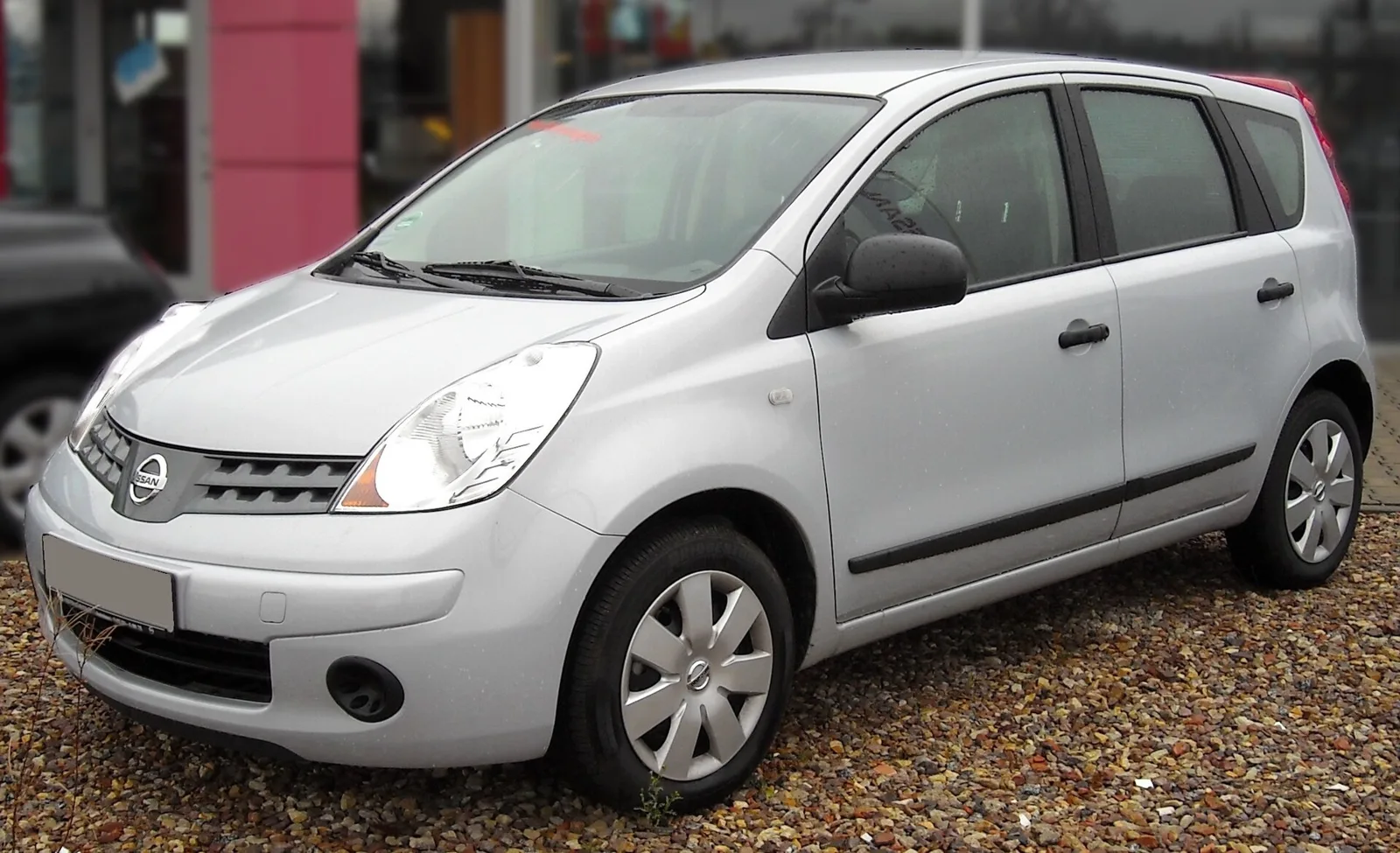
The T30 was unveiled at the September 2000 Paris Motor Show and entered production in October that year. It rode on the Nissan MS/M&S/FF-S platform, which it shared with the Almera and the Primera, and Japanese sales began in November 2000.
The T30 reached the United Kingdom and Australia in October 2001. The 2003 facelift changed the grille, bumpers and Nissan badge, and it upgraded the 2.2-litre turbo-diesels to a variable turbocharger version producing 136 PS (100 kW) instead of 114 PS (84 kW).
A compact crossover that began as a Paris Motor Show debut in 2000 and became the Rogue across the Pacific.
How did the T30 sell in Japan?
In Japan the X-Trail was offered with the QR20DE petrol engine, which produced 140 PS (103 kW), and the SR20VET turbocharged petrol, which produced 280 PS (206 kW).
The special X-Trail GT arrived in February 2001 as an all-wheel-drive model with the SR20VET. It was the first SR20 Nissan made with VVL variable valve lift paired to a turbo, and it was offered only in Japan under the model code PNT30.
The St and Xt grades followed on 1 October 2001, with Stt and Xtt added in October 2002. The facelifted Japanese car was released on 9 June 2003.
How did T30 trim lines differ by market?
In the United Kingdom the first-generation car came in S, Sport and SE+ trims until 2004, with a Fat Face special edition in 2005 that Nissan built for the retailer's anniversary. By 2006 the line-up had been trimmed to SE, Columbia and the top-grade Aventura, which had heated and electrically operated front seats.
Australian buyers could choose the ST, the mid-spec ST-S, the high-spec Ti and the luxury Ti-L, along with limited editions such as the ST-X, ST-R and a 40th anniversary ST-S. The Ti-L added leather, electric seats and an optional DVD player.
Taiwan's Yulon-Nissan launched the X-Trail in 2003 with a different front end for local tastes, and it kept the car in production until 2008.
Did the X-Trail ever run on hydrogen?
Nissan leased a hydrogen fuel cell version, the X-Trail FCV, to business customers. The car first appeared at the 60th Frankfurt Motor Show in September 2003 and was then displayed at the 37th Tokyo Motor Show the following month.
The fuel cell car remained a limited lease programme for business customers rather than a mass-market offer. It showed how Nissan approached alternative drivetrains long before the later e-Power hybrids.
How did the X-Trail reach the Philippines, Canada and Mexico?
Nissan Philippines launched the X-Trail in 2003 with a single trim called the 200X, which used a 2.0-litre QR20DE and a four-speed automatic. A 250X followed in 2004 with a 2.5-litre QR25DE and redesigned 16-inch rims.
In 2007 a Tokyo Edition 250X arrived with the 2.0-litre QR20DE, CVTC, a new interior and grille, leather seats and automatic climate control. The T30 remained on sale with the 2.0-litre engine until 2014, alongside the T31 that used the 2.5-litre.
The X-Trail was never sold in the United States, but Canada got it for the 2005 and 2006 model years and Mexico from 2003. In 2006 a Canadian commercial for the Bonavista Edition drew complaints from the town's mayor, and the advert was later parodied by a local dealer in St. John's.
What changed with the second-generation T31?
The T31 made its public debut at the Geneva Motor Show in March 2007. It went on sale in Japan in August 2007, in Europe in the third quarter of that year and in Australia and Mexico towards the end of the year.
Based on the Renault-Nissan C platform, the T31 was slightly larger than its predecessor. It was not sold in the United States or Canada, where the Rogue took its place.
At launch in Japan the T31 came in just two trims, the entry-level S and the top-of-the-line X. Its two petrol engines were the only choice until the diesel arrived later in the model's life.
What engines did the T31 offer?
Japanese T31s started with a 2.5-litre petrol and a 2.0-litre petrol, with a CVT and a six-speed manual for the 2.5. The GT's SR20VET was dropped because of Japan's 2005 emissions rules, and in September 2008 the 20GT arrived with a 2.0-litre turbocharged diesel.
The 2.0-litre M9R diesel, developed with Renault, was the first diesel X-Trail sold in Japan. It came in two outputs: 150 PS (110 kW; 148 hp) and 177 PS (130 kW; 175 hp).
The T31 reached Malaysia in 2010, where it was fully imported from Indonesia with the MR20DE engine and a CVT. A facelift arrived in Japan in July 2010, and a limited run of 200 Platinum models reached the UK in January 2012.
How did the T32 change the X-Trail?
The third-generation X-Trail was unveiled at the 2013 Frankfurt Motor Show. Built on the new CMF-CD platform shared with the Qashqai and Renault Koleos, it became the common successor for the second X-Trail and the Rogue sold in North America.
Nissan said the car would be available in 190 countries. It ditched the boxy look of its predecessor for an urban crossover shape, and Nissan drew the styling from the Hi-Cross concept.
Weight was cut where possible, and the tailgate was largely plastic, saving 7 kg. Carefully shaped door mirrors and a spoiler covering the exhaust box and rear panel completed the aerodynamic work.
When did the T32 go on sale in Asia and Europe?
Japanese sales began on 11 December 2013, with the MR20DD engine and either two or three rows of seats. Chinese models followed at the end of March 2014, and Thailand received cars in November 2014 after manufacturing began in Samut Prakan.
In Japan the T32 was offered as the 20S, 20X, 20X Emergency Brake Package and 20X X-TREMER X. In April 2015 Nissan said a hybrid claiming 4.9 L/100 km was coming to Japan.
The Philippines launched the T32 on 19 September 2014 in two variants, and Indonesia started building it at Purwakarta on 12 September 2014. Malaysia took the car in January 2015 in 2.0-litre 2WD and 2.5-litre 4WD forms.
Malaysia's facelifted car reached showrooms in April 2019 in four CVT variants: two 2.0-litre 2WD models, a 2.5-litre 4WD and a 2.0-litre hybrid. Indonesia's facelift, launched on 18 July 2019, was sold only in VL trim with a 2.5-litre petrol CVT.
Australia received the third generation in March 2014, while European models arrived in July 2014 with the Renault-sourced 1.6 dCi R9M diesel as their only engine.
Australian T32 models came in ST, ST-L and Ti trims. The base ST was a 2.0-litre manual, the 2.5-litre cars were CVT models, and third-row seats were available on the ST and ST-L 2.5.
What did the 2017 facelift and hybrid bring?
The facelifted third generation went on sale in October 2016, with restyled headlights, tail lamps and LED daytime running lights. A hybrid version premiered in January 2017 and combined a 2.0-litre petrol engine with an electric motor for a total of 176 hp. The hybrid was offered in two trims, SV and SL, while the others kept halogen headlamps with LED daytime running lights.
The hybrid used regenerative braking, an energy monitor and a lithium-ion battery under the floor of the cargo area. That battery location meant the hybrid could not be fitted with the third-row seating or the Divide-N-Hide cargo system.
Where was the X-Trail built?
Nissan announced in October 2016 that the next X-Trail would be built at its Sunderland plant, which has been in operation since 1986 and employs around 7,000 people. In February 2019 those plans were cancelled, and production moved to Kyushu, citing concerns about Brexit and falling diesel demand.
Assembly in Indonesia ended in February 2019 and was replaced by an imported car from Japan, while Thailand halted production in September 2020 with no replacement.
What is the fourth-generation T33?
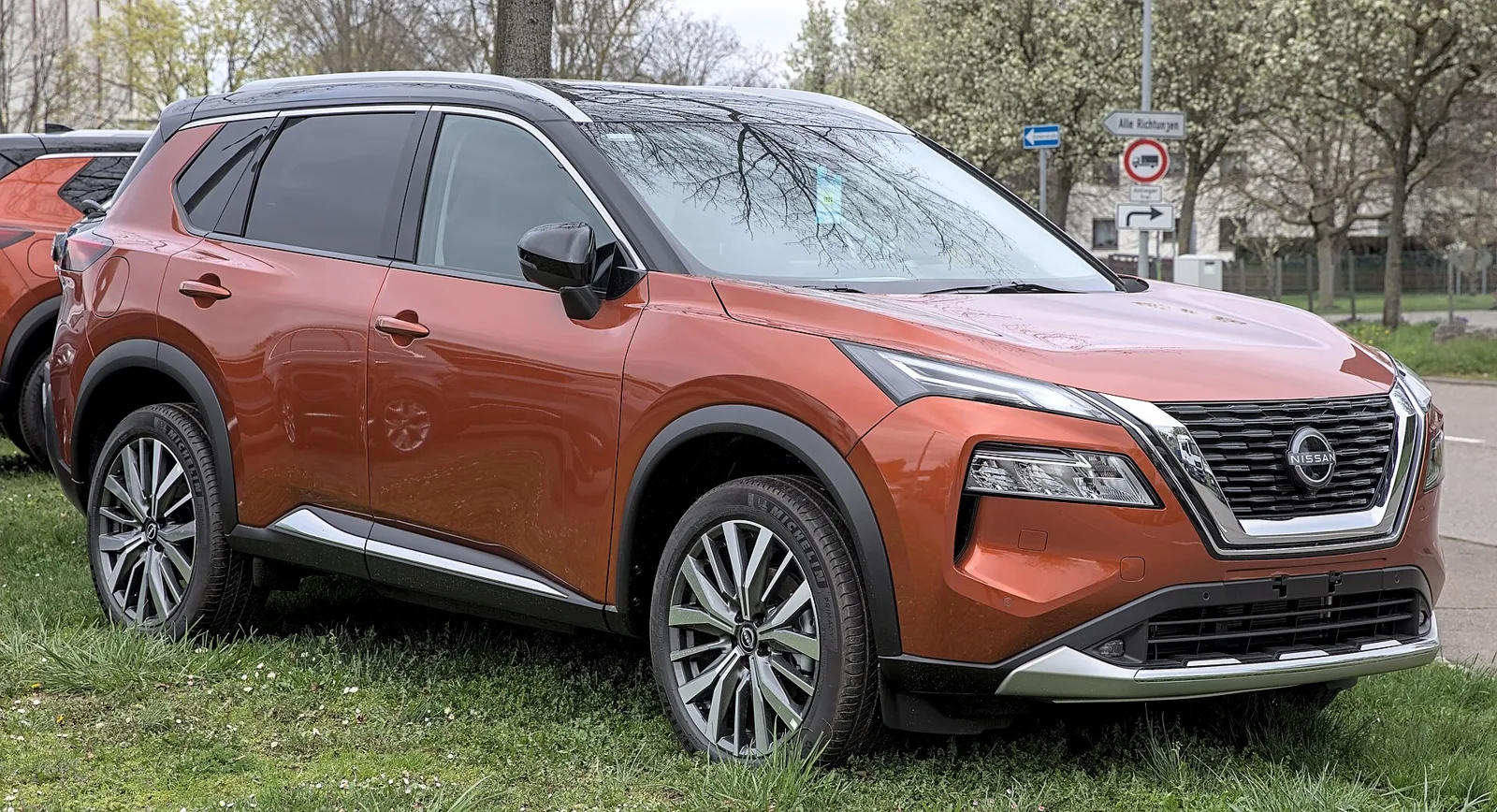
The T33 was unveiled on 19 April 2021 at Auto Shanghai and went on sale the same day. It arrived nearly a year after its Rogue counterpart launched in North America in June 2020.
The T33 is 15 mm (0.6 in) taller, 20 mm (0.8 in) wider and 10 mm (0.4 in) shorter than the T32, while the wheelbase is unchanged. Its boot holds 560 L with the second-row seats in place, which is 5 L less than before.
The e-Power model pairs a variable compression ratio 1.5-litre VC-Turbo three-cylinder petrol engine with a second-generation e-Power series hybrid system. No diesel was offered in this generation.
Where is the T33 sold?
In Japan the T33 launched on 20 July 2022 with e-Power only, in S, X and G trims, with optional e-4ORCE electric four-wheel drive and three rows of seats on the X 4WD. Thailand followed on 28 November 2025 with a single e-4ORCE hybrid variant.
Europe received the car in September 2022 with a 1.5-litre mild hybrid turbocharged petrol and a dual-motor e-Power option. Australia introduced it in May 2022 with a 2.5-litre petrol engine, and the e-4ORCE hybrid for the Ti and Ti-L followed in early 2023.
India showed the car on 17 July 2024 and launched it on 1 August 2024 in a single trim with a 1.5-litre mild hybrid petrol. Taiwan, Singapore, Indonesia, Laos and the Philippines each followed with their own launches between 2023 and 2026.
What facelifts followed the T33?
The facelifted X-Trail launched in several markets through 2026, after its facelift went on sale on 21 August 2025. The Nismo and Rock Creek variants were added at that point.
Australia received the updated car on 17 February 2026, Mexico on 3 June 2026 as a 2027 model, Taiwan on 7 July 2026 and South Africa on 22 July 2026, with trim levels and powertrains largely unchanged.
Specifications across the generations
| Generation | Model code | Launch | Notable powertrain |
|---|---|---|---|
| First | T30 | September 2000, Paris | QR20DE and QR25DE petrol, SR20VET in the Japanese GT |
| Second | T31 | March 2007, Geneva | 2.5 and 2.0 petrol, 2.0 dCi M9R diesel in Japan |
| Third | T32 | 2013, Frankfurt | MR20DD petrol, 2.0-litre hybrid with 176 hp combined |
| Fourth | T33 | 19 April 2021, Shanghai | 1.5-litre VC-Turbo e-Power, 560 L boot |
| Fifth | T34 | 14 April 2026 | Revealed alongside the next Juke |
What is the fifth-generation T34?
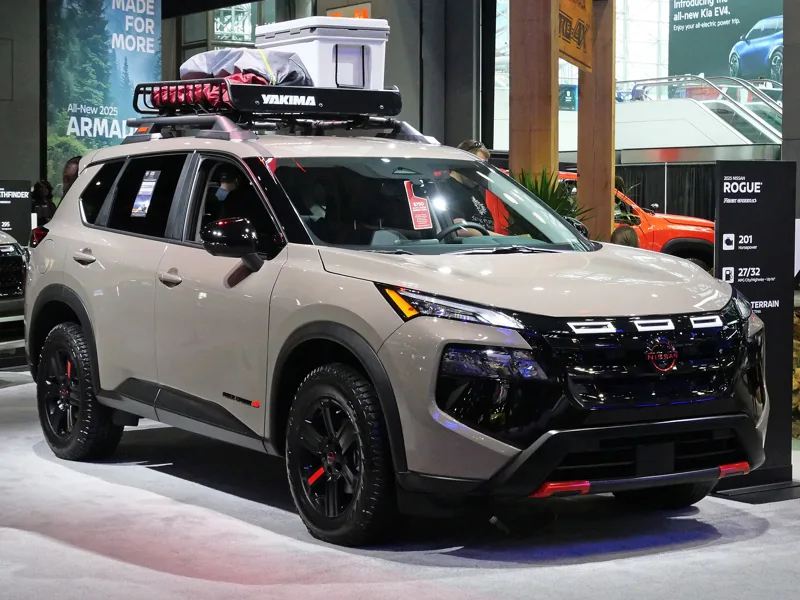
The fifth-generation X-Trail, codenamed T34, was unveiled on 14 April 2026 alongside the next-generation Juke. In North America it is the fourth-generation Rogue, continuing the arrangement that began with the third generation.
The T34 is the next step for a nameplate that began with a Paris Motor Show debut in 2000.