A bold concept-car look, an award-winning design and a converted-fuel experiment could not carry the P12 Primera far in its two main markets.
The third-generation Nissan Primera was a segment D car built from 2001 to 2007 for Japan and Europe. Its bold styling won a design award and its engines ranged from 1.6-litre petrol to a 2.2-litre turbodiesel, but it sold 290 thousand cars and never had a direct successor.
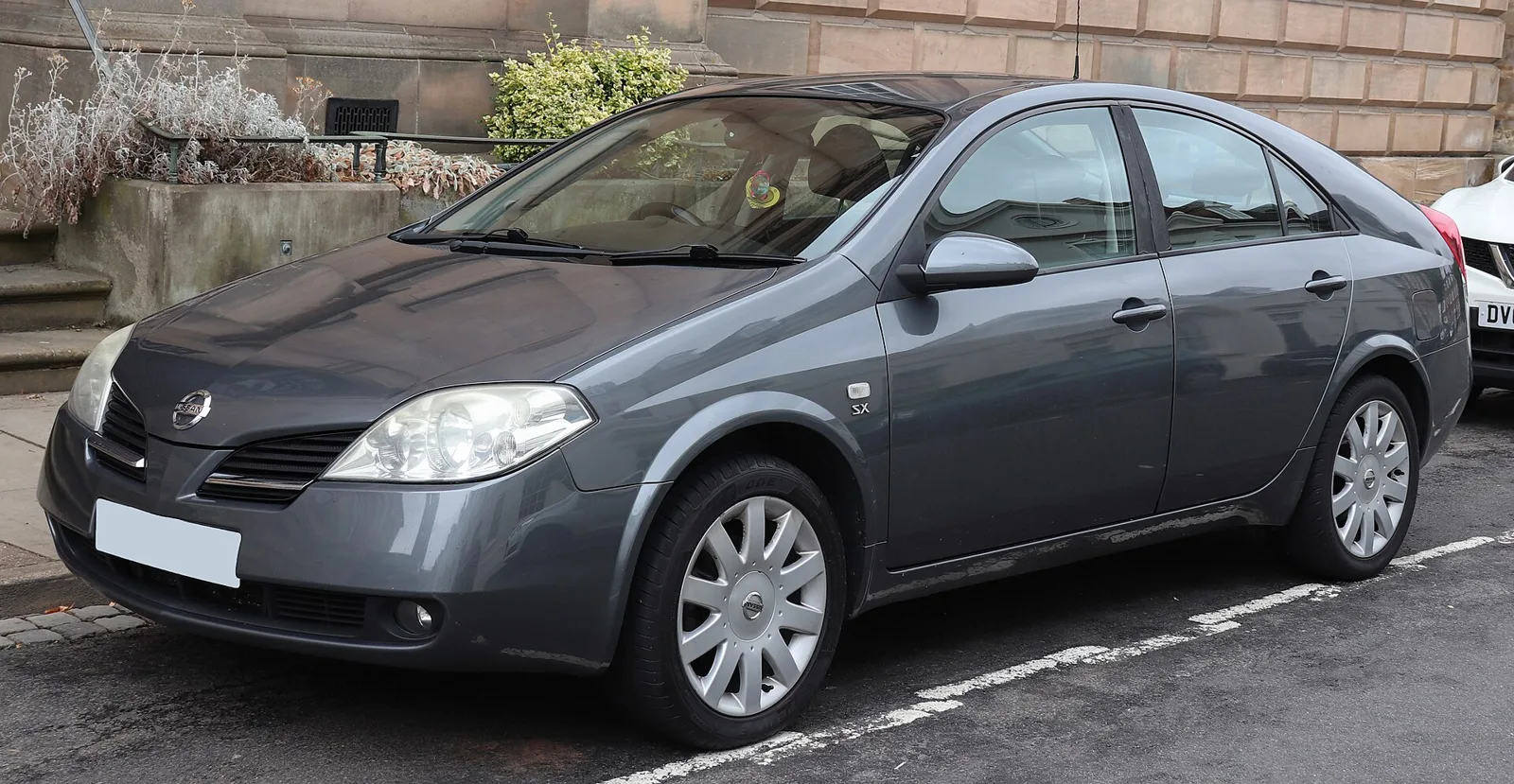
The third-generation Nissan Primera, known in Japan as the Purimera and coded P12, was a segment D family car that Nissan sold in Japan and Europe from 2001. It came as a saloon, a liftback and an estate, and it was built at Sunderland for Europe and in Japan for its home market. Its styling was bold enough to win a design prize, yet it had only average success in its main markets.
Where did the third-generation Primera come from?
Nissan announced the third-generation Primera in December 1999, and it was the first Primera released after the Renault-Nissan alliance was formed, and its design work stayed in Europe, where the Nissan Design Europe studio shaped the car under the direction of Stefan Schwarz.
The concept came first. In September 2000 Nissan showed the Fusion saloon at the Paris Motor Show as a preview of how it wanted its cars to look in the years ahead. The production car followed with more than 600 changes, although its basic platform stayed largely the same.
A car praised for its looks and its cabin still could not hold its place in the two markets it was built for.
What did the Fusion concept look like?
The Fusion was a one-volume saloon whose bodyline ran smoothly from bonnet to cabin, with cameras replacing the mirrors and a panoramic roof running down the car. Its four seats were separate, and the cabin mixed aluminium, Plexiglas and leather with plastic.
The windscreen flowed into a panoramic roof only at its edges, with a metal strip down the centre. The grille was split in two and sat nearer the headlights, with the logo placed between the halves. The door handles sat inside the doors and extended when pressed.
Lighting drew on a fibre-optic system developed by Philips and placed in the centre of the roof. The floor material was named Techno-Tatami, resembling the matting used in traditional Japanese homes.
How did the Japanese launch unfold?
Japan received the Primera and Primera Wagon on 30 January 2001, with Carlos Ghosn presenting them personally. Nissan's plan called for roughly two thousand saloons and three thousand estates each month, but by July 2003 its expectations had fallen sharply.
The launch was the second car under the Program 180 recovery scheme, after the first-generation X-Trail. Sales ran through the Red Stage and Red and Blue Stage dealer chains, and a version for people with disabilities, the Primera Enchante, was developed by Autech, Nissan's subsidiary.
The Enchante adapted the passenger seat so it could swing out, and it was built as both a saloon and an estate. In March 2001 Autech added the Drive Gear controls, a lever on the steering column that is pulled towards the driver for the accelerator and pushed away for the brake. The saloon cost 2,450,000 yen, and the estate 2,550,000 yen.
The IT Driving versions of August 2001 used a two-litre SR20V producing 204 PS (150 kW; 201 hp). They added bigger front brakes, retuned suspension, a mesh grille and aluminium pedals, and they sold for 2,390,000 yen as a saloon and 2,490,000 yen as an estate.
On the same day as the IT Driving models, the Limited trim went on sale, with a two-litre engine and DVD navigation fitted as standard. An all-wheel-drive version now joined the saloon, which had previously been offered with that drive only on the estate. An all-wheel-drive estate cost 2,450,000 yen, and an all-wheel-drive saloon between 2,199,000 and 2,350,000 yen.
The 18C saloon, the cheapest in the range, arrived on 6 February 2002 with a 1.8-litre QG18DE producing 125 PS (92 kW; 123 hp) for 1,848,000 yen. In May 2002 the IT-NAVI package reached two-litre cars, using road information from the navigation unit to adjust engine torque and CVT ratios.
Two-litre models earned the super ultra-low emission rating under the 2010 standards, which let owners claim tax benefits. In 2002 saloons were priced between 1,848,000 yen and 2,650,000 yen, and estates between 2,098,000 yen and 2,750,000 yen.
A larger update came on 8 July 2003. It brought a new grille, bumper, fog lamps, side indicators and 16-inch alloy wheels, plus a grey shade called Twilight Grey. Wood-effect dashboard trim and active head restraints appeared, and the dampers, rear springs and power steering were retuned for steadier high-speed running.
The July 2003 update also brought a price adjustment. The sporty versions shown in August 2001 went out of production, and the 25X and W25X became 150,000 yen cheaper, with a navigation system available as an option. The final spread ran from 1,848,000 yen to 2,430,000 yen for saloons, and 2,098,000 yen to 2,530,000 yen for estates.
Expectations had already dropped by then. The July 2003 plan of 1,500 saloons and as many estates monthly meant falls of a quarter for the saloon and half for the estate, measured against the forecasts of January 2001. Sales lasted three more years before they ended in 2005 because demand was low.
How did the Primera fare in Europe?
Europe and Russia gave the car average success, and the saloon, liftback and estate were all built at Sunderland in the United Kingdom. Nissan aimed to raise its segment D share from 3.7% to 5% and targeted roughly 120 thousand units annually.
Sales in Europe and Russia began in March 2002, and the Sunderland-built cars served both markets.
The car was shown at the Frankfurt Motor Show in September 2001. A few British dealers began selling in February 2002; the official launch of saloon and estate came on 1 March 2002. The launch line-up spanned 1.8 litres, 2.0 litres and 2.2 litres.
A five-door liftback, exclusive to European countries, went on sale on 17 June 2002 at 14,600 pounds. Nissan expected it to account for around 80% of Primera sales in the United Kingdom.
What was the Primera LPG?
The Primera LPG was a converted-fuel version that reached the United Kingdom in December 2002 and the rest of Europe in March 2003. Its engine grew out of the 1.8-litre petrol unit, and it had a range of about 480 miles (772 km). MSD Special Vehicle Engineering converted the petrol cars, and the British launch price was 16,747 pounds.
A modest facelift in August 2004 changed the door panels, seat fabrics and door handles, and it made the front springs 18% stiffer. Post-update prices stretched from 17,990 euros up to 24,080 euros, and the saloon was dropped from the European range. Sunderland production wound down from 2006 onwards.
What was the Primera's design like?
The third-generation Primera was styled for drivers with an active outlook who prize individuality and novelty. It grew taller, wider and longer, and its unusual shape stood out sharply from rivals such as the Opel Vectra, Ford Mondeo and the Volkswagen Passat. The magazine Autorevue called the design a bio-crystal.
The car was also wider and longer than its predecessor. Japan had only the saloon and estate, while Europe also had the five-door liftback.
Nissan's German Red Dot Award in April 2002 was its fourth, after wins in 1993, 1996 and 2001. A jury member praised how the design broke the classic saloon outline by merging bonnet and boot into one smooth line, giving the cabin a generous feel.
Inside, a screen sat on the centre console above a panel of buttons split into audio, navigation and climate sections. Engaging reverse brought up the rear-view camera, and Nissan claimed the Primera was the first car in Europe with one.
The Intelligent Cruise Control system used a front distance sensor linked to the accelerator and brake actuators. It accelerated back to the set speed when the car ahead pulled away, backed off when that car slowed, and braked when needed, with a warning tone for emergencies. A Bird view navigation display showed a pseudo-3D map, and a female voice repeated every command.
Which engines and trims did the Primera offer?
In Europe the car came in three trims, S, SE and SVE, and the engine range covered three petrol engines and one turbodiesel. The two-litre petrol produced the most power, while the 2.2-litre turbodiesel was the only diesel offered.
| Engine | Output | Gearbox options |
|---|---|---|
| 1.6-litre (97.6 cu in) petrol | 6,000 rpm: 109 PS (80 kW; 108 hp) | Five-speed manual |
| 1.8-litre (109.8 cu in) petrol | 5,600 rpm: 116 PS (85 kW; 114 hp) | Five-speed manual; four-speed automatic |
| Two-litre petrol | 5,800 rpm: 140 PS (103 kW; 138 hp) | Six-speed manual; CVT with six fixed ratios |
| 2.2-litre turbodiesel | 4,000 rpm: 126 PS (93 kW; 124 hp) | Six-speed manual |
| Suspension | Front independent, coil-sprung, multi-link | Rear dependent, with trailing links and Scott-Russell mechanism |
The base S trim included electric front windows, climate control and six airbags. The SE added alloy wheels, electric rear windows and a CD radio, and the SVE topped the range with satellite navigation.
Did the Primera have a successor?
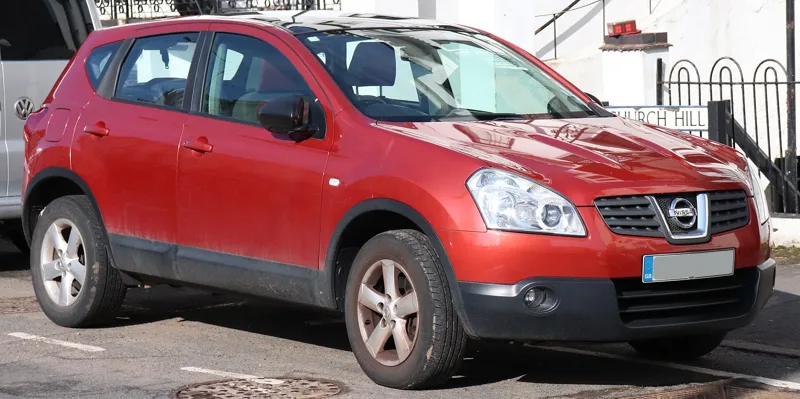
Nothing directly succeeded the third-generation Primera, and no segment D saloon, liftback or estate followed it. Nissan had decided in 2005 that the Qashqai would fill the niche shared by the Primera and the smaller Almera, and it went on sale in Europe and Japan in spring 2007.
Nissan's 2007 marketing analysis showed that Primera and Almera sales were much better in Central and Eastern Europe than in Western Europe. To win more sales in those conservative markets, the Tiida, a C-class car sold elsewhere since 2004, was chosen to succeed the ageing pair, arriving in Europe in the second half of 2007.
How safe was the Primera in crash tests?
Euro NCAP crash-tested the liftback in 2002, and the car gave a fairly high level of occupant protection in a frontal impact. The front passenger, however, faced unstable airbag contact and a risk of knee injury from the dashboard.
The side impact results were better, with the side airbag protecting the driver well, although the curtain airbag did not deploy fully. Rear curtain airbags opened without problems. Pedestrian protection was the weak point, with the bonnet's leading edge doing badly, and the car missed two stars by a few points.
Child protection drew no particular complaints in the tests, and in the side impact the driver dummy showed only raised loads in the abdomen from the armrest.
Why did Primera production in Britain end?
Production at Sunderland gradually wound down from 2006, and by early 2007 the Primera had disappeared from official dealer price lists. The Japanese magazine Web Cartop reported that UK production nevertheless carried on until 2008.
In January 2005 reports said Nissan planned to build the successor at a Renault factory in France. It was to share a platform with the third-generation Renault Laguna, a shared-platform saving that would have cut development costs sharply. No successor to the model ever appeared.
Across its life the third-generation Primera sold 290 thousand cars. Its exterior and cabin won praise, while its suspension on uneven roads drew criticism, and that design, together with the raw chassis, was among the reasons it failed to take hold in Europe.