How a fiberglass-topped Hilux conversion became a Land Cruiser Prado-linked SUV that Toyota has sold worldwide since 1984.
The Toyota 4Runner is a mid-size SUV that Toyota has built since 1984 across six generations, starting as a Hilux-based fiberglass-topped model. Sold mainly in the Americas, it has used V6 and V8 engines and has been built in Japan throughout its life.
The Toyota 4Runner is an SUV that Toyota has sold worldwide since 1984 across six generations. It began as a fiberglass-topped version of the Hilux pickup and grew into a mid-size off-road SUV that shares its underpinnings with the Land Cruiser Prado. Every 4Runner has been built in Japan.
What is the Toyota 4Runner?
Toyota has sold this SUV around the world since 1984, spanning six generations. Japanese buyers knew it as the Hilux Surf, a badge that disappeared in 2009. Today it blends compact and mid-size traits, and it is assembled in Tahara, Aichi, and at a Hino Motors plant in Hamura.
As of 2021 the model's core territory was the Americas: North and Central America plus parts of South America. Europe, Asia and the Middle East got the Land Cruiser Prado in its place. In certain countries a cheaper Hilux-based sibling, the Fortuner, filled a similar role.
A pickup with a removable shell that grew into one of Toyota's longest-running SUVs.
Where did the 4Runner name come from?
Robert Nathan, a copywriter at the advertising firm Saatchi & Saatchi, came up with the name during a naming contest for Toyota's upcoming vehicles. It played on the word forerunner. Toyota explained that the 4 described the four-wheel drive system, while Runner referred to the car's ability to run off-road.
That pickup-based beginning still shapes the vehicle. The 4Runner's ancestors were pickup trucks that gained a removable shell and rear seats, and the body-on-frame construction carried through to the most recent generations.
Where did the 4Runner come from before 1984?
Its direct predecessor was the Toyota Trekker, a walk-through conversion of the short-bed Hilux that Winnebago Industries produced between 1981 and 1983. Toyota ended the Trekker in 1984, when its own SUV reached showrooms. Somewhere between 1200 and 1500 examples were sold in the United States.
Toyota had worked with third-party recreational vehicle makers since at least 1973. In one earlier case a Chinook Mobilodge popup camper was fitted to a longbed Toyota truck chassis as a cheaper alternative to larger motorhomes, with a walk-through to the cab. Those conversions were in effect marketing tests for the 4Runner.
The idea for the Trekker came from Jack Safro, who ran a Toyota dealership in Brookfield, Wisconsin. He approached Winnebago about converting the Hilux into a four-passenger vehicle. Most Trekkers sold on the West Coast, and 20 to 30 kits were shipped to Saudi Arabia.
What were the Trekker's specifications?
The Trekker's body was a fiberglass tub with bed sides, topped by a canopy that could not be removed, plus a rear hatch and no tailgate. Winnebago cut away the rear wall and fitted a bench seat in the bed. A folding rear seat, which lay flat to add cargo room, came as part of the kit.
In 1981 the list price was set at US$13,000. Every Trekker carried the SR5 trim designation, whatever its VIN said. Early trucks had vented canopy windows, and 1982 models received non-vented windows for all trim levels. Toyota shipped the trucks as cab and chassis to avoid the 25% customs tax on assembled trucks.
How did the first generation differ from the Hilux?
The first generation, introduced in 1983 as the Hilux Surf and export 4Runner, modified the existing short-bed Hilux rather than building a new vehicle. Engineers cut away the panel behind the front seats, then added back seating, a roll bar and a fiberglass canopy that came off. Under the skin the vehicle was nearly mechanically identical to the Hilux 4x4.
The idea echoed the Ford Bronco and the Chevrolet K5 Blazer, both pickups given removable fiberglass shells and bench seats. All three vehicles also cut out the rear wall behind the front seats, so the changes went well beyond adding a shell to a pickup.
Nearly all changes sat behind the B-pillar, and the rear springs were not upgraded for the extra weight of the seats and roof. Early examples often developed a saggy rear end. In North America the first cars went on sale for the 1984 1/2 model year from May 1984, with black or white fiberglass tops.
What changed in the 1980s 4Runner?
The 1985 model year brought the electronically fuel-injected 2.4-litre 22R-E engine, which lifted output from 96 hp (72 kW) to 116 hp (87 kW). For 1986 the solid front axle gave way to independent Hi-Trac front suspension, and the track grew by three inches. The change improved on-road comfort and stability.
A turbocharged version of the 22R-E, the 22R-TE, arrived in the 1986 model year with 135 hp (101 kW). City-cycle economy was put at 17 mpg-US for the turbo model, though tests recorded 14.5 mpg-US in real-world driving. Most turbocharged 4Runners carried the SR5 package, and the models used automatic transmissions.
In 1988 the 22R-TE was replaced by an optional 3.0-litre V6, the 3VZ-E with 145 hp (108 kW), available with the SR5 package. Many 1984 to 1986 cars had reached the US without rear seats, which let them be classed as trucks and avoid higher duties. Dealers often added seats and belts after import.
What made the second generation different?
The second generation, launched in 1989 as the N120/N130 series, moved from a fiberglass-topped pickup to a full-steel integrated body on the existing frame. From the B-pillars forward it still looked almost identical to the Hilux, and the powertrain was shared with the pickup. It was a fundamental departure from the first generation.
Four-door bodies dominated, although two-door versions were produced from launch until May 1993. The rear end switched to four links, a Panhard rod and coil springs, with a solid axle at the centre. The layout sagged much as the old leaf-sprung arrangement had.
Rivals like the Nissan Pathfinder and Ford Explorer hinged their tailgates upward, glass and all. The second generation kept the retractable-glass tailgate from the first, so the rear window had to retract before the tailgate could be lowered, as on a pickup.
The 1992 model year brought one-piece front bumpers, modular headlamps and a new interior pattern. A wide-body version with extended wheel arch flares arrived at the same time. Side-impact beams were added in the doors for the 1994 and 1995 model years in the United States.
What did the third generation bring?
The third generation arrived in late 1995 as a 1996 model, with an all-new body and chassis developed from 1990 to 1995 under chief engineer Masaaki Ishiko. It shared engines and transmissions with the Tacoma and its chassis with the Land Cruiser Prado. The car kept the rugged off-road character that rivals were giving up for highway comfort.
Compared with the old 2.4-litre, the 2.7-litre 3RZ-FE gained 38 hp (28 kW), reaching 150 hp (112 kW) at 4800 rpm. The 5VZ-FE V6 replaced the 3.0-litre unit and made 183 hp (136 kW), with 217 lb-ft (294 N-m) of torque at 3600 rpm. The 3RZ-FE's torque reached 177 lb-ft (240 N-m) at 4000 rpm.
The body sat on a 2.3 inch (58 mm) longer wheelbase and a track 1 inch (25 mm) wider. Ground clearance dropped by half an inch (13 mm), leaving 8.5 inches (220 mm). Towing with the optional V6 rose from 3,500 lb (1,590 kg) to 5,000 lb (2,270 kg), and airbags for the driver and passenger arrived in the 1996 model year.
How did the fourth generation change the 4Runner?
The fourth generation, the N210 introduced in 2002, was built on the Land Cruiser Prado 120 platform and reached showrooms in October 2002 as a 2003 model. It came with a 4.0-litre V6 making 245 hp (183 kW), and a V8 was offered for the first time. The styling kept the themes of the third generation.
In US trim the 4.7-litre 2UZ-FE V8 delivered 175 kW (235 hp) and 434 N-m (320 lb-ft). For the 2005 model year, VVT-i lifted the figures to 200 kW (268 hp) and 427 N-m (315 lb-ft). Towing reached 3,311 kg (7,300 lb) on rear-drive V8 models.
The chassis used front double wishbone suspension, a body-on-frame design and a solid rear axle. The optional 4WD system ran full-time on V8 cars and part-time on V6 cars, and an X-REAS suspension was standard on the Sport Edition. Sport models also had a non-functional hood scoop, and the early cars wore grey plastic cladding.
How has the fifth generation evolved?
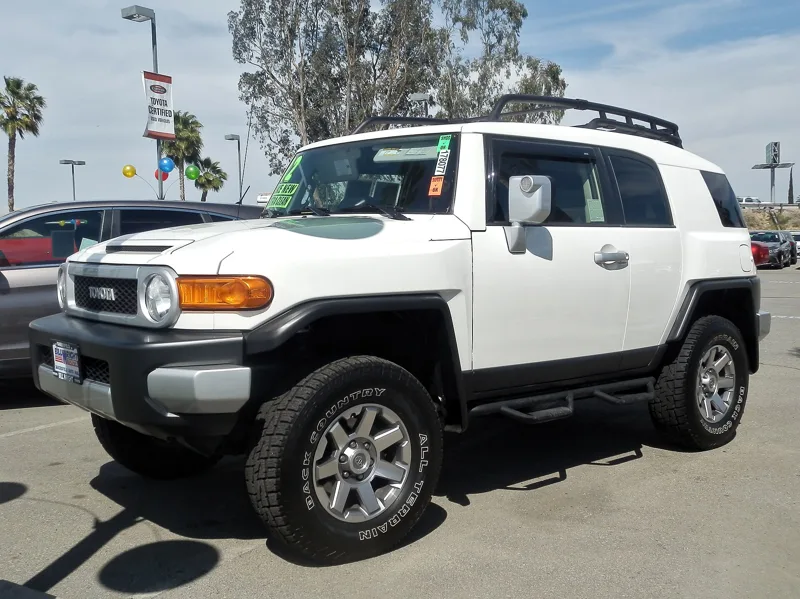
The fifth generation debuted on 24 September 2009 at the State Fair of Texas. It was built on the platform shared with the J150 Land Cruiser Prado, the Lexus GX and the FJ Cruiser, and it was produced only in left-hand drive. It was never sold in right-hand drive markets.
The 4.0-litre V6 with Dual VVT-i was standard across the range, and the 4.7-litre V8 was not carried over. The 2.7-litre four stayed on 2WD models until the 2010 model year ended. The new Trail Edition offered Kinetic Dynamic Suspension and Crawl Control, which had previously been limited to premium Toyota vehicles.
The 2014 model year brought a facelift with projector headlamps, LED tail lamps and an Optitron instrument cluster. The 4.0-litre V6 then made 201 kW (270 bhp), with 377 N-m and 278 ft-lb of torque, mated to a five-speed automatic. The TRD Pro arrived for 2015 with its own colour each model year.
Later changes included the Trail renaming to TRD Off-Road for 2017, the Nightshade package from 2019 and a 40th Anniversary Special Edition limited to 4,040 units. Toyota Safety Sense-P became standard on every trim from the 2020 model year.
What is the sixth generation 4Runner?
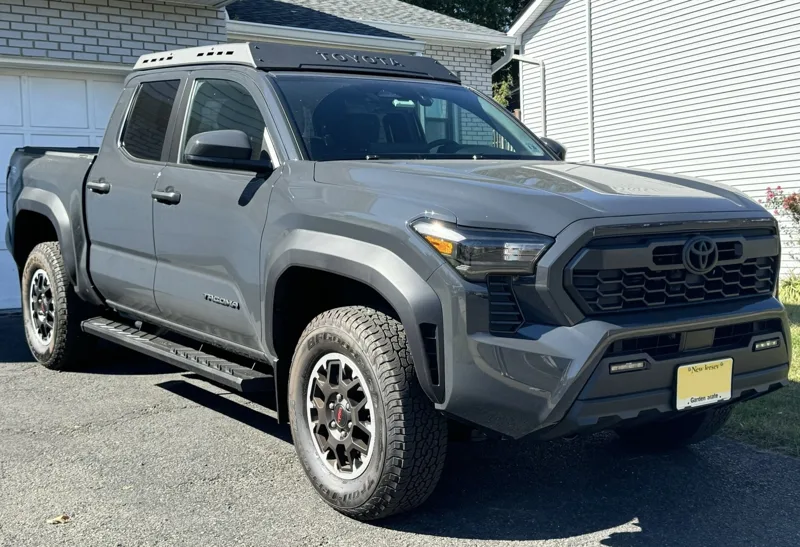
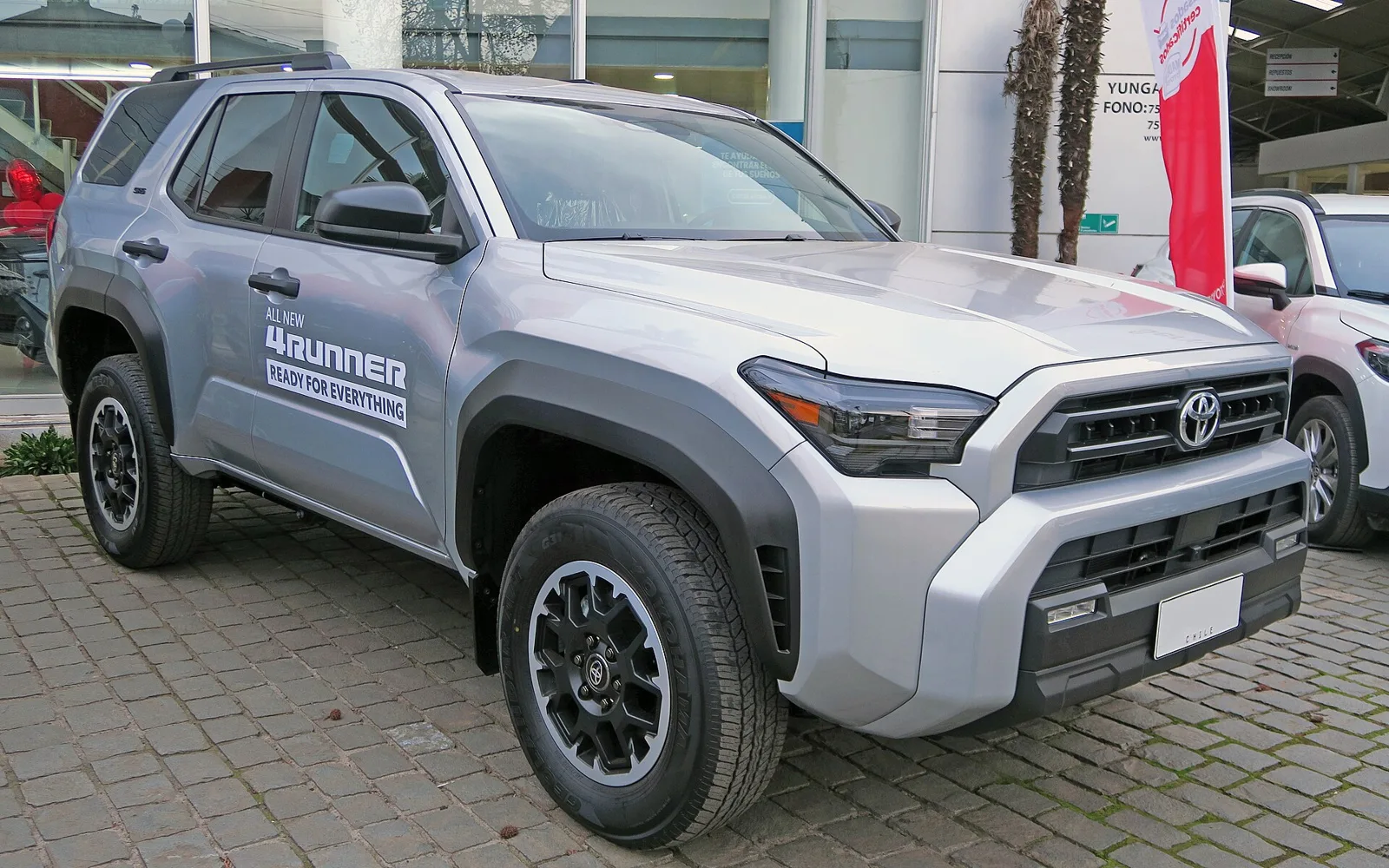
The sixth generation, the N500, was revealed on 9 April 2024 and continues to be built at Toyota's Tahara plant. It uses the body-on-frame GA-F platform shared with the Tacoma, and the hybrid i-Force Max drivetrain is available. Nine trim levels were planned, including the new Trailhunter and Platinum.
Toyota kept the electrically roll-down rear window that earlier generations had. Engineers evaluated each part of the mechanism and cut weight to retain it. The hybrid's high-voltage battery sits beneath the load floor, so the hybrid is not expected to offer the optional third row.
Sales were initially set to start after mid-2024 but were pushed back to December 2024 at the earliest. The delay stemmed from short supply of components that other Toyota models also use. The Trailhunter runs 33-inch off-road tyres and an integrated 20-inch LED light bar.
How safe was the 4Runner?
The first and second generations were both criticised as unsafe SUVs. Early models had doors that offered little side protection, and the second generation scored one to two stars for the driver in a frontal collision. The passenger side fared better, with three to four stars.
The fourth generation earned a Good rating in the IIHS frontal offset test and a Good rating in the side test on cars with side airbags. Rear impact protection was judged Poor. A 2007 study by the same body placed the death rate at 13 per million registered vehicle years for 2003 and 2004 models.
Only three vehicles had lower death rates than the 4Runner in that study: the Chevrolet Astro, the Infiniti G35 and the BMW 7 Series. Every 4Runner came with Toyota's Star Safety System, bundling ABS, brake assist, traction control and stability control.
What are the 4Runner's key specifications?
| Specification | Detail |
|---|---|
| Generations | Six, launched 1984; sixth revealed 9 April 2024 |
| Built at | Tahara, Aichi, and Hino Motors plant in Hamura |
| First generation engine | 2.4 L 22R-E I4, 116 hp (87 kW) from 1985 |
| Turbo option | 22R-TE, 135 hp (101 kW), 1986 model year |
| Third generation engines | 2.7 L 3RZ-FE I4, 150 hp (112 kW); 5VZ-FE V6, 183 hp (136 kW) |
| Fourth generation engines | 4.0 L 1GR-FE V6, 245 hp (183 kW); 4.7 L 2UZ-FE V8, 235 hp (175 kW) in the US |
| Fourth generation towing | 2,268 kg (5,000 lb) on V6; 3,311 kg (7,300 lb) on rear-drive V8 |
| Fourth generation economy | 17 mpg city, 20 mpg highway (V6, estimated) |
| Third generation ground clearance | 8.5 inches (220 mm) |
| Fifth generation engine | 4.0 L V6 with Dual VVT-i, standard on all models |
| Sixth generation drivetrain | i-Force Max hybrid, plus a base i-Force on other trims |
| Sixth generation trims | Nine, including Trailhunter and Platinum |