A V6, a full-time 4x4 option and a run of special editions gave Toyota's retro off-roader a loyal following from 2006 until production ended in 2022.
The Toyota FJ Cruiser was a retro-styled mid-size SUV produced by Toyota from 2006 to 2022. It drew on the FJ40 Land Cruiser for its shape, used a 4.0-litre V6, and offered full-time four-wheel drive and a run of special editions.
Toyota's FJ Cruiser wore its heritage openly, borrowing its look from the FJ40 Land Cruiser that Toyota stopped making in 1984. Built from 2006 until 2022, it carried a V6 engine, a full-time four-wheel drive option and off-road hardware that reviewers praised. The model sold in North America, Japan, Australia and several smaller markets before the final editions arrived.
Where did the FJ Cruiser come from?
The FJ Cruiser was first revealed as a concept in January 2003 at the North American International Auto Show. Toyota approved it for production after a warm public reaction, and the finished car made its debut at the February 2005 Chicago Auto Show. Its production was handled by the Toyota subsidiary Hino Motors at Hamura, Japan.
The idea took shape in the mid-1990s, when product planner Dave Danzer and sales vice-president Yoshi Inaba began pushing for a new FJ with the rugged ability of the FJ40. The car shares many structural parts with the Land Cruiser Prado, although its design story is its own.
The project's internal brief was Rugged Youth Utility, aimed at young male buyers, a group Toyota believed it was losing. Many concepts followed, including the 2001 Rugged Sports Coupe, before a retro exterior by 24-year-old designer Jin Won Kim was picked as the final shape.
A retro shape with real off-road hardware, built from 2006 to 2022 and sold in small numbers beyond North America.
How did the FJ Cruiser get from concept to production?
Development began with a secret test shop at the NUMMI plant, where engineers combined Tacoma underpinnings with Bandeirante bodies to see whether a new FJ40-style vehicle could work. Calty, Toyota's flagship design studio, then delivered the look that reached showrooms, and the project gained high-level support from Akio Toyoda.
The Bandeirante, an FJ40-based vehicle, was still built in Brazil as a diesel-only model at that time, and it was discontinued in 2001. Toyoda moved back to Japan and took a board seat, which gave the project senior backing.
The concept was shown in Detroit in 2003 wearing Voodoo Blue, which later became the production car's signature colour. Critics and buyers embraced the bold styling even though it had to compete with flashier show cars such as the Cadillac Sixteen and the Dodge Tomahawk. Commentators saw the car as a halo model for Toyota, much as the 2005 Mustang had been for Ford.
In mid-2004 Toyota took development mules to some of North America's hardest trails, including Moab in Utah, the Angeles National Forest, the Mojave Desert and the Rubicon Trail. Each mule cost hundreds of thousands of dollars, but the team kept pushing the prototypes. The results shaped the A-TRAC traction control and the suspension tuning in the final car.
When the production car reached Chicago in 2005 its exterior looked almost unchanged. The interior was another matter, because chief production engineer Akio Nishimura trimmed features to keep the price reasonable.
How did the design echo the FJ40?
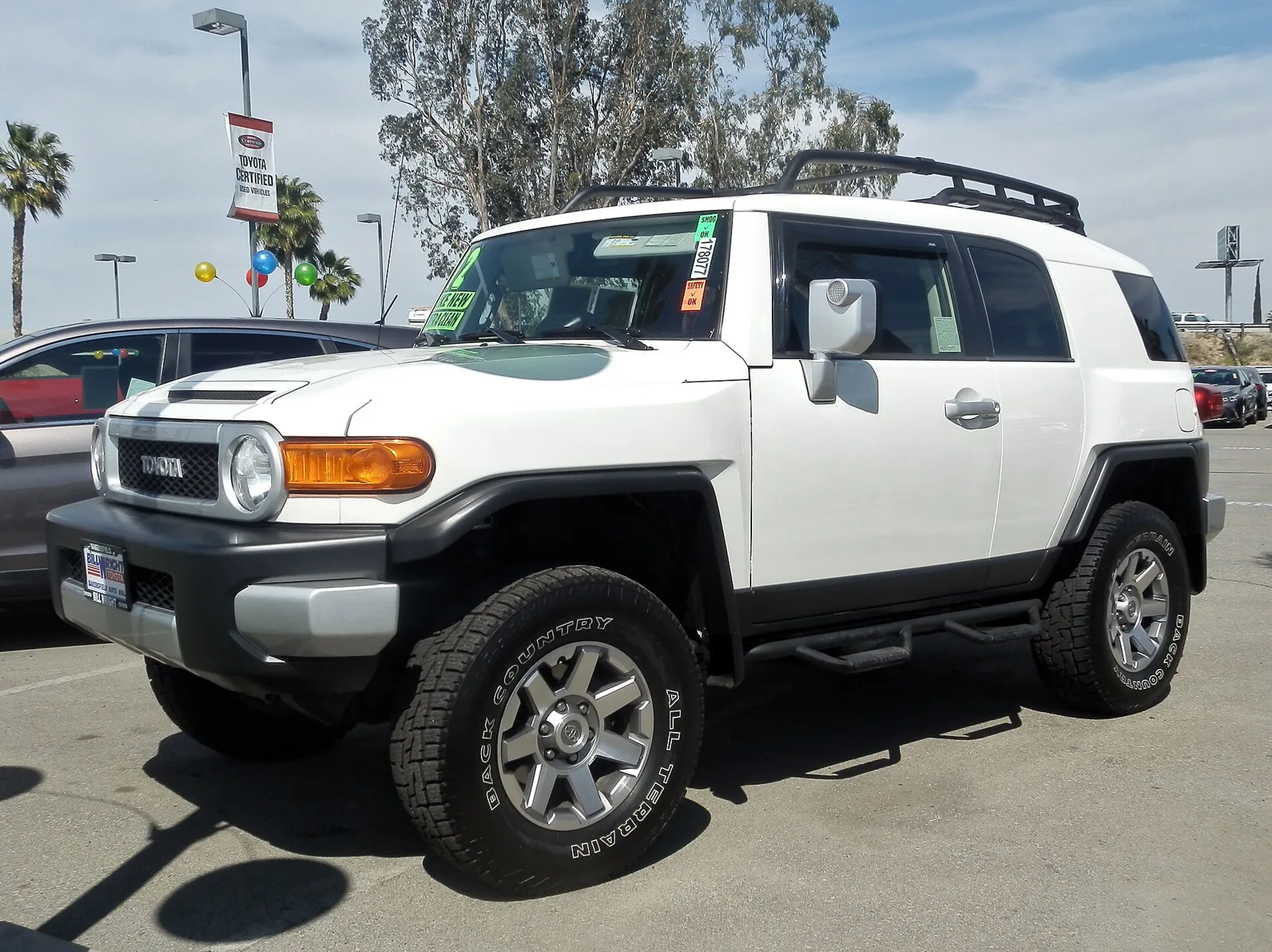
The FJ Cruiser used a short wheelbase, a stocky frame and a grille-and-headlight arrangement much like the original FJ40. Toyota also spelled its name across the grille rather than using the corporate emblem, a nod to older Toyota trucks, and a nearly vertical windshield completed the look.
Three windshield wipers covered the large glass area, and the rear-opening doors gave the body an unusual profile. Toyota used high-strength steel to protect occupants in a side impact without a door pillar.
Inside, the design focused on off-road use. Every surface was covered in washable rubber for quick cleaning after muddy trips, and the controls were oversized so they could be used with gloves. A three-gauge cluster showing compass, temperature and inclinometer readings, plus a 120 V rear outlet, were offered as options.
Several interior ideas from the concept did not survive the cost review. A shifter that doubled as a shovel handle, lights that could be removed and used as flashlights, and flat-folding front seats were dropped, though several concept items returned as factory options.
What engine and drivetrain did the FJ Cruiser use?
The FJ Cruiser used a 4.0-litre 1GR-FE V6. Cars from 2007 to 2009 made 239 hp (178 kW) and 377 Nm (278 lb ft), and the 2011 engine produced 260 hp (194 kW) and 367 Nm (271 lb ft) after Dual VVT-i was added.
Dual VVT-i adjusts timing on both the intake and exhaust camshafts. It arrived for the 2010 model year, giving 259 hp (193 kW) at 5,600 rpm and 366 Nm (270 lb ft). The 2011 engine met LEV II/Tier 2 Bin 5 emissions standards.
Both engine versions run on 87 octane, though Toyota recommended premium for towing, off-road trips and high-altitude driving. The lower grade costs power, so the advice was about performance rather than basic running.
Four-wheel drive versions with the six-speed manual had a full-time system built around a centre TORSEN differential that split torque 40:60 under most conditions. The differential can vary that split by steering angle and wheel slip, and it includes a locking feature.
Rear-wheel drive models were limited to automatic transmissions in the markets that sold them, and they came with a limited-slip rear differential as standard. The five-speed A750E automatic served those cars, while the five-speed A750F paired with a VF2A transfer case for part-time 4x4s. The six-speed RA61F manual went with a VF4B transfer case on full-time models.
The front uses high-mounted double wishbones with a stabiliser bar, and the rear uses a four-link layout with a lateral rod and coil springs. Brakes are four-piston at the front and two-piston at the rear, backed by ABS, EBD, brake assist and stability control.
A-TRAC brakes any wheel that loses grip, giving much of a locking differential's effect with less steering resistance. Some 2007 and early 2008 cars developed bulging and cracking in the inner fender aprons of the engine bay. Toyota linked the problem to a design flaw affecting certain vehicle identification numbers and then changed the design.
How capable was the FJ Cruiser off road?
The 4x4 model had 24 cm (9.6 in) of ground clearance, a 34-degree approach angle, a 30-degree departure angle and a 27.4-degree breakover angle. It could wade 70 cm (27.5 in) deep and tow 2,268 kg (5,000 lb), and the towing rating applied to both 4x4 and 4x2 versions.
Suspension travel was 20 cm (8 in) at the front and 23 cm (9 in) at the rear. On the road the car reached 97 km/h (60 mph) in 7.8 seconds, and testers recorded 0.69 G of lateral grip on stock Bridgestone Dueler tyres.
Reviewers almost universally praised the off-road performance, yet several noted body roll and low lateral grip. Toyota had tuned the suspension soft with long travel for rough terrain, which explains the on-road softness.
The FJ sits on a body-on-frame structure that resembles, without copying, the two-door Prado platform. The 120-series Prado, the Tacoma, the 4Runner and the Hilux share suspension parts with it.
Which special editions did the FJ Cruiser get?
The TRD Special Edition was built in 3,200 units for North America in 2007, with a black diamond pearl body and matching black roof. Trail Teams editions followed from 2008, each with a new monotone colour, and the 2014 Ultimate Edition closed out the US run.
The TRD edition added a TRD cat-back exhaust, Bilstein off-road shocks, rock rails, 16-inch gunmetal grey wheels with BFGoodrich all-terrain tyres and TRD badges. Toyota also synchronised the locking differential with traction control, and it applied that fix to all FJ Cruisers by November 2006.
In 2009 Toyota offered a TRD package on iceberg white cars. It had silver TRD alloys with BFGoodrich all-terrain tyres and TRD graphics, but fewer features than the Special Edition, and it was limited to two-wheel drive models in 2008 and 2009. A total of 2,400 units were built that year.
Trail Teams editions numbered 3,200 units for 2008, then 1,500 for 2010 and 2,500 a year from 2011 to 2014. No Trail Teams models were made in 2009, when the TRD package took their place. Each year's car wore one solid colour, with blacked-out trim including the mirrors, door handles and bumper caps.
Toyota announced on 5 November 2013 that 2014 would be the last US model year, so the final Trail Teams car became the Ultimate Edition. It came in Heritage Blue, a shade that echoed the paint of the original FJ40, with a white grille bezel and black remaining trim.
The Ultimate Edition used a rear remote reservoir suspension that lifted the stance slightly, plus a 1/4-inch aluminium TRD skid plate to protect the front. Inside, the panels were black, the radio bezel silver, and a dash plaque read One of 2500.
What was the FJ Crawler?
The FJ Crawler was a dealer-fitted package first offered in 2007 for the 2008 model year. Dealer Services International and ARB Corporation developed it, adding an ARB front bull bar, a 3-inch Old Man Emu suspension lift and 17-inch wheels with 33 or 35-inch tyres.
Participating Toyota dealers could special-order the Crawler for buyers who wanted more capability than the factory Off-Road Package offered. Buyers chose one of three wheel options, one of three tyre options and the exact Old Man Emu springs and shocks.
Other accessories included a Warn winch, IFP driving lights mounted to the bumper, a fog light kit, an ARB roof rack, a cat-back exhaust, a high-flow intake and side steps. Speedometer calibration was supplied as well, because aftermarket tyre sizes change the recorded speed.
DSI later offered Pro Comp 5-inch lift kits, 35-inch Pro Comp off-road tyres, LRG or Pro Comp alloy wheels and Smittybilt parts, all selected by the buyer or dealer.
What was the FJ-S Cruiser concept?
The FJ-S Cruiser Concept made its appearance at SEMA in Las Vegas in 2012, built by Toyota and Toyota Racing Development. It kept the FJ look while adding a stiffer underbody, racing shocks and a supercharged engine rated at 345 hp and 345 lb ft.
The concept borrowed suspension parts from the Baja Series Tacoma and gained an underbody exoskeleton for stiffness. Its shocks were 60 mm Bilstein racing units at the front and 50 mm units with remote reservoirs at the rear, giving about 1.3 inches (33 mm) of lift over stock.
According to Toyota, output and torque were up by 30% and 25% over the standard FJ Cruiser, helped by a TRD supercharger with a Twin Vortex System and a large air-to-water intercooler.
Other changes included 17-inch TRD wheels in Midnight Black on BFGoodrich Mud-Terrain tyres, plus a front nudge bar and rock rails. The car was finished in Quicksand paint with a white roof, and its seats were two-tone leather with FJ-S logos.
Toyota has not said whether the concept will reach production, so its future remains uncertain. Some parts did move on: the Bilstein shocks and TRD front springs matched the Trail Teams Ultimate Edition set-up for 2014, and the Midnight Black alloys were used on the TRD Pro Series 4Runner.
Where was the FJ Cruiser sold?
The FJ Cruiser was developed mainly for North America but reached small numbers in other markets. Toyota had announced the Japanese launch on 25 November 2010, and right-hand drive cars reached Australia and New Zealand in 2011.
Japanese-built cars differed from North American ones: the number plate sat on the bumper rather than under the tailgate handle, and the side indicators sat on the wings instead of the mirrors. Japanese sales began on 4 December 2010 and stopped in January 2018. The Final Edition went on sale on 12 September 2017.
Australian and New Zealand cars were sold only as four-wheel-drive automatics with petrol engines.
Sales continued elsewhere for longer. As of April 2022 the car was still on sale in Chile, the Middle East, the Philippines and the Southern African Customs Union. Toyota announced that Middle East sales would end by December 2022, with a final edition of 1,000 units.
Why did FJ Cruiser sales fall?
North American sales peaked at 56,225 units in 2006, then fell below 12,000 by 2009. The FJ had been strong at launch, riding a wave of interest in its retro styling. Critics later pointed to tougher mid-size SUV competition, poor fuel economy as petrol prices rose, environmental concerns and the Jeep Wrangler.
Toyota's answer for the 2010 model year was an updated engine that ran on regular unleaded rather than premium, with a slight rise in fuel economy.
How did critics and owners react?
Critics welcomed Toyota's decision to build an aggressively styled, purpose-built vehicle, and reviewers praised its off-road performance almost universally. Complaints focused on body roll, low lateral grip, large blind spots, a smaller than average cargo area and cramped rear seats.
Many forums and groups grew up around the FJ Cruiser, and the off-road community embraced another Toyota off-road model. Toyota added a rear backup camera from the 2009 model year and changed the front seat hinges for easier rear entry from 2011.
What are the FJ Cruiser specifications?
| Specification | Detail |
|---|---|
| Production | 2006 to 2022, Hino Motors, Hamura, Japan |
| Length | 4.67 m (183.9 in) |
| Engine | 4.0-litre 1GR-FE DOHC V6 |
| Output, 2007 to 2009 | 239 hp (178 kW) at 5,200 rpm; 377 Nm (278 lb ft) at 3,700 rpm |
| Output, 2010 | 259 hp (193 kW) at 5,600 rpm; 366 Nm (270 lb ft) |
| Output, 2011 | 260 hp (194 kW) at 5,600 rpm; 367 Nm (271 lb ft) |
| Transmissions | Five-speed A750E and A750F automatics; six-speed RA61F manual |
| Ground clearance | 24 cm (9.6 in) |
| Approach, departure, breakover | 34, 30 and 27.4 degrees |
| Suspension travel | 20 cm (8 in) front; 23 cm (9 in) rear |
| Wading depth | 70 cm (27.5 in) |
| Towing capacity | 2,268 kg (5,000 lb), 4x4 and 4x2 |
| 0-97 km/h (0-60 mph) | 7.8 seconds |
| Lateral grip | 0.69 G on stock Bridgestone Dueler tyres |
| Safety | IIHS Top Safety Pick; side curtain airbags standard from 2008 |