A mid-size three-row crossover that began in 2000, went hybrid in 2005 and became battery electric in its fifth generation.
The Toyota Highlander is a mid-size three-row crossover that Toyota has built since 2000, sold as the Kluger in Japan and some other markets. It has moved through five generations, and the fifth, a battery electric model, was unveiled in February 2026.
The three-row family SUV from Toyota has been a steady seller since its debut in 2000, when it arrived as one of the earliest mid-size crossovers built on a car platform. Its path has run from petrol V6s to hybrids and finally to a battery electric model.
What is the Toyota Highlander?
Toyota's three-row family SUV has been built since 2000, and in Japan and some other markets it goes by the name Kluger. Five generations have now been produced, from petrol V6 and four-cylinder models through hybrids to the latest battery electric version, which was revealed in 2026.
The fifth generation, unveiled in February 2026, is an all-electric model. A Subaru-badged version, sold as the Getaway, followed in the same year.
The name Kluger comes from the German word klug, meaning clever or smart. Australia uses it too, since Hyundai holds the Highlander trade mark there.
A mid-size three-row crossover built on a car platform in 2000, which went hybrid in 2005 and turned electric in 2026.
Where did the Highlander come from?
Toyota unveiled the Highlander at the New York show in spring 2000, with Japanese cars following that year and North American deliveries starting in early 2001. It marked a shift toward SUVs built on car platforms. Its launch placed it among the first crossovers, a category that grew quickly afterwards.
The model was an early member of the mid-size SUV group that rode on a car-based chassis, a group later called crossovers. Underneath sat Toyota's K architecture, the same one used by the Camry.
In the American market it was Toyota's top SUV until 2006, when the smaller RAV4 took that spot.
Japanese buyers knew the first generation as the Kluger, sold through the Netz dealer chain as a bigger option than the RAV4.
How did the first generation handle?
The first Highlander shared a platform with the XU30 Lexus RX and Toyota Harrier. It was offered in five-seat form from 2001 to 2007 and in seven-seat form from 2004 to 2007. Its on-road comfort was a deliberate aim, unlike the more off-road-minded 4Runner.
Front-wheel drive was standard, with full-time four-wheel drive available, and a rear limited-slip differential could be ordered on models without traction control. Its unibody construction and independent rear suspension aimed it at on-road comfort.
The Highlander was longer than the 4Runner available at launch, but a redesigned 4Runner passed it for length in August 2002.
Trims in the United States were the base, Sport and Limited models. The base and Limited were there from launch, while the Sport arrived in March 2006.
What engines did the first generation use?
Three engines were offered over the first generation: a 2.4-litre four from 2001 to 2007, a 3.0-litre V6 from 2001 to 2003, and a 3.3-litre V6 from 2004 to 2007. The four produced 116 kW (155 hp; 157 PS). Each engine had its own place in the lineup.
The 3.0-litre V6 made 164 kW (220 hp; 223 PS) and could reach 60 mph (97 km/h) in roughly 8.8 seconds. For 2004 the Highlander received the 3.3-litre V6, which made 172 kW (230 hp; 233 PS) and cut the sprint to 7.8 seconds.
The 2004 update also brought a five-speed automatic, which replaced the four-speed fitted to the outgoing 3.0-litre V6. The four-cylinder models were unchanged.
In Australia the Kluger arrived in October 2003 in CV, CVX and Grande forms. Only the 3.3-litre V6 was offered there, and no hybrid was sold.
How did the hybrid arrive?
The hybrid version, the Kluger Hybrid in Japan and the Highlander Hybrid in North America, paired Toyota's Hybrid Synergy Drive with the 3.3-litre 3MZ-FE V6. The hybrid was shown first in 2004 at the North American International Auto Show, and it reached buyers in July 2005 as a 2006 model.
It was the first seven-seat hybrid from Toyota. The electric motors improved acceleration, particularly at passing speeds, and the state of California's emissions board rated it SULEV. Its hybrid system closely resembled the Lexus RX 400h's.
For front-wheel-drive hybrids the EPA gave city figures of 28 mpg-US (34 mpg-imp, 8.4 L/100 km) and highway figures of 25 mpg-US (30 mpg-imp, 9.4 L/100 km). All-wheel-drive models were rated differently, and they could tow 1,600 kg (3,500 lb).
The 2005 update brought an all-wheel-drive configuration for Canadian V6 models, and hybrid models used a part-time system that Toyota called 4WD-i, with a separate electric motor driving the rear wheels.
What changed in the second generation?
The second generation debuted at the 2007 Chicago Auto Show, with US sales from July and hybrids from late September. It was never sold in Japan. Toyota built it in Japan, the United States and China over its life, and a four-cylinder returned in 2009.
The 2008 Highlander started with a 3.5-litre 2GR-FE V6 making 274 PS (270 hp; 201 kW), paired with a five-speed automatic. The four-cylinder was dropped and then returned in 2009.
The bigger engine produced 56 PS (55 hp; 41 kW) more than the old 3.3-litre, but the extra size and sound-deadening added nearly 225 kg (500 lb), taking kerb weight to roughly 1,815 kg (4,000 lb). Even so, the fuel economy figure improved slightly.
For 2009 a 2.7-litre 1AR-FE four with a six-speed automatic returned as a five-passenger front-wheel-drive option. It peaked at 190 PS (187 hp; 139 kW) at 5,800 rpm, with 252 Nm (186 lb-ft) at 4,100 rpm, running on regular fuel.
The five-seat version sold in the US and Canada was dropped once the Venza took its place. Production began in May 2007 at Toyota Motor Kyushu's Miyata plant, and Indiana production followed in October 2009.
How was the second generation rated for safety?
The first generation earned a Good overall rating in the IIHS frontal offset test. The IIHS also found the first generation's driver fatality rate was among the lowest of any vehicle, with only the 4Runner lower among SUVs. The second generation later matched those results in several tests.
All second-generation models came with enhanced stability control, anti-lock brakes, brake assist, a tire pressure monitor and a driver's knee airbag. Hill Start Assist was standard, and Downhill Assist Control came on all-wheel-drive trims.
The IIHS rated the second generation Good in the frontal offset and side impact tests, and Good in the roof strength test, which earned a Top Safety Pick. Its frontal head and neck protection was rated Acceptable.
The stability system drew criticism in 2007, when a magazine editor rolled a test vehicle on gravel during Wheels Car of the Year testing. Toyota disputed the circumstances and called the testing procedures unscientific.
What was the third generation like?
The third generation (XU50) was shown in New York on 27 March 2013, and dealers received it in early 2014. Output started on 5 December of that same year. The line was built to a longer and wider footprint than before.
The XU50 was longer and wider than its predecessor, and it dropped the boxy look for a shape closer to other mid-size crossovers. It offered seating for eight, with a sliding second-row entry that added 109 mm (4.3 in) of width space.
The three powertrains were a 2.7-litre six-speed automatic in front-wheel drive, a 3.5-litre six-speed in front- or all-wheel drive, and an all-wheel-drive hybrid with a 3.5-litre V6 and an eCVT. New York City has also approved the Highlander for taxi use.
In Australia and New Zealand the Kluger was built in the United States from 2013 after Japanese production of the second generation ended, and that arrangement continued until 2021.
A facelift for the 2017 model year appeared at the New York show in March 2016, with sales from the fourth quarter of 2016. The V6 gained an eight-speed automatic and Toyota's D4-S direct injection.
How did the fourth generation change the Highlander?
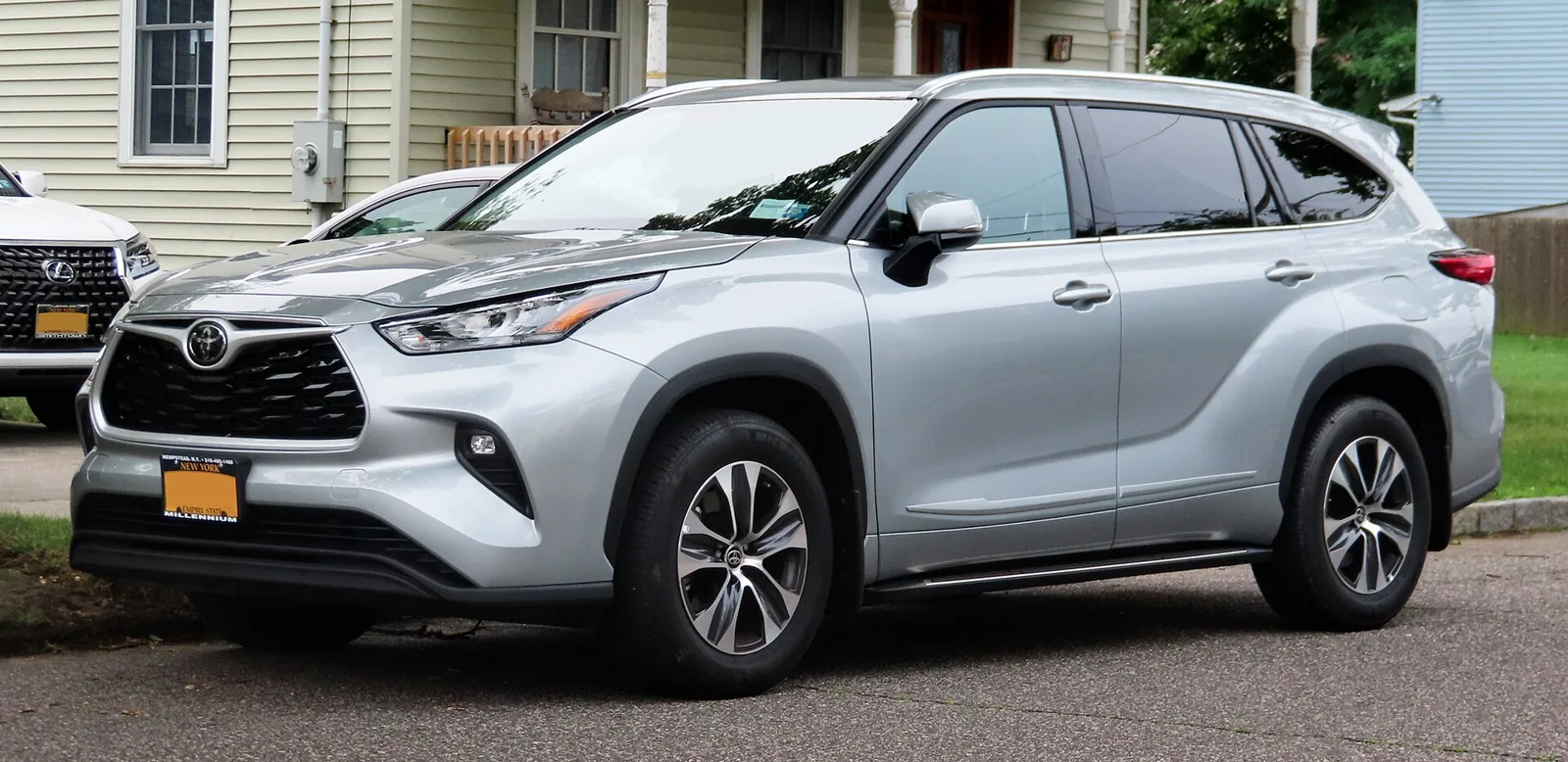
The fourth generation debuted in New York on 17 April 2019 on the GA-K platform. Gasoline models went on sale in the United States on 18 December 2019 as 2020 models. Apple CarPlay and Android Auto support came with it.
The Highlander Hybrid reached Europe in January 2021 with a hybrid-only line-up. The UK Highlander arrived in March 2021, a year after the US, because of the work needed for right-hand drive, and the Australian Kluger followed in June 2021.
The Chinese launch took place on 19 April 2021 at Auto Shanghai. FAW Toyota built a twin model, the Crown Kluger, with a Crown badge on the grille and steering wheel, and both used a 2.5-litre engine with a hybrid option.
Japan received the Highlander as an import from the US. It was announced in December 2025 and unveiled in April 2026 under the Highlander name rather than Kluger, in a single Limited ZR hybrid variant.
The Highlander reached South Korea on 25 July 2023, and Gulf Cooperation Council markets received hybrid-only models in mid-2020.
What are the fifth generation and Grand Highlander?
The fifth generation was revealed on 10 February 2026. Unlike earlier models, it is exclusively a battery electric vehicle. Its design follows the bZ Large SUV concept shown in December 2021, and sales are due to start in late 2026.
Subaru sells a rebadged version as the Getaway, shown in New York on 1 April 2026.
The Grand Highlander arrived in North America in February 2023 as a larger option. It shares the GA-K platform and the Highlander's petrol and hybrid engines, but it is longer, taller and wider and offers a more powerful Hybrid MAX option.
Toyota Highlander specifications
| Generation or engine | Detail |
|---|---|
| First generation, 2001 to 2007 | 2.4-litre four, 116 kW (155 hp; 157 PS) |
| First generation, 3.0-litre V6 | 223 PS (220 hp; 164 kW); about 8.8 seconds to 60 mph |
| First generation, 3.3-litre V6 | 233 PS (230 hp; 172 kW); 7.8 seconds to 60 mph |
| Hybrid, 2006 model | 28 mpg-US (34 mpg-imp, 8.4 L/100 km) city |
| Second generation V6, 2008 | 3.5-litre 2GR-FE with 274 PS (270 hp; 201 kW) |
| Second generation four, 2009 | 190 PS (187 hp; 139 kW); 252 Nm (186 lb-ft) |
| Hybrid, 2011 | 3.5-litre 2GR-FXE V6 with 248 PS (245 hp; 183 kW); 8 L/100 km in the city |
| 2023 turbo four | 2.4-litre T24A-FTS; 17 percent more torque than the 3.5-litre V6 |
| Third generation hybrid | 238 PS (235 hp; 175 kW) net power |
| Fifth generation | Battery electric only, unveiled 10 February 2026 |