From a 1995 compact truck built for personal use to a 2023 hybrid-capable mid-size pickup, the Tacoma has stayed Toyota's most-watched truck.
The Toyota Tacoma is a pickup built by Toyota since 1995, first as a compact and later as a mid-size truck. It has used four-cylinder and V6 engines and a turbo-hybrid option, and it is sold under its own name in a handful of markets.
The Toyota Tacoma is a pickup that Toyota has built since 1995, starting as a compact truck and growing into a mid-size model in later generations. Its name borrows a Coast Salish word for Mount Rainier, and Motor Trend named it Truck of the Year for 2005. Outside a handful of countries, the Hilux takes its place.
What is the Toyota Tacoma and where is it sold?
The Tacoma is a pickup that Toyota has manufactured since 1995. The first generation was a compact truck, and later generations moved into the mid-size class. By 2015 the truck was available across North America and in places such as Costa Rica, Bolivia, Bermuda and New Caledonia.
Most other markets receive the Hilux in its place. The name itself is taken from the Coast Salish name for Mount Rainier in Washington state, a choice that ties the truck to the Pacific Northwest.
A compact pickup built for personal use that grew into a mid-size truck with a hybrid option.
Where did the first generation Tacoma come from?
The first Tacoma went on sale in the United States in March 1995, after a February introduction, as the successor to the Toyota Truck. Toyota had used the Hilux name in North America since 1984 for that truck. The new model put ride quality, handling, comfort and safety ahead of ruggedness and payload, because American and Canadian owners used pickups as personal vehicles.
Development ran from 1989 to 1994, following the fifth-generation Toyota Truck of late 1988. Calty Design Research in California worked on the design from 1990 to 1992. Kevin Hunter's exterior proposal was picked in the autumn of 1991, and the production design was frozen in 1992. Japanese patents were filed in April 1993 and American ones on 28 October 1993.
What engines did the first generation Tacoma have?
Buyers could choose a 2.4-litre or 2.7-litre four-cylinder, or a 3.4-litre V6 that the larger T100 truck also used. Two-wheel-drive trucks used five-stud wheels, while four-wheel-drive and PreRunner models had six-stud patterns.
At first the 2.4-litre was limited to 2WD models, and the 2.7-litre was the standard four for 4WD trucks. From 1997 the V6 was dropped from the regular cab models. A Toyota Racing Development supercharger lifted the V6 to 189 kW (254 hp), and a seventh injector kit later pushed it to 262 hp (195 kW).
A five-speed manual was standard across the range, with a four-speed automatic as an option, except on the four-wheel-drive V6 regular cab. The PreRunner and Double Cab were automatic-only in the first generation, so buyers who wanted a stick had to choose a regular cab or an Xtracab.
What updates did the first generation Tacoma receive?
In October 1996 the first update changed the headlamps from recessed sealed beams to a flush design on 2WD models. Facelifts followed in July 1997 and October 2000, with new grilles for the 1998 and 2001 model years. Buyers could order a StepSide bed from the 2000 model year.
The PreRunner arrived for the 1998 model year, sharing the taller suspension, six-lug wheels and base 2.7-litre engine of the four-wheel-drive truck. The TRD Off-Road package also appeared in 1998, with a locking rear differential for four-wheel-drive and PreRunner trucks fitted with the V6.
The Double Cab, a four-door crew cab, went on sale in October 2000. It used Tokico gas shocks and a bed of 5 feet 5 inches (1.65 m), while the Xtracab kept Bilstein shocks and a 6 foot (1.8 m) bed. Many buyers disliked the small crew cab bed, although most competitors had the same shortfall.
The S-Runner trim arrived with the October 2000 facelift. It was a 2WD Xtracab with the V6 and a five-speed manual, lowered by about 1 inch (25 mm) on 16-inch wheels. Output ran at 800 units a month between September 2000 and August 2004.
Did the first generation Tacoma have a rust problem?
Yes. In 2008 Toyota announced a 15-year corrosion warranty with unlimited mileage for 1995 to 2000 models, because rust had affected more than 800,000 trucks. Engineers suspected that poor drainage in the fully boxed frame trapped moisture and started the corrosion.
Owners could have the frame repaired or sell the truck back to Toyota for 1.5 times its Kelley Blue Book retail value. The warranty was later widened to 2001 to 2004 models, but a frame rusted through to the point of perforation was replaced rather than bought back. The second generation switched to frame rails with an open C-section.
A separate recall in November 2012 covered about 150,000 trucks from the 2001 to 2004 model years, sold mainly in 20 cold-weather states. The problem was the spare tire, which could come loose and fall off.
What changed with the second generation in 2004?
Toyota began developing the second generation in 2000 under chief engineer Chikuo Kubota, and most of the work fell to Hino in Japan. Hino designers Shigeya Hattori and Hideo Karikomi won the internal design contest in 2001. The truck was unveiled at the Chicago Auto Show on 4 February 2004 and launched on 18 October 2004 as a 2005 model.
The new model was offered in 18 combinations of cab, transmission, engine and bed length, which made it much bigger and more powerful than its predecessor. The 4.0-litre 1GR-FE V6 replaced the 3.4-litre 5VZ-FE, and a 2.7-litre 2TR-FE four-cylinder was offered on the cheaper models.
With the V6 the truck could tow 6,500 lb (2,948 kg), and its payload was 1,650 lb (748 kg). The bodies used three cab configurations, namely regular, access and double cab, although the access cab was the one that drew most attention at launch.
What trims and packages did the second generation offer?
Toyota introduced the X-Runner as a successor to the S-Runner. It paired the 1GR-FE V6 with a six-speed manual, 18-inch alloy wheels and an X-Brace, and it sat two inches lower than standard. The X-Runner was only offered in a few colours each year.
The TRD Sport package focused on on-road performance, while the TRD Off-Road package was aimed at off-road use. Only the Off-Road carried a rear electronic locking differential. Both packages included TRD seats and a 400 W AC inverter mounted in the bed.
The X-Runner is believed to have sold roughly 3,000 units per model year. Production ended in the mainland United States after the 2013 model year, while Canada and Hawaii kept it a little longer.
Where were second generation Tacomas built?
Second-generation trucks came together in Tijuana, Mexico and in Fremont, California, with the plastic and composite beds made in Mexico. After General Motors went bankrupt, it ended its joint venture with Toyota, and Toyota then needed more volume at its Texas and Mississippi plants.
Toyota ended Corolla and Tacoma production at Fremont and moved US output to its San Antonio plant in Texas in 2010, where the Tundra was also built. The move brought roughly 1,000 new jobs to the city.
How did the second generation perform on safety?
ABS, brake assist and EBD were standard on the Tacoma. From 2009 Toyota's Star Safety System added vehicle stability and traction control, and the active head restraints earned the model an IIHS Top Safety Pick award that year.
The IIHS rated the side-impact test Good for the Tacoma equipped with side airbags, and it gave the frontal offset test a Good rating as well. Crash testing of pickups lags behind full-size trucks, but the small Tacoma still did well in the groups that were tested.
What is the third generation Tacoma?
Toyota unveiled the third generation in January 2015 at the North American International Auto Show, and US sales began on 10 September 2015. The truck was similar in size and mechanics to the one before, but the V6 models moved to a new N300 series while the four-cylinder kept its N240 and N260 codes.
The styling borrowed from the 2014 4Runner and Tundra, with a bigger grille, projector headlamps and a tailgate with an integrated spoiler and a debossed logo. The Access Cab and Double Cab were the only bodies offered, because the Regular Cab was discontinued for this generation.
Inside, the materials became softer, and the touchscreen was larger. Dual climate control appeared in the Tacoma for the first time, and a leather option was introduced. Toyota also improved sound insulation with an acoustic windshield and better sealed doors.
What engines and towing did the third generation offer?
Toyota offered a 2.7-litre 2TR-FE four-cylinder with a five-speed manual for 2016 and 2017, or a six-speed automatic. The 3.5-litre 2GR-FKS V6 came with a six-speed manual or automatic, and it could run a simulated Atkinson cycle through VVT-iW.
The V6 also used D-4S fuel injection, which switched between port and direct injection depending on driving conditions. Under the SAE J2807 tow guidelines, the truck could pull 3,100 kg (6,800 lb) once the tow package was fitted.
Did the third generation get a facelift?
The 2020 model year brought a facelift with exterior updates and new technology. Apple CarPlay and Android Auto, now wired, arrived alongside Amazon Alexa, and the SR5 and higher trims received a power-adjustable driver's seat.
The Limited Double Cab gained a Panoramic View Monitor that gives a 360-degree view from above. Toyota also introduced a dealer-installed TRD Lift Kit in January 2021, which raised the frame ground clearance by 1.7 inches (43.2 mm).
How many third generation Tacomas were built?
Output in 2014 came to 177,195 trucks, split between 105,796 from San Antonio and 71,399 from Baja. The 2015 total of 193,239 comprised 110,911 from San Antonio and 82,328 from Baja.
US and Canadian buyers took 191,673 Tacomas in 2016, and the San Antonio plant ran at 125 percent of projected capacity, with extra Saturday shifts. Toyota planned to lift Tijuana output from about 100,000 to 160,000 for 2018.
What is the fourth generation Tacoma?
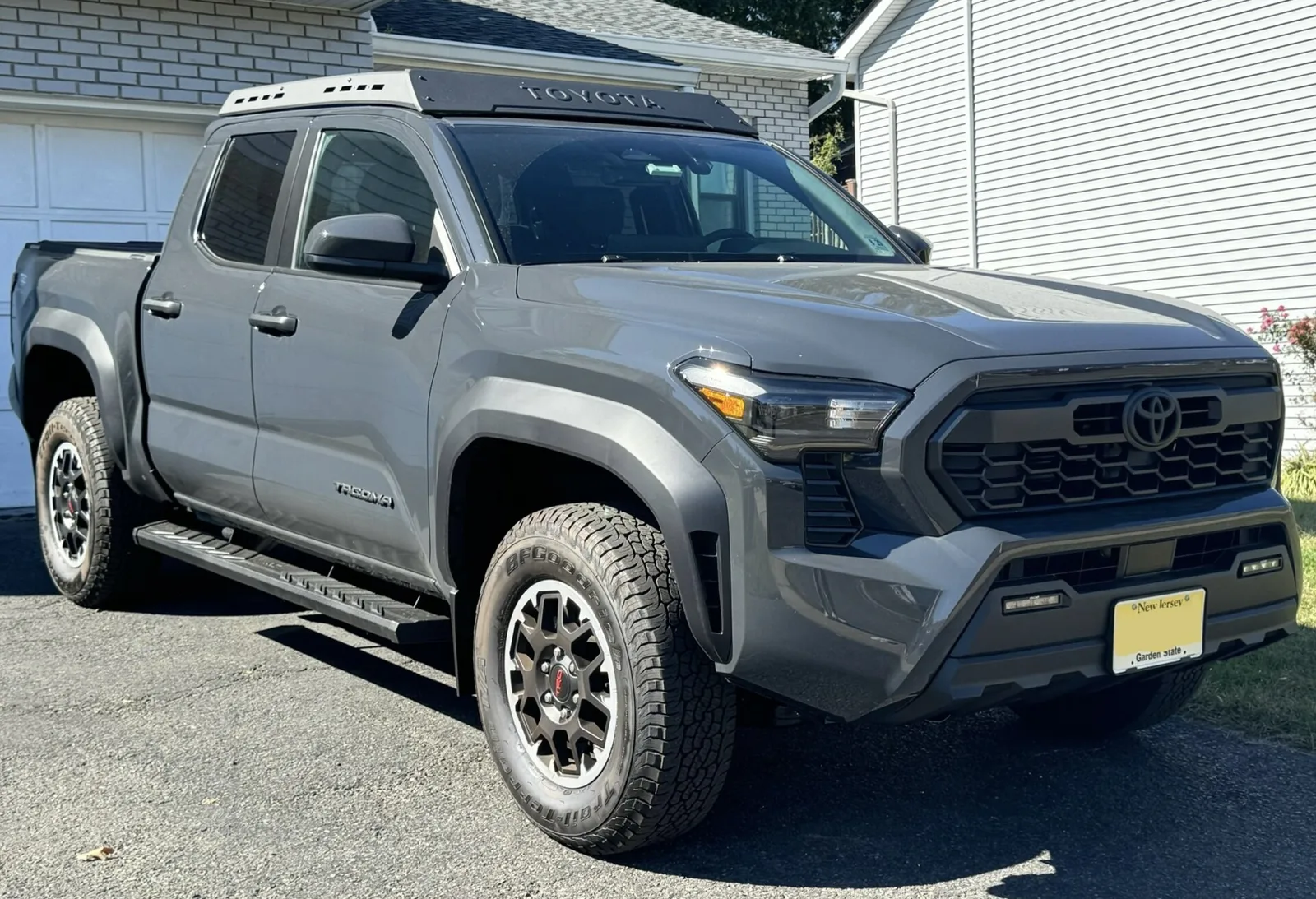
The fourth generation was revealed on 19 May 2023 on the TNGA-F platform that the Tundra also uses. Calty Design Research in California and Michigan styled it to look authentic to rugged outdoor use, keeping high lift, big tyres and a slim body.
The core engine is a 2.4-litre T24A-FTS turbocharged four making 228 to 278 hp, depending on trim and transmission. A parallel hybrid, the i-Force Max, produces 243 kW (326 hp) and 630 N-m (465 lb-ft). Most engines pair with an eight-speed automatic, and a six-speed manual is available on some trims.
The XtraCab is now a two-door, two-seat body with no rear jump seats, replaced by an interior storage area. Toyota made the change after finding that half of third-generation Access Cab buyers had asked for the seats to be deleted, and that most owners who kept the seats rarely used them.
Eight trim levels are offered. Six carry over from the earlier model, among them the base SR, the Limited and the TRD Pro. The Trailhunter is new, and the TRD PreRunner returns as a rear-wheel-drive XtraCab. The fourth generation can tow up to 2,900 kg (6,500 lb).
What are the Tacoma concepts and special editions?
Toyota revived the X-Runner name on a 2024 Tacoma concept, shown at the 2023 SEMA Show. It uses a modified i-Force Max V6 producing 421 hp, a lowered air suspension borrowed from the Tundra and a widened track. The concept's exterior is painted Speedway Blue, the colour of the 2004 original.
On 21 October 2015 Toyota and Universal Pictures marked 30 years of Back to the Future with a Tacoma concept based on the 1985 Hilux from the film. It was built on a 2016 Tacoma 4WD with matching lights, mudflaps and a black paint trim, though it used different tyres and kept an independent front axle.
How was the Tacoma used by the military?
Many Tacomas saw service in the Iraq War and under Operation Enduring Freedom, usually as double cabs in SR5 or TRD trim. The military bought them from American dealers and adapted them, rather than using the Hilux that is common in the Middle East.
The army removed the standard radio and most exterior lights, fitted infrared spotlights for night-vision equipment, and bolted on winches, mud flaps and roll bars that could take machine guns. The engines were left unchanged, and the Tacoma's suspension was judged weaker than the Hilux's.
What were the Tacoma's motorsport highlights?
At CORR, Toyota supplied a Tacoma for the Pro Lite class in 1998. Johnny Greaves and Jeff Kincaid won 19 of 20 races in that class and took the overall championship. In the same year, Rod Millen's Tacoma took the overall title in the Unlimited class at the Pikes Peak hill climb.