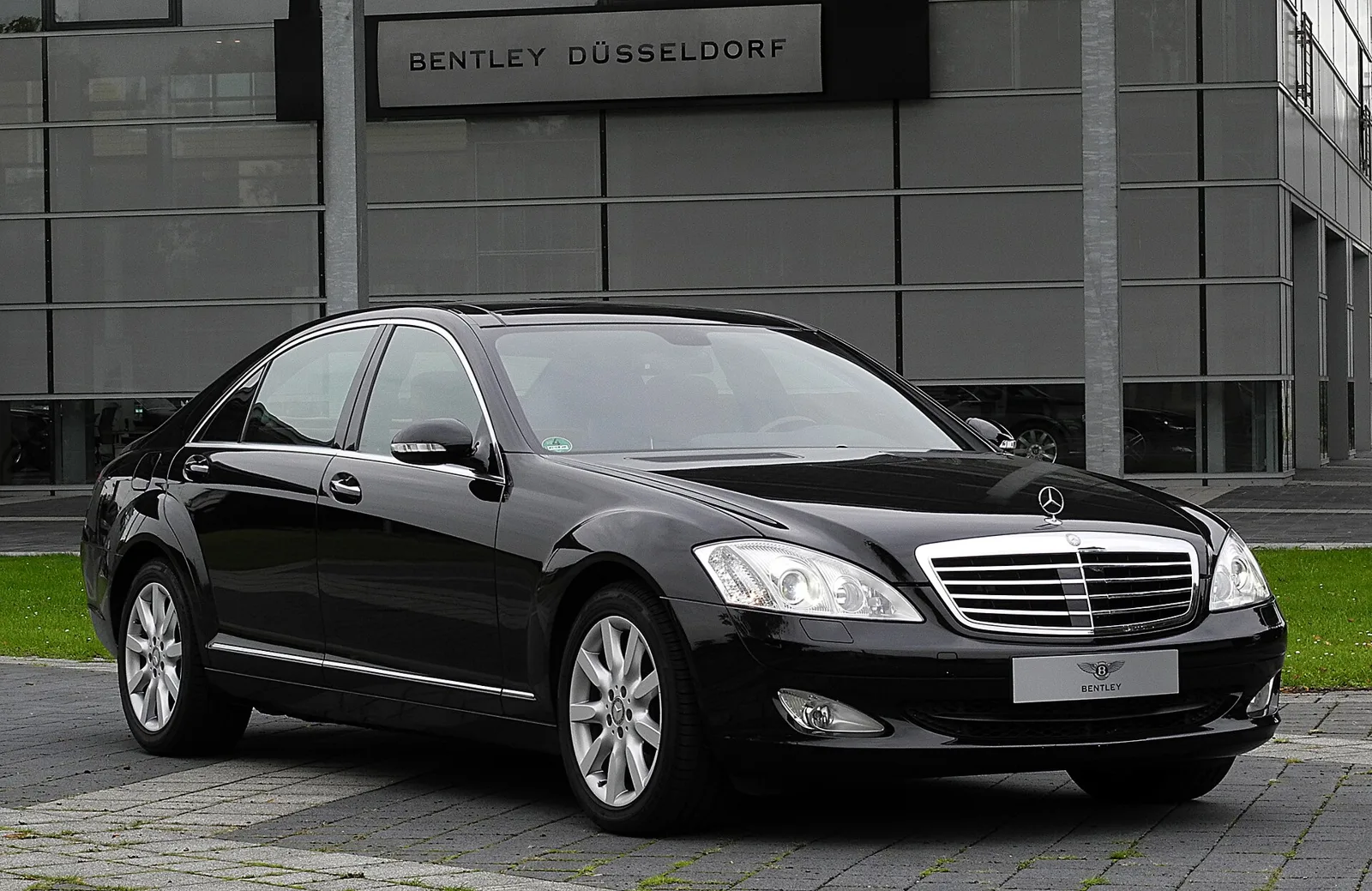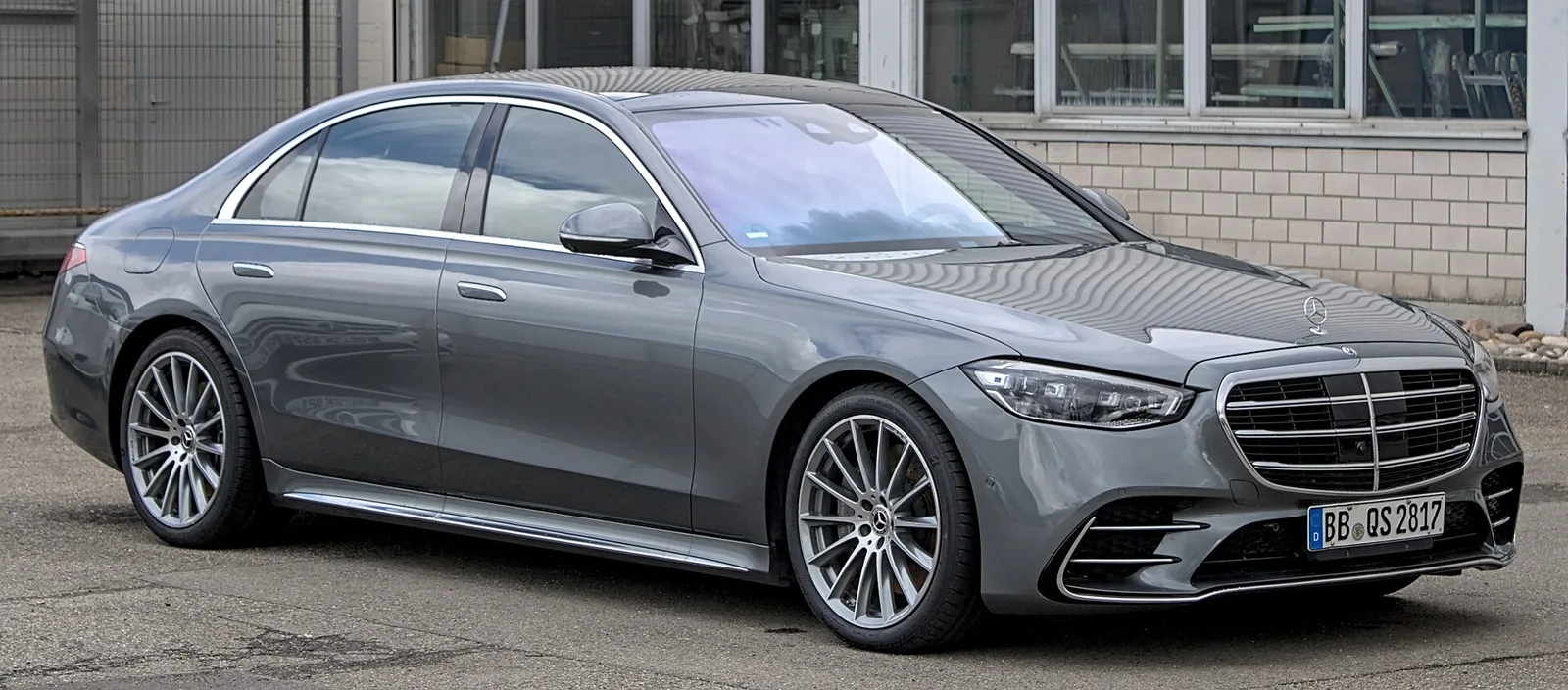
From the 1972 W116 to the 2020 W223, the flagship has carried safety firsts from airbags to rear-seat airbags.
The S-Class is the flagship sedan of Mercedes-Benz, first formally named in 1972 with the W116. Its generations introduced many of the brand's safety firsts, including airbags and rear-seat airbags, and the nameplate is widely cited as the top-selling luxury sedan.
The Mercedes-Benz S-Class is the flagship of the German brand, and it has ranked as the world's best-selling luxury sedan. Its name comes from Sonderklasse, meaning special class, and it was formally introduced in 1972 with the W116. Since then the model has passed through several generations, and it has been the place where Mercedes debuted much of its newest technology.
Where did the S name come from?
Mercedes-Benz used the S suffix long before 1972. The 1949 to 1951 170S denoted a W136 car with a more modern chassis and a larger body, in both saloon and cabriolet form, as opposed to the regular 170V and 170D. After 1951 the 170S became the W191, and in 1953 hybrid 170S-D and 170S-V models became the company's discount cars until 1955.
The S suffix was applied in many ways. A two-door W188 300S sat above the W186 300 saloon, and in 1986 the W180 220 gained an S when it was facelifted.
The change to a real range came in 1968 with the /8 series, whose S-labelled cars had their own bodies, chassis and powertrains. In 1972 Mercedes formalised the idea, branding its premium range the Sonderklasse. That covered the new W116 sedans and the W107 two-door coupes and roadsters.
Six decades of flagship tech, from the 1972 W116 to rear-seat airbags, all under the S badge.
What were the Ponton and Fintail predecessors?
The W180 line of 1954 was the first of the Ponton models later linked to the S-Class. It came as a six-cylinder sedan, coupe and convertible, and it was made until 1959. The 220S models used a 2.2-litre straight-six, and only the six-cylinder W180s are counted in the S-Class chronology, because they were the most powerful Pontons.
The Fintail, a nickname for the tail-finned Mercedes of the late 1950s, replaced the Ponton. The sedans were the W111 from 1959 to 1968, with coupes and cabriolets from 1961 to 1971. The luxury versions with big-block 3-litre engines took the W112 code, and the entry-level four-cylinder cars were the W110.
The W108 and W109 lines arrived in 1965. The squarish W108 included the 250S, 250SE, 280S, 280SE and 280SEL, and the 300 SEL 6.3 of 1968 borrowed the 6.3-litre V8 from the W100 600 Pullman. The W109 300SE and 300SEL had air suspension at both ends, and their long-wheelbase versions added an extra 10 cm (3.9 in) to the rear compartment.
What set the W116 apart in 1972?
The W116 was the first car officially called the S-Class. It was built from 1972 to 1980 with four-wheel independent suspension and disc brakes, and the 280, 350 and 450 (4.5-litre) models came in SE and SEL versions. Production totalled 473,035 units, and it marked a clear shift towards safety in Mercedes design.
Its safety features were new on a production car. They included padded door trim, a padded steering wheel, dual asymmetric windscreen wipers and headrests that located the head more centrally in a rear impact. A rain-water management system channelled water through deep grooves in the windscreen and the mirrors. A first aid kit sat in a recessed compartment on the rear parcel shelf, and the body shape was rounded to reduce pedestrian injury.
The W116 was one of the first cars offered with ABS and a driver's airbag, although the airbag was not on the car at launch. It was also the first mass-production passenger car sold with a turbocharged diesel engine. The 450SE won European Car of the Year in 1974.
How powerful was the 450 SEL 6.9?
The W116 V8s of the 350 and 450 SE and SEL became regular options. Despite the oil crisis, Mercedes still built the high-performance, limited-production 450 SEL 6.9. It was nicknamed simply the 6.9, and its engine was the largest fitted to a postwar Mercedes up to that time. Each one had self-levelling hydropneumatic suspension, and ABS was optional from 1978.
In the United States and Canada, Mercedes introduced the economical 3.0-litre five-cylinder turbo-diesel OM 617 A in 1978, sold as the 300SD. It made 85 kW (116 PS; 114 bhp).
The W116 also had a special edition. Between 1973 and 1977, 997 Special Edition cars were made to order. They had stronger body panels and suspension, and they were 50 kg heavier than the standard car.
How did the W126 bring airbags to the S-Class?
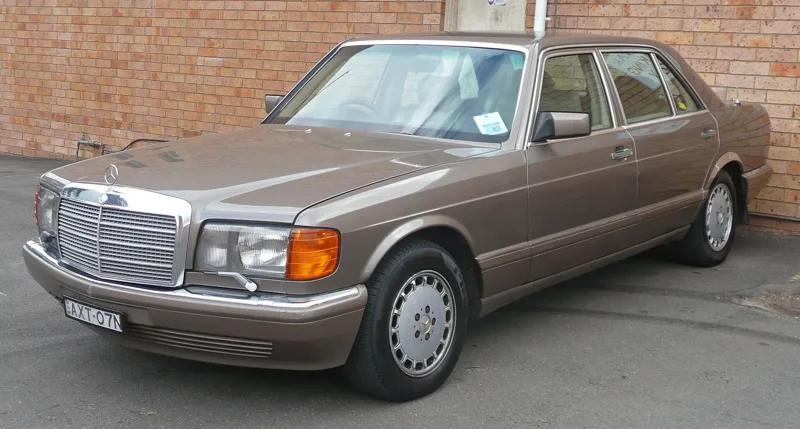
The W126 series premiered in September 1979, went on sale in March 1980 as a 1980 model, and reached the US and Australia as a 1981 model. In 1981 it won Wheels magazine's Car of the Year award in Australia. The W126 was built from 1979 to 1991, with a mid-cycle update, and it used improved aerodynamics and enlarged aluminium engine blocks.
In December 1980 the W126 introduced a driver's airbag, which Mercedes had patented in 1971. Passenger airbags followed in 1988, along with seatbelt pretensioners and traction control. It was the first production car with an airbag as standard, and as late as 1991 only a few other European makers offered one. A four-speed automatic was standard.
The 500SEL offered the hydropneumatic suspension of the 6.9 as an option. A new cruise control system was also offered, and the W126 added a two-door SEC coupe to the range.
Total sales of the W126 sedans reached 818,036, with an additional 74,060 coupes sold. Most of the diesel sales came from Europe, while the United States mostly bought straight-sixes.
Were the W126's V8 engines any good?
The V8 models were praised by contemporary journalists, but the US launch was poor. The 3.8-litre V8 was the first engine the Americans received, and it was a disaster. Its timing chain needed repair, and it was badly underpowered, needing 11 seconds to reach 60 mph (97 km/h) and topping out at 117 mph (188 km/h).
The 5.0-litre V8 was far more capable, reaching 60 mph in 7.3 seconds and topping out at 138 mph (222 km/h). During the 1986 mid-cycle update the straight-six grew from 2.8 to 3.0 litres, the 3.8 V8 became a 4.2, and the 5.0 became a 5.6.
What was the W140 generation?
The W140 replaced the W126 in 1991, with the first production car assembled in April of that year. It grew in size, came in two wheelbases, and had a shorter-wheelbase coupe. The W140 cost 25% more than the car it replaced, and its production totalled 432,732 units.
It had double-pane window glazing, self-closing boot and doors, and electric windows with jam protection that lowered when they met an obstruction. US cars had rear parking markers that appeared on the wings in reverse, and the heating kept blowing warm air for a while after the engine was switched off.
In 1993 Mercedes rationalised its model names, and the SE, SEL and SEC became the S-Class with inverted designations, so both the 500SE and 500SEL became the S500. A 1995 facelift added clear turn-signal lenses and separate low- and high-beam reflectors for the US. The coupe and saloon then received Electronic Stability Control.
What was the W220 like?
Mercedes presented the W220 in July 1998 as a sedan only. It was smaller than its predecessor but offered more interior space. Production totalled 485,000 units. It introduced Airmatic air suspension, a navigation system with a centre console screen and the COMAND control system, keyless entry and ignition, Distronic radar cruise control, and Active Cylinder Control.
All-wheel drive, called 4MATIC, came to the North American S-Class for 2003. Reliability reviews were mixed. Consumer Reports graded the W220 poor on reliability, its bottom rating, and listed it among the least reliable luxury cars. Edmunds, by contrast, gave the S-Class top marks for reliability, and by March 2011 Consumer Reports had revised its ratings for the 2001 and 2002 cars to average.
In 2002 Mercedes introduced Pre-Safe, a world first for a pre-emptive safety system on the W220. The car also had a refresh with a more upright grille and new xenon headlamps with transparent housings. In 2005 it became the first vehicle to receive an environmental certificate from the German TUV institute.
How did the W220 engine line-up grow?
The entry engine was a V6 at 165 kW (224 PS; 221 bhp), later replaced by a 180 kW (245 PS; 242 bhp) V6 in the S350. The S430 had a 4.3-litre V8 at 205 kW (279 PS; 275 bhp), and the S500 a 5.0-litre V8 at 225 kW (306 PS; 302 bhp).
The S55 AMG used a supercharged 5.4-litre V8 producing 368 kW (500 PS; 493 bhp), while the naturally aspirated version made 265 kW (360 PS; 355 bhp). The S600 used a 5.5-litre V12 biturbo, and a later version used the naturally aspirated 5.8-litre V12.
In 2001 Mercedes built a very rare S 63 AMG with a five-speed automatic and a 6.3-litre V12. It made 327 kW (444 PS; 438 bhp) and 620 N m (457 lb ft) of torque, and only 70 were built. In 2003 the S 65 AMG arrived with a bi-turbocharged 6.0-litre V12 making 450 kW (612 PS; 604 bhp) and 999 N m (737 lb ft). It was limited to 250 km/h (155 mph), and its 0 to 100 km/h time was officially 4.4 seconds.
What was new in the W221 of 2005?
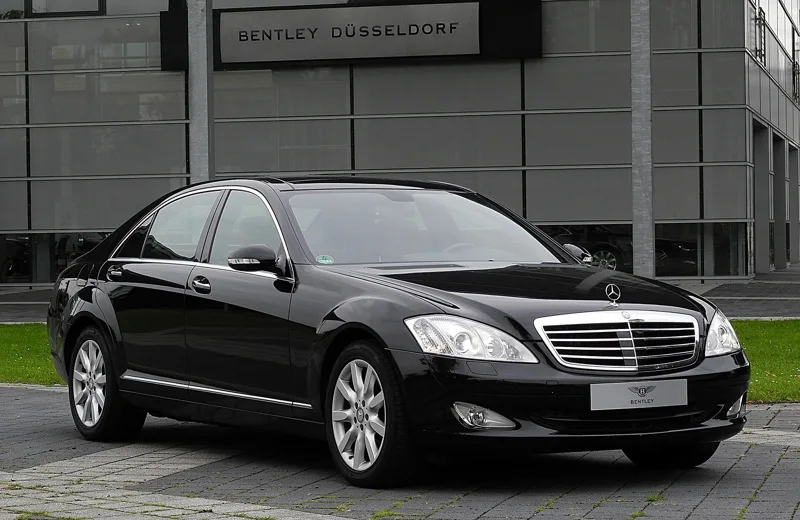
The W221 made its debut at Frankfurt in autumn 2005, with exports beginning the following year. Its North American debut came at the January 2006 North American International Auto Show. It was slightly larger in every dimension, and its three new engines gave up to 26% more power.
The interior was completely new, with upgraded materials and a column-mounted gear selector in place of the centre console lever. The W221 added an infrared Night View Assist and the latest pre-collision system, and it had sharper styling with wide fender arches. It was the second consecutive S-Class to be sold only as a sedan.
The 2010 model year brought a mid-2009 facelift and a new S400 Hybrid. The rear had 52 LEDs in the two taillights, the exhaust tailpipes were integrated into the bumper and the wheels were updated. The S550 reached 0 to 100 km/h in 5.4 seconds, the S600 did it in about 4.6 seconds, and the S65 AMG, which weighed 2,304 kg (5,079 lb), managed 4.2 seconds.
How did the Saks Fifth Avenue S600 sell?
Upscale department store Saks Fifth Avenue offered 20 special-edition S600 sedans in its 2005 Christmas catalogue. They were priced at US$145,000 each, and all 20 sold on 22 November 2005 in under seven minutes. The cars had a mocha black exterior and an almond beige interior, and they were the first examples of the S600 sold to private owners. Nearly every option came as standard.
Car and Driver chose the S550 as the winner of a five-way comparison of flagship luxury sedans. Motor Trend also picked it in July 2009, in a three-way test against the BMW 750Li and the Audi A8L 4.2 Quattro. In 2007 Automobile Magazine named the W221 one of its All-Stars, beating rivals from Lexus and BMW.
What is the W222 generation?
The sixth generation, the W222, was officially unveiled in May 2013. It had a more streamlined look than the outgoing car, with a large front grille inspired by the F700 concept and LED lights used inside and out, which Mercedes called a first in the industry. Two strong converging character lines gave the flanks a more sculpted look.
The S-Class spawned a coupe, the C217, and a convertible, the A217, and an extended-wheelbase Pullman version called V222 was also made. Mercedes concentrated development on the longer model, because customers in fast-growing Asian markets often prefer to be chauffeured.
Inside, almost every surface was covered in a luxury material. The instrument cluster used two 305 mm widescreen LCDs, and a Head-Up display and gesture-responsive touchpad became options in early 2014. Magic Body Control used windscreen-mounted stereo cameras to read the road surface ahead and prepare the active suspension for it.
The W222 also offered massage options for each seat and Burmester premium audio. Its DISTRONIC PLUS with Steering Assist could keep a lane and follow a leading car in traffic. Mercedes engineers said that under controlled conditions a W222 had driven autonomously for 50 km, using equipment already fitted to production cars.
What engines did the W222 offer?
The W222 offered a twin-turbo V8 at 339 kW (455 hp), with a twin-turbo V12 in the S600. The S350 BlueTEC used a diesel, the S400 hybrid paired a 20 kW (27 PS; 27 hp) electric motor with a 228 kW (310 PS; 306 bhp) V6, and a diesel-electric S300 BlueTEC was also offered.
The S500 Plug-in Hybrid, shown at the Frankfurt Motor Show and sold from 2014, paired a 3-litre V6 rated at 245 kW (334 PS; 329 bhp) with an electric motor of 80 kW (109 PS; 107 hp). Mercedes claimed 3 L/100 km and 69 g/km of CO2, with up to 30 km of emissions-free driving. AMG versions of the V8 and V12 powered the S63 and S65.
How did the W223 start its run?
The W223 was unveiled on 2 September 2020. This generation did not have a coupe or convertible, because those body styles had been replaced by the next-generation AMG GT and SL-Class. Inside there were as many as five displays, an augmented reality head-up display and ambient lighting.
It was the first production car with rear seat airbags, which inflate supporting structures so that ambient air fills the bag rather than gas. In December 2022 Mercedes-AMG debuted the S 63 E Performance V8 plug-in hybrid with 802 hp. A facelift model followed on 26 January 2026.
How did the S-Class lead on safety?
Mercedes used the S-Class to introduce many of its safety innovations. The S-Class was the first car in Europe to carry airbags, and ABS arrived in 1978, co-developed with Bosch. Traction control and the Electronic Stability Program came in 1995, and infrared night vision in 2005. Active lane keeping became standard in 2011.
Passive safety included crumple zones, which dated from 1957, a collapsible steering column and a strengthened occupant cell. Pre-accident seatbelt tensioning and sandwich platforms also helped. PRE-SAFE, the holistic system introduced in 2002, primes the brakes, locks the doors, adjusts the seats and tightens belts before a crash. If the car rolls, the doors unlock and the windows drop slightly so occupants can get out.
The S-Guard is an armoured version of the car, able to withstand small arms fire and certain explosive devices, with a self-sealing fuel tank and an alarm. The Pullman Guard, launched in 2009, is 1,100 mm (45 in) longer and has a higher roof. About ninety governments use the S-Guard for their leaders and dignitaries.
How many S-Class cars have been built?
Some 2.7 million S-Class vehicles have been produced in roughly forty years. The W116 totalled 473,035, the W126 818,036, the W140 432,732 and the W220 485,000. The W221 reached roughly 516,000 and the W222 373,637 across its years of production.
Where are S-Class models built?
Most S-Class models, including the W221, were built at the Sindelfingen plant in Germany and at the Mercedes-Benz plant in Santiago Tianguistenco, Mexico. The Sindelfingen plant was founded by Daimler Motoren Gesellschaft in 1915 and also made the Grosser Mercedes 600. Earlier models were built in several places, and in 2007 Mercedes began building S350s at its Pekan plant in Malaysia.
How did Mercedes sell its engineering?
Mercedes once used the slogan engineered like no other car in the world, which it applied throughout the 1980s to the W126. The company dropped it in the late 1990s after DaimlerChrysler formed and the engineering-led overbudgeting ended. The W220 was reported to suffer lower reliability and quality, though ratings improved from the W221 onwards.
Did the S-Class drive itself in the 1990s?
In the 1980s Mercedes worked with Professor Ernst Dickmanns at the Bundeswehr University in Munich to build early driverless cars on the S-Class. The climax came in 1995, when Dickmanns' re-engineered S-Class robot drove from Munich to Copenhagen and back. On the autobahn it exceeded 175 km/h (109 mph) and suggested and carried out overtaking manoeuvres.
The F700 research car was shown at the 2007 Frankfurt Motor Show. It had three conventional doors and a fourth that rotated 180 degrees, and it was also fitted with bulletproof, puncture-resistant tyres.
Mercedes-Benz S-Class generations at a glance
| Generation | Years | Production | Key points |
|---|---|---|---|
| W116 | 1972-1980 | 473,035 units | First officially named S-Class; 450 SEL 6.9 |
| W126 | 1979-1991 | 818,036 sedans, 74,060 coupes | Driver's airbag from December 1980 |
| W140 | 1991-1998 | 432,732 units | Double-pane glazing; 25% dearer than the W126 |
| W220 | 1998-2005 | 485,000 units | Airmatic suspension; Pre-Safe from 2002 |
| W221 | 2005-2013 | About 516,000 units | Night View Assist; sedan only |
| W222 | 2013-2020 | 373,637 units | Magic Body Control; V222 Pullman |
| W223 | 2020 onward | Ongoing | Rear seat airbags; plug-in hybrid versions |