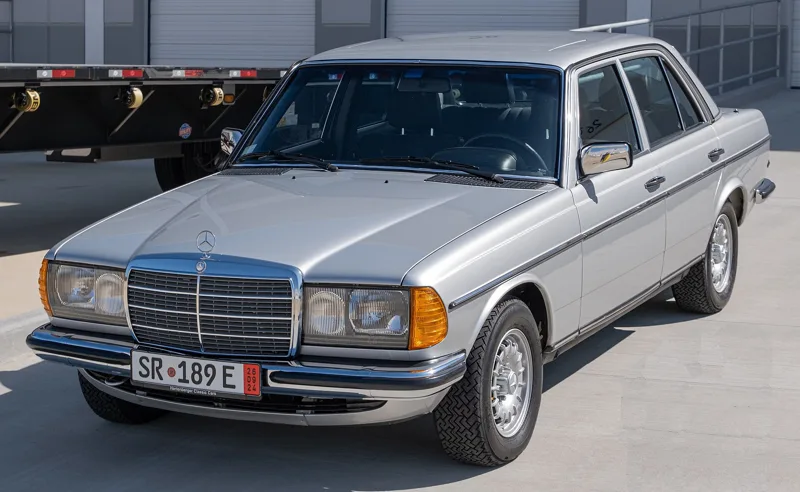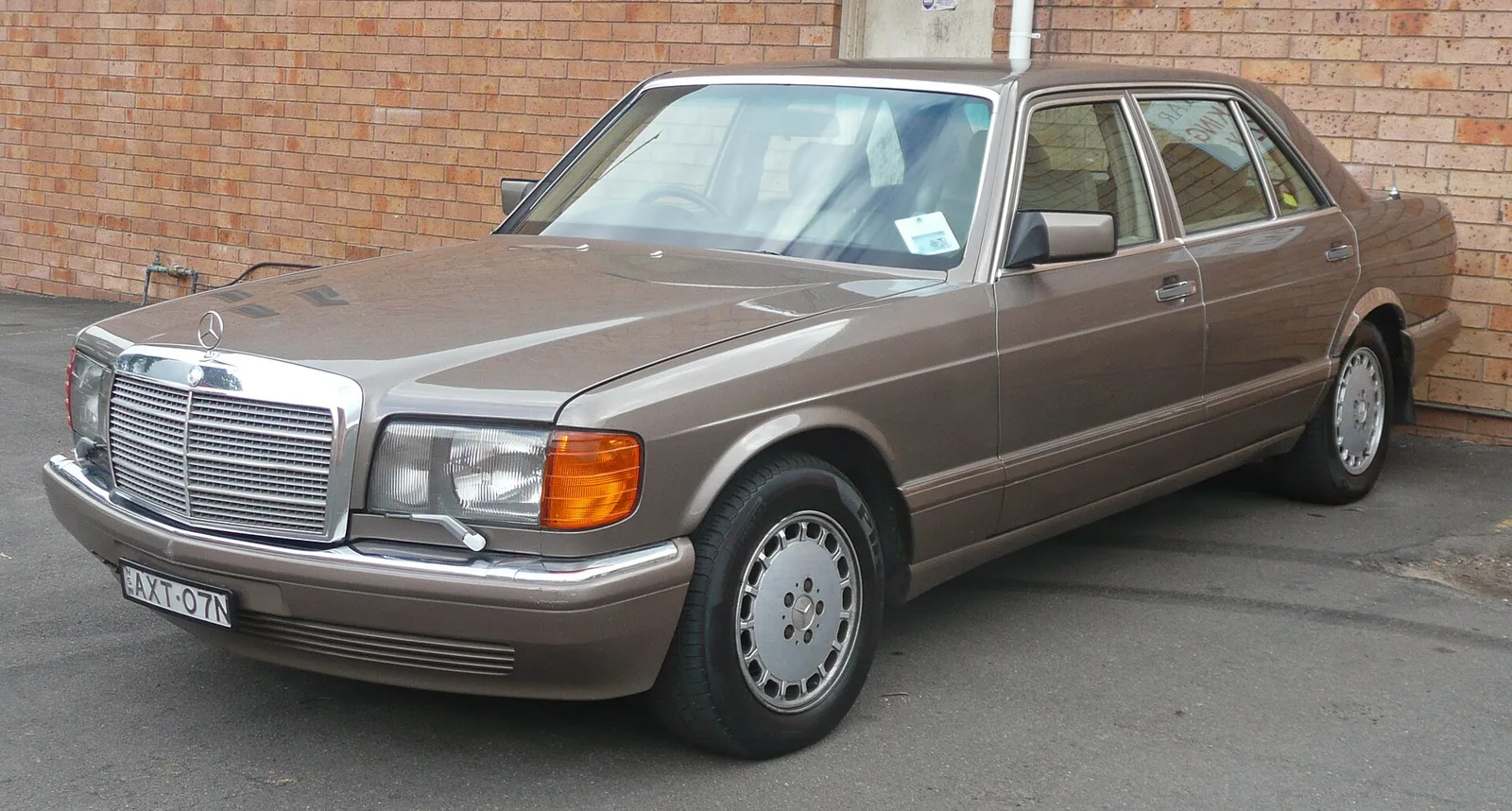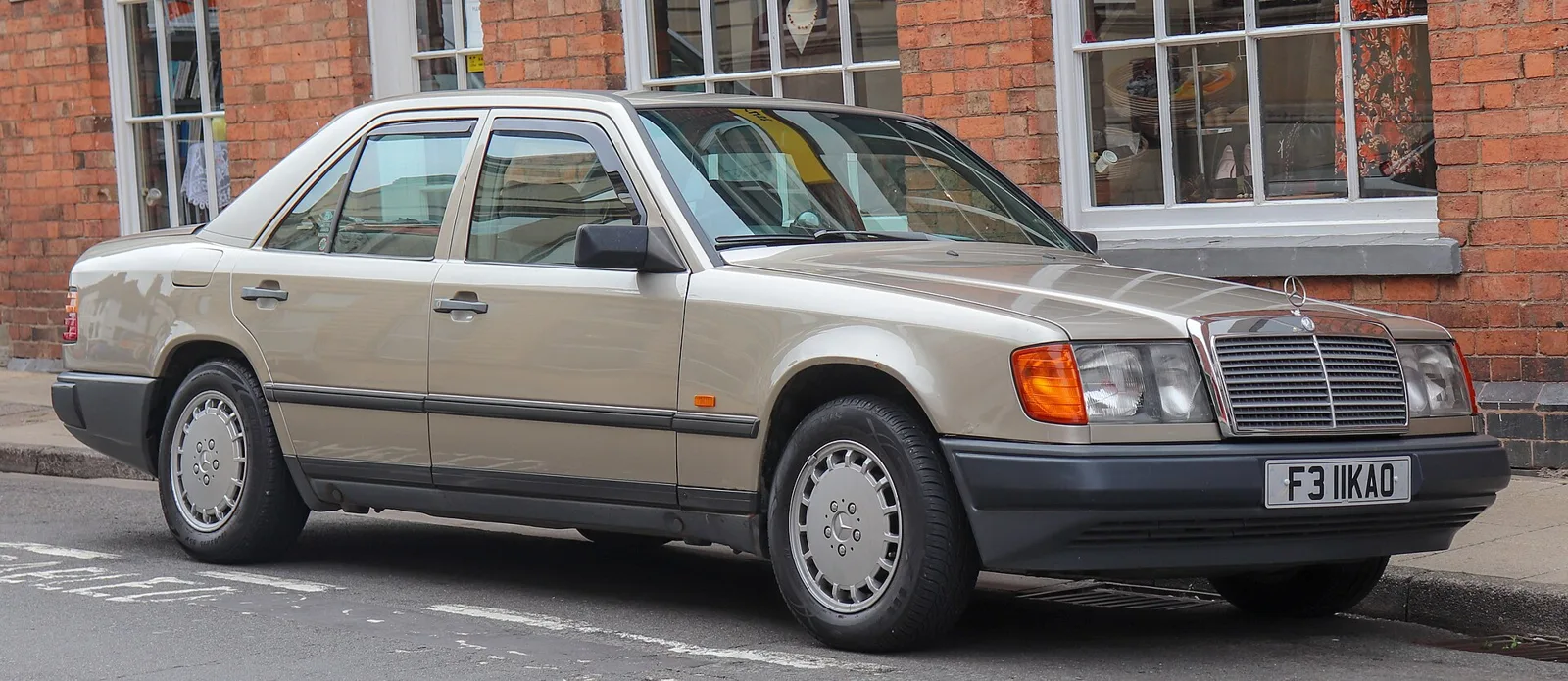
One platform carried saloons, estates, coupes, cabriolets and a six-door limousine from 1984 to 1997, and a German breakdown survey backed up its name for durability.
The Mercedes-Benz W124 was an executive car range built by Daimler-Benz from 1984 to 1997, with saloon, estate, coupe, cabriolet and limousine bodies on one platform. Marketed as the E-Class from 1993, it gave way to the W210 saloon in 1995 and the CLK-Class coupe and cabriolet from 1997.
The Mercedes-Benz W124 was a family of executive cars built by Daimler-Benz from 1984 to 1997. Saloons, estates, coupes and cabriolets all shared one platform, and from 1993 the range carried the E-Class name. A 1995 breakdown survey in Germany put its diesel version at the top of its class.
How did the W124 come to be?
Planning began in the autumn of 1976 under Hans Scherenberg, and the programme officially started in July 1977 with Werner Breitschwerdt in charge of research and development. The decision to base the car on the W201 programme came in April 1978, and the final exterior, chosen by design director Bruno Sacco, was approved in early 1981.
Pilot production started in March 1984, and the car was shown to the press in Seville on 26 November 1984. The sedan went on sale in December 1984, and customer deliveries across Europe began in January 1985.
Five body styles, one platform and a German breakdown survey that put its diesel at the top of the class.
What made the W124 slippery and practical?
The W124 was one of the slipperiest cars of its era, with a drag coefficient of 0.28 for the 200 and 200D on European 185/65 R15 tyres. Engineers added plastic moulding under the car to smooth airflow, and a single wiper with an eccentric mechanism reached the top corners of the windscreen.
The rear axle was the real engineering statement. Mercedes used a multi-link layout first seen on the W201 in 1982, and it later became standard on many modern cars. The front used separate springs and dampers, with the control arms mounted directly to the body and no subframe.
Estates, and optionally saloons and coupes, could be fitted with self-levelling rear suspension. It used gas-filled spheres and an under-bonnet pump, a hydropneumatic arrangement similar in principle to Citroen's. Coil springs held the ride height steady when the car was parked.
Estates also gained a rear door that closed itself. A sensor-driven servomotor pulled it shut, which allowed a tighter seal and cut the cabin noise that often troubled station wagons. The T-model's rear seat base sat 10 cm (3.9 in) higher than in the saloon, so the load floor stayed flat, at the cost of some rear headroom.
Which engines did the W124 launch with?
The first range had seven models: the 200 and 230E petrol fours, the 260E and 300E sixes, and the 200D, 250D and 300D diesels. The 200 kept the 1997 cc M102, while the 230E was bored out to 2299 cc. The six-cylinder petrol engines were the new M103 units of 2599 and 2962 cc.
Every engine used an overhead-cam layout inclined at 15 degrees. Petrol cars had transistorised breakerless ignition, while the diesels kept mechanical injection with a Bosch fuel pump and distributor.
A four-speed manual was standard, with a five-speed overdrive gearbox for the sixes. The W4A 020 (722.4) automatic was optional on most models, and the 300E took the stronger W4A 040 (722.3).
How did the W124 meet US rules and the grey market?
The US received the 300E saloon as a 1986 model, sold from autumn 1985 in five-speed and automatic form. Mercedes changed the cars to meet EPA emissions and safety rules, and the only visible sign was a set of rectangular sealed-beam headlights.
American cars weighed about 100 kg more than European ones, yet engine performance was identical for the whole production run.
Grey-market imports were the other problem. By 1985 around 60,000 vehicles were arriving in the United States outside official channels, and every third one was a Mercedes. The company lobbied Congress, and the Imported Vehicle Safety Compliance Act followed, effectively banning private imports of cars under 25 years old.
Diesels caused their own trouble. In 1988 Mercedes dropped the diesel range for North America, because of reliability problems with the particulate filter that the California Air Resources Board required. The petrol 300TE took its place as the only T-model on offer there.
When did the coupe and 4Matic arrive?
The two-door coupe arrived in early 1987 as the 230CE and 300CE, with a shorter wheelbase and a lower roofline. The same year brought 4Matic all-wheel drive, which engaged automatically when sensors detected lost traction. Mercedes designed it to rival Audi's quattro and offered it first on the 260E, 300E and 300D saloons.
The coupe had pillarless glazing and a five-speed manual as standard on both models. Instead of a large panoramic rear window, its ceiling padding ran further back below the glass.
What did the 1989 facelift and the 24-valve engine change?
The September 1989 facelift brought plastic side panels with a chrome strip running into the bumpers, chrome door handles and hubcaps, and body-coloured mirrors. Customers could order Sportline trim with firmer suspension, a lower driveline and 205/60R15 tyres on 7J alloy rims, in place of the standard 195/65 R15 on 6.5 inch steel wheels.
The big mechanical news was the M104 engine with twin overhead camshafts. Cosworth had built the twin-cam heads for the 190E 2.3-16, but the M104 was an in-house design. It had two-position variable valve timing on the intake shaft, and the 3.0-litre cars became the 300E-24, 300TE-24 and 300CE-24.
The 24-valve motor added a peak 40 hp without any loss of fuel economy. US buyers got the facelifted car as the 1990 model year, when the 260E was rebadged as the 300E 2.6 and the 4Matic versions joined the range.
How did the 500E come to be built with Porsche?
The 500E was shown in October 1990, and production began in February 1991 for a spring launch. It used the 5.0-litre, 32-valve V8 M119 from the R129 500 SL roadster, and Porsche engineered its chassis with a performance bias. It was the high performance version of the W124 range.
The 500E's wider wings meant it would not fit the Mercedes-Benz factory line. Porsche's factory in Zuffenhausen had spare capacity at the time, so the company took on the assembly under an agreement with Mercedes. The same Porsche-built chassis also served the 400E, which lacked the wider wings.
What did the 1992 engine family change?
In 1992 Mercedes moved the whole mid-range to a new engine family. Every engine except the 2.0-litre M111 gained Bosch LH Jetronic with the HFM system, and all four engines shared a bore of 89.9 mm, with different strokes creating the sizes.
The biggest gain came on the 280E, where the 2799 cc M104 added 23 percent power (37 hp) and 50 Nm of torque over the old six. The 320E took the 3199 cc M104, with peak power of 220 PS at 5500 rpm, down from 6400 rpm, and 17 percent more torque (45 Nm).
The 200E's 1998 cc M111 used a different management system and gained 15 percent (18 hp) in power and 10 percent (18 Nm) in torque.
The cabriolet came back in 1992, after an absence that began with the W111 280SE in 1971. Built as the A124, its structure drew on the reinforcement work done for the R129 SL roadster, and in Europe it was sold as the 300CE-24 with the 3.0-litre M104.
Why did the W124 become the E-Class?
The second facelift in August 1993 changed the front to match the W140 flagship and the new W202 C-Class. The same year the range was renamed, and the W124 became the E-Class. The letter E originally stood for injected, and it was later read as Executive.
Under the new system the letter came before the engine size, and body labels such as C or T were dropped. Diesels gained a Diesel or Turbodiesel tag, so the 250TD Turbo estate became the E250 Turbodiesel. The range that followed ran from the E200 to the E500:
- E200, 2.0-litre DOHC M111, in all four body styles (the coupe in only some markets)
- E200 Diesel, 2.0-litre OM601, saloon only
- E220, 2.2-litre DOHC M111
- E250 Diesel, DOHC 2.5-litre OM605, saloon and estate
- E280, 2.8-litre M104
- E300 Diesel, DOHC 3.0-litre OM606
- E320, 3.2-litre M104, in all four body styles
- E420 and E500, 4.2 and 5.0-litre M119 V8s, saloon only
How fast were the AMG versions?
AMG had worked with Mercedes-Benz for years before the partnership became official. Dealers could fit AMG parts to new cars from 1990. In 1991 a small run of 300E-24 3.4 AMG cars arrived, with the M104 bored to 91.5 mm, and a 1993 agreement put AMG models into Mercedes-Benz showrooms.
The E36 AMG estate, coupe and cabriolet took the 3.2-litre M104 and bored and stroked it to 3604 cc. With a 10.5 compression ratio and racing camshafts, power and torque rose by almost 25 percent. The car ran 0-100 km/h in 7.2 seconds and was electronically limited to 250 km/h (155 mph).
The E60 AMG took the M119 V8 to 5956 cc. Power rose by 18 percent and torque by 24 percent, and its 5.2 seconds to 100 km/h beat the W140 S600 flagship. That made it the top-performing sedan in the Mercedes-Benz line at the time.
Nobody knows how many E36 and E60 cars were built. Many were performance packages fitted by the dealer at the factory, so they carried the Mercedes-Benz warranty, while others were fitted later as aftermarket upgrades.
When did production end?
The W210 E-Class saloon arrived in June 1995, and the last W124 saloons left Sindelfingen in August. Estates lingered until February 1996, and the S210 estate debuted in May with no production overlap. Coupes followed in March 1996, and each body ended on its own timetable.
The cabriolet soldiered on until July 1997 with no direct replacement. Daimler used the smaller W202 C-Class platform for the new CLK-Class instead, with the coupe arriving in January 1997 and the cabriolet in March 1998. India kept building the E250 Diesel and E220 from kits until June 1996.
Some countries sold a final batch as the Masterpiece in 1995. The cars carried a walnut steering wheel option, an engraved gear knob and six-hole light alloy wheels.
How reliable was the W124?
The W124 had a strong reputation for reliability. In a 1995 survey of cars aged four to six years by the German automobile club ADAC, the diesel version topped the upper-middle-class category, with 11.8 breakdowns per 1,000 vehicles at four years and 21.6 at six years.
The comparison set the diesel against the Audi 100. Four-year-old Audi 100s recorded 14.6 breakdowns per 1,000, and six-year-old big Audis recorded 27.3. The Mercedes diesel had the lower figure at both ages.
What commercial versions were built?
The W124 platform was adapted for many speciality vehicles. Binz co-designed a stretched six-door limousine shown in 1989. It had an 800 mm insert at the B-pillar, an extra pair of doors and a forward-facing seat bench, and 2,342 were built before production halted in July 1994.
The estate's higher roof made it the better base for commercial chassis. Specialist firms built ambulances, hearses, vans and motorhomes on short (F124) and long (VF124) wheelbases, the latter 650 mm longer. By the end of 1995, 1,266 short-wheelbase and 5,132 long-wheelbase chassis had been built.
W124 specifications at a glance
| Specification | Detail |
|---|---|
| Production | 1984 to 1997 |
| Launch | Press presentation 26 November 1984, Seville; deliveries January 1985 |
| Body styles | Saloon (W 124), estate (S 124), coupe (C 124), cabriolet (A 124), limousine (V 124) |
| Drag coefficient | 0.28 for the 200 and 200D, European market, 185/65 R15 tyres |
| Launch petrol engines | 200 (1997 cc M102), 230E (2299 cc), 260E and 300E (2599 and 2962 cc M103) |
| Launch diesel engines | 200D, 250D and 300D on the OM601, OM602 and OM603 |
| 500E | 5.0-litre 32-valve V8 M119; shown October 1990 |
| E36 AMG | 3604 cc; 0-100 km/h in 7.2 seconds; electronically limited to 250 km/h (155 mph) |
| E60 AMG | 5956 cc; 0-100 km/h in 5.2 seconds |
| Indian assembly | From March 1995 with Telco; replaced December 1997 |
| Reliability (ADAC, 1995) | Diesel: 11.8 breakdowns per 1,000 at four years, 21.6 at six years |