From the slash eight of 1968 and a taxi that covered 4.6 million kilometres to the 2.7 million W123s and the Cosworth-headed 190 E 2.3-16.
The Mercedes /8 range of 1968, the W123 of 1975 to 1986 and the W201 190 series of 1983 to 1993 carried the company's reputation for durability and engineering. The W123 sold 2.7 million, introduced the first turbocharged diesel passenger car engine, and the 190 E 2.3-16 added a Cosworth 16-valve engine.
In 2004 a Greek taxi driver, Gregorios Sachinidis, gave the Mercedes-Benz Museum a 1976 240 D with 4.6 million kilometres (2.9 million miles) on the odometer. It is recognised as the highest-mileage Mercedes-Benz known, and it belongs to the family of saloons the German market nicknamed Strich Acht, the stroke eight.
Three Mercedes-Benz saloon generations run from the late 1960s into the early 1990s: the /8 range, the W123 and the compact W201 190 series. Between them they carry the Mercedes-Benz name through taxis that refused to wear out, an export market that reshaped the cars, and one compact saloon that the company itself called massively over-engineered.
The stroke eight and the Mercedes W115
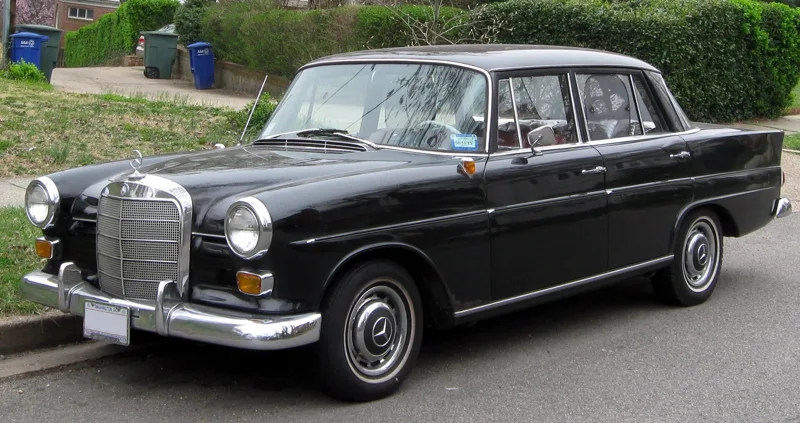
Mercedes-Benz introduced the W114 and W115 in 1968 to succeed the W110 models of 1961. Paul Bracq drew the squared-off, three-box shape. W114 models had six-cylinder engines and were sold as the 230.6, 250 and 280, while W115 models had four cylinders and carried the names 200, 220, 230.4 and 240, with a D added for diesels. The company marketed them as New Generation Models, the only cars ever to receive that label.
The nickname comes from the ID plates. Mercedes used a /8 on them to mark the 1968 launch year, which gave rise to slash eight, and in German Strich Acht, loosely stroke eight.
Under the skin they were the first post-war Mercedes-Benz production cars with a new suspension, a semi-trailing rear arm and ball-joint front end that all new passenger cars used until the multi-link rear suspensions of the 1980s. The W115 chassis also hosted the company's first five-cylinder diesel, the OM617. In 1968 the 250 CE, followed by the 280 CE, took Bosch D-Jetronic, the first fully electronic fuel injection system fitted to a Mercedes-Benz. The range was the first with a full centre console running from the dashboard to the tunnel.
A coupe arrived in 1969, with a longer boot lid and a 2.5 or 2.8 litre six-cylinder engine, and with a pillarless body that let every window drop completely. From 1969 to 1976 Mercedes made 67,048 coupes against 1,852,008 saloons; 24,669 of the coupes were 280 C and 280 CE models and 42,379 were 250 C and 250 CE. A facelift in August 1973 brought a lower bonnet line, a lower and broader grille, a single front bumper, ribbed tail lights to resist road dirt, larger mirrors, inertia reel seat belts and a new padded steering wheel.
Each of the three saloons leaned on the same evidence: they were built to last.
What the American rules did to the /8
US models changed more than most. For 1974 they gained massive 5-mph bumpers, which added weight and blunted the performance. Tightening emission rules replaced the M130 six with the DOHC 2.7-litre M110, turning the 250 and 250 C into the 280 and 280 C. In 1975 a three-litre five-cylinder OM617 diesel arrived in the United States as the 300 D, while Europe called the same engine the 240 D 3.0. In 1976 the American range was the 230, 240 D, 280, 280 C and 300 D.
| 280 C, 1973 to 1976 | European car | US car |
|---|---|---|
| M110 engine output | 160 hp (DIN net) in 1973 | 132 hp in 1973, 122 hp by 1975 |
| Kerb weight | 1455 kg throughout 1973 to 1976 | 1490 kg in 1973, 1510 kg in 1974, 1565 kg for 1975 and 1976 |
The Mercedes W123, the car that outsold them all
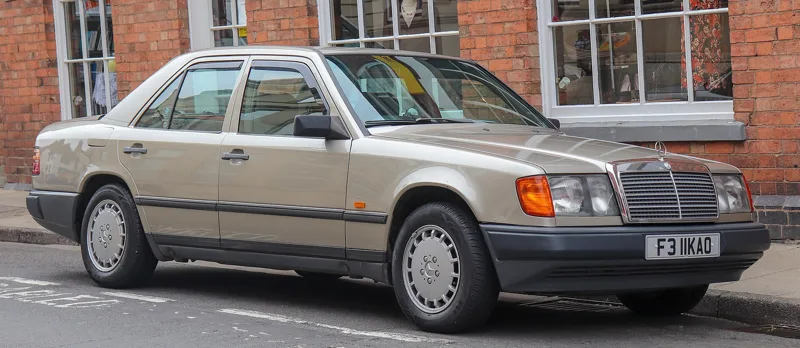
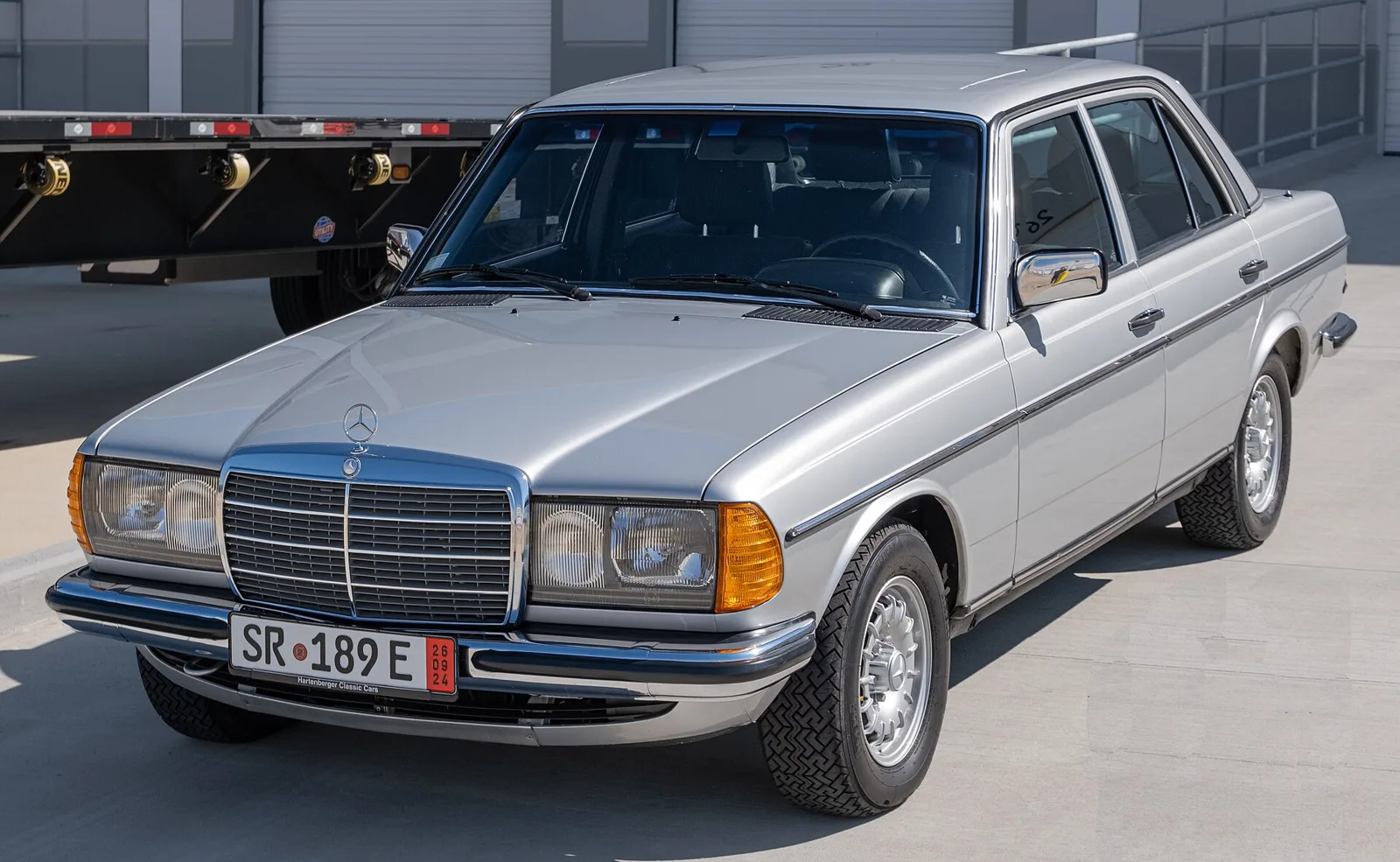
The W123 ran from November 1975 to January 1986, and beat its predecessor as the most successful Mercedes-Benz, with 2.7 million built. Saloon production ended in the autumn of 1985 and the coupe and estate closed the line in January 1986, when the last 63 estates rolled out. The best sellers were the 240 D at 455,000 cars, the 230 E at 442,000 and the 200 D at 378,000.
The first year was slow, and customers who ordered then waited nine to twelve months. A black market sprang up for buyers willing to pay for immediate delivery, and a slightly used W123 fetched about 5,000 Deutsche Mark over its original price.
Reliability built the legend. Many German taxi companies chose the W123, and reaching 500,000 km or more with only minor mechanical problems was common in taxi service. When service life was over, the cars were often shipped to Africa and developing countries, where people prized their ability to cope with rough roads and their infrequent need for maintenance.
The W123 kept the engines, steering and suspension of its predecessors. Its look took cues from the larger W116, with wider ribbed tail lights, horizontal headlamps, front indicators on the outer edge and pull-to-open door handles. Friedrich Geiger headed the styling department when the design was finalised in 1973. Chief engineer Hans Scherenberg wanted a balanced, dynamic, non-aggressive shape, with horizontal lines, less chrome and rounded forms, and said the company was as unimpressed by revolutionary leaps of style as by fashionable gimmicks.
How W123 names and bodies were organised
The model name followed engine size, with letters for the body and fuel system: W for the saloon, C for the coupe, T for the estate (Tourismus und Transport), D for diesel and E for Einspritzung, fuel injection. A turbocharged diesel wore a Turbodiesel emblem on the boot lid. The chassis codes were W123 for the saloon, S123 for the estate, C123 for the coupe, V123 for the long-wheelbase saloon and F123 for the bare long chassis.
- Saloon: on sale from 29 January 1976.
- Coupe: spring 1977, on a wheelbase of 2,710 mm (106.7 in) against 2,795 mm (110.0 in) for the saloon, as the 230 C and later 230 CE, the 280 C and 280 CE, and the 300 CD Turbodiesel for the US.
- Limousine: from August 1976, extended to 3,425 mm (134.8 in), seating seven to eight, with 250, 240 D and 300 D engines.
- Chassis: a strengthened long chassis with the front body as the base for ambulances and hearses by specialists such as Binz and Miesen.
- Estate: the brand's first factory-built estate, shown at the 1977 IAA in Frankfurt and built from April 1978 in Bremen. Earlier estates had been custom-built by coachbuilders.
Mercedes never built its own convertible, but outside firms converted C123 coupes. Crayford in the UK made the St. Tropez using folding soft-top mechanisms from salvaged 1973 Ford Mustangs, Niko-Michaels worked in New York, and the small family firm Baehr in Hagen built cabriolets and conversion kits until 2016.
W123 engines, a diesel first and a London to Sydney win
The W123 inherited the W115 engines, including the 2.0 and 2.3 litre petrol fours and the three-litre five-cylinder OM617 diesel, while a new 2.5-litre M123 six replaced two older W114 motors and wore the 250 badge. The flagship 2.7-litre M110 came as the carburetted 280 and the K-Jetronic 280 E. In autumn 1978 the 240 D rose from 65 to 72 PS (48 to 53 kW; 64 to 71 hp) and the 280 E from 177 to 185 PS (130 to 136 kW; 175 to 182 hp). In June 1980 a new M102 four-cylinder petrol engine replaced the M115.
The standout arrived in September 1979. The 300 TD Turbodiesel carried the OM617 A, the world's first turbocharged diesel engine for a passenger vehicle, at first exclusive to Europe. North America and Japan received it in 1981. On the rally stage, the 280 E won first and second places in the 28,200 km (17,500 mi) 1977 London-Sydney Marathon, ahead of the third- and fourth-placed Citroen CX.
Selling the W123 in America
American sales began with the 1977 model year, with the 230, 240 D, 300 D and 280 E. Meeting Environmental Protection Agency and Department of Transportation rules took extensive changes, so the cars differed markedly from European ones. The estate came to the US in 1979 with only the three-litre diesel. Externally the changes were big 5-mph bumpers and sealed-beam headlights.
The same period brought federal fuel economy regulations and Clean Air Act amendments requiring catalytic converters, lower compression and exhaust gas recirculation. The European 280 E weighed 1460 kg. Its DIN rating was 185 PS (136 kW; 182 hp), with 240 Nm (177 lb ft) of torque. The North American version made between 137 and 142 hp (102 and 106 kW; 139 and 144 PS) and weighed at least 100 kg (220 lb) more.
Diesels faced less stringent rules, which Mercedes-Benz saw as a way round the restrictions. From 1981 the turbocharged diesel was the only engine for the 300 D, 300 CD and 300 TD, and the 300 CD was sold only in the US. Its extra performance meant the 280 E and 280 CE were dropped for 1982, and American buyers found the naturally aspirated diesel too slow for the extra weight. The 240 D disappeared for the 1984 model year because the new W201 190 E and 190 D took over as the cheapest Mercedes-Benz. Until the W124 arrived in 1986, the US W123 range had a single engine, the three-litre turbodiesel.
The Mercedes 190E and W201, the compact Mercedes
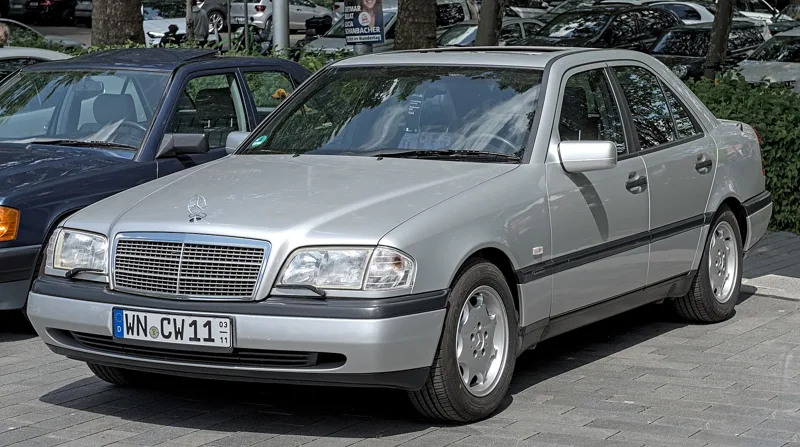
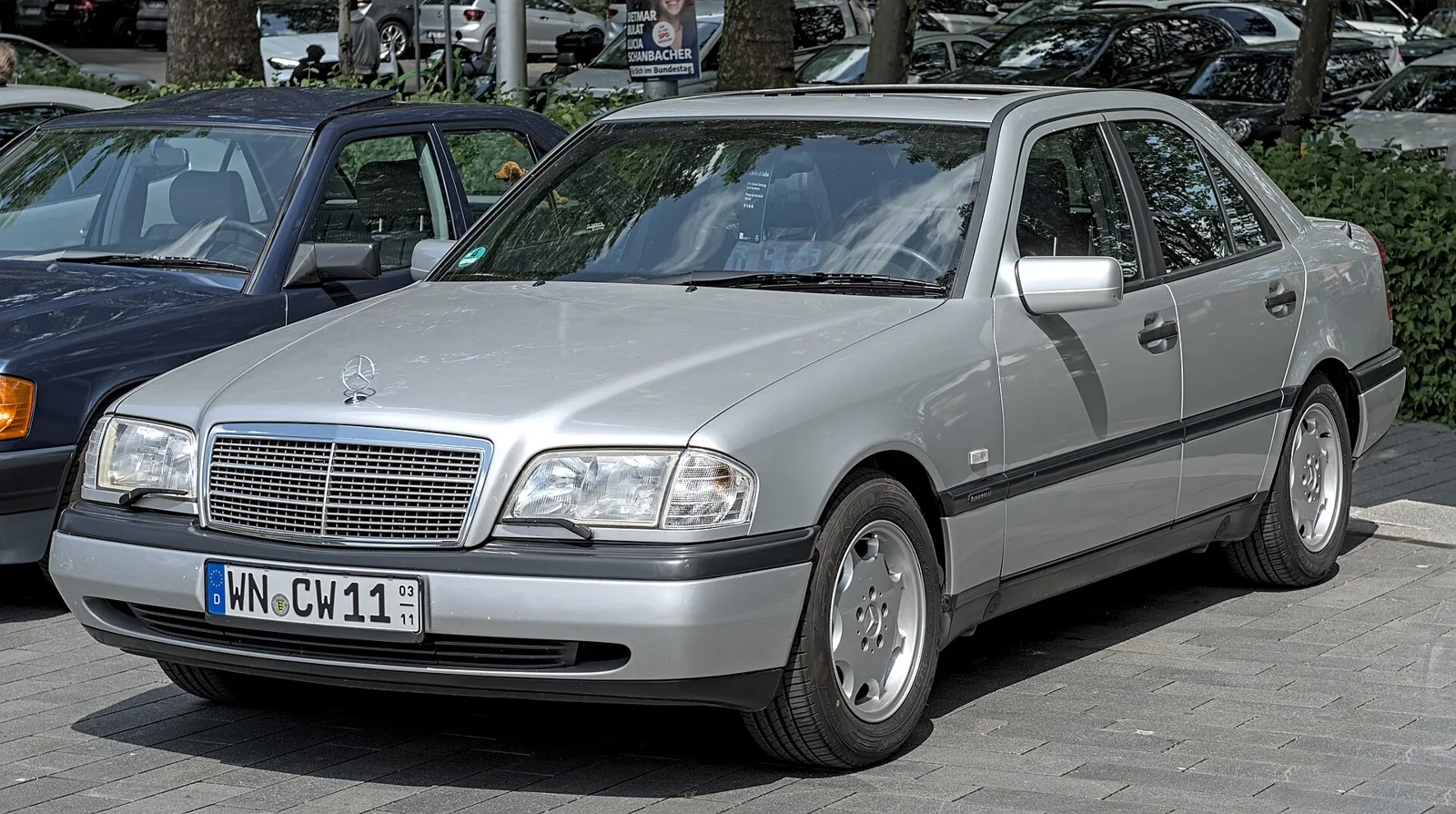
The W201 is the internal name for the 190 series, a range of rear-drive, five-passenger, four-door saloons built over a single generation from 1983 to 1993 as the company's first compact class car. Bruno Sacco, head of styling from 1975 to 1999, designed it. Production reached 1,879,629 across eleven years at Bremen and Sindelfingen.
It introduced a five-link rear suspension that later spread to the E-Class and C-Class, together with anti-roll bars at both ends, anti-dive and anti-squat geometry, airbags, ABS brakes and seat belt pretensioners. Extensive light, high-strength steel let it take a 35 mph (56 km/h) offset crash into a concrete barrier with no serious injury to occupants and no deformed cabin.
The development cost was enormous. From January 1974 to January 1982 Mercedes spent more than 600 million pounds, later saying the car was massively over-engineered. Prototype testing began in 1978, final styling was approved on 6 March 1979 and pilot production began in February 1982. The 190 was unveiled on 8 December 1982 and launched in Germany the next day, with right-hand drive for the UK from September 1983. When Bremen could not start production at first, Sindelfingen began it at a capacity of only 140,000 units a year.
The 190 E, E for Einspritzung, used Bosch KE-Jetronic fuel injection in place of the carburettor on the 190, and with larger valves it made more power. The carburetted car was dropped in April 1990 and replaced by a fuel-injected 1.8. The 1991 model year brought light exterior changes, such as door frames painted in body colour instead of anodised black, and the last 190 E was built on 17 May 1993.
Mercedes 190 engines and special editions
The first models in 1982 were the 190 and 190 E, both with the 1,997 cc M102 four. The 190 made 90 PS (66 kW; 89 hp) and the 190 E 120 PS (88 kW; 118 hp). A 190 E 2.3 followed in September 1983 for North America with 113 hp (84 kW; 115 PS), cut by emission rules, and in September 1985 the first inline-six 190 appeared at the Frankfurt show as the 190 E 2.6, with 160 PS (118 kW; 158 hp) with a catalytic converter and 166 PS (122 kW; 164 hp) without. In 1992 and 1993 the 2.6 was offered as a Sportline with upgraded suspension and interior. The diesel 190 D came with a 2.0-litre four, a 2.2 for the US and Canada only in 1984 and 1985, and a 2.5-litre five. A 2.5 Turbo reached American buyers only in 1987 and has since become something of a collector's item, with fender vents to feed air to the turbocharger.
Special editions were common. Roughly 1,000 190 LE cars went to the UK and Ireland for the 1993 model year, each with a numbered certificate and priced nearly 3,500 pounds below an equivalent 1.8. In Australia the 180 E ran from October 1991 to March 1994 at A$45,450 against A$63,200 for the 190 E, with ABS, power windows, climate control, electric seats, cruise control and the multi-speaker sound system all deleted. Portugal had a 190 E 1.7, built from May 1992 to August 1993 with the bore cut to 87.5 mm (3.44 in) to give 1,737 cc and keep under a tax threshold of 1,750 cc. And in 1993, 1,400 limited-edition cars went to the US, split evenly between the 2.3 in Emerald Green and the 2.6 in Black.
The Mercedes 190E 2.3-16 and the Cosworth engine
In the late 1970s Mercedes rallied with big V8 coupes of the R107 series, mainly the 450 SLC 5.0. It then wanted to rally the 190 E and asked the British firm Cosworth for an engine with 320 hp (239 kW; 324 PS), a job Cosworth called project WAA. The Audi Quattro, with its four-wheel drive and turbocharged engine, arrived at about the same time and made the 190 look outclassed for rallying. Mercedes turned to the German touring car championship, the DTM, whose cars had to be based on a road model, so it put a detuned version of the engine into series production as the 190 E 2.3-16.
It was shown at the Frankfurt Motor Show in September 1983, with its reputation already made. In August, three lightly altered cars had set three world records at the Nardo test facility in Italy, averaging 247.94 km/h (154.06 mph) over 50,000 km and taking twelve international endurance records.
Cosworth built on the 2.3-litre eight-valve M102, which made 136 hp (101 kW; 138 PS) in the 190, developing a light alloy cylinder head made by its own casting process, with twin overhead camshafts and four valves per cylinder. In road trim the 16-valve engine made 183 hp (136 kW) at 6,200 rpm and 236 Nm (174 lb ft) at 4,500 rpm. Its oversquare dimensions of 95.50 x 80.25 mm let it rev to a 7,000 rpm redline. Acceleration from 0 to 100 km/h (62 mph) took under eight seconds, and the top speed was 230 km/h (143 mph). To bring power down from the racing version the engineers reduced port sizes, changed the cam profiles, dropped the dry sump and replaced the Kugelfischer injection with Bosch K-Jetronic. The outcome was an engine described as unusually flexible, with a very flat torque curve.
| Version | Output | Notes |
|---|---|---|
| 2.3-16, European | 183 hp (136 kW) at 6,200 rpm | 230 km/h (143 mph) top speed |
| 2.3-16, US specification | 167 hp (125 kW; 169 PS) at 5,800 rpm | Compression ratio 9.7:1 instead of 10.5:1 |
| 2.5-16, European, no catalytic converter | 204 PS (150 kW; 201 hp) | Introduced in 1988 with double-row timing chains |
| 2.5-16, with catalytic converter | 195 PS (143 kW; 192 hp) | Cosworth's code for the head was WAB |
| 2.5-16 or Evolution I with AMG Power Pack | 224 hp (167 kW; 227 PS) at 7,200 rpm | 250 km/h (155 mph) top speed |
The 2.5-litre engine replaced the 2.3 in 1988 and added double-row timing chains to cure the early 2.3's habit of snapping its single chains. The 16-valve cars wore a body kit that cut the drag coefficient to 0.32, one of the lowest for a four-door saloon of the time, and reduced lift at speed. In racing tune the engines produced up to 350 bhp (261 kW).
How the three generations connect
Durability is the thread. The W115 produced the highest-mileage Mercedes-Benz on record, the W123 piled up kilometres in German taxi service before a second life in Africa, and the 190 followed more than 600 million pounds of development. Naming carried over too, with engine size in the badge and D and E suffixes for diesel and fuel-injected cars, a tradition that held until the 1993 rebranding.
What this means if you are looking at one
The badge reads as a code: displacement, then letters for body and fuel. A US car of the 1970s and 1980s is not the same car as its European sibling, with bumpers, headlights and power that differ, and a 280 E will behave differently depending on which market it was built for. A 190 can be a plain 1.8 or a 16-valve Cosworth car, and the 2.3-16 and 2.5-16 differ from other 190 models in the engine and the body kit.
What came next
The W123's single American engine option lasted until the W124 arrived in 1986, and the W201 190 E and 190 D had already replaced the 240 D as the lowest-priced Mercedes in the US lineup. The last 190 E left the line on 17 May 1993, the year of the rebranding that ended the older naming tradition. The 2.3-16 and 2.5-16 sit at the top of the 190 story.