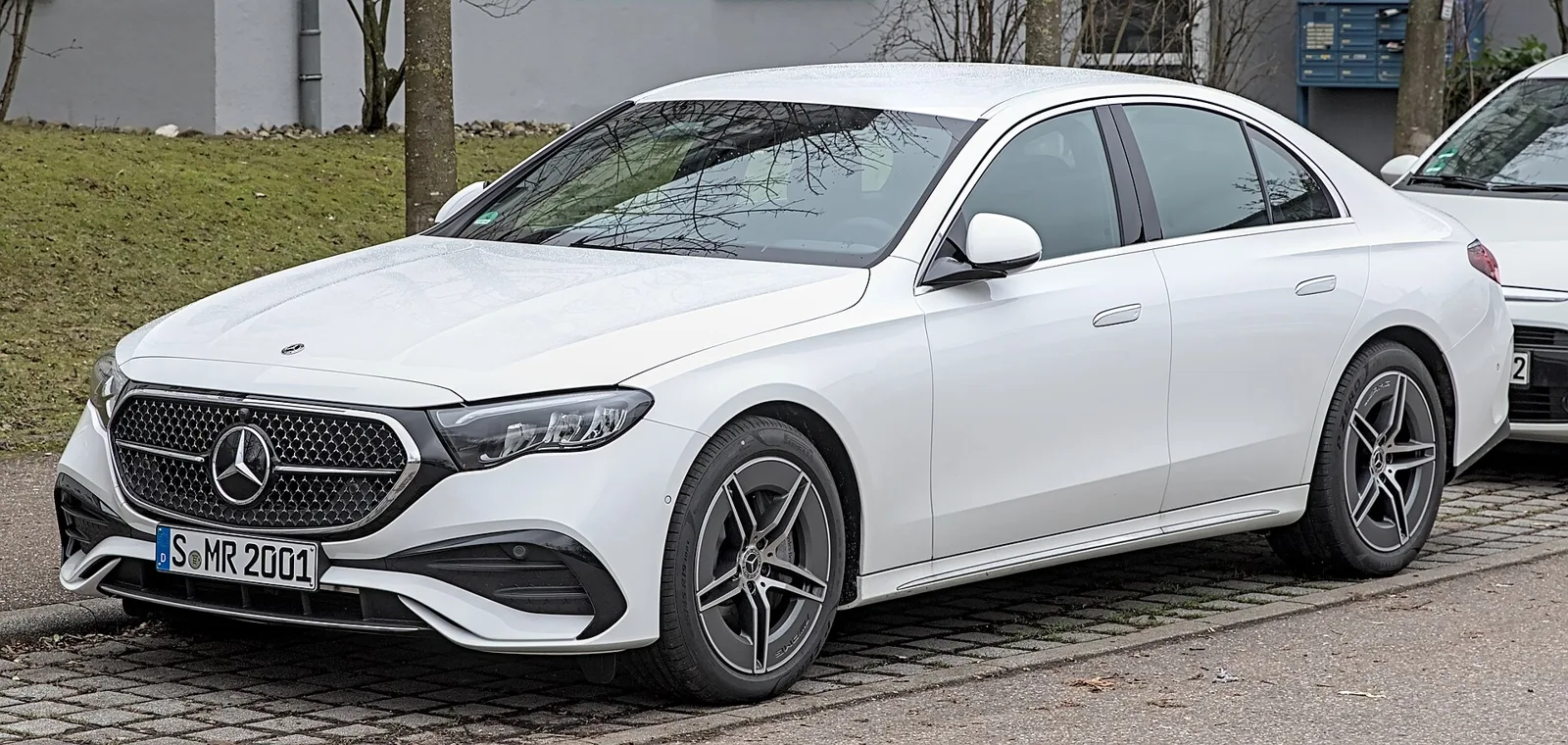
A mid-range Mercedes line that dates from 1953, took its E name in 1993 and has since passed through six generations.
The Mercedes-Benz E-Class is a mid-range executive car line that dates back to 1953, although the E name arrived in 1993. More than 16 million have been sold, and the W214 generation debuted in April 2023 as a saloon and estate.
The Mercedes-Benz E-Class has sat in the middle of the Mercedes range since September 1953, and by 2023 more than 16 million had been sold, which makes it the marque's top seller. The E label is much younger than the cars that carry it, dating only from a 1993 rebrand. Every generation has been offered with rear-wheel drive or the 4Matic four-wheel drive system.
Where does the E-Class name come from?
Before 1993 the E in Mercedes names was short for Einspritzmotor, the German word for a fuel injection engine. Once the W124 was facelifted in 1993, almost every Mercedes engine was injected, so the letter moved in front of the number, as in E 220.
The name was adopted in July 1993 as part of a company-wide scheme that placed each product into a named class. It first appeared on the facelifted W124 in August 1993 for European buyers, and in September for the 1994 model year in America.
The rebrand reached well beyond the mid-range. The R129 SL became the SL-Class, the G-wagen became the G-Class, and the W124 finally shed its unnamed status. Because the petrol engines were all injected, the E suffix had become the most common one on the W124, which made it the obvious name for the mid-range.
The E name arrived in 1993, but the mid-range line it names dates back to 1953.
Did the E-Class exist before 1993?
The mid-range line is far older than its name. From 1949 to the early 1980s Mercedes built two prestige lines, with four-cylinder engines in the mid-range and eight-cylinder engines in the S-Class, although six-cylinder engines were often shared between them.
The divide became official in 1972, when the premium range took the Sonderklasse label, which lasted until July 1993. That label covered more than the sedans, reaching the R107 and R129 SL roadsters and the C107 and C126 coupes as well. The lower tier had no brand of its own, so people called it the mid-range or the medium class, Mittlere Klasse in German.
Before 1972 the two tiers often shared a chassis, body shell and much of the underpinnings. The W114 and W115 Stroke-8 cars, in production from 1968, are seen by some writers as the first real predecessor of the E-Class.
Mercedes-Benz later recognised pre-war cars as ancestors, naming the W15 170, the W21 200 and the diesel W138 260D among them. It dated the lineage to 1946, when production restarted with the W136 170V, and passenger deliveries began in July 1947.
What were the Ponton and Fintail cars?
The first modern midsize car was the 1953 Ponton 180, a W120 saloon built until 1962 with a four-cylinder engine. It shared engineering with the 1955 R121 190 SL, and the W121 190 with an OHC engine followed in 1956 beside a six-cylinder W105.
The Fintail W110 190 of 1962 added tailfins, and the 1965 230 brought the range its first straight-six. The four-cylinder engines grew in capacity at the same time, which made the line-up harder to follow.
Several inter-class models filled the gaps. Between 1956 and 1968 a run of models, from the W105 219 to the W110 230, took over from one another, and from 1965 to 1968 the W111 230S ran alongside the new W108 and W109.
In 1968 the midsize range was redesigned as the W114 and W115 Stroke-8. Six-cylinder W114 models were the most prevalent, while the W115 covered the bottom of the range with four- and five-cylinder engines. A coupe joined in 1969 and became the first mid-range Mercedes offered with D-Jetronic fuel injection.
Specifications
| Generation | Code | Launch | Notes |
|---|---|---|---|
| First generation | W124 | 1984, production from January 1985 | 4Matic, DOHC heads, catalytic converters |
| Second generation | W210 | January 1995 | Four large oval headlights, facelift in 1999 |
| Third generation | W211 | 2002 | Facelift in 2006 for the 2007 model year |
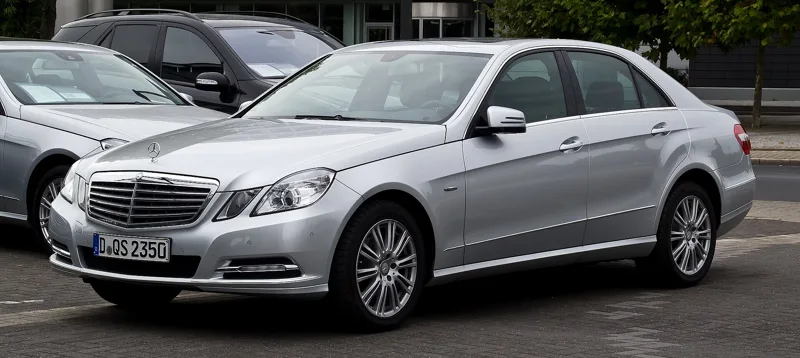
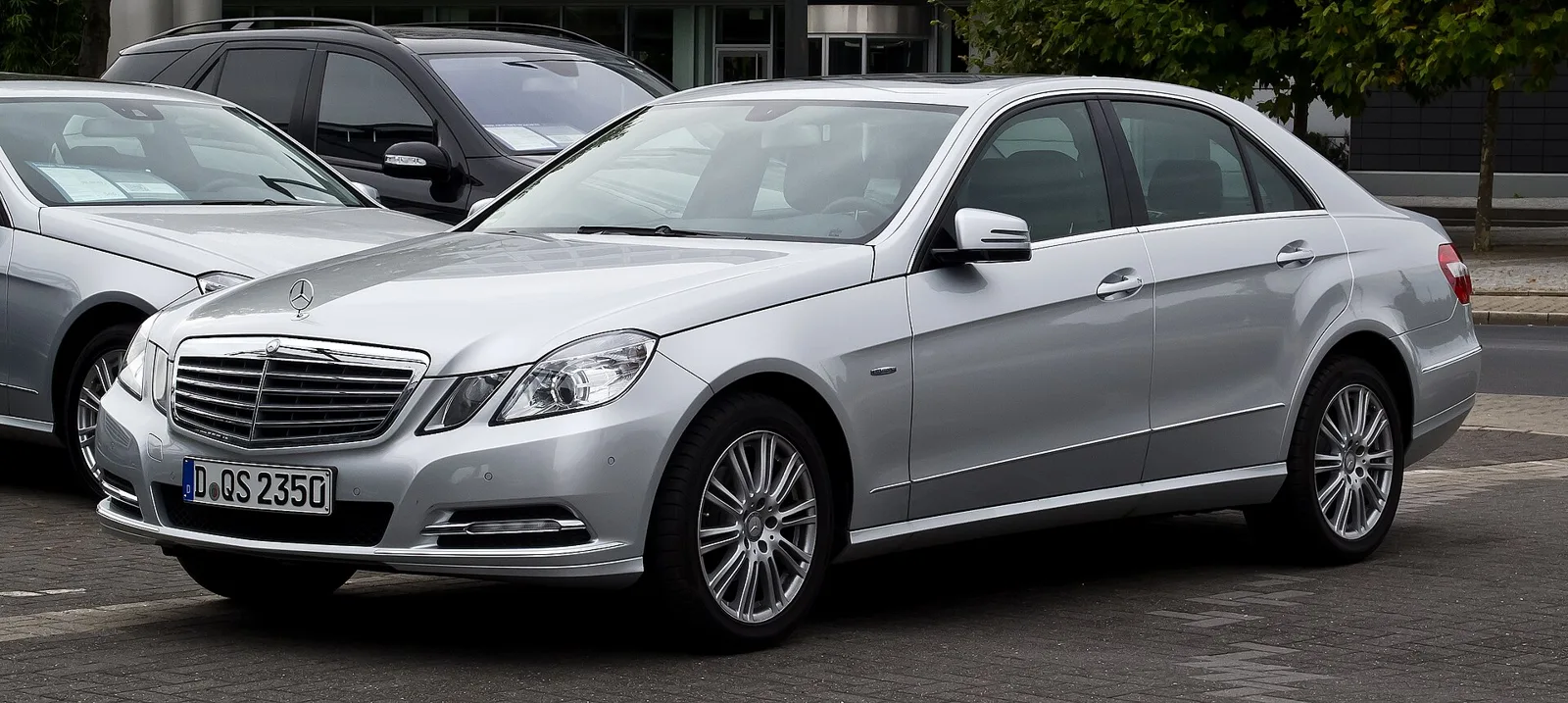
| Fourth generation | W212 | 2009, as a 2010 model | Estate from November 2009, facelift in 2013 |
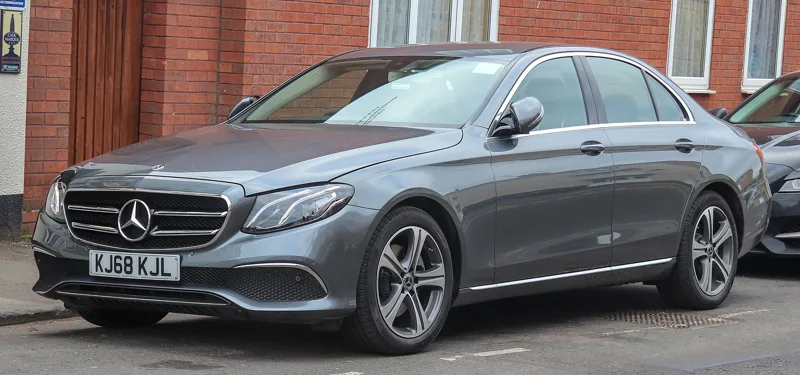
| Fifth generation | W213 | 2016 | Inline-six engines return, facelift in 2020 |
| Sixth generation | W214 | 25 April 2023 | Saloon and estate only |
How did the W124 start the modern E-Class?
The W124 was presented in November 1984 and went into production in January 1985, and it was the car that later carried the E-Class name. It added 4Matic all-wheel drive, double overhead camshaft heads and a new set of emission controls.
The emissions package spanned catalysts, particulate filters for diesels and exhaust gas recirculation. The top 500E was a performance model co-built with Porsche. The W124 was the third car to take the company's newer design theme, after the flagship W126 and the compact W201.
The W124 came as a saloon, coupe, estate and, from 1992, a cabriolet called the A124. Saloons were built through 1995, while estates and coupes ran to 1996 and cabriolets to 1997.
Which body styles did each generation offer?
The W210 offered a saloon and an estate, and the estate lingered as the S210 until March 2003. The W211 brought a saloon and an S211 estate, and the CLS-Class four-door coupe sat alongside it from 2005.
The W212 offered saloon and estate bodies, with coupe and convertible versions added on the W204 platform. From the W213 onward every body style has shared one platform, and the W214 keeps only the saloon and estate.
What made the W123 a best-seller?
The W123 became a best-seller soon after its 1976 launch, and it lifted the company's reputation for quality, especially in 240D and 300D diesel form. Saloon, coupe and estate bodies were offered, and over 2.6 million were built before production ended in 1986.
The diesels carried much of that reputation. Their economy and durability gave Mercedes a name for long-lasting cars, and the W123 became a familiar sight on roads across Europe and beyond.
How big was the W210 change?
The W210 arrived in January 1995 with four large oval headlights, a fresher face meant to appeal to younger buyers and women. It was also larger, at 4.1 cm longer (1.6 in) and 5.8 cm wider (2.3 in), with far more interior room, yet it still counted as a mid-size car.
In September 1999 the W210 gained visual, mechanical and quality improvements in a facelift. Motor Trend had already named it Import Car of the Year for 1996.
The W210 saloon gave way to the W211 in 2002. The estate remained on sale until March 2003, when an S211 model replaced the S210 wagon.
What changed with the W211 and W212?
The W211, launched in 2002, was an evolution of the W210 rather than a clean break. Its June 2006 facelift tackled quality and technical problems, removed Sensotronic and made Pre-Safe standard. That year the E500 grew from 5 litres to 5.5 litres, the largest factory engine in the range.
AMG models badged E55 and E63 were offered, along with installations by tuning houses. A niche CLS-Class four-door coupe, introduced in 2005, used the W211 underpinnings to reach a younger audience.
The W212 took over from the W211 in 2009 and was sold as a 2010 model. Its photos leaked online on 9 December 2008, ahead of the 2009 Geneva show, and a brochure surfaced in January 2009 detailing E 200 CGI and E 230 CGI engines with direct injection.
What did the W212 add and how was it priced?
The safety kit grew too, with a blind spot monitor, Lane Keeping Assist, a Pre-Safe system that worked with attention monitoring, and Night View Assist Plus. American buyers paid nearly US$4,600 less than for the car it replaced, and the estate arrived in November 2009.
Daimler put close to EUR 1 billion into the 2013 facelift, which makes it likely the most expensive mid-life update the car industry has seen. The work brought significant styling changes, fuel economy gains and updated safety equipment.
The biggest change was a single front light unit that replaced the twin headlamps, marking the end of Mercedes' dual headlamps. Integrated LED daytime running lights completed the new face.
How powerful was the E63 S AMG?
The E63 S AMG is rated at 577 HP (585 PS) and 590 lb-ft (800 Nm) of torque. Those are the official ratings. Dynamometer testing has indicated that the engine's real output is higher, with figures above 600 HP (608 PS) at the flywheel.
Enthusiasts therefore tend to quote the higher number when they discuss the car. The official rating and the measured output are both useful, but they answer different questions about the same engine.
Where did the coupe and convertible fit?
From 1997 to 2009 the coupe and convertible versions were sold as the CLK-Class. That car used C-Class mechanics, while taking styling and some engines from the E-Class. The C207 coupe and A207 convertible that followed sat alongside the W212 saloon and estate.
The C207 coupe was first shown at the 2009 Geneva show, and the A207 convertible followed in 2010. Both replaced the earlier CLK models, and they were built on the W204 C-Class platform in Bremen.
Why did the W213 matter?
The W213 was revealed in 2016, and its styling took hints from the W222 S-Class, which is bigger, and from the W205 C-Class, which is smaller. Its engine line changed as well, with inline-six engines returning in place of the V6s, and a new family of four-cylinder diesels arrived under the code OM654.
Since the W213 arrived for 2017, every body style has used one platform, so saloons, estates and the rest share identical underpinnings.
The W213 was described as the second most technologically advanced Mercedes behind the new S-Class. Its highway system could take over steering, braking and speed on its own, reaching 210 km/h (130 mph) for stretches of up to two minutes, but the driver had to keep hands on the wheel at all times.
Motor Trend named the W213 its car of the year in November 2020, a first for the marque. A facelift followed in 2020. A facelift followed later that year.
What is the W214?
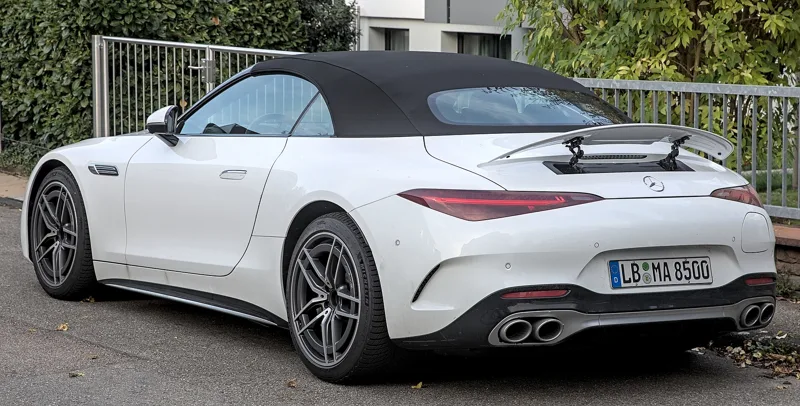
The sixth-generation E-Class, the W214, debuted on 25 April 2023 with saloon and estate bodies only. Coupes and convertibles were dropped, and executive coupes and convertibles now sit between the E-Class and the C-Class under the CLE name. Buyers who want a coupe or convertible will therefore look at CLE rather than the E-Class. The core E-Class now comes only as a saloon and an estate.
Why are E-Class cars used as taxis and police cars?
The E-Class is large and durable, which made it a frequent choice for taxis in European countries, and its familiarity on those streets is part of its reputation. The factory also built special-purpose versions, including police and ambulance conversions, so the car reached well beyond private buyers, and many examples spent their working lives in daily service.
That breadth let one model cover private owners, taxi operators and emergency services. It is one reason the E-Class has been a steady seller across so many markets.