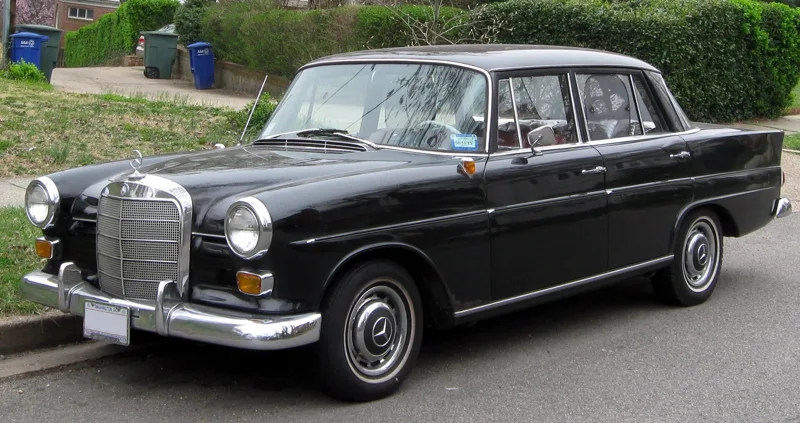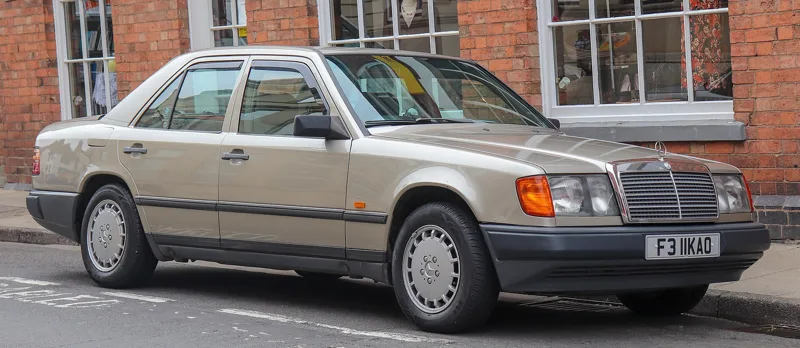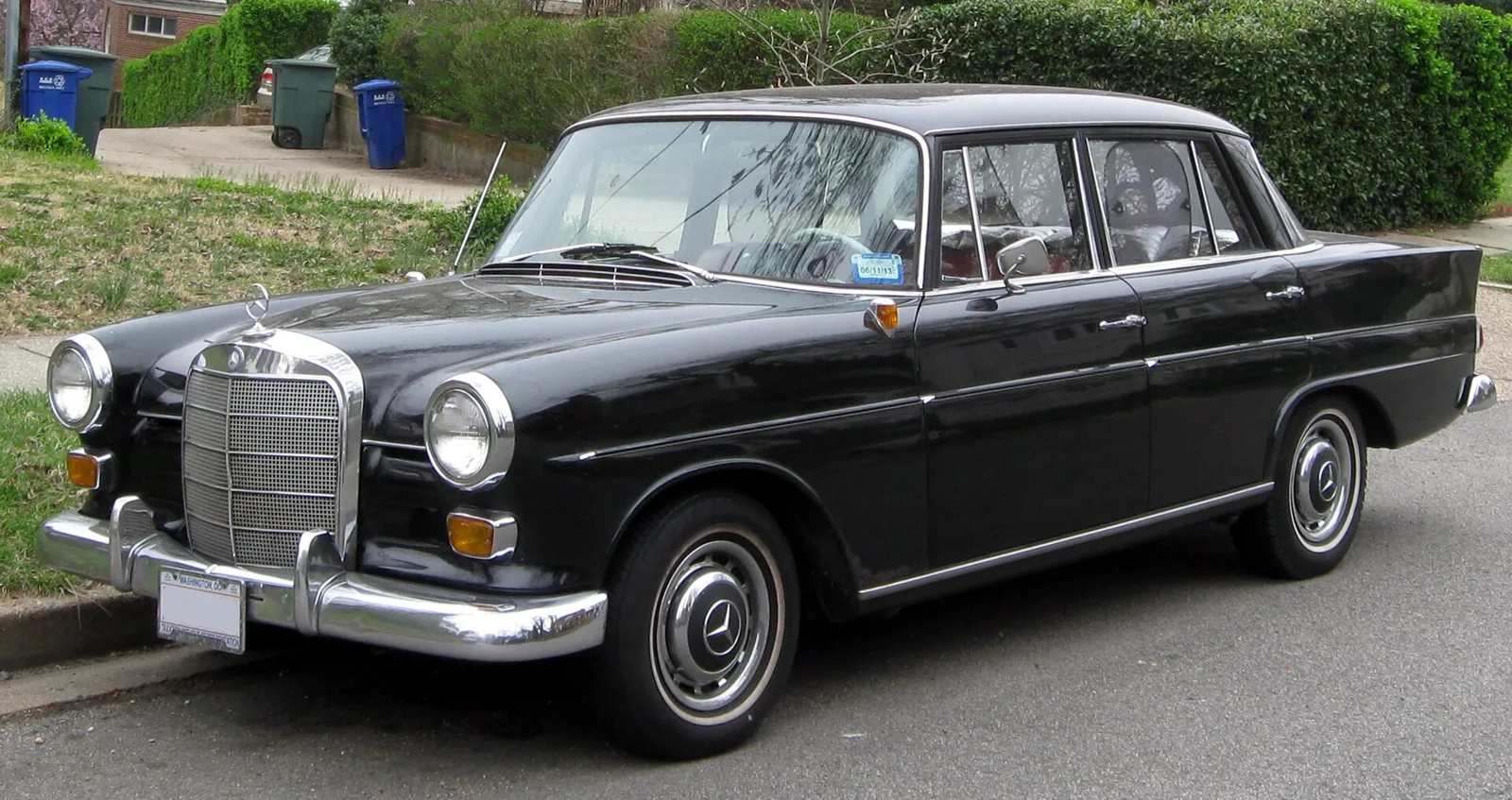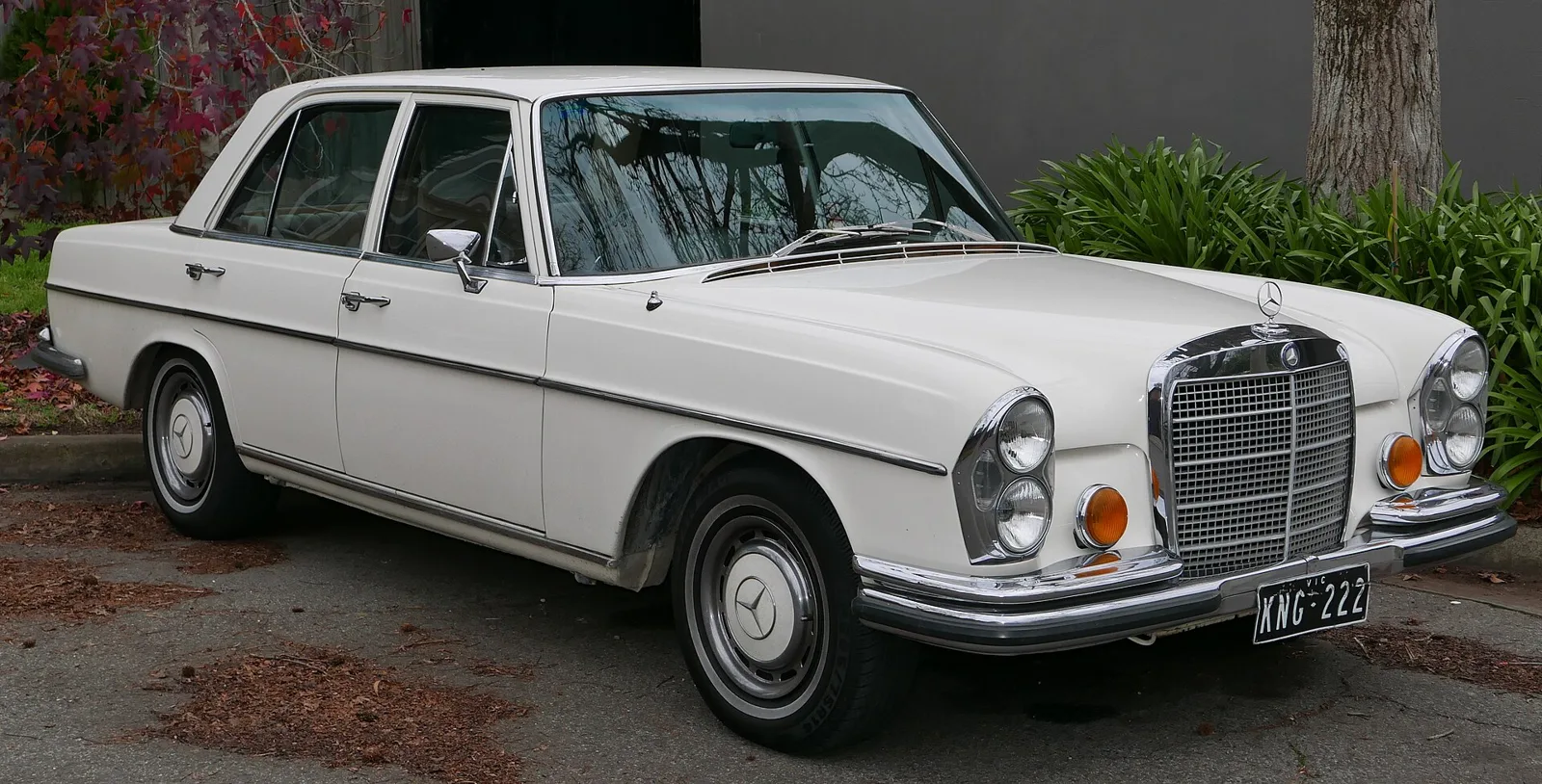
From the 250 S to the 6.3 Q-car and the 4.5-litre American V8, the 1965 to 1972 range that closed the Ponton era.
Four-door luxury saloons from 1965 to 1972, the W 108 and W 109 as an Upper Middle Class range. A total of 383,072 were made, and the line ran from the 250 S to the 6.3-litre V8 and the 4.5-litre American model.
Mercedes-Benz sold the W 108 and W 109 as luxury saloons from 1965 to 1972, and the company placed them in a new Upper Middle Class bracket. Over the seven years, 383,072 left the factory, and the cars sold well in West Germany, North America and Southeast Asia.
The W 108 was the standard-wheelbase car and the W 109 the long-wheelbase version. Both were four-door only, and their boxy outlines were easy to confuse with the two-door coupes and convertibles of the W 111 and W 112 family, which were drawn in a similar style.
Where did the W 108 and W 109 come from?
Their roots lie in the four-door W 111 of 1959 to 1965 and the W 112 of 1961 to 1965. Those cars put the whole Mercedes line onto one platform and one body, trimming cost and build time. Their tailfins, a late-1950s fashion, had already lost favour by the time the new saloons were planned.
Paul Bracq took charge of the company's design department in 1957 and moved styling away from ornament towards function. His two-door W 111 and W 112 of 1961 were the first to show it, with fins rounded into the body. Work on the replacement saloon began alongside, and the design was settled by 1963 on the same platform and underpinnings.
The brief was to give the interior more room without growing the compact six-cylinder outline. The top W 112 sedan had sold poorly, partly because it looked like the cheaper four-cylinder W 110, so the new big saloons were kept off the lower tiers' hardware.
A four-door Mercedes that sold 383,072 times and hid a Q-car V8 under a sober body.
How much roomier were the new bodies?
Compared with the Type 220 S, the new body was only slightly larger, at 25 mm (1.0 in) longer and 15 mm (0.6 in) wider, while the roof sat 60 mm (2.4 in) lower. Better packaging did the rest, with curved side glass and a dropped beltline.
Interior width gained 70 mm (2.8 in) in the back and 90 mm (3.5 in) in front. The floor ahead of the rear bench fell by 20 mm (0.8 in), and a lower centre of gravity sharpened the handling. The windscreen grew 17 per cent over the W 111's, and the total glass area rose by 12 per cent.
The nose kept the traditional Mercedes grille and a lowered bonnet, with vertical Lichteinheiten units that housed headlamps, parking and indicator lights and fog lamps in one assembly. American export cars instead used round sealed-beam headlamps with separate parking and indicator lamps to comply with local rules.
How was the body built and protected?
Welding the body to the floor pan produced a single unit with strong torsional stiffness. Exposed areas got a seven-stage paint process, starting with a zinc phosphate anti-rust coat and finishing with a topcoat, all baked between 130 and 165 degrees Celsius.
The underside, inner wings, sills and front valance were covered in roughly 14 kg of PVC. The compound stayed flexible so that stones bounced off, and it damped noise too. Wax went onto the engine bay and underbody, while the chrome trim was built up from five separate layers over steel.
Bela Barenyi shaped the safety package, drawing on accident research carried out by Daimler-Benz. The passenger cell was made stiff, and the nose and tail were made to collapse in a crash. Inside, the dashboard was padded at its top and bottom edges, the door handles and pull knobs were made of resilient material, and the steering wheel carried a padded hub.
Every model had dual-circuit power brakes with discs at all four corners, and the booster supplied about three-quarters of the pedal effort. On the sedans, a brake pressure limiter on the rear axle gave way to fixed pressure distribution from around 1969.
What did the seats and cabin offer?
Doctors helped engineers design the seats, which used firm cushions so that occupants could shift position without bouncing. The backrest followed the curve of the spine, and the bucket shape held the body in place. The driver's seat moved fore and aft and up and down, and the backrest could be laid almost flat.
Heavy insulation separated the engine bay from the cabin, and the blower ran at three speeds even with the engine off. Luggage space measured 610 litres. Options included a sunroof, electric windows, power steering and air conditioning, while twin horns were fitted as standard.
How did the W 108 differ from the W 109?
The W 108 began as a successor that merged the W 111 with the short-wheelbase W 112 saloons lacking air suspension. The W 112 had itself been a holding measure for the hand-built 300 Adenauer, until the 600 Grand Mercedes arrived in 1963. It had used the alloy M 189 engine and self-levelling air suspension.
Equipment separated the two cars. The W 109 300 SEL kept self-levelling air suspension, whereas every W 108 from the 300 SEb downwards used steel springs and a hydropneumatic compensator on the rear axle, which kept a near-constant ride height whatever the load. Power windows, power steering and automatic transmission, which were optional on the W 108, came as standard on the W 109.
From outside, the W 109 showed polished metal trim around its door windows and A-pillars. Later 3.5 and 6.3 models added vacuum-operated central locking.
How did the chassis handle?
At the front, a pressed U-profile carrier held double wishbones on each side, so that wheel location and springing were handled separately. Coil springs, gas-filled telescopic dampers and progressive bump stops completed the set, and an anti-roll bar came as standard, with a second one at the rear of the 300 SEL.
The rear used a single-jointed swing axle whose pivot sat low, and its gas-filled dampers stopped the oil from frothing. Rubber mounts isolated the whole suspension from the bodyshell, and an extra damper on the engine mounts tamed vibration.
Hydraulic assistance came with the recirculating-ball steering. Up to a wheel force of 600 grams it worked purely mechanically, and beyond that a control valve sent pressurised oil to assist. Should the assistance fail, the car could still be steered.
What was the W 109 air suspension?
Daimler-Benz air suspension came as standard on the 300 SEL. The rubber bellows were developed with Phoenix, and the regulating valves came from Bosch. A compressor fed a reservoir at 16 bar, and three level-control valves kept the ride height steady whatever the load. A dashboard switch offered a high setting, raising the body by about 5 cm (2.0 in).
How did the first series perform in 1965?
Frankfurt was the launch venue in 1965, where the W 108 and W 109 were first shown. The launch line-up was the 250 S, 250 SE and 300 SEb, joined by the W 109 300 SEL. The six-cylinder engines came from the previous generation with refinements, and the 2.3-litre M 127 was stroked out to 2.5 litres.
A 2,497 cc M 108 with two downdraught carburettors powered the 250 S and a crankshaft with seven main bearings, which allowed it to run to 6,300 rpm. It delivered 128 bhp (130 PS; 96 kW) at 5,400 rpm and was good for roughly 112 mph (180 km/h). The 250 SE swapped the carburettors for a Bosch six-plunger mechanical injection system, which lifted output to 150 PS (110 kW; 148 bhp) and top speed to 190 km/h (118 mph).
Both the 300 SEb and the 300 SEL relied on a 2,996 cc alloy-block six, the M 189, with mechanical injection. It made 168 bhp (170 PS; 125 kW) at 5,400 rpm, and its torque peaked at 184 lb ft (249 N m), or 25.4 kp m. The automatic could manage about 185 km/h (115 mph), and a manual car with a shorter final drive reached about 200 km/h (124 mph).
Between mid-1965 and early 1968, 129,858 of the 250 S and SE were built, against 5,106 of the 300 SEb and SEL. The small 300-series figure reflected the price and the exclusive intent.
What was the 300 SEL 6.3?
In 1966 the engineer Erich Waxenberger dropped the 6,333 cc M 100 V8 from the 600 into a W 109 chassis, producing the first Q-car from Mercedes-Benz. Series production began in December 1967, and the car was shown at Geneva in March 1968 and at Britain's motor show that October.
Marketing presented it as a long-distance limousine that paired comfort with serious pace. Critics had said the 300 SEL felt sedate, because its air-suspended ride masked speed, and the 6.3 answered that. Its engine made 247 hp DIN (250 PS; 184 kW) at 4,000 rpm, or 304 PS (300 hp; 224 kW) SAE at 4,100 rpm, and the car weighed 6.95 kg per hp (DIN).
The 6.3 covered 62 mph (100 km/h) in 6.5 seconds, with a standing kilometre taking 27.1 seconds, with a top speed of about 220 km/h (137 mph). Fuel use ranged from 14 to 24 L/100 km, drawn from a 105 L tank. The engine's eight-plunger pump and the four-speed automatic came from the 600, and the front axle sat 1.5 cm further forward to make room.
A total of 6,526 were made before the W 108 and W 109 range ended in September 1972. That closure freed the Sindelfingen lines for the new W 116.
Why did the 280 models follow?
Known as the '/8' models, the W 114 and W 115 appeared at the Brussels show in January 1968 and at Chicago that February. Designed by Paul Bracq, they echoed the W 108 and W 109 but used a fresh chassis, sitting beneath the big cars in the range.
Revisions to the six came for 1968. The 1965 M 108 and M 129 units were bored out to 2,778 cc and renamed M 130, giving the 280 S 140 PS (103 kW; 138 bhp) at 5,200 rpm. The fuel-injected 280 SE made 160 PS (118 kW; 158 bhp) at 5,500 rpm, and both gained molybdenum-treated piston rings and an air-to-oil cooler.
Production of the 280 S and 280 SE ran until September 1972, in large numbers. A long-wheelbase 280 SEL came in September 1969 with coil springs, and the 300 SEL kept air suspension with the M 130, tuned to 168 bhp (170 PS; 125 kW) at 5,750 rpm.
What was the 3.5-litre V8?
Mercedes began work on a new generation of V8 in 1963, following the M 100 in the 600. The 3.5-litre M 116 was intended as the mainstay for both American and European cars, and it was developed with a German tax change on engine size in mind.
It was a 90-degree V8 with a grey cast-iron block and light-alloy heads, and its short stroke kept it lower than the six. Bosch D-Jetronic injection replaced the mechanical pump, and the ignition went transistorised. The 300 SEL 3.5 appeared at Frankfurt in 1969, making 200 PS (147 kW; 197 bhp) at 5,800 rpm and reaching 100 km/h in 9.0 seconds.
With the automatic the top speed was 205 km/h (127 mph), and a manual car could reach 130 mph (210 km/h). Amsterdam brought the 280 SE 3.5 and the 280 SEL 3.5 in February 1971, and they shared the engine with the larger cars.
Prices stepped up across the range. By mid-1971 injection on the base 280 S added 10%, while the 3.5 V8 brought 30%, a long wheelbase 40% and air suspension 80%. The flagship 6.3 cost two and a half times the base price. Plenty of M 116 cars were built before the 3.5 series ended in late summer 1972.
How did the 4.5-litre V8 serve the American market?
The 300 SEL 3.5 went on sale in America in 1970, following its New York debut. Tighter emissions rules pushed compression and fuel quality downwards, so Mercedes stroked the M 116 to 4,520 cc, creating the M 117.
Its 4.5-litre engine developed 198 PS (195 hp; 145 kW) at 4,500 rpm, a little below the domestic 3.5. Its torque, 36.5 kp m at 3,000 rpm, was 25 per cent higher, and the company judged that enough to take the 6.3 out of the American market for 1972 and 1973. The M 117 used a three-speed automatic with a torque converter.
The 300 SEL 4.5, along with the 280 SE 4.5 and 280 SEL 4.5, was sold only in America. Deliveries of these American-only cars ran until the range closed in November 1972, bringing the Ponton era to an end.
How did the transmissions develop?
Mercedes made its own automatic transmissions, which set it apart from most mainstream European makers. Europe's standard gearbox was a four-speed manual, with an optional four-speed automatic using fluid coupling. The first series used the K4A 025, and the second series the K4C 025, which arrived in May 1969.
The K4B 050 was introduced in 1963 for the 600 and the 300 SEL 6.3, with its pinion count doubled to cope with the big V8's torque. That design led to the K4C 025 for four- and six-cylinder cars and to the reinforced K4A 040 for the M 116. The W3A 040, a three-speed with torque converter, was derived for the American 4.5.
Model by model specifications
| Model | Engine | Output | Notes |
|---|---|---|---|
| 250 S | 2,497 cc M 108 inline six | 128 bhp (130 PS; 96 kW) at 5,400 rpm | About 180 km/h (112 mph) |
| 250 SE | 2,497 cc M 129 with injection | 148 bhp (150 PS; 110 kW) at 5,500 rpm | 190 km/h (118 mph) |
| 300 SEb and SEL | 2,996 cc M 189 alloy six | 168 bhp (170 PS; 125 kW) at 5,400 rpm | About 185 km/h (115 mph) automatic |
| 300 SEL 6.3 | 6,333 cc M 100 V8 | 250 PS (184 kW; 247 hp) DIN | About 220 km/h (137 mph); 6,526 built |
| 280 SE | 2,778 cc M 130 with injection | 160 PS (118 kW; 158 bhp) at 5,500 rpm | Built in large numbers |
| 300 SEL 3.5 | 3.5 L M 116 V8 | 200 PS (147 kW; 197 bhp) at 5,800 rpm | 205 km/h (127 mph) automatic |
| 300 SEL 4.5 | 4,520 cc M 117 V8 | 198 PS (195 hp; 145 kW) at 4,500 rpm | American market only |
How did the W 108 and W 109 end?
With the W 116 taking over the production space in 1972, the W 108 and W 109 left the lines that autumn. Mercedes later grew both car and engine into the 450 SEL 6.9 of 1975, even though the 1973-74 oil shocks were under way.
The 6.3 remains the most striking member of the family, a sober four-door body carrying a V8 taken from the 600 limousine.