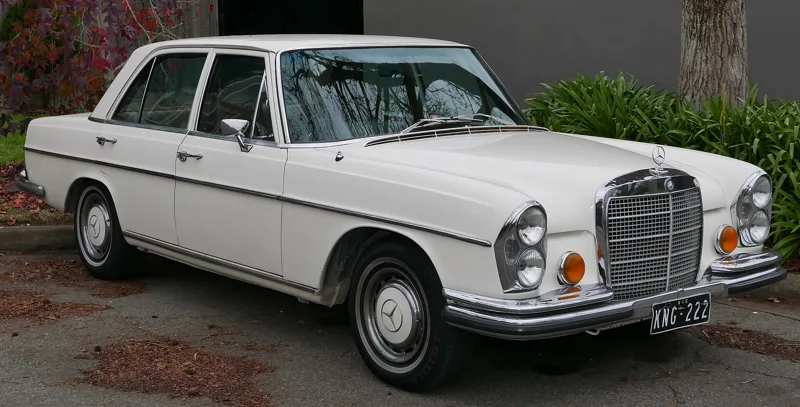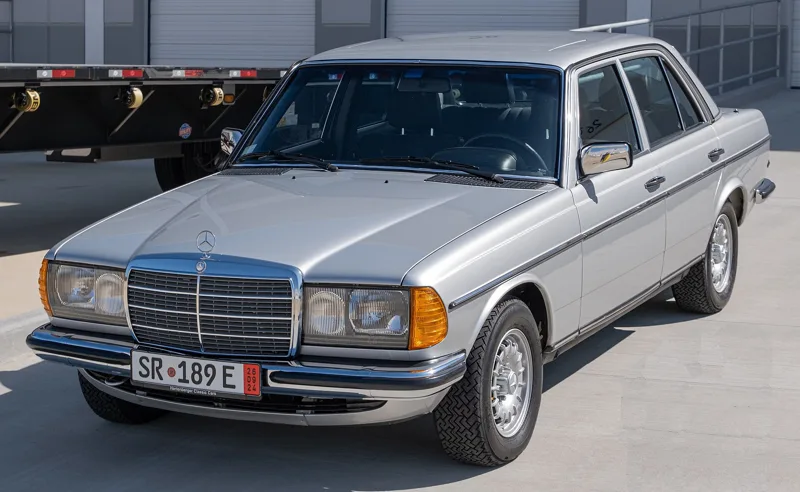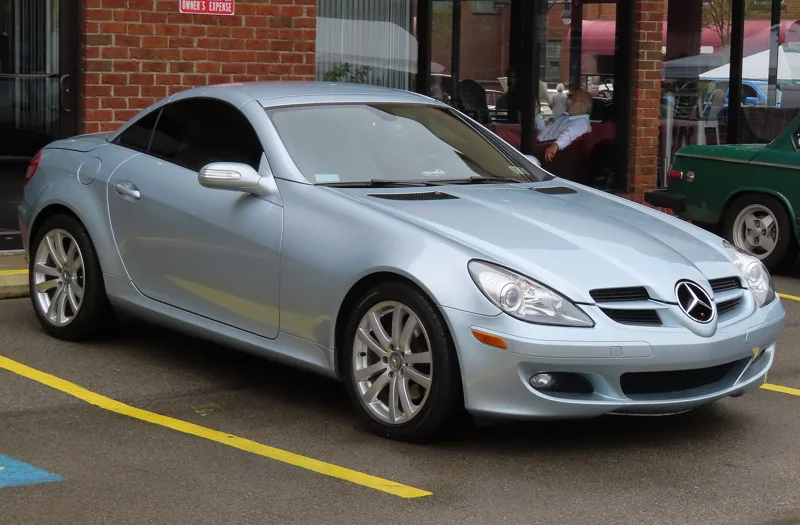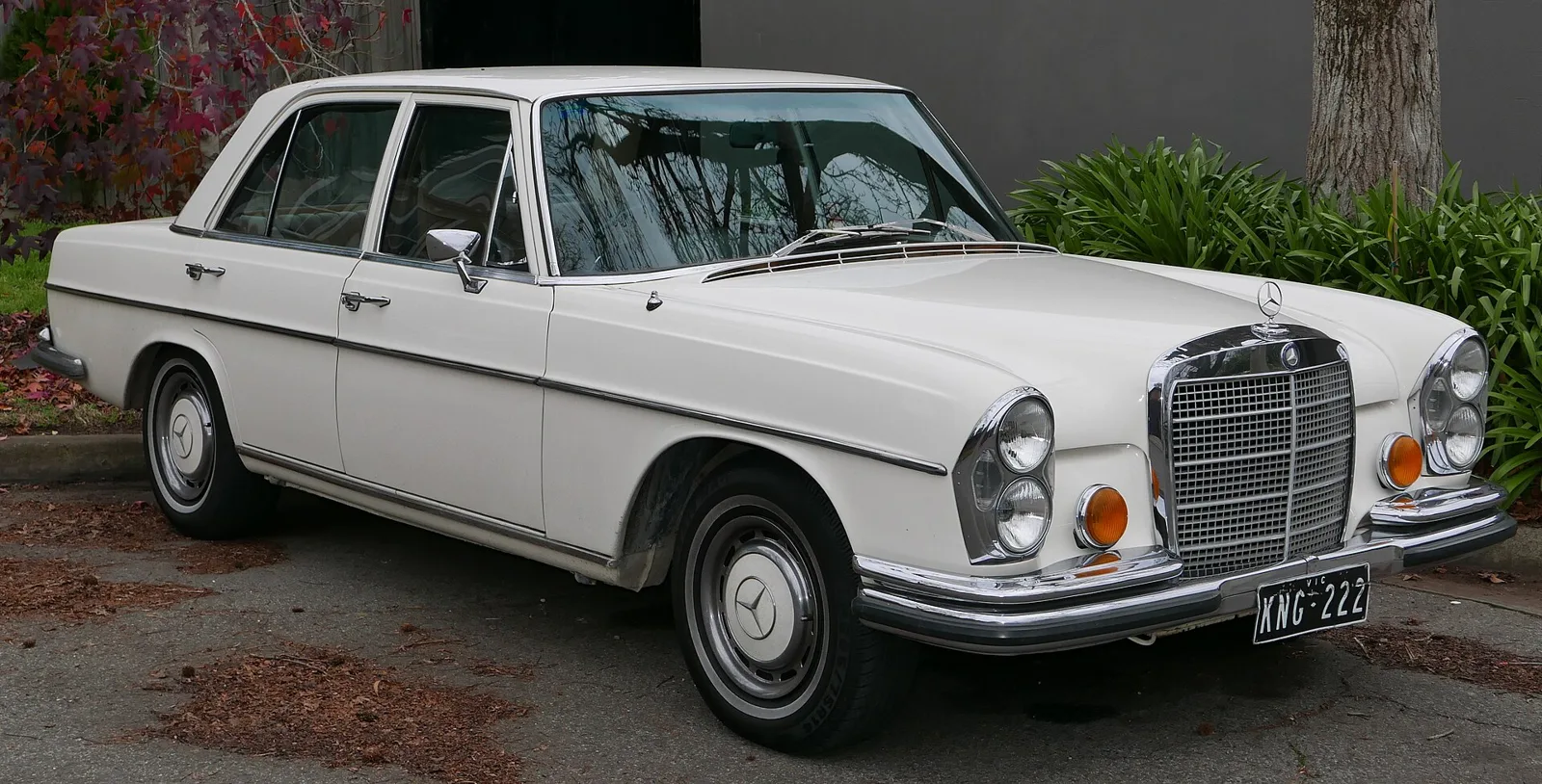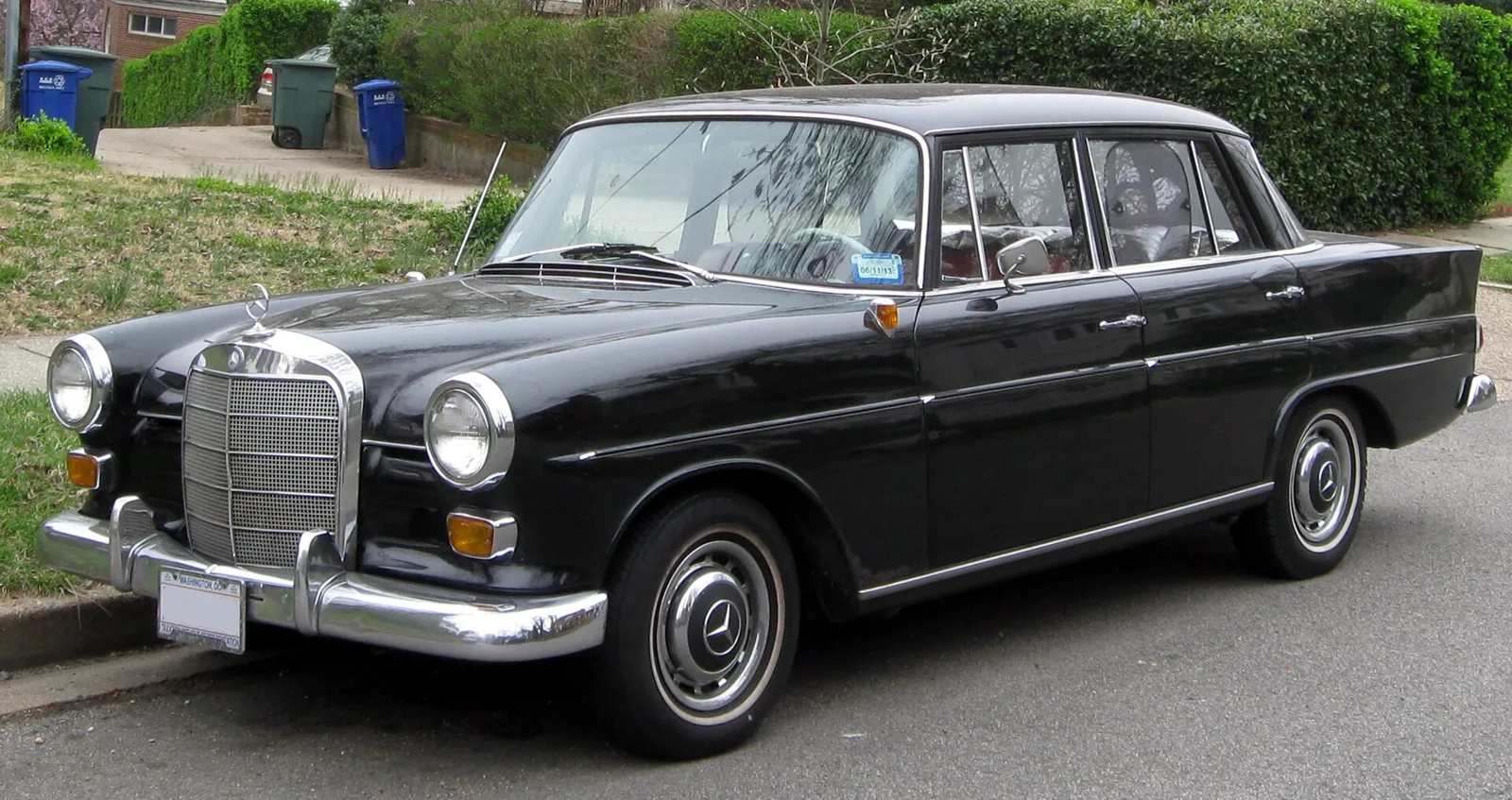
The W111 floor plan was stretched into cheaper and dearer saloons, then shortened by 30 cm to make the 1963 W113 SL.
The Mercedes Fintail family was the W111 saloon of 1959 and the cheaper W110 and dearer W112 variants of 1961. The W113 Pagoda SL of 1963 used a W111 platform shortened by 30 cm, and it was built until 1971 in 230, 250 and 280 SL forms.
The Mercedes-Benz W113 Pagoda is a sports car built on a family saloon. Its chassis is the W111 Fintail platform with 30 cm (11.8 in) cut out of it, and its engineers borrowed technology from the W112, the most expensive Fintail. The Fintail family runs from the humble W110 to the grand W112, and the roadster grew out of the middle of it.
Mercedes Fintail: how the family was planned
Mercedes-Benz emerged from the Second World War with expensive grand tourers such as the 300 S, but it was the simple unibody Ponton saloons that provided most of the company's revenue. Work on replacing them began in 1956 with a design built around passenger comfort and safety. The cabin grew wider and boxier, with a big expanse of glass for better visibility. Front and rear crumple zones, a milestone in car design, absorbed kinetic energy on impact, and the company patented retractable seatbelts.
The result, the W111, went into series production in August 1959 and appeared at the Frankfurt show that autumn. The pointed tailfins that gave it the nickname Heckflosse, German for fintail, were its most obvious feature. Daimler-Benz had also decided to unify its model range on one platform to gain economies of scale. In 1961 the W111 was stretched both up and down: downward into the cheaper four-cylinder W110, upward into the luxury W112.
A sports car cut from the middle of a family saloon.
Mercedes W111 and the first Fintail saloons
Three saloons launched together: the 220 b, 220 Sb and 220 SEb, priced at DM16,750, 18,500 and 20,500, and selling in a rough ratio of one to two to one. All used the 2195 cc M127 straight-six, which produced 95 hp (71 kW) at 4800 rpm in the single-carburettor 220b. The 220 Sb used twin carburettors for 110 hp (82 kW), while the top 220 SEb had Bosch fuel injection and 120 hp (89 kW), a top speed of 172 km/h (107 mph) and a 0-100 km/h time of 14 seconds.
In May 1965 the 230 S took over from the 220 Sb and 220 SEb. It was visually the same, but a more powerful 2,306 cc M180 six gave 120 hp (89 kW) at 5400 rpm and 176 km/h (109 mph). Some 41,107 230 S models were built until January 1968, when the last four-door Fintail left the line. In all, 337,803 W111 saloons were made between 1959 and 1968.
Mercedes W110 190c: the taxi-driver's Fintail
The 190c and 190Dc arrived in April 1961 to replace the older 180 and 190 sedans. The body came from the W111 but with a nose 145 mm (5.7 in) shorter and round headlights, while the rear and the interior dimensions matched the W111 220b. Buyers gave up wood for bakelite on the dashboard, and the seat backs were fixed. Because the car was shorter and more fuel-efficient yet offered the same cabin and luggage space, taxi drivers adopted it in force. Diesel production, with its 2.0 L OM621 engine, exceeded the petrol 190c by nearly 100,000 cars.
The second series began in July 1965 and lasted two and a half years. The 200 got a bored-out 1,988 cc M121 BIX with a second carburettor, and the 200D kept its 55 PS (40 kW; 54 hp) diesel but gained a five-bearing crankshaft in place of three. A six-cylinder 230 joined them, using a 2,307 cc engine at first detuned to 105 PS (77 kW; 104 hp), then raised to 120 PS (88 kW; 118 hp) from July 1966. Outside, the front indicators moved below the headlights and the tail lights were squared off, with two horizontal chrome strips in place of chrome-trimmed tailfins. The range ended in January 1968 with the arrival of the W115 220 and 220D.
Mercedes put the W110 and the six-cylinder W111 through its first wide-ranging crash testing aimed at protecting occupants. Specialists adapted them too. Mercedes-Benz's Belgian importer at Mechelen introduced a 230S estate in 1965 and kept assembling cars until 1973, by which point 78,568 four-cylinder cars had been built there. The coachbuilder Binz made ambulances and a rare seven-seater on a wheelbase 65 cm (25.6 in) longer, assembled at Sindelfingen.
Mercedes W112 300SE: the Fintail that cost twice as much
The W112 existed because the 300d Adenauer limousine needed a replacement and the 600 Grosser was not ready. Mercedes took the biggest platform it had, the W111, dropped in the 3.0 L fuel-injected M189 six from the 300d, then the company's largest, and added wood, leather, chrome and standard power steering, air suspension and an automatic gearbox. It cost almost twice as much as the best W111, the 220SE.
The sedan was a compromise, since for the first time the most prestigious Mercedes did not have a platform of its own. The coupe and cabriolet arrived in February 1962, and a long-wheelbase sedan followed in March 1963 to fill the gap below the 600. Power was 160 hp, rising to 170 after 1964, for a top speed of 180 km/h that rose to 190.
Sales told the story. In 1962 Mercedes built 24 W111 saloons for each W112 sedan, and by 1964 the ratio approached 40 to 1. The W112 was too similar to the mass-produced W110 and W111, which were common as taxis, and lacked the size and cachet of the 300d and 600 either side of it. In 1962 a total of 2,769 W112s were made; in 1963, with the 600 in place, sales plummeted to 1,382. Production of the sedan ended before the W108 and W109 arrived in 1965, with 5,202 built, 3,656 short and 1,546 long.
Mercedes W111 coupe and cabriolet: the exception to the fins
The two-door cars looked different because they were. Paul Bracq designed them with a squarer, more subtle rear end than the pointed fins used elsewhere in the range. Design work began in 1957, production in late 1960, and the coupe made its debut in February 1961 at the 75th anniversary of the opening of the Mercedes-Benz Museum in Stuttgart. The cabriolet, almost identical, followed at Frankfurt a few months later, its soft top folding into a recess behind the rear seat under a leather cover matching the seats. Both used the 220 SE name and the 2.2 L M127 engine.
When the W108 and W109 sedans replaced the Fintails in 1965, they adopted a design based on Bracq's restrained coupe, which let Mercedes avoid the expense of redesigning the coupe and cabriolet. Those continued with modest changes. A 250 SE appeared in early autumn 1965 with the 2.5 L M129 engine, 150 hp (112 kW), 193 km/h (120 mph) and a 12-second 0-100 km/h time. The 280 SE followed in November 1967 with 160 hp (119 kW) from the 2.8 L M130 and a 10.5-second sprint.
The last model, the 280 SE 3.5 of August 1969, was the first post-war Mercedes coupe with an engine larger than 3 litres. A 3.5 L M116 V8 gave 200 hp (150 kW) and 210 km/h (130 mph), and the lower, wider grille earned the facelifted car the German nickname "Flachkuehler". The last 280 SE was built in January 1971, and the 3.5 ended in July.
Mercedes W113: how the Pagoda was born
The W113 replaced both the 300 SL and the 190 SL. By 1955 Mercedes-Benz technical director Fritz Nallinger and his team had few doubts about the 190 SL's lack of performance, while the 300 SL cost too much for most buyers. A fuel-injected 220 SL, the W127, was proposed for production from July 1957, but technical difficulties kept postponing it. In 1960 Nallinger proposed a fresh design based on the Fintail W111 chassis, shortened by 30 cm (11.8 in), using W112 technology. Geneva in March 1963 hosted the 230 SL's debut.
The team included Rudolf Uhlenhaut, chief engineer, and Friedrich Geiger, head of styling, with Paul Bracq and Bela Barenyi as lead designers. They created the patented, slightly concave hardtop that inspired the Pagoda nickname. The bonnet, boot lid and door skins were aluminium to save weight. Upright "fishbowl" headlights and a plain chrome grille with a big star on the nose paid homage to the 300 SL roadster.
Safety was part of the point. It was the first sports car with a safety body, and also the first Mercedes-Benz on radial tyres. The interior was rounded, with hard corners and edges removed, the steering gear moved back toward the firewall and the column set at an angle with universal joints, guarding the driver. The autumn 1967 refresh added a collapsible telescopic column and padded hub.
Mercedes 230 SL, 250 SL and 280 SL compared
| Model | Built | Engine | Output | Cars made |
|---|---|---|---|---|
| 230 SL | June 1963 - January 1967 | 2,308 cc inline-six | 150 PS (110 kW; 148 hp) | 19,831 |
| 250 SL | December 1966 - January 1968 | 2,496 cc inline-six | 150 PS (110 kW; 148 hp) | 5,196 |
| 280 SL | December 1967 - 23 February 1971 | 2,778 cc inline-six | 170 PS (125 kW; 168 hp) | 23,885 |
Together they total 48,912 cars, 19,440 of which were sold in the United States.
What changed from 230 SL to 280 SL
The 230 SL used a 2,308 cc engine based on the established M180 six, with Bosch multi-port injection, a new cylinder head with a compression ratio of 9.3 instead of 8.7, and a six-plunger pump that fired fuel through the open valves into the cylinders. It had front disc brakes, a four-speed manual or automatic gearbox, and from May 1966 an optional ZF five-speed. In 1963 Uhlenhaut lapped the tight Annemasse track in 47.5 seconds, against 47.3 for Mike Parkes in a Ferrari 250 GT.
The 250 SL is the rarest. It was shown at the 1967 Geneva show after production started in December 1966, and it lasted only until January 1968. A longer-stroke engine with seven main bearings raised torque from 197 to 216 N m, though the claimed power stayed at 150 PS, and the 230 SL engine rarely managed more than 143 PS in practice. The 250 gained rear disc brakes, a bigger fuel tank, rising from 65 to 82 litres, and an optional limited-slip differential. It also brought the 2+2 California Coupe, with a removable hardtop only and a small rear bench in place of the soft-top well.
The 280 SL went on sale in December 1967 and ran to 23 February 1971, when the heavier R107 350 SL replaced it. Its 2,778 cc M130 produced 170 PS (125 kW; 168 hp) and 244 N m, enough at last to give the car the power it needed. To get there the bore was enlarged by 4.5 mm, which meant separating the paired cylinder casts, adding cooling passages and fitting an oil cooler, and each engine was bench-tested for two hours. By then the W113 had changed character, from sports car to comfortable grand tourer. Of the 23,885 made, over half went to America, where automatic gearboxes and air conditioning were common; the ZF five-speed was ordered only 882 times.
Pagoda details and a Pininfarina rival
US cars had sealed-beam headlights instead of the Bosch units used elsewhere, imperial gauges, side reflectors and, for the 280 SL, emissions changes that cut power from 170 PS to 160 PS (118 kW; 158 hp). Fuchs alloy wheels became a factory option in August 1970. In 1963 Pininfarina also built its own fixed-head coupe version of the 230 SL, designed by Tom Tjaarda and resembling the Ferrari 250 GT Lusso.
What replaced the Fintails and the Pagoda
Replacements came quickly. The W114 and W115 replaced the four-cylinder W110 line in 1968, and the R107 350 SL replaced the Pagoda in 1971. The W111 coupe and cabriolet had an indirect successor in the C107 SLC, a hardtop coupe version of the SL roadster, while the true successor was the C126 coupe of 1981. A four-seat Mercedes convertible then did not return until the A124 in 1992.