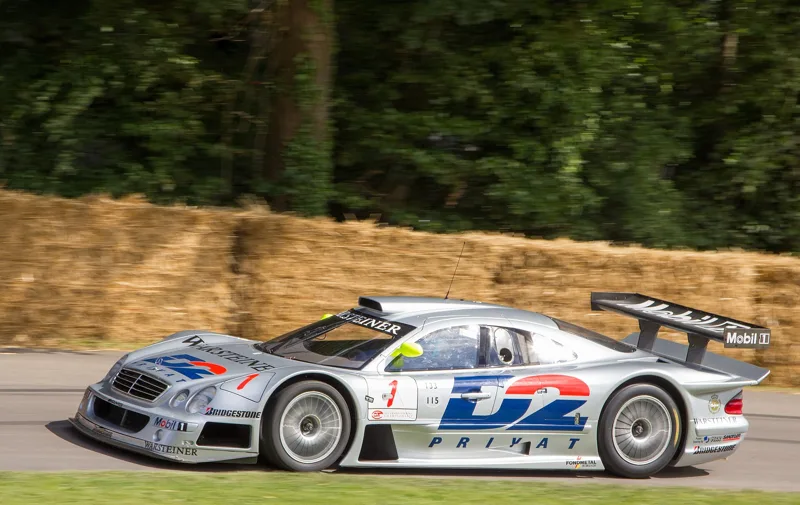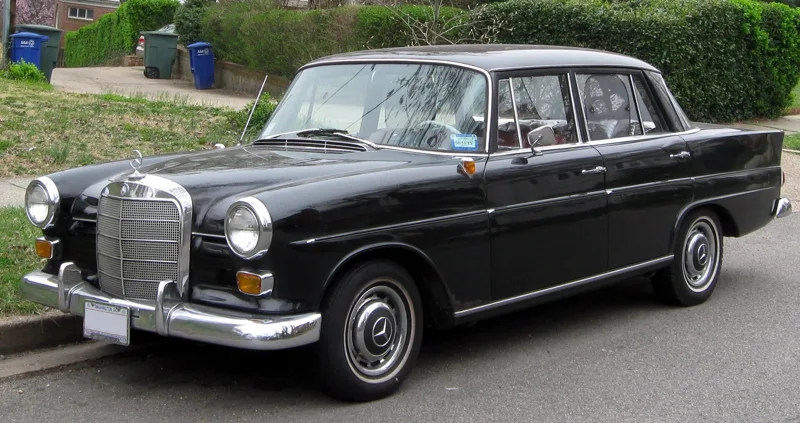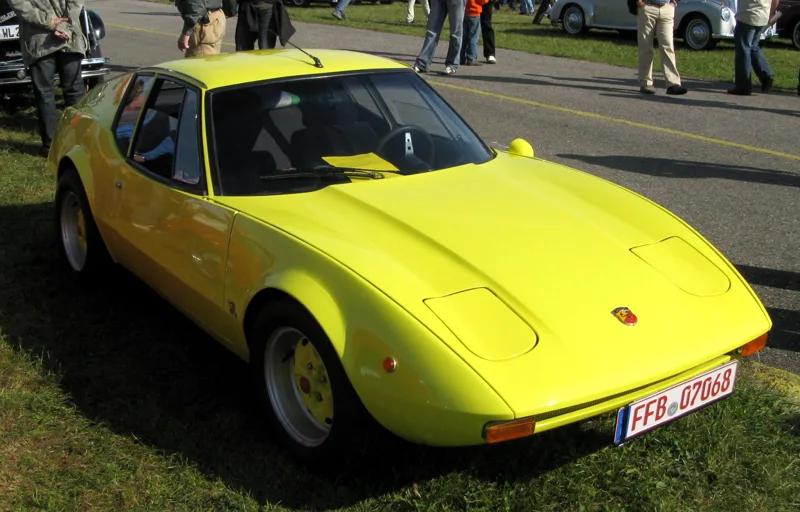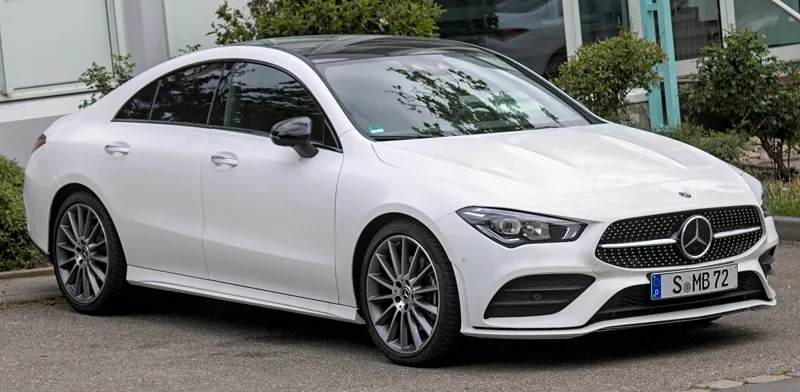
A folding metal roof, a Chrysler cousin, a 400 PS Black Series and the roadster that was renamed SLC in 2016.
The Mercedes-Benz SLK was a compact roadster with a folding metal roof. The R170 ran from 1996 to 2004, the R171 from 2004 to 2011 and the R172 from 2011, becoming the SLC in 2016. It was discontinued after the 2020 model year.
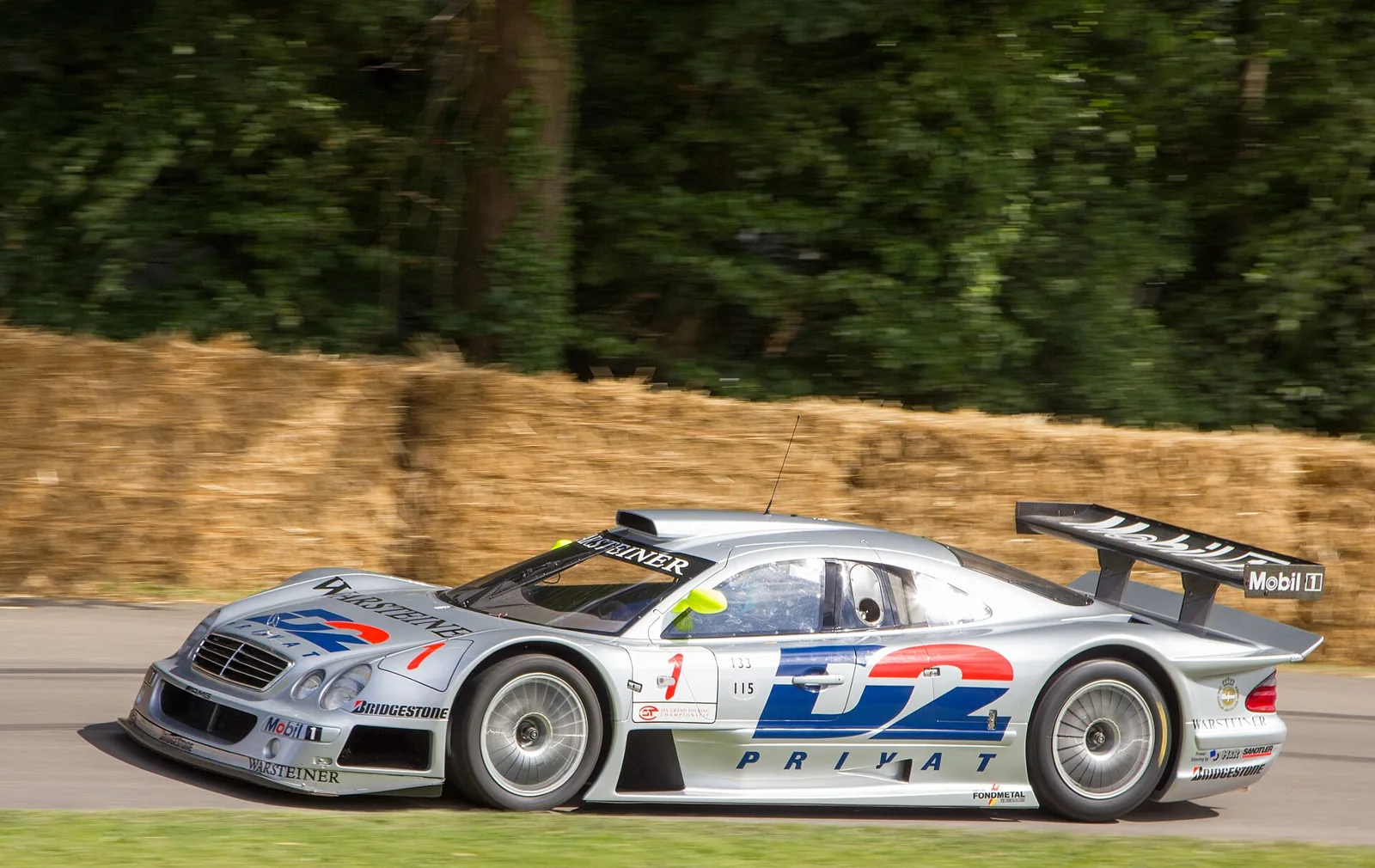
Eighty percent of a Chrysler Crossfire is a Mercedes-Benz SLK. The American coupe shared that proportion of its components with the first-generation roadster, which tells you something about how conventional the SLK's underpinnings were even as its folding metal roof drew the attention. Across three generations the little roadster moved from a shortened C-Class floor to a sharper AMG-fed sports car, and finally to a chassis that was renamed SLC.
How did the Mercedes-Benz SLK change across the R170, R171 and R172 generations?
The R170 ran from 1996 to 2004 on a shortened C-Class platform, the R171 from 2004 to 2011, and the R172 was launched in January 2011. At its mid-life facelift the R172 was renamed SLC, and it was discontinued after the 2020 model year.
The letters SLK stand for sportlich, leicht and kurz, German for sporty, light and compact. Each generation kept that brief while adding length, safety equipment, more power and, eventually, a diesel.
The SLK stands for sporty, light and compact, a brief it kept across three generations.
How did the R170 SLK begin?
The R170 grew out of two show cars: the SLK I Concept, presented in Turin in early 1994, and the SLK II Concept, shown in Paris late the same year. Both were two-seat roadsters with a folding metal electro-hydraulic roof that Mercedes called the vario-roof, which took 25 seconds to operate.
A German design patent had been filed on 30 September 1993. The production car made its debut in Turin on 22 April 1996, with pre-production test cars built from October 1995 and mass production starting in July 1996. More than 300,000 R170s were built.
What was underneath the R170?
Underneath was a cut-down W202 C-Class floor, with plenty of C-Class drivetrain and chassis hardware. Its wheelbase of 2,400 mm (94.5 in) matches that of the 190SL and 300SL. Chrysler used the same platform for the Crossfire, which has 80% of its components in common with the R170.
Standard equipment included power seats, windows and steering, dual-zone air conditioning, a dimmable interior mirror and alloy wheels. The safety package covered front and side airbags, ABS and stability control.
Buyers could add an AMG body design package with 17-inch wheels, a five-speed 5G-Tronic automatic, heated seats, xenon headlamps, a Bose sound system, a six-disc CD changer and eight-way power seats. Many of these were standard on the top model.
Which engines and models did the R170 have?
The SLK 200 Kompressor was sold initially only in Italy, the Netherlands, Portugal, Turkey and Greece, and only with a Getrag five-speed manual gearbox. After the 2000 facelift it went worldwide.
The SLK 32 AMG, introduced in 2001, was aimed at the BMW M Roadster and the Porsche Boxster S. It used an upgraded M112 engine from the SLK 320 with a helical twin-screw supercharger and a water-to-air intercooler. It also introduced the SpeedShift 5G-Tronic automatic, which allows manual shifting and faster automatic downshifts before overtaking, and there was no manual option. Brake discs grew from 300 mm (12 in) to 334 mm (13 in). Between January 2001 and March 2004 Mercedes built 4,333 of them: 979 stayed in Germany, 2,056 went to the US and 263 to the UK.
How did the R170 change over time?
In 1998 the passenger airbag began to switch itself off when a Mercedes child seat was fitted. In 1999 buyers gained an AMG Sport package with an aero body kit, staggered 17-inch wheels, stiffer sway bars and a performance exhaust, along with a storage net, auto-dimming mirrors and a motion-sensing alarm.
Production of facelifted cars began after February 2000. They had redesigned bumpers, a silver grille and new taillights, body-colour side skirts and door handles, indicators in the mirrors and stainless-steel exhaust trim. Inside there was a restyled steering wheel and shifter and more supportive seats. The naturally aspirated SLK 200 was dropped, the SLK 230 Kompressor engine was updated, the SLK 320 was introduced, stability control was upgraded and the fuel tank grew from 45 L (12 US gal) to 53 L (14 US gal). A six-speed manual replaced the five-speed in 2001.
Critics liked it: it joined the Ten Best list at Car and Driver for 1997, and it took the North American Car of the Year title that year.
What changed with the R171 SLK?
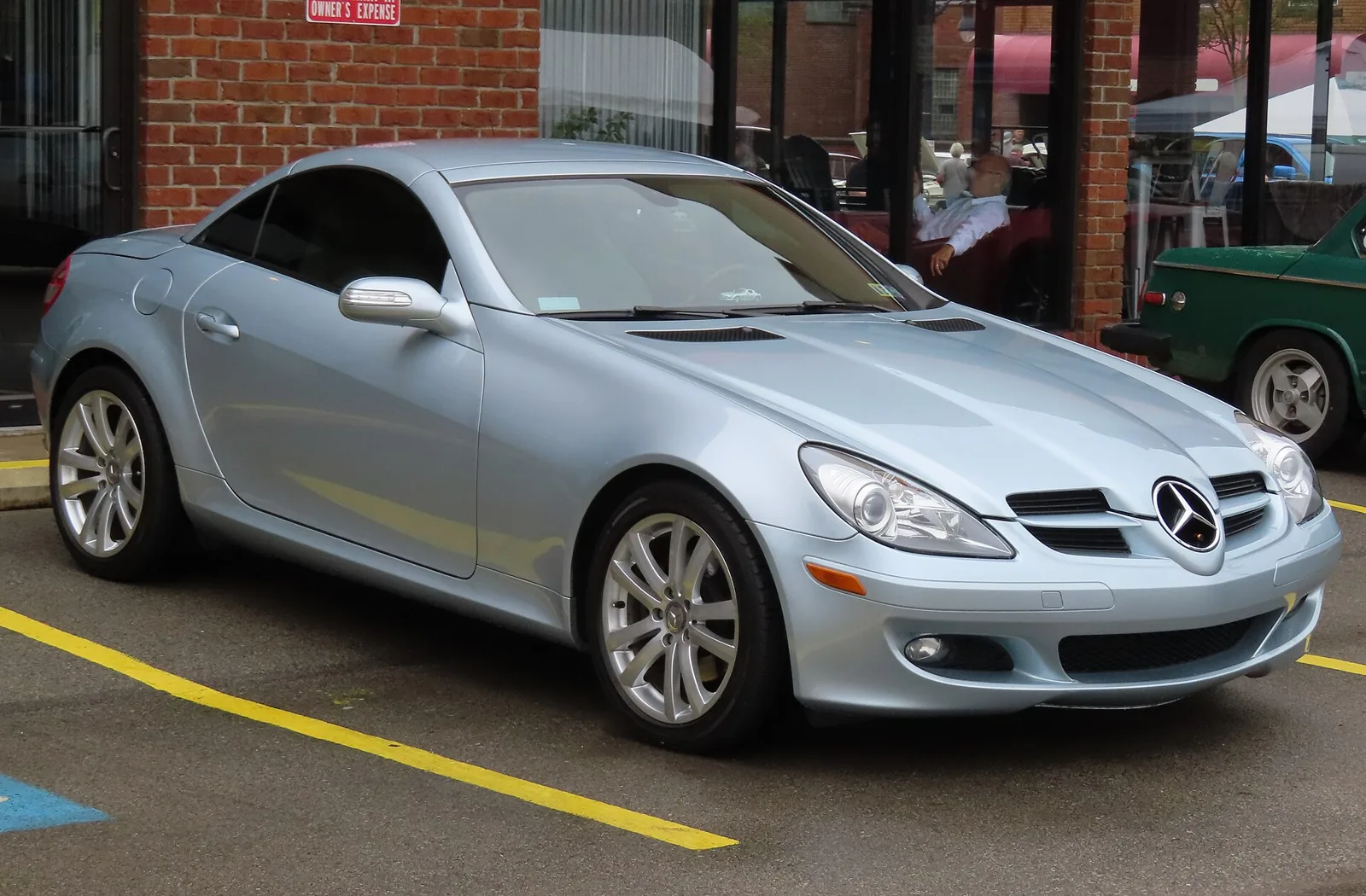
The R171 was built from 2004 to 2011 and made its debut at the 74th Geneva show. It remained a two-seat, front-engine, rear-wheel-drive roadster with a retractable hardtop. Its roots go back to the Vision SLA concept, shown in January 2000 at the Detroit Auto Show, with a plastic and aluminium body, extremely short overhangs and a short wheelbase, built by Stola in late 1999.
Against the R170 it grew: the wheelbase was 30mm longer, the car 72mm longer and 65mm wider. It used 40% more high-strength steel and gained a seven-speed automatic transmission, adaptive two-stage airbags and head and thorax side airbags.
The revised roof, marketed as the Vario roof, opened in 22 seconds instead of 25, and a rotary-pivoting rear window allowed a more compact folded stack, which added 63 litres of boot space with the roof down. Options included remote roof operation and Airscarf, a forced-air system in the headrests that blows warm air on the back of the neck.
How strong and slippery was the R171?
The fully galvanised body improved static bending strength by 19 percent and torsional strength with the roof down by 46 percent. Aerodynamic efficiency improved by 3% to a drag coefficient of 0.32, and the shape was tuned to minimise draughts with the top down, helped by a fabric windblocker that could be raised over the two roll-over bars. Mercedes marketed designer Steve Mattin's tapering nose as Formula One-inspired.
In 2008 the SLK passed 500,000 sales. Awards followed too, including a place on Car and Driver's 2005 Ten Best list and the Best New Convertible prize in Canada's Car of the Year contest.
Was there a manual R171?
Yes, and it was the last. The R171 was the final series to offer a manual in a six-cylinder Mercedes-Benz convertible, because the R172 only gave a manual to its four-cylinder cars. Car and Driver reviewed the SLK350 in November 2004 and praised the gearbox, saying the engine had a willing personality that suited it.
Top speed was electronically limited to 250 km/h (155 mph) under the 1986 gentlemen's agreement. The AMG Driver's Package on the SLK 55 AMG raises it to 280 km/h (174 mph).
What was the SLK 55 AMG?
AMG fitted a naturally aspirated 5.4L M113 V8. It made 360 PS (265 kW; 355 hp) at 5,750 rpm and 510 N-m (376 lbf-ft) at 4,000 rpm, and the only gearbox was a seven-speed automatic. Mercedes quoted 4.9 seconds from 0 to 62 mph (100 km/h), and Car and Driver recorded 4.3 seconds to 60 mph and 12.7 seconds for the quarter mile.
The car also had bigger brakes with 345x30mm discs, an extra engine oil cooler, a lowered and stiffened suspension, 18-inch wheels, an AMG body kit with gills in the front bumper, a quad exhaust and a Napa leather interior. Cars before the 2008 model year have six-piston front calipers; later models use a mix, including the four-piston fronts from the C55, which Mercedes chose partly to cut costs and to reduce complaints about brake squeal. The 2008 facelift brought an upgrade to the SPEEDSHIFT 7G-TRONIC that shifts 10% faster.
An option package developed by the AMG Performance Studio, known as 030 or P30, added Nurburgring suspension, composite front discs of 360x32mm, carbon-fibre interior accents and a smaller performance steering wheel. A track-focused SLK 55 Asia Cup was limited to 35 cars.
What was the SLK 55 AMG Black Series?
From 2006 to 2008 the Black Series raised output to 400 PS (294 kW; 395 hp) and 520 N-m (384 lb-ft), at the same engine speeds as the standard car, largely through long-tube headers and a revised ECU. It also had a carbon-fibre-reinforced plastic hardtop that does not retract, wider CFRP front fenders, KW coilover suspension and 19-inch wheels. At 1,495 kg (3,296 lb) it weighed 45 kg (99 lb) less than the standard SLK 55 AMG. It went on sale in Germany in July 2006 at EUR 107,300 including 16% VAT.
Which special editions did the R171 get?
The Edition 10 of 2007 celebrated the SLK's tenth anniversary. It started as a concept at the 2006 Paris Motor Show, based on the SLK 280, with matte-grey paint, ten-spoke wheels and black leather. Production versions were available in the SLK 200 Kompressor, SLK 280 and SLK 350. The 2LOOK Edition of 2009, shown at the Geneva Motor Show, offered white and black paint, 18-inch wheels and nappa leather seats with white centres and black bolsters, with 300 units combined in obsidian black metallic and designo mystic white.
What did the 2008 facelift change?
The facelifted R171 was unveiled at the 2008 North American International Auto Show and went on sale in April 2008. It had a revised front bumper with a more pronounced arrow shape, a diffuser-style lower rear section, larger mirrors with LED indicators and almost entirely new wheels. Inside, the instrument cluster and NTG 2.5 audio and telematics system were updated, with optional LINGUATRONIC voice control, and a gullwing red leather option was inspired by the original 300 SL. Direct steering assist became an option, and standard on the SLK 55 AMG.
In November 2012 Road & Track ranked the SLK350 ninth in its Best All Around Sports Car test, and its tester said the facelift, helped by a better manual gearbox, had at last made the SLK a serious sports car. The magazine gave it the best ride of any car in the test but said it leaned towards grand touring over high performance.
What was the R172 SLK and the SLC?
Mercedes launched the third-generation SLK, series R172, at Stuttgart in January 2011, then showed it to the public at the 2011 Geneva Motor Show. International sales began in spring 2011. It borrowed themes from both earlier generations, with a radiator intake inspired by the 1950s 190 SL and a nose inspired by the SLS AMG Coupe and the CLS (W218).
The Edition 1 combined glacier grey paint with Airscarf, AMG styling, a panoramic roof, the Dynamic Handling package and two-tone designo nappa leather. Orders opened on 17 January 2011 and cars reached showrooms on 26 March 2011, starting with the SLK 200, 250 and 350 BlueEFFICIENCY. In the US, sales began in 2011 with cars badged as 2012 models. For the 2014 model year the AMG Sports package became AMG Line.
What is the Roadster Pure?
A version of the SLK 200 BlueEFFICIENCY with a seven-speed automatic, panoramic vario-roof, COMAND Online multimedia, 18-inch wheels, LED daytime running lights, metallic paint, heated leather seats and a sports suspension that sits 10 mm (0.4 in) lower.
Was there a diesel SLK?
The SLK 250 CDI was the first SLK with a diesel engine. Orders began on 13 September 2011, early cars used the 7G-TRONIC PLUS automatic, and six-speed manual cars followed in the second quarter of 2012. It measures 4,134 mm (163 in) long, 1,817 mm (72 in) wide and 1,303 mm (51 in) high, with a wheelbase of 2,430 mm (96 in).
What did the R172 SLK 55 AMG offer?
Unveiled at the 2011 Frankfurt Motor Show and on sale from January 2012 until 2015, power came from an M152 V8 rated at 422 PS, or 310 kW (416 hp), at 6,800 rpm. Peak torque was 540 N-m, arriving at 4,500 rpm. It added cylinder management, start-stop, sports exhaust with flaps, AMG SPEEDSHIFT PLUS 7G-TRONIC, torque-vectoring brakes and the AMG direct-steer system, and ventilated discs measuring 360 x 36 mm at the front and 330 x 22 mm at the rear.
Across the range, the two-piece metal folding Vario Roof came in body colour, as a panoramic roof with dark-tinted windows, or as a panoramic roof with MAGIC SKY CONTROL, a smart-glass panel that switches from clear to tinted.
What happened with the SLC facelift?
Mercedes presented the SLC-Class to the press in December 2015, announcing a March 2016 launch date, timed for the 20th anniversary of the first SLK.
The range started with the SLC 180, a 1.6L turbo with 156 PS that reaches 100 km/h in 7.9s and tops out at 226 km/h. The SLC 200 has a 2.0L turbo with 184 PS (7.0s, 240 km/h), and the SLC 300 raises that to 245 PS, 5.8s and 250 km/h. The SLC 250 d is a 2.1L turbodiesel with 204 PS that covers 100 km/h in 6.6s and uses 4.4 L/100 km. At the top, the AMG SLC 43 has a 3.0L biturbo V6 with 367 to 390 PS and 4.7s to 100 km/h.
The 9G-Tronic automatic is standard on every version except the SLC 180 and 200, which have a six-speed manual as standard with the automatic optional.
The three SLK generations compared
| Generation | Years | Foundation | Roof time | Notable fact |
|---|---|---|---|---|
| R170 | 1996 to 2004 | Shortened W202 C-Class platform, 2,400 mm wheelbase | 25 seconds | Over 300,000 built |
| R171 | 2004 to 2011 | Wheelbase 30mm longer than R170 | 22 seconds | 500,000 SLKs sold by 2008 |
| R172 (SLC from 2016) | 2011 to 2020 model year | 250 CDI wheelbase 2,430 mm | Two-piece metal Vario Roof | First diesel SLK |
When did the SLC end production?
After its mid-cycle facelift the SLC stayed in production until the end of the 2020 model year, and then it was discontinued.