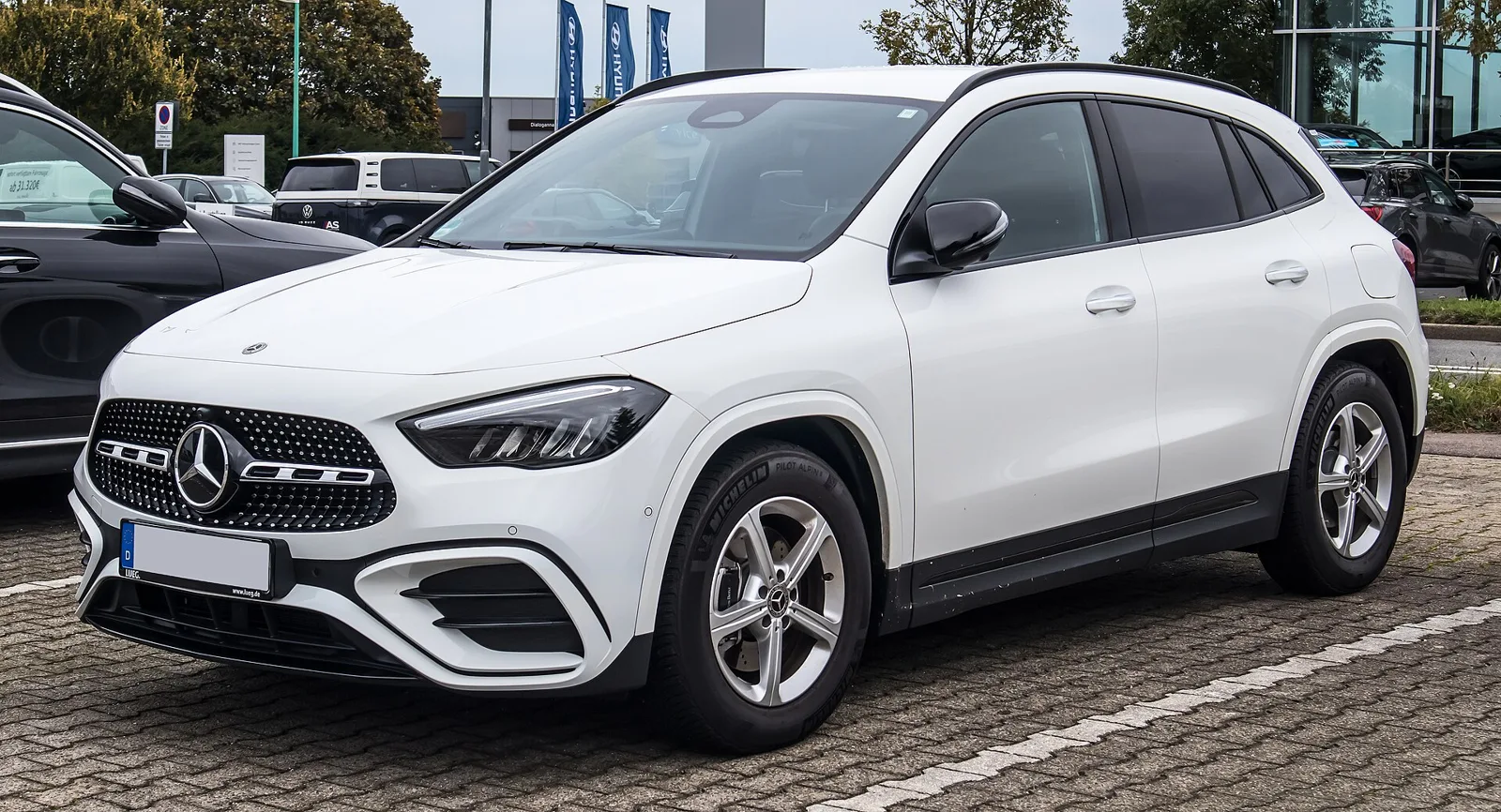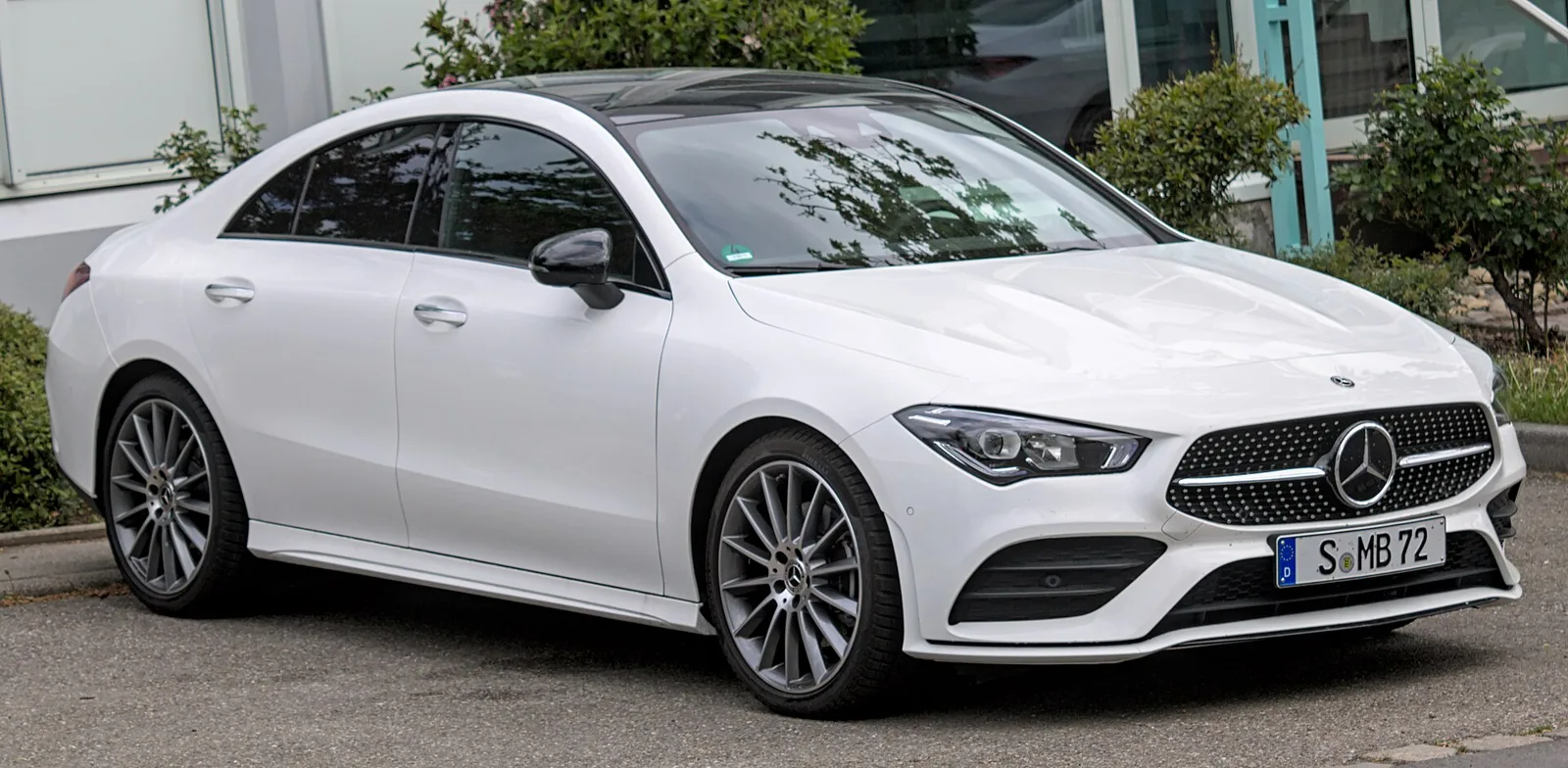
A sandwich floor, a fastback sedan, a three-row compact SUV and a big MPV that never caught on: how four Mercedes gap-fillers relate to the A-Class.
The B-Class is a small MPV built on the A-Class since 2005, the CLA is a fastback sedan above it from 2013, and the GLB is a compact SUV with an optional third row from 2019. The R-Class was a large MPV on the M-Class platform, sold from 2005 until it was discontinued in 2012 in North America.
In a head-on crash the Mercedes-Benz B-Class is designed to let its engine and gearbox slide beneath the passenger compartment instead of pushing into it. That safety trick comes from a layered floor that the B-Class inherited from the A-Class, and it is the clue to how the whole family fits together.
How the B-Class, CLA, GLB and R-Class relate to the A-Class
| Model | Body | Debut | Relation to the A-Class |
|---|---|---|---|
| B-Class | Small MPV | 2005 | Taller, larger car built on the A-Class idea |
| CLA | Four-door coupe, later Shooting Brake | 2013 | Fastback sedan on the A-Class platform, priced above it |
| GLB | Compact crossover with optional third row | 2019 | MFA2 platform with a longer wheelbase |
| R-Class | Mid-size luxury MPV | 2005 | None; shares the M-Class platform |
Three of the four are A-Class relatives. The second-generation CLA, the W247 B-Class and the X247 GLB all use the MFA2 platform that sits under the W177 A-Class, together with the GLA. The R-Class is the odd one out, a larger MPV on a different platform.
The B-Class was never sold in the United States, apart from an electric version in zero-emission states.
Mercedes B-Class history, from 2005
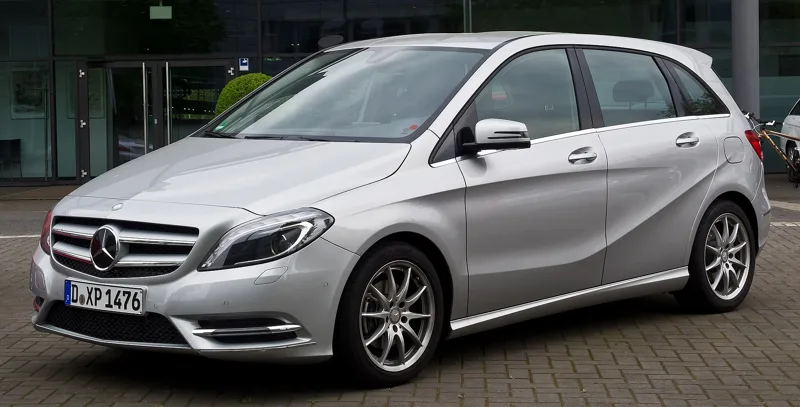
Mercedes-Benz sells the B-Class as a subcompact executive car, based on the A-Class but larger, and Euro NCAP classes it as a small MPV. Its roots go back to the Vision B Compact Sports Tourer, shown at the 2004 Paris Motor Show. Deliveries reached one million worldwide on 20 December 2013.
The first generation, the W245, reached Europe and Australia in early 2005 and Canada late that year. It never went on sale in the United States, where Mercedes could not match the price and still make a profit. Its structure is the clever part. Think of a sandwich with the drivetrain as the filling: a double-layered floor holds the engine and transmission partly in front of and beneath the passengers, so the car has a two-box shape with one box for the drivetrain and one shared by people and luggage. Because the floor is thick, the B-Class gets its interior volume from height. Front-wheel drive and a parabolic rear suspension complete the layout.
In 2008 it gained a start-stop system, a BlueEFFICIENCY option and an NGT version that could burn petrol or natural gas. Three years later Mercedes sent three F-Cell vehicles on a world tour, one of them a hydrogen-powered B-Class that covered more than 30,000 kilometres, starting and ending in Stuttgart.
Revealed in August 2011, the second-generation W246 debuted publicly at the 2011 International Motor Show Germany. A six-speed manual was standard, with a 7G-Tronic automatic optional, and stop-start technology was fitted to every model. Mass production began in November 2011 at the Rastatt plant, and the car was the first to use the MFA platform. Safety kit included seven to nine airbags, hill-start assist, drowsiness detection and a Pre-Safe system that tightens the belts and closes the windows and sunroof when an accident looks imminent.
The B-Class Electric Drive was one of the only B-Class models ever sold in the United States. It arrived in December 2013 as an early 2014 model, was available only in states with zero-emission mandates, and was the first Mercedes-Benz ever offered in an electric variant. It was renamed the B250e in 2017.
The third generation, the W247, arrived at the Paris Motor Show on 2 October 2018. It had a much shorter front overhang and dropped the controversial side sculpting, and at launch Mercedes claimed it carried the Intelligent Drive semi-automated system borrowed from the S-Class. The all-electric version was dropped, but a plug-in hybrid arrived with a 10.9 kWh battery that has a WLTP combined range of 66 km. For the 2023 model year a facelift changed the taillights, interior and MBUX infotainment. The manual gearbox was dropped too, in line with the A-Class and CLA, as Mercedes-Benz works to retire manual transmissions, and petrol models gained a 48-volt mild hybrid system.
Mercedes CLA vs A-Class
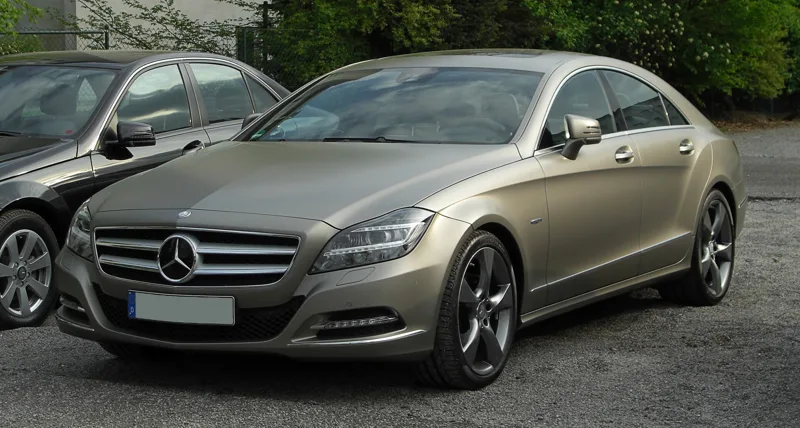
The CLA is a four-door fastback sold as a coupe, which shares underpinnings with the W176 A-Class and W246 B-Class. It is positioned above the A-Class, close to C-Class territory, and tends to give up some of the A-Class's practicality. Mercedes launched it in Europe in April 2013 and in the United States in September 2013.
It was also the first front-wheel-drive Mercedes sold in America. Global sales reached 100,000 in the first year, which the company called its best launch in 20 years, and about 750,000 first-generation cars were sold. The styling followed the Concept Style Coupe of 2012, and production of the C117 began at Kecskemet in Hungary in January 2013.
Mercedes claimed a drag coefficient of 0.23, which would have beaten the 0.24 of the Tesla Model S, and 0.22 for the CLA 180 BlueEFFICIENCY. But Car and Driver measured 0.24 for the Tesla in May 2014 and 0.30 for the CLA, a result that was itself criticised for being unclear about which CLA variant it tested.
The CLA family grew quickly. The Shooting Brake, announced at the 2014 Los Angeles show, was a five-door wagon with the same length and wheelbase as the sedan. It changed only from the B-pillar back, for more headroom, and its boot held 495 litres against 470 for the sedan, rising to 1354 litres with the seats folded. Its drag coefficient rose to 0.26, and it was not sold in the United States. Engines were all four-cylinders: 1.6 L and 2.0 L petrols and three diesels, a 1.5L, a 1.8 L and a 2.2 L, all with stop-start. The seven-speed 7G-DCT dual-clutch gearbox offered Economy, Sport and Manual programmes.
At the top sat the CLA 45 AMG, unveiled at the 2013 Geneva show. Its 2.0-litre twin-scroll turbo four made 355 hp (265 kW) and 450 N-m (332 lb-ft), and it was the world's most powerful production four-cylinder when it appeared, reaching 100 km/h in a claimed 4.3 seconds. For the 2016 model year it rose to 375 hp (280 kW) and 475 N-m (350 lb-ft), cutting the 0-60 mph time to 4.1 seconds from 4.4. Safety was strong too, with five stars from Euro NCAP.
Mercedes CLA second generation, the C118
Mercedes showed the second-generation CLA at the Consumer Electronics Show in January 2019. Sharing the MFA2 platform, it kept the fastback shape and the powertrains of the A-Class. A nearly flat underbody gave a drag coefficient of 0.23. Compared with the car it replaced, the C118 is 48 mm (1.9 in) longer, 53 mm (2.1 in) wider, 2 mm (0.079 in) lower and has a wheelbase longer by 30 mm (1.2 in).
The MBUX infotainment system, with its "Hey Mercedes" voice assistant and Interior Assist gesture control, is standard. Two 7-inch screens come in the base car and 10.25-inch screens, a head-up display and active steering assist are optional. The Shooting Brake, unveiled at Geneva in 2019 and in production from June that year, has a 505-litre boot, 10 L more than the outgoing wagon, and is not sold in the United States or Australia. The AMG CLA35 followed at the New York show in 2019 with all-wheel drive.
Mercedes GLB, the compact SUV with a third row
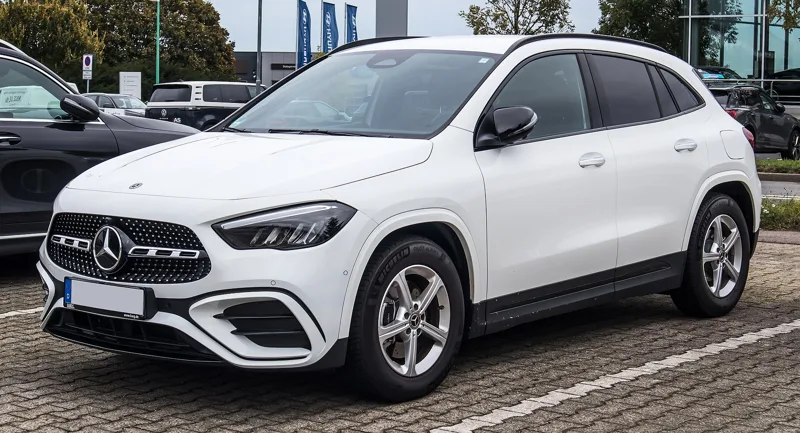
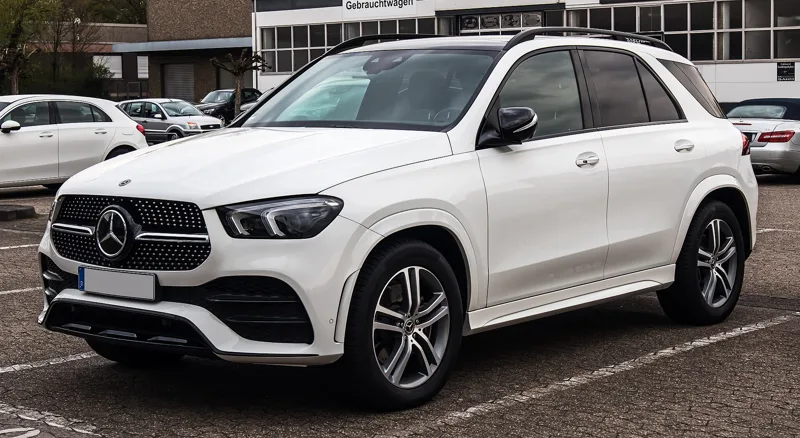
Daimler unveiled the GLB on 10 June 2019 in Park City, Utah, after showing it as a concept in Shanghai two months earlier. It slots between the GLA and the larger GLC but, unlike them, offers optional third-row seats thanks to a better use of space. It uses the MFA2 platform with a wheelbase 10 cm (3.9 in) longer than the A-Class, which makes it 4.63 m (182.3 in) long, only 22 mm (0.9 in) shorter than a GLC.
Engines are shared with the A-Class and teamed with an eight-speed dual-clutch automatic. All-wheel drive is standard or available with the 2.0-litre engines. The styling is square and angular, taking cues from the GLS and the old boxy GLK. In the United States only the 2.0-litre turbo four of the GLB 250 was offered at launch. The AMG GLB 35 4MATIC, announced on 28 August 2019, produces 225 kW (306 PS; 302 bhp) and was the first 35-series car with an eight-speed gearbox.
A 2023 facelift for the 2024 model year brought new lights, wireless Apple CarPlay and Android Auto and a 48-volt mild hybrid system called EQ Boost. The electric EQB was unveiled in April 2021.
Mercedes R-Class, the big MPV that did not catch on
The R-Class was a mid-size luxury MPV introduced in 2005 for the 2006 model year. It followed two concepts, the Vision GST shown with coachbuilder Stola in 2002 and the Vision R in 2004, and it was built in Vance, Alabama, until 2015, after which small-volume production moved to Mishawaka, Indiana, until 2017. It shared its platform with the M-Class and GL-Class and came in two wheelbases, 2,980 mm (117.3 in) and 3,215 mm (126.6 in), though North America got only the long one.
A 2007 update added a 3.0-litre V6 in petrol and diesel versions, rear-wheel drive on selected models and a choice of five, six or seven seats. The 2011 facelift returned a 5.5-litre V8 R 500 that was not offered in North America. The rarest version was the R 63 AMG 4MATIC of 2007, with a handbuilt 6.2-litre V8 making 375 kW (510 PS; 503 bhp) and 630 N-m (465 lb-ft). It reached 100 km/h in 4.6 seconds, but its handling was poorly received and only 200 were built before it was withdrawn that year.
Mercedes aimed to sell 50,000 R-Classes a year, half of them in North America. Sales were strong for the first two model years, then fell in 2008 to less than ten percent of ML-Class sales. The car was discontinued in North America in 2012 and elsewhere in 2013, except for China, where R 320 and R 400 models sold between 12,000 and 14,000 a year until 2017. In Germany almost 4,500 were sold in 2006, almost 2,500 after the 2011 refresh, and fewer than 500 in 2013.
Several causes are possible. Mercedes tried to sell it as a new category that was part estate, crossover, SUV and van, first as a "Sports Cruiser" and then as a "Family Tourer", and the Chrysler Pacifica looked too much like it. Buyers moved from MPVs to SUVs, and the 2008-2009 recession and higher fuel prices hit a thirsty car. The Metris of 2014 is considered its North American successor. On safety, the R-Class was rated Good in the Insurance Institute for Highway Safety front test, and after seatbelt and door trim changes for 2009 it earned a Top Safety Pick award.
The second-generation GLB, X244
The second-generation GLB, the X244, was unveiled on 7 December 2025 with mild hybrid and battery-electric versions. The electric car is now called the GLB with EQ technology, and it launches first as the GLB 250+ and the GLB 350 4Matic. The mild hybrid and an entry-level electric version are due in 2026.