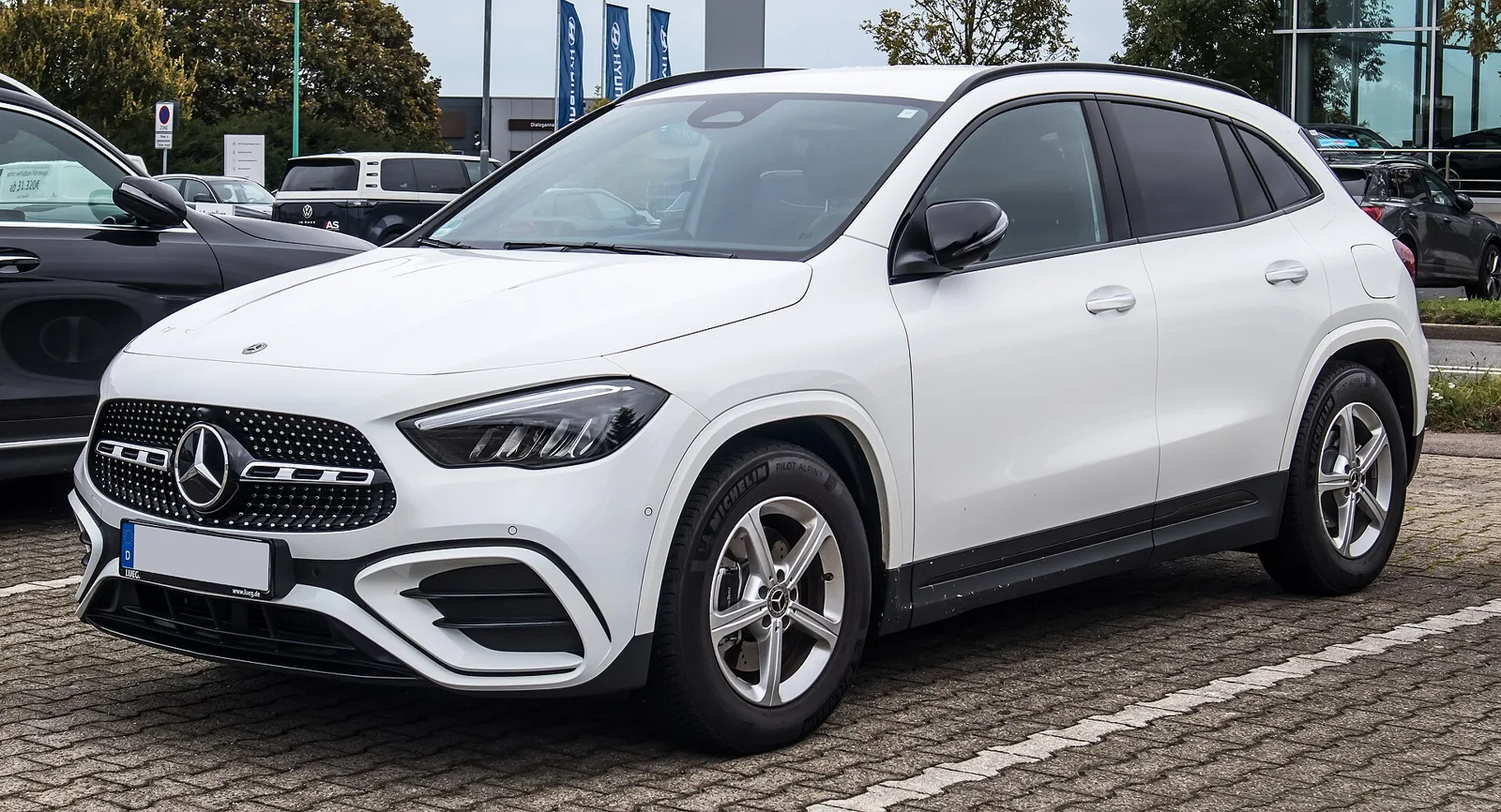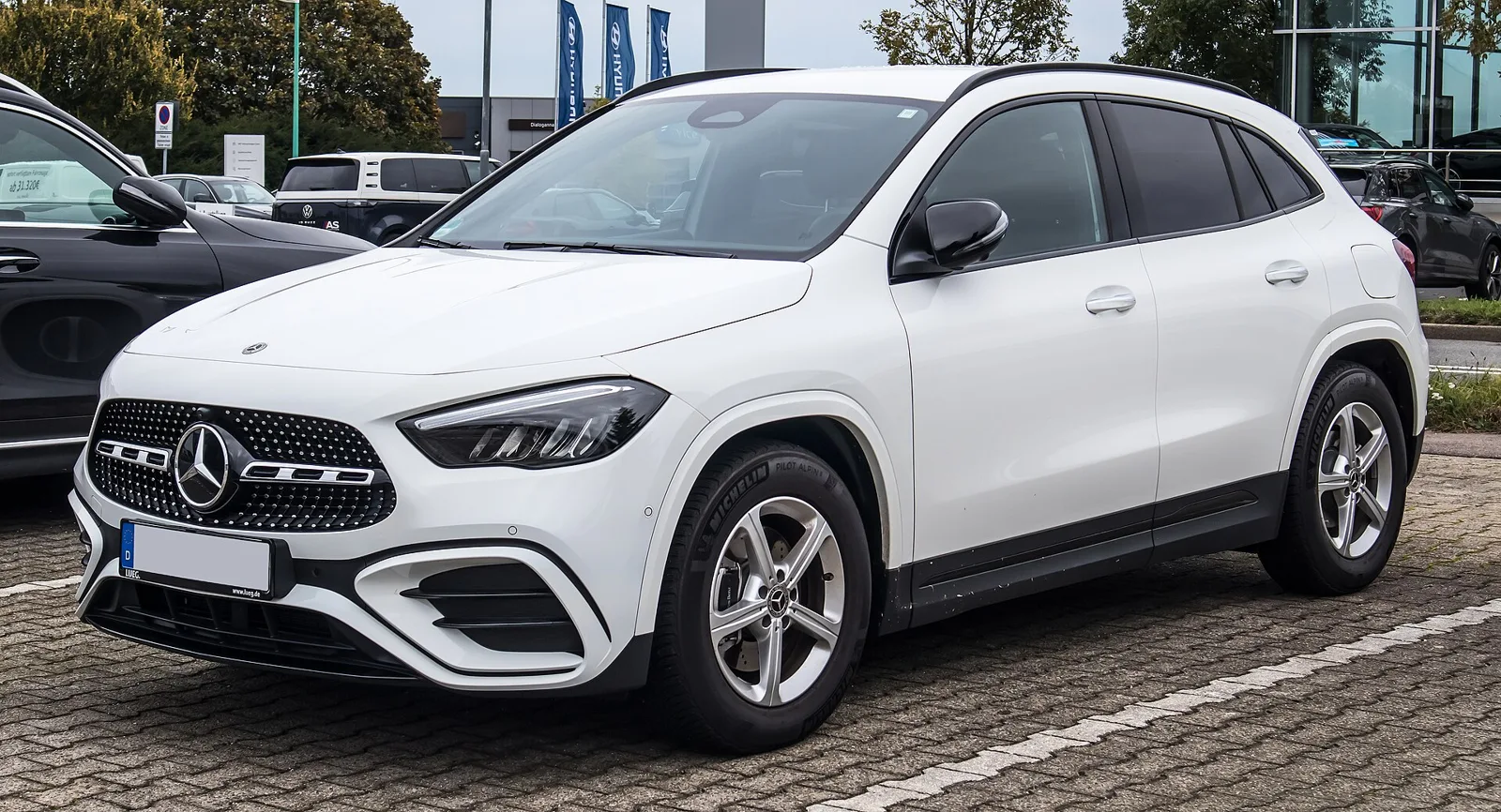
How Mercedes-Benz built its smallest SUV on A-Class foundations, added AMG and plug-in versions, and folded the electric EQA into a third-generation GLA.
Mercedes-Benz launched the GLA in 2013 as its entry-level luxury SUV, built from A-Class parts and sold with front-wheel or 4Matic all-wheel drive. A second generation followed in December 2019, and a third, revealed in July 2026, joins combustion and battery electric versions under a single name.
The Mercedes-Benz GLA is the brand's smallest SUV, a compact luxury crossover that rests on A-Class foundations and was revealed in August 2013. Three generations have now carried the name, moving from petrol and diesel four-cylinder cars to a third generation that also covers battery electric power.
What is the Mercedes-Benz GLA?
The GLA is a subcompact luxury crossover SUV from Mercedes-Benz. It is essentially the SUV counterpart of the A-Class, and it is the smallest SUV the brand markets. Buyers can choose front-wheel drive or 4Matic all-wheel drive, and the range has been built around petrol and diesel four-cylinder engines.
Mercedes-Benz showed the production version in August 2013, shortly before it appeared at the Frankfurt Auto Show in September 2013. Right away the car drew on several petrol and diesel four-cylinder units, and Mercedes-Benz marketed its all-wheel-drive system under the 4Matic name. Offering two fuel types and two ways of driving the wheels let a single compact body suit a wide range of buyers.
The story divides neatly into generations. The first, coded X156, ran from 2013. The second, coded H247, arrived in December 2019, and a third, coded H248/244, was revealed in July 2026. Each one grew more sophisticated inside, and each moved the car closer to the electric future of the brand.
The smallest Mercedes-Benz SUV grew from an A-Class relative into the brand's first nameplate to cover petrol, hybrid and electric power.
What does the GLA name mean?
The name follows the Mercedes-Benz SUV naming scheme. GL stands for Gelaendewagen, the German word for an off-road vehicle, and the closing letter shows where the model sits in the range. Here the A means the smallest class, which is why the GLA lines up with the A-Class on which it is based.
Reading the name this way makes the logic of the range easy to follow. The GL half points back to the off-road heritage that the German word describes, while the last letter ties the car to a passenger-car class. A buyer who already knows the A-Class can place the GLA straight away as its SUV relative, sitting at the bottom of the brand's SUV ladder.
How did the concept cars shape the GLA?
Three concepts came before and around the production car. The Concept GLA at the 2013 Auto Shanghai set out the look and the all-wheel-drive layout, and two Concept GLA 45 AMG cars, shown in 2013 and 2016, previewed a high-performance version of the compact SUV.
The Concept GLA used a 2.0-litre turbocharged petrol engine rated at 211 PS (155 kW; 208 hp), sending drive to all four wheels through a 7-speed dual-clutch automatic and the 4Matic system. Show-car details included headlamps with a laser-beam projector, 20-inch wheels and fibre-optic ambient lighting inside the cabin.
The first Concept GLA 45 AMG appeared at the 2013 Los Angeles Auto Show, a sporting interpretation of the compact SUV. Its twin-scroll turbocharged 2.0-litre four-cylinder produced 360 PS (265 kW; 355 hp), along with 450 newton metres (332 lb ft) of torque. It came with 4Matic all-wheel drive, paddle shifters and an AMG sports exhaust whose electronically controlled variable vane system modulates the exhaust note.
A 2016 version of the Concept GLA 45 AMG lifted output to 381 PS; 375 hp (280 kW), and peak twisting force rose to 475 newton metres (350 lb ft). It kept the same recipe of a twin-scroll turbocharged four-cylinder, all-wheel drive and a variable-vane exhaust, so the later car simply asked more of an engine layout that was already established.
What was the first-generation X156 GLA like?
The X156 GLA followed the Concept GLA's design closely, and Mercedes-Benz presented it at the 2013 Frankfurt Motor Show. Orders opened at the end of November 2013, and cars reached dealers during 2014, with Japan and the United States following in the autumn. Mercedes-Benz claimed the best aerodynamics in its segment, with a drag coefficient of 0.29.
Underneath, the car is built on a platform common to the A-Class and B-Class, so its choice of petrol and diesel engines mirrors theirs, although which engines are available depends on the market. The chassis uses strut-type front suspension, a multi-link rear and electric power steering.
A drag coefficient of 0.29 was the headline number at launch. It was a manufacturer's claim about the segment rather than an independent comparison, which is worth remembering when you set the figure against rivals. Even so, it shows that the designers treated the compact SUV shape as something to be smoothed, not only a tall body to be sold on practicality.
What did the 2017 facelift change?
Mercedes-Benz showed a mid-life update in Detroit in January 2017. The exterior gained a new grille and fresh bumpers at both ends, alongside revised 18-inch alloy wheels, all-LED lighting front and rear and a new Canyon Beige paint option.
The lighting change was the most visible. Bi-xenon headlamps from the earlier cars gave way to all-LED units, and the taillights also became LED with a new pattern. These were cosmetic revisions, so the aim was to freshen the look rather than rethink the car.
Inside, the dashboard layout carried over unchanged. The main difference was the infotainment system, which received an 8.0-inch screen. The display was mounted above the centre console as a stand-alone unit, so it looked like a tablet placed above the controls instead of a panel built into the dash.
What made the GLA 45 AMG different?
The GLA 45 AMG took the concept's design and added an AMG sports suspension, speed-sensitive electromechanical steering and a high-performance braking system. Mercedes-Benz revealed it in Detroit at the 2014 North American International Auto Show, and sales began that summer.
The chassis changes were extensive. At the front sat a MacPherson strut axle with stiffer steering knuckles, and at the rear a four-link layout, with springs and dampers tuned specially and larger anti-roll bars to keep the body flat. Braking relied on ventilated, cross-drilled discs gripped by grey or red calipers, while a three-stage ESP added a SPORT Handling mode and ESP Curve Dynamic Assist.
Standard wheels were AMG alloys with five twin spokes, finished in titanium grey and fitted with 235/45 R19 tyres. Buyers could instead specify a ten-spoke design with 235/40 R20 tyres, in titanium grey or matt black. The nose carried an AMG apron with a matt titanium grey splitter and a twin-blade grille, with black flics above the large cooling intakes. 'TURBO AMG' lettering marked the front wings and aluminium roof rails, and a diffuser insert and chrome rectangular tailpipe finishers completed the rear.
Some early cars were sold as the Edition 1, offered for just the first year on sale. It added an Aerodynamics package in high-gloss black, bringing a larger front splitter, additional flics in the front apron and a rear aerofoil, so early buyers received the most visually aggressive version.
How did Infiniti use the GLA?
Nissan sold a restyled GLA through its Infiniti brand in North America from 2016 to 2019, badged as the Infiniti Q30 and QX30. The cars carried GLA mechanicals under revised exterior sheet metal, and they were built in the same 2016 to 2019 window.
The arrangement shows how far a compact Mercedes-Benz platform could travel. The Infiniti cars shared the mechanical parts of the GLA but were given their own bodywork, so they looked distinct while relying on the same engineering underneath.
How did Mario help launch the GLA in Japan?
Mercedes-Benz teamed up with Nintendo for a television commercial in which Mario drives a GLA. It aired in the Japanese market in May 2014, timed to match the model's launch there, and further commercials with other Mario characters followed in November 2014.
The partnership reached beyond advertising. Players of Mario Kart 8, and of its Switch port, can pick the GLA as a vehicle, and the game also includes the W 25 Silver Arrow and the 300 SL Roadster from the Mercedes catalogue. A modern compact SUV therefore ended up sharing a virtual garage with two historic Mercedes-Benz machines.
What changed with the second-generation H247 GLA?
Mercedes-Benz introduced the second generation on 11 December 2019 at a media event. The H247 sits on the second-generation MFA2 platform and is the eighth model in the W177 A-Class compact family. Its chassis number, 247, is shared with the W247 B-Class and the X247 GLB.
The body changed in measured ways. The H247 is 15 mm (0.59 in) shorter than the first-generation car and 10 mm (0.39 in) narrower, yet 104 mm (4.1 in) higher. The wheelbase grew by 30 mm (1.2 in), which helped the cabin, and the car offers 116 mm more headroom and 45 mm more elbow room than before.
Rear passengers gained 43 mm of shoulder room. Ground clearance rose 9 mm, reaching 143 mm, and the front seats are mounted 140 mm above those of the W177 A-Class. Despite that raised seating, the driver and front passenger still gain 22 mm (0.87 in) of headroom over the predecessor.
The suspension follows the pattern of other MFA2 cars, with MacPherson struts at the front and either a torsion beam or a multi-link arrangement at the rear. Adaptive damper control is an option. Inside, the dashboard carries a stand-alone digital display, the MBUX infotainment system and a colour Heads-Up Display.
Which engines and gearboxes did the H247 use?
At launch the second generation offered four petrol and four diesel models. The GLA 250 e plug-in hybrid was revealed in March 2020. In the United States the range covered the GLA 250, the GLA 4MATIC and the Mercedes-AMG GLA 35 4MATIC.
Gearbox choice depended on the engine. Only the GLA 180 and GLA 200 use the 7-speed 7G-DCT automatic, while the rest of the engine range has the 8-speed 8G-DCT. The AMG GLA 35 4MATIC uses an 8-speed AMG Speedshift automatic, and the GLA 250 e has an 8-speed 8F-DCT. A manual gearbox is no longer offered.
The electric EQA arrived in 2020 as the third electric SUV from Mercedes-Benz. It was sold alongside the combustion GLA as a separate nameplate, a split that the third generation later removed.
What did the 2023 facelift add?
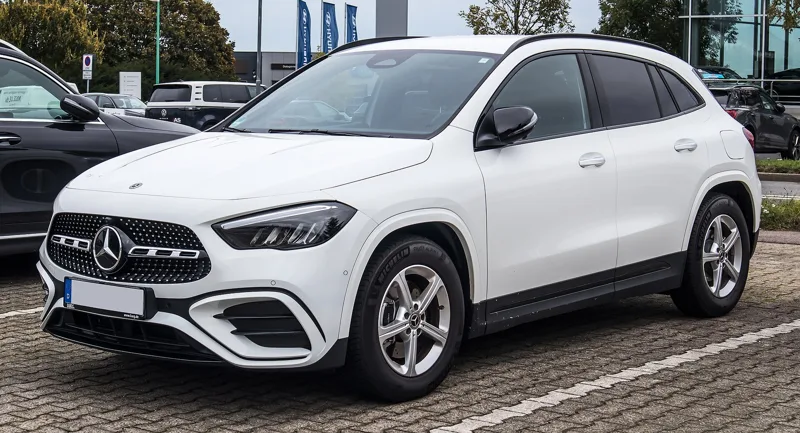
The GLA received a facelift in March 2023. It brought redesigned headlights and taillights, updated powertrain options and three new optional wheel designs, and it introduced the latest generation of the MBUX infotainment system.
The new MBUX supports wireless Apple CarPlay and Android Auto, so phones connect without a cable. The dual 10.3-inch screen that had previously been part of the Premium Package became standard equipment, which put the larger display in every car regardless of options.
What is the third-generation GLA?
The third-generation GLA, coded H248/244, was revealed on 29 July 2026. It brings combustion and battery electric (EQA) models together under the GLA name, as the C174 CLA did a year earlier. The battery electric versions arrive first, and the hybrid follows in 2027.
Against the model it replaces, the newest car stretches 143 mm (5.6 in) further and sits 20 mm (0.79 in) lower, on a wheelbase extended by 61 mm (2.4 in). The exterior and interior are completely redesigned. The electric version has the Iconic Grille, similar to that of the electric GLC, while the hybrid uses a star pattern instead.
Inside, the car has the MBOS Superscreen found in other models. It combines a 14-inch central display, a 14-inch passenger display and a 10.25-inch driver display. Luggage space is 410 L (14 cu ft), growing to 1,400 L (49 cu ft) once the second row is folded flat. Electric versions also have a 107 L (3.8 cu ft) frunk under the bonnet.
What electric versions does the new GLA offer?
Buyers can pick from three battery electric versions. The entry model, the GLA 200 electric, makes 221 hp (165 kW), the GLA 250+ electric makes 268 hp (200 kW), and the all-wheel-drive GLA 350 4Matic electric tops the range at 349 hp (260 kW). The 350 covers 0-100 km/h in 5.3 seconds.
All versions use a nickel-manganese-cobalt battery. Usable capacity is 58.0 kWh in the GLA 200 electric and 85.0 kWh in the others. Mercedes-Benz says the electric GLA should manage as much as 657 km (408 mi) between charges and accept power at up to 320 kW, although these are manufacturer figures for a car that was only just revealed.
What are the Mercedes-Benz GLA specifications?
| Specification | Detail |
|---|---|
| Type | Subcompact luxury crossover SUV |
| Generations | X156 (2013), H247 (2019), H248/244 (2026) |
| Drive | Front-wheel drive or 4Matic all-wheel drive |
| X156 drag coefficient | Cd 0.29 |
| X156 platform | Shared with the A-Class and B-Class |
| H247 platform | MFA2, chassis number 247 |
| H247 wheelbase | 30 mm (1.2 in) longer than the X156 |
| H247 ground clearance | 143 mm |
| H247 gearboxes | 7-speed 7G-DCT (GLA 180, 200); 8-speed 8G-DCT (rest) |
| Third-generation boot | 410 L (14 cu ft); 1,400 L (49 cu ft) with seats folded |
| Electric power | 221 hp (165 kW), 268 hp (200 kW) or 349 hp (260 kW) |
| Battery | Nickel-manganese-cobalt, 58.0 kWh or 85.0 kWh usable |
| Electric range | Up to 657 km (408 mi) claimed |
| Charging | Up to 320 kW |