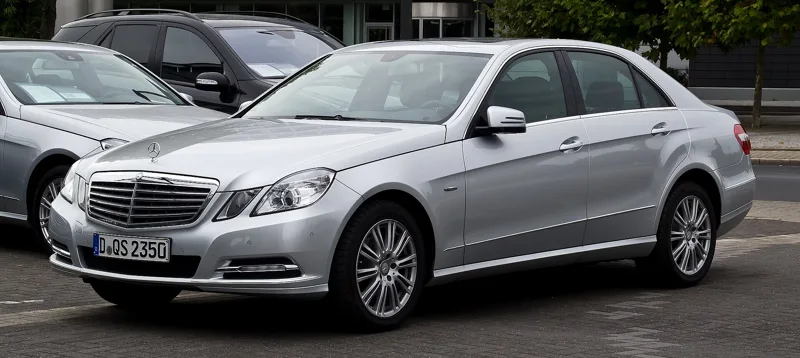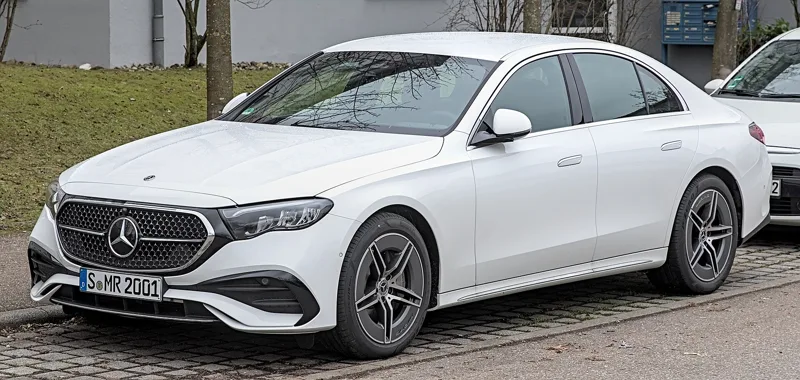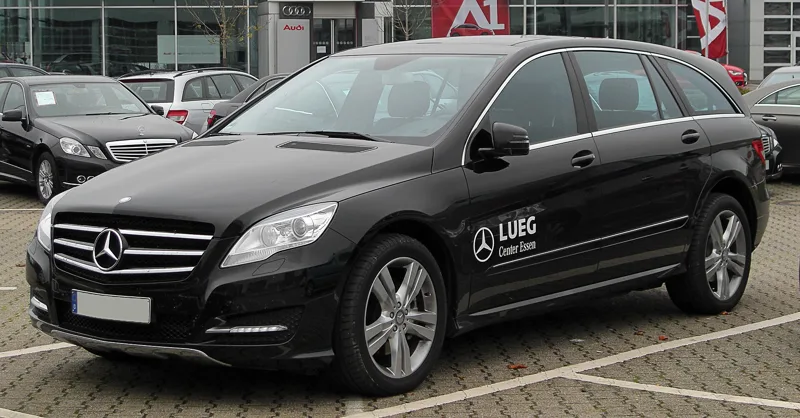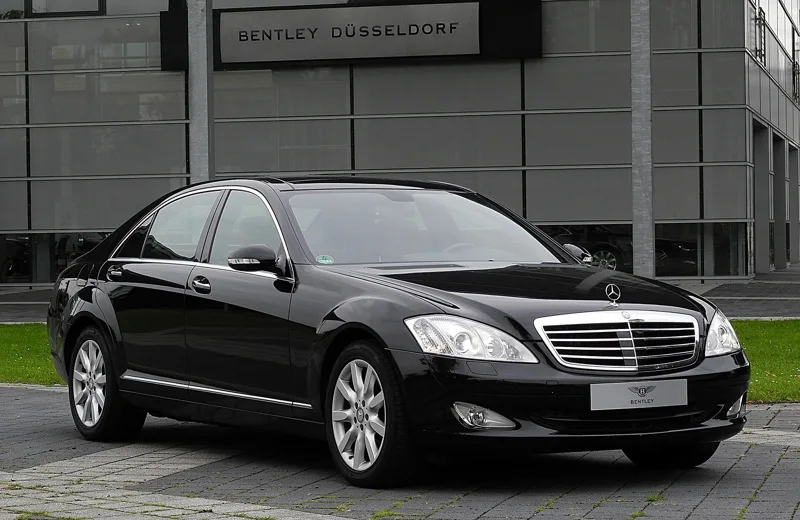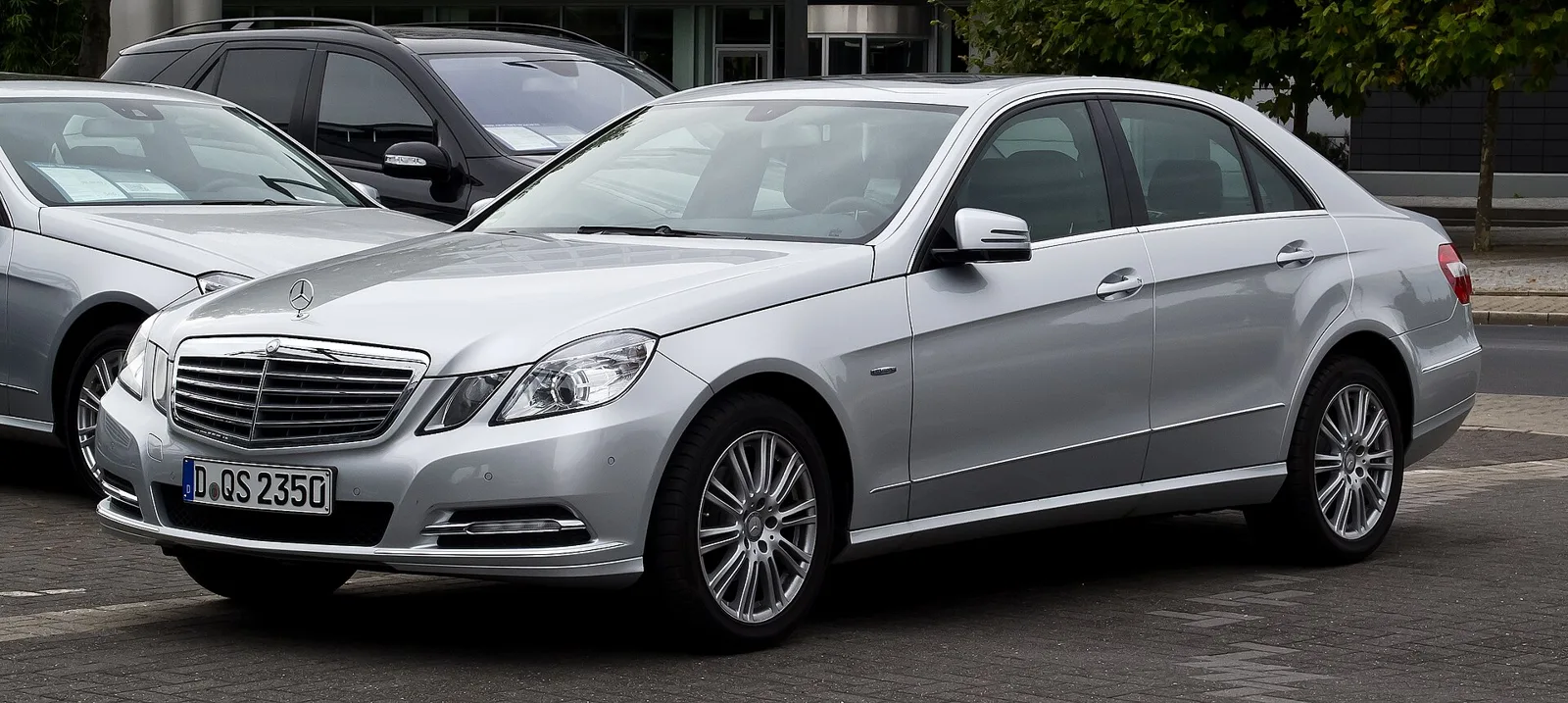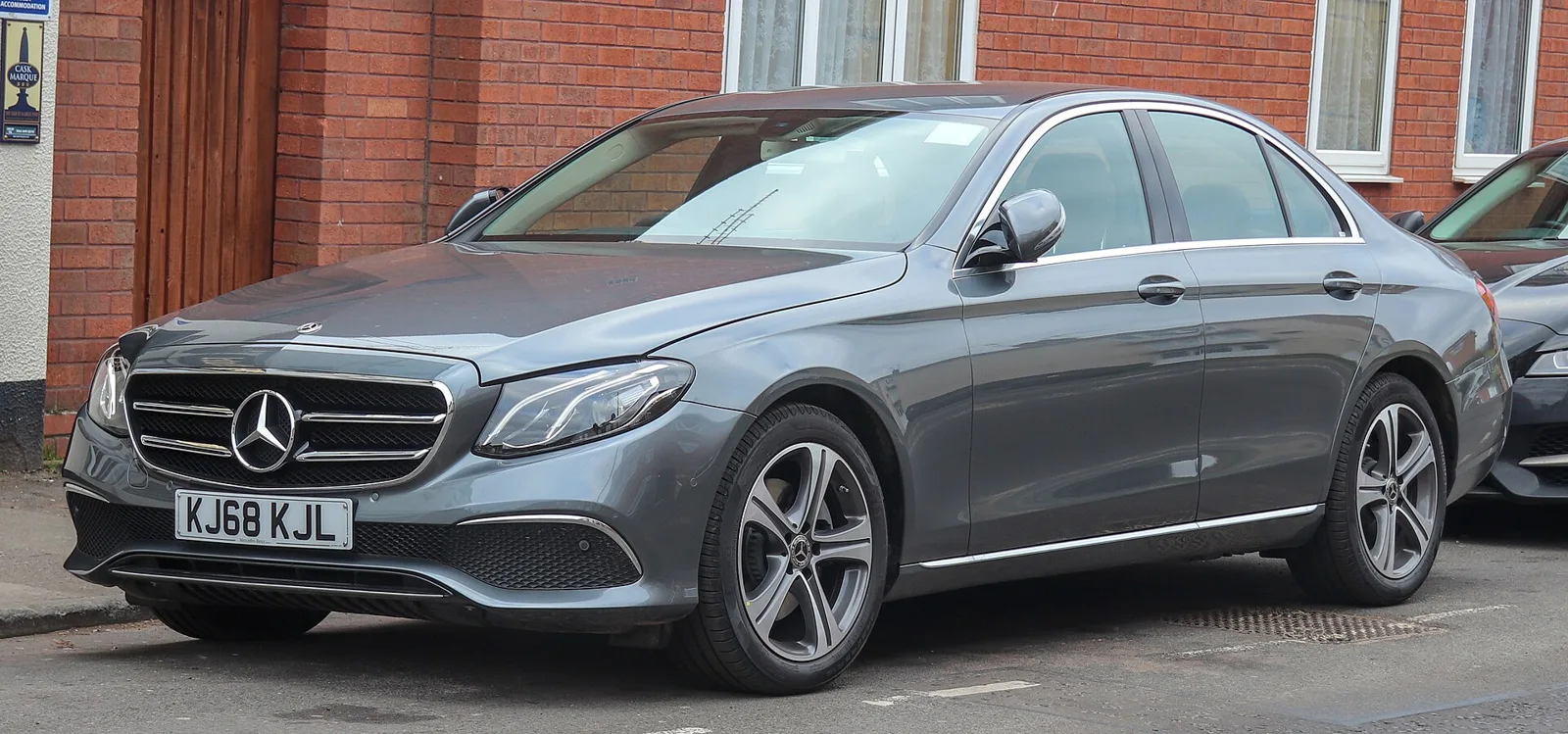
The V213 stretched the 2016 W213 E-Class to 5,065 mm, sold in China and India, and gave buyers a cheaper route to S-Class style.
Built on the W213 platform, the V213 stretched the fifth-generation saloon to 5,065 mm for China and India. Launched in 2016, it was the longest E-Class ever built, and it drew buyers with room, equipment and a price close to the standard car.
The Mercedes-Benz V213 is the long-wheelbase version of the fifth-generation E-Class, built on the W213 platform and sold only in China and India. At 5,065 mm it is the longest E-Class ever made, and it was launched at the 2016 Beijing Auto Show.
What is the W213 E-Class?
The W213 marks the fifth generation of the E-Class saloon line, reaching showrooms from 2016 as a 2017 model. It succeeded the W212 and S212 models, and the coupe and convertible shared their platform with the sedan and wagon, which was a change from the previous generation.
The W213 was unveiled at the 2016 North American International Auto Show, after a January world debut, and launched in spring 2016. The AMG E 63 and E 63 S were the only versions with V8 engines, and they arrived from 2016 as 2017 models.
A stretched E-Class built for China and India, sitting beside a 2016 saloon that won the 2021 Motor Trend Car of the Year.
How long did the W213 take to develop?
The whole development process stretched over 48 months, during which Mercedes-Benz built 1,200 prototypes. The cars covered a combined 12 million kilometres in conditions that ranged from snow to desert heat, and they were used to test the Distronic semi-autonomous driving suite.
Prototypes ran more than 10,000 autonomous braking procedures and 5,000 automated lane changes. In all, 1,200 engineers worked on the fifth-generation E-Class.
How did the W213 change the design?
The W213 was based on the F800 Style design language used on the larger W222 S-Class and the smaller W205 C-Class. Where its predecessor had a tighter surface and harder edges, the new car was curvier and more flowing, and its drag coefficient improved from 0.25 to a class-leading 0.23.
The W213 adopted Mercedes' modular MRA platform, the same family used by the C-Class and S-Class. It grew 43 mm in length and 65 mm in wheelbase, and it was 2 mm narrower and 6 mm lower than the W212. Up to 100 kg was shaved off through greater use of high-strength steel and aluminium.
What are the W213 and V213 dimensions?
| Specification | W213 (sedan) | V213 (long-wheelbase) |
|---|---|---|
| Length | 4,923 mm (194 in) | 5,065 mm, the longest E-Class ever |
| Wheelbase | 2,939 mm (116 in) | Longer than the standard car |
| Width | 2 mm narrower than the W212 | Not separately quoted |
| Drag coefficient | 0.23 | Not separately quoted |
| Sales markets | Worldwide | China and India only |
| Estate luggage | 695 litres (estate) | Not applicable |
| Transmission | 9G-TRONIC nine-speed automatic | 9G-Tronic, standard across the range |
What is the V213 long-wheelbase E-Class?
The V213 is the newest long-wheelbase E-Class saloon, launched at the 2016 Beijing Auto Show. It went on sale in China in August 2016 and is sold only in China and India, where it has been popular with buyers who wanted extra room.
The car is often called a smaller S-Class, mainly because it shares several features with that car, including the shape of the C-pillar. It is 5,065 mm long, which makes it the longest E-Class ever built.
Which V213 models were offered?
The V213 was sold in three basic models, the E200L, E300L and E320L, and each could be chosen with either the Exclusive line or the AMG Line design. The four-cylinder turbocharged M274 or M276 petrol engines powered the range, and the new 9G-Tronic transmission was standard throughout.
The E200L reached 100 km/h (62 mph) in 8.6 seconds, the E300L took 6.9 seconds, and the E320L 4MATIC was claimed at 5.7 seconds. The 9G-Tronic gearbox was designed to focus on efficiency and smoother gear changes.
Why did Chinese buyers respond to the V213?
Since its launch the V213 has won both disappointment and admiration in China. Its longer wheelbase and luxury equipment made it widely seen as a less expensive alternative to the S-Class, and its design took inspiration from the Maybach S-Class.
Some buyers were unhappy that multibeam headlights and several driver-assistance features, which were new on this model, were not standard and had to be bought as optional extras. Others praised the spacious cabin, the 12.3 inch displays, onboard Wi-Fi, wireless charging and automatic emergency braking as standard.
The price gap to the W213 in China was only about 10,000 RMB ($1,560), which made the V213 more attractive. Features that were not available on the worldwide W213, such as Wi-Fi and wireless charging, helped the long-wheelbase car sell well.
What changed in the V213 facelift?
Mercedes-Benz unveiled the facelifted V213 at Auto China on 29 September 2020. Like the original, it was sold only in China and India.
The facelift built on the W213 updates for the 2021 model year, including a new inline-six mild-hybrid engine for the E450 and the MBUX infotainment system that replaced COMAND. The wider W213 facelift also brought a 12.3 inch touchscreen, a new steering wheel and an advanced capacitive hands-off detection system.
What was the W213 interior like?
The interior of the 2017 E-Class was unveiled in December 2015, after a preview on the Concept IAA that Mercedes showed in September 2015 at the Frankfurt show. It mounted two 12.3 inch full HD screens within a single unit, and most E-Class models received this widescreen layout as standard.
Base Avantgarde versions kept analogue dials with a seven-inch multi-information display and an 8.4 inch central screen. Mercedes also added a pair of touch-sensitive buttons on the steering wheel that respond to finger swipes, and the traditional COMAND controller remained on the centre console.
What safety and driver aids did the W213 have?
A number of sensors, cameras and radars allowed semi-automated driving. There were fewer sensors than before, with 12 and four respectively compared with the W212, but each one offered more functions, which reduced cost and complexity.
The Drive Pilot system could negotiate motorway bends while keeping a safe distance from slower traffic at up to 210 km/h (130 mph). Steering Pilot followed road markings through bends at up to 130 km/h (81 mph), and it could adjust speed by reading speed limit signs. The Drive Pilot system was not hands-free, and an audible alert prompted the driver if attention wandered.
Active Brake Assist and Evasive Steering Assist worked together to warn of and prevent collisions, and the first system could brake automatically in an emergency. Car-to-X communication let vehicles warn each other of hazards, and PRE-SAFE Impulse Side moved the occupant away from an unavoidable side impact.
How did the W213 headlights work?
Mercedes' Multibeam LED headlamps first appeared on the CLS in 2014, and the W213 extended them. The number of individually controllable LEDs rose from 24 to 84, switching between high and low beam and following the curve of the road through electronic adaptive lighting.
Like the mid-cycle refresh of the W212, the W213 used two larger units in place of four separate headlamps, although LED light bars inside still gave the night-time look of four.
Which engines did the W213 offer?
Engine choices for the 2017 E-Class changed with the move from V6 units to inline-six engines, along with a new generation of four-cylinder diesels and the existing M274 petrol fours. All engines except the AMG V8 came with the 9G-TRONIC nine-speed automatic, and the AMG V8 used a nine-speed AMG SPEEDSHIFT gearbox.
The E 400 used a 3.0 litre twin-turbo V6 making 333 PS (328 hp; 245 kW) and 480 Nm (354 lb-ft). For 2019 it was renamed the E 450, rated at 362 PS (357 hp; 266 kW), with torque of 500 Nm (369 lb-ft). The E 300 used a 2.0 litre turbo four whose 370 Nm (273 lb-ft) of torque came with 245 PS (242 hp; 180 kW).
The E 350 gained an updated 2.0 litre turbo for the 2020 model year, with 400 Nm (295 lb-ft) of torque and 299 PS (295 hp; 220 kW). The E 350e plug-in hybrid paired a 208 hp turbocharged four with an 87 hp electric motor and a claimed electric-only range of 21 mi (34 km).
What did the AMG models offer?
The Mercedes-AMG E 43 arrived in September 2016 with all-wheel drive only, a 401 PS (295 kW; 396 bhp) 3.0 litre Biturbo V6 and a nine-speed automatic. It reached 100 km/h in 4.6 seconds and was electronically limited to 250 km/h (160 mph), but it was dropped for 2018 and replaced by the E 53.
The E 53 4MATIC+ used a 3 litre inline-six, delivering 435 PS (429 hp; 320 kW) on top of 520 Nm (384 lb-ft). It remained the sole AMG option for both the coupe and cabriolet after the Mercedes-AMG coupe and cabriolet returned in 2019.
The AMG E 63 4MATIC+ and E 63 S 4MATIC+ used a twin-turbo 4.0 litre V8 in two states of tune. The standard car made 571 PS (420 kW; 563 hp) and reached 100 km/h in 3.5 seconds, while the S made 612 PS (450 kW; 604 hp) and reached 100 km/h in 3.4 seconds. Both were limited to 250 km/h, which could be raised to 300 km/h with the AMG Driver's Package.
Why did the E 63 skip the mild-hybrid system?
While most other AMG models gained electrification, the E 63 did not receive the 48V mild-hybrid system. Mercedes-AMG's vehicle development director gave two reasons, physical space and market positioning, and said the package had no room for the integrated starter-generator.
The second reason was the lineup itself. Above the E 63 sits the GT 63 S, and Mercedes-AMG did not want the two to overlap, so it kept more power exclusive to the GT 63 S. The E 63 also used an electromechanical clutch rather than a torque converter to allow a race start and quick shifts.
How did the Coupe and Cabriolet differ?
The Coupe (C238) premiered at the 2017 North American International Auto Show, and the Cabriolet (A238) at the 2017 Geneva show. Both replaced the earlier C207 and A207 E-Class models and were released for the 2018 model year.
Like the coupe it replaced, the C238 had no B-pillar between the front and rear side windows, although a small pillar stood between the main rear window and the fixed quarter glass. Both models began as the E 400 with the M276 V6, and the E 450 replaced it from 2019.
How did the estate and All-Terrain versions work?
The estate was offered in two variants, a traditional on-road model and an All-Terrain version aimed at the Audi A6 Allroad and Volvo V90 Cross Country. The All-Terrain was unveiled at the 2016 Paris Motor Show.
The All-Terrain sat 29 mm higher than the standard estate, using Air Body Control air suspension and 20 inch wheels fitted as standard. It had plastic cladding to protect the body, and its 4Matic permanent four-wheel drive split torque 31/69 between the front and rear.
The E 400 wagon used the same 3.0 litre twin-turbo V6 as the sedan, rated at 333 PS (245 kW; 328 hp), with torque of 480 Nm (354 lb-ft). It offered 64.3 cubic feet of load space, against 57.4 cubic feet in the sedan, and could be ordered with third-row seats. It reached 60 mph (97 km/h) in 5.1 seconds.
What were the late W213 updates?
For the 2021 model year the E-Class received updated front and rear fascias, and the All-Terrain became available in the United States in place of the standard estate. It had been planned for the 2020 Geneva show, which was cancelled because of COVID-19.
Mercedes-AMG announced the updated coupe and cabriolet on 27 May 2020, and in mid-2022 it revealed the Final Edition of the E 63 S 4Matic+. That car marked the end of the V8's production run, with 999 units to be built.
Was the W213 well received?
The W213 won praise from automotive publications, and it went on to take the 2021 Motor Trend Car of the Year, the first time Mercedes-Benz had won that award. Car and Driver also placed it among its 10 Best vehicles in 2019.
The long-wheelbase V213 showed a different side of the same reception, with strong sales in China driven by room, equipment and price.