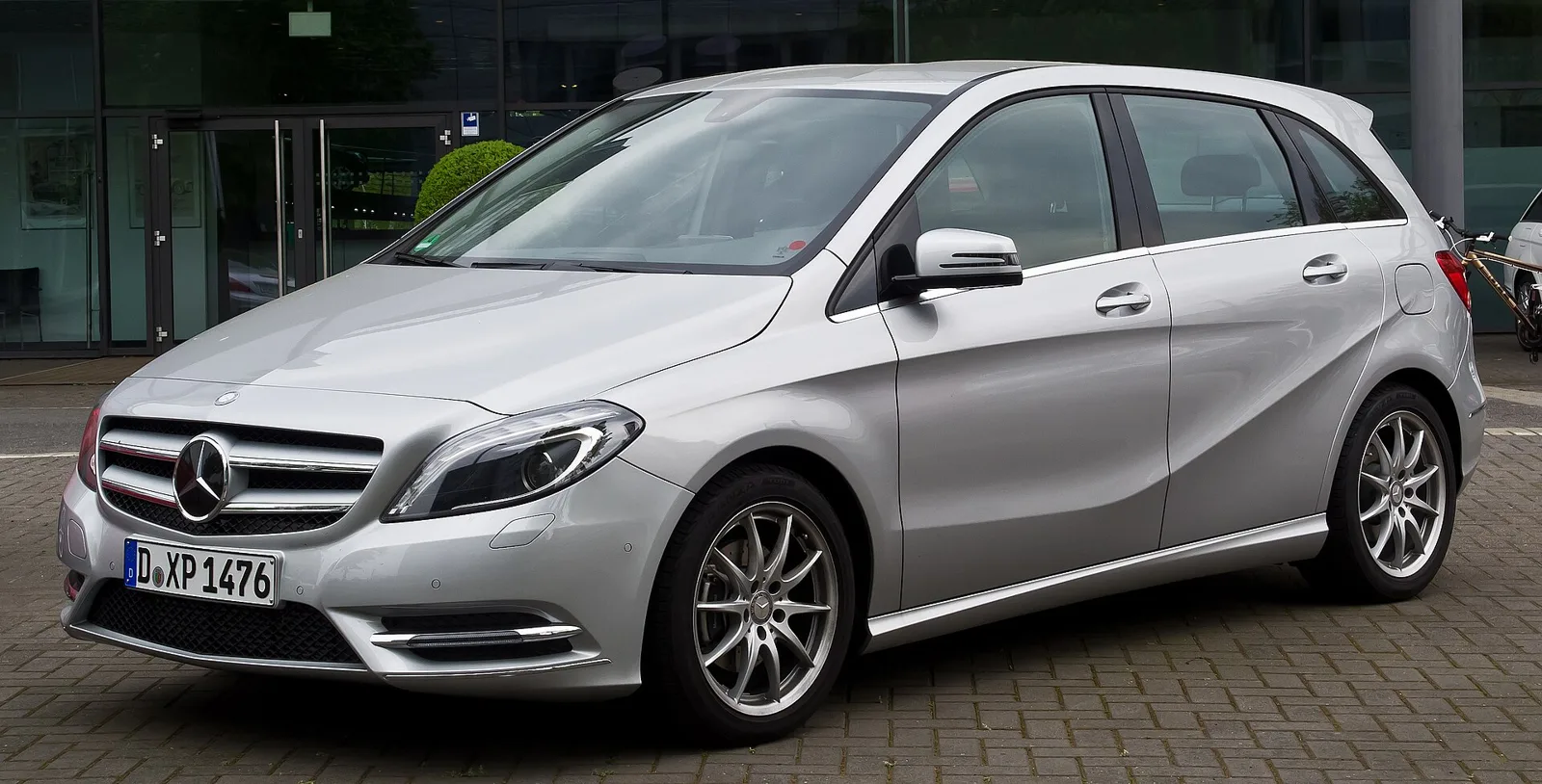
The second-generation hatchback built from late 2011 to late 2018, with petrol, diesel, natural gas and electric versions and a 2014 facelift.
Built from late 2011 to late 2018, the second-generation Mercedes-Benz hatchback coded W246 rode on the MFA platform it shared with the A-Class. It came with petrol, diesel, natural gas and electric drivetrains, and more than 230,000 had been delivered by summer 2013.
The Mercedes-Benz B-Class W246 was a five-door hatchback that arrived as a taller and more practical alternative to the A-Class. It was built from late 2011 to late 2018, and by summer 2013 more than 230,000 had been delivered.
It was also the first vehicle to use Mercedes' MFA platform, which the A-Class shared. BMW launched the 2 Series Active Tourer as a direct rival in August 2014.
How did the B-Class come to market?
Mercedes said in early 2011 that the B-Class would launch that year on the MFA platform, which the A-Class would also use. Development boss Jorg Prigl said the platform could build a direct, high-roof replacement for the B-Class, and the car was revealed in August 2011.
Prigl also said the architecture was versatile enough to take a fuel cell stack, a high-voltage battery, hydrogen storage and CNG tanks. That flexibility is one reason the car later appeared in so many drivetrains.
A taller hatchback on the MFA platform that Mercedes sold alongside the A-Class.
Where was the B-Class built and when did it arrive?
The W246 went on sale in Europe in November 2011, and Japanese and Australian buyers received it in April 2012. Mass production had begun in November 2011 at the Rastatt plant in Germany, and Kecskemet in Hungary also built cars from 2011.
Canadian models arrived in late 2012 as 2013 model year cars. Production ended in December 2018, and the W247 B-Class replaced the W246.
The W246 was revealed in August 2011 and made its public debut at the International Motor Show Germany that September. Model years for the car ran from 2012 to 2018.
How did the B-Class differ from the A-Class?
The B-Class was pitched as a taller and more practical choice than the A-Class, with a tall-roof hatchback body and some of the feel of a compact minivan. It was offered with petrol, diesel, natural gas and battery electric powertrains.
Euro NCAP classed the car as a small MPV, although its styling stayed firmly hatchback-directed. It measured 4,360 mm (172 in) long and belonged to the C-segment in the small family car classification.
Compared with its predecessor, the W246 was 90 mm (3.5 in) longer, 8 mm (0.31 in) wider and 46 mm (1.8 in) lower. Its wheelbase was 80 mm (3.1 in) shorter.
Like the W176 A-Class, the B-Class sat on the MFA platform, which had been announced as the base for both cars.
What design changes did the W246 bring?
The W246 had a drag coefficient of 0.26 Cd, down from 0.31 on the model it replaced. Its centre of gravity was lowered by 20 mm, and the body gained a more upright pose that was noticeably less curvy, especially at the rear.
The car was among the first to wear Mercedes' new design cue, which later appeared on the W222 S-Class, the X156 GLA and the W205 C-Class. The grille was larger than before, and the car's lighting was inspired by that of the C218 CLS.
LED lamps were available, and the daytime running lights and indicators gained a switchback effect. The car's lights were also a visible break from the previous design.
What safety and driver aids came with the B-Class?
Safety equipment included seven to nine airbags, hill-start assist, driver drowsiness detection and tyre pressure monitoring. Pre-Safe tightened the seatbelts, and a system closed the windows and sunroof if the car detected an approaching accident.
Anti-lock braking, electronic stability control and brake assistant were standard. The front suspension used MacPherson struts, while the rear was a four-link arrangement shared with its platform partner.
BlueEFFICIENCY was a set of measures to cut fuel use and CO2. It combined a start/stop function, alternator management for regenerative braking and tyres optimised for rolling resistance. The B 180 CDI BlueEFFICIENCY was available from September 2011.
Which trims did Europe get?
Before the facelift, European cars came in SE, Sport and AMG Line trims. The SE had 16-inch alloy wheels, LED daytime running lamps, comfort suspension and cruise control, along with a reversing camera and a 7-inch infotainment screen.
The SE also had USB ports with smartphone integration, air conditioning, an adjustable boot floor and man-made leather upholstery.
The Sport trim added 17-inch alloys, twin sport exhaust pipes, an interior lighting package and a larger infotainment screen with two-way climate control. The AMG Line brought AMG-style front, side and rear aprons, 18-inch AMG-type alloys with five double spokes and lowered suspension.
The AMG Line also featured perforated brake discs, artificial leather with red contrasting stitching and a leather-covered steering wheel with red topstitching. In July 2012 Mercedes added illuminated door sills and an optional auxiliary heater with remote control for the 2013 model year.
Packages were Executive, Premium and Premium Plus. Executive added parking assist, heated seats and automatically dimming, folding mirrors, while Premium brought LED headlights and satellite navigation. Premium Plus added a larger tablet display, a panoramic glass sunroof and dual-zone climate control.
German buyers could also choose the Chrom, Night, Sport, Exklusiv and Licht- und Sicht packages, or the Sondermodell Edition 1 special model. Those names were kept in German in the German market. A natural gas variant of the B 200 became available in early 2013 with a choice of manual or 7G-DCT dual-clutch transmission.
What did Canada and Australia get?
Canadian buyers started with one trim before the facelift, the B250 Sports Tourer in front-wheel drive. A second trim, the B250 4Matic all-wheel-drive version, joined the range in 2015 with the facelift.
Both Canadian trims had heated seats, auto start/stop and a seven-speed dual-clutch transmission. Their 2.0-litre turbo made 208 hp (155 kW) and 258 lb ft (350 Nm), and the front-drive car reached 0-100 km/h (62 mph) in 6.8 seconds, while the 4Matic took 6.7 seconds. The 4Matic also had better traction control, thanks to its all-wheel-drive suspension.
The Versatility package added a powered driver's seat with lumbar support, auto-dimming mirrors, a universal garage door opener and the Easy Vario Plus storage system. That system gave a flat-folding passenger seat, sliding rear seats and a height-adjustable cargo floor.
The Premium package added a black fabric roof-liner, a panoramic sunroof, dual-zone automatic climate control, a rearview camera, navigation, a DVD player and blindspot assist. The Sport package brought AMG-style trim, an AMG sporty front bumper, sport brakes, direct steering and black leather seats.
Australian models were sold as the B180, B200 and B250. The B180 had 16-inch 10-spoke alloys, a six-speaker audio system, Bluetooth audio streaming and a 14.7 cm TFT colour display, with climate control and cruise control as standard.
The B200 added 17-inch alloys, Artico leather seats and four-way power adjustable front seats. The B250 finished the range with 18-inch alloys, a lowered Avantgarde suspension, bi-xenon headlights with washers and privacy glass.
The B180 also came with rain-sensing wipers, front and rear parking sensors, a trip computer and rear seats that folded in thirds. The B200 was recognisable by its three-louvre silver grille and chrome highlights, and it added black ash wood trim and electrochromatic door and rear view mirrors.
What was the B-Class Electric Drive?
The Electric Drive, internally designated W242, used a 136 PS (100 kW; 134 hp) electric motor and a 36 kWh lithium-ion battery from Tesla Motors. It had a range of 200 km (124 mi) and a top speed of 150 km/h (93 mph), and it was Mercedes' first mass-produced battery electric vehicle.
Development began under the BlueZERO project, with batteries from Li-tec and a drivetrain from Tesla. Shows in Paris in 2012, New York in 2013 and the IAA later that same year gave the car its public showings before retail production began in April 2014 at Rastatt.
Mercedes announced German and UK availability for the first quarter of 2015 and opened orders in November 2014, when pricing was published. The car could charge from a standard 230 V single-phase outlet or a 400 V three-phase rapid charger.
Tesla Supercharging was not enabled, so the car could only use CHAdeMO through aftermarket conversion parts.
How did the Electric Drive sell in the United States?
The Electric Drive reached the US in December 2013 as an early 2014 model. It was one of the few B-Class models ever sold in America, and the first Mercedes-Benz offered in electric form, but it was limited to states that required zero-emission vehicles.
The EPA rated the 2014 car at 87 mi (140 km) all-electric, with 40 kWh/100 miles for combined driving and 84 miles per gallon gasoline equivalent. Pricing started at US$41,450 before any tax credits and other incentives. City driving was rated at 85 mpg-e and highway driving at 83 mpg-e.
Over 1,900 electric B-Class cars were sold in the US in 2015. Sales reached 4,100 in 2017, the year the car was renamed the B250e, and it was discontinued shortly afterwards because demand was low.
What changed with the 2014 facelift?
Mercedes revealed the facelifted B-Class at the October 2014 Paris Motor Show, and production began in November 2014 as a 2015 model. The changes were mostly exterior, with a revised front bumper, a larger grille with two louvres, LED High Performance headlamps and refreshed LED taillamps.
The trims were restyled. The Style model had two louvres painted in Iridium Silver and chrome inserts around the car, while the Urban line used five-spoke alloy wheels and twin exhaust pipes set inside the rear bumper. The Style interior used Vianen fabric on the seats, with silver chrome accents on the steering wheel, gear lever and dash switches. The AMG Line stayed much as it had been.
Technical data stayed the same, but several model names changed. The B 220 CDI became the B 220d, the Electric Drive became the B 250e and the fuel cell model was called the B 200f. Ambient lighting came in 12 colours, and a new head unit display was added. The Electric Drive and natural gas models kept the pre-facelift headlamp look, although their taillamps were refreshed.
How safe was the B-Class?
A 2011 test gave the W246 an overall five-star rating. The car tested was a black B200 CDI in left-hand drive, weighing 1,475 kg (3,252 lb) kerb, and it was built in November 2011, which made it one of the first units made.
Mercedes-Benz B-Class W246 specifications
| Specification | Detail |
|---|---|
| Generation | W246, second generation, 2012 to 2018 model years |
| Assembly | Rastatt, Germany; Kecskemet, Hungary from 2011 |
| Platform | MFA, shared with the W176 A-Class |
| Length | 4,360 mm (172 in) |
| Drag coefficient | 0.26 Cd, down from 0.31 |
| Canada B250 engine | 2.0-litre turbo, 208 hp (155 kW), 258 lb ft (350 Nm) |
| Canada 0-100 km/h (62 mph) | 6.8 seconds front-drive, 6.7 seconds 4Matic |
| Electric Drive motor | 136 PS (100 kW; 134 hp), 310 Nm (229 lb ft) |
| Electric Drive battery | 36 kWh lithium-ion |
| Electric Drive range and top speed | 200 km (124 mi) and 150 km/h (93 mph) |
| EPA all-electric range, 2014 | 87 mi (140 km) |
| Sales, 2015 and 2017 (US electric) | Over 1,900 and 4,100 |