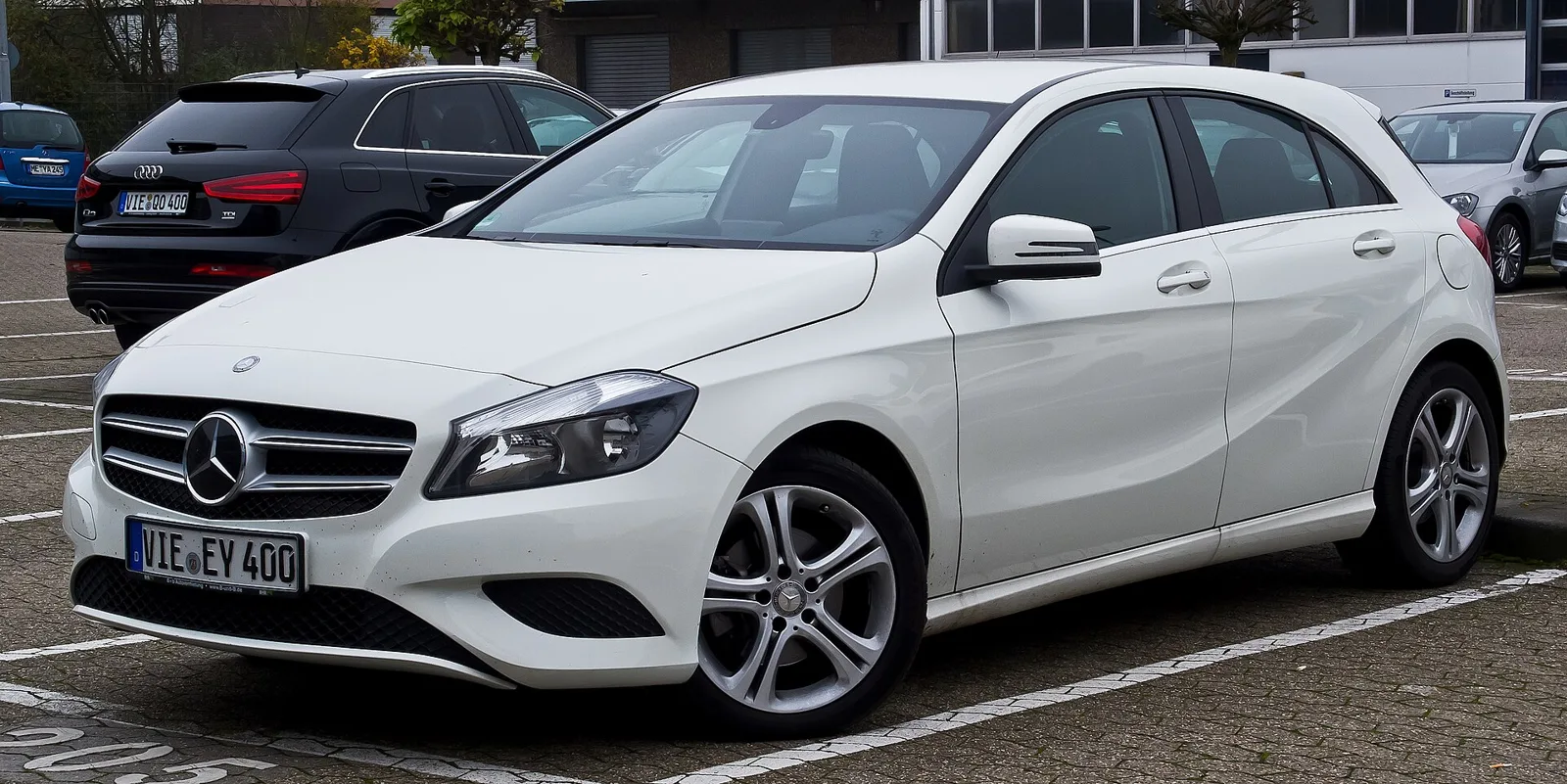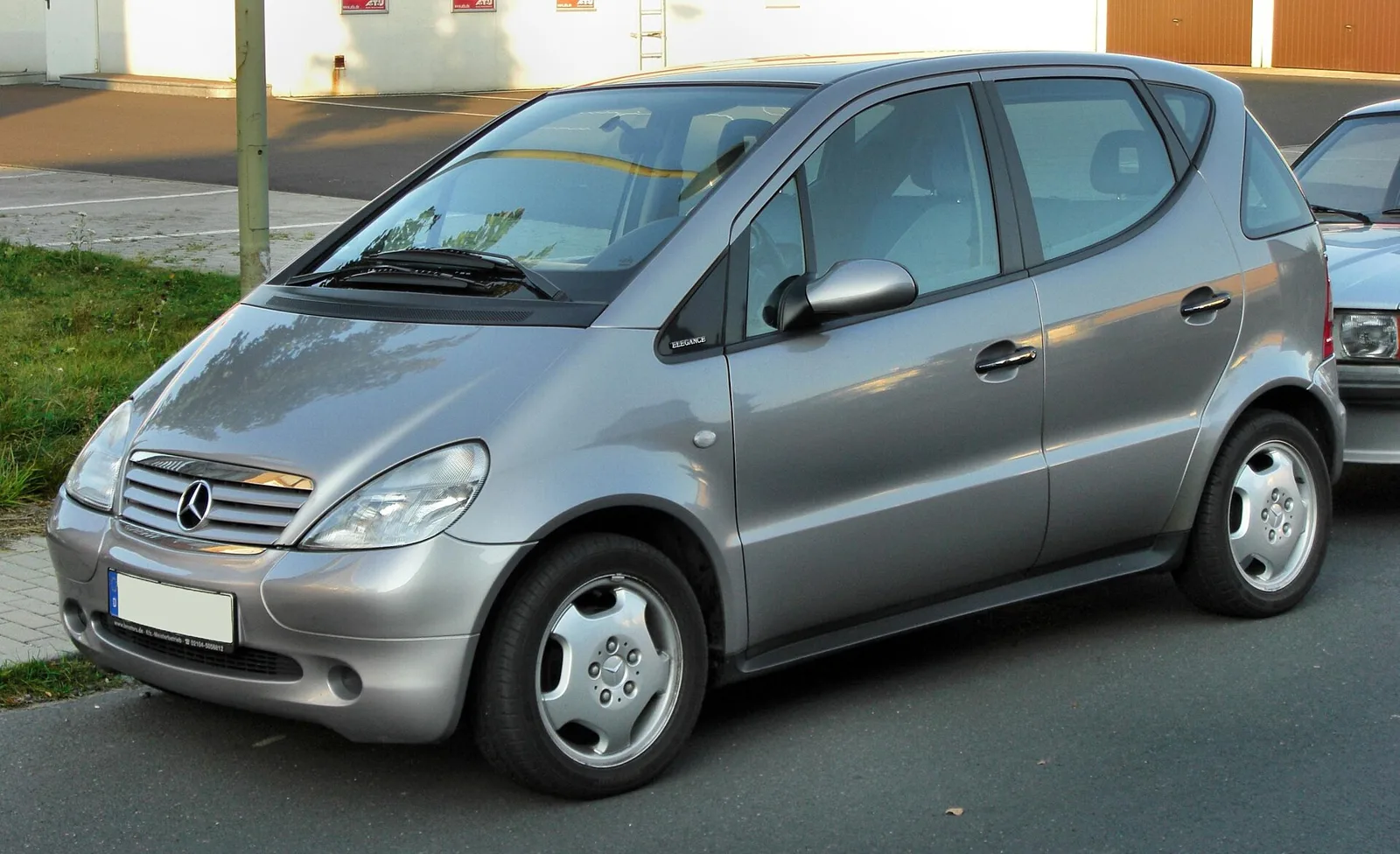
A sandwich-floor compact built from 1997 to 2004, with a high seating position, a moose-test crisis and the standard ESP that followed.
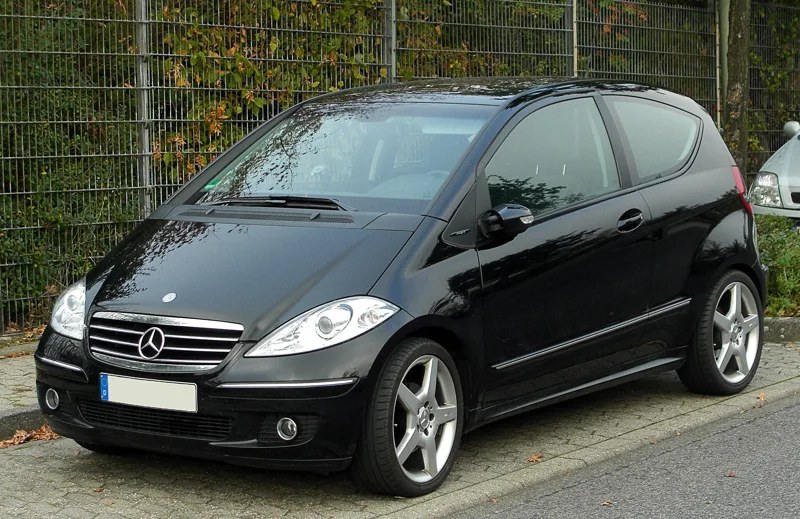
The Mercedes-Benz W 168, sold as the A-Class from 1997 to 2004, marked the brand's entry into the compact front-wheel-drive segment. Its sandwich floor gave a high seating position and small outside dimensions, and after the moose test Mercedes fitted ESP as standard.
Mercedes-Benz entered the compact front-wheel-drive segment with the series 168 A-Class, built between 1997 and 2004. Its sandwich floor set the drive beneath the passenger compartment and raised the seat, which suited the car to city use. The model is remembered as much for the moose test that followed its launch as for its design.
Where did the A-Class come from?
Study A, shown at the IAA in September 1993, grew from the sandwich concept invented in 1991. Series planning had started internally as early as June 1992, and by August 1994 the first prototype was being tested under everyday conditions, so the path from concept to showroom was quick.
A prototype with electric drive was developed in parallel with the petrol-engined car. Visitors to the 1993 IAA and the 1994 Tokyo Motor Show backed a small Mercedes-Benz like the concept in large numbers, with 80 percent and 95 percent respectively. That result led the Daimler-Benz board to decide on series production.
A sandwich-floor Mercedes whose moose test pushed electronic stability control into the mainstream.
Mercedes and small cars before 1997
Contrary to a widespread prejudice, Mercedes-Benz had worked on compact vehicles early on. Models such as the 8/18 of 1911 and the 1924 Mercedes 6/25/40 PS were small by the standards of their time.
After Daimler-Benz AG was founded, smaller classes were drawn up several times. Ferdinand Porsche and his successor Hans Nibel both worked on compact concepts, and the designer Josef Muller later built a small series of twelve cars with a 1.2-litre engine. The 1930s brought the type 130 and the type 120 H.
In 1935 the W 144, a front-drive prototype, was built, but it never reached series production and was later destroyed. After the Second World War further small-car concepts were studied, and the NAFA ('Nahverkehrsfahrzeug', a local transport vehicle) of 1981 is today seen as a forerunner of the A-Class, with a very space-saving concept.
Why did Mercedes need a compact car?
Mercedes mainly built upper-class and upper-middle saloons, and its buyers were growing older on average. The mid-range 190 had joined them only in 1982. Board member Jurgen Hubbert warned that the brand was on its way into a positioning trap, pointing to the S-Class, which sold only 49,996 units in 1996.
Hubbert argued that had the company been content with those figures, it would have ended up in the Rolls-Royce corner, which he called an existential problem for the whole company. The aim was a car that was still a proper Mercedes in solidity and comfort, but with small outside dimensions.
Traffic was changing as well. Denser traffic in city centres, a shortage of parking and long jams altered what customers needed from a car, and the compact class was the answer to that shift.
Pressure also came from California. Its Clean Air Act and Zero Emission Mandate became law in 1990 and pushed carmakers towards emission-free cars, which led to the General Motors EV1 and shaped the development of every major manufacturer.
How did the design come together?
The design aimed at clear lines, a compact silhouette and a sporty note. Steve Mattin's sketches were chosen and reworked by chief designer Bruno Sacco, and many colours were developed specially for the model to underline its claim to youth and innovation.
The body had an aerodynamic shape, with gently curving lines and a new radiator grille that carried the Mercedes star at its centre. It was meant to differ clearly from similar competitor models.
Most of the novelty was in the interior and the paint. In the Classic trim, cockpit panels and fabrics came in four colours each. Elegance offered a choice only of cockpit panels, while Avantgarde had none at first: its panels were painted anthracite until mid-1999, when grey leather replaced them.
Launch and the A-Motion Tour
The interior concept was shown at the Frankfurt IAA in September 1995, by which time the overall length had grown by 225 millimetres compared with the study. Interior room grew further, most of all in the boot.
Mercedes presented the A-Class officially at the Geneva Motor Show in March 1997. Buyers could choose between two petrol engines, 1.4 l and 1.6 l. Sales opened eight weeks after the show, in May 1997, and by October the cars were in dealerships.
Between March and October 1997 a marketing event called the A-Motion Tour took the car to 20 European cities. It ended on 15 October 1997 at the Rastatt plant, where the model was built. About 500,000 people saw the show over 185 days, and the campaign carried the line 'A strong piece of the future'.
Ferdinand Piech regarded the widening of Mercedes' target group as an attack on the Volkswagen Group's portfolio. Volkswagen answered with a luxury strategy and later with the Audi A2, aimed squarely at the A-Class.
How did the moose test change the car?
A test car tipped onto its side at about 65 km/h during a moose-test manoeuvre on 21 October 1997, three days after market launch. Sales were halted, and Mercedes decided to revise every car already built and fit the Electronic Stability Programme (ESP) as standard.
At first the company announced only changes to tyres and chassis. Shortly afterwards it went further, and the measures included wider tyres on a stiffer carcass, changed springs and dampers, and a modified chassis tuning.
Production stopped on 11 November 1997 and resumed on 26 February 1998. The incident became one of the biggest public crises in Mercedes-Benz history, and the media mockery that followed shaped perceptions of the first A-Class for years.
Before that, ESP had been available mainly in upper-class cars. Its standard fitting in the A-Class carried it into the volume segment, and it later became the safety standard across the industry. Mercedes later turned the episode into self-mockery, using moose images in advertising and accessories.
Higher positioning and the 2001 update
Although the car was initially polarising and positioned as modern and design-led, it appealed to every age group thanks to build quality, a raised seat with good all-round visibility and everyday practicality. It became a great success, particularly among well-off buyers.
Mercedes answered with a wider range of upmarket versions. In October 1998 came the Edition Hakkinen and Edition Coulthard, each limited to 250 vehicles, alongside an AMG appearance package. The 1999 update brought the stronger A 190, optional individual rear seats, and upgraded Elegance and Avantgarde trim.
Mercedes also changed the palette, dropping the brightest tones for Atoll Blue, Night Black and Nova Violet.
The March 2001 update was visually discreet. Interior trim was improved, and Mercedes-typical wood veneer trim became available as an option for the first time. Controls, exterior details and paints were adjusted to make the car look more conservative without breaking with its design concept, and newer, more sober colours such as Ocean Blue, Comet Grey, Cumulus Grey, Alpine Blue and Galaxy Black were added.
Which engines did the A-Class use?
At launch the A-Class offered the A 140 and A 160 petrol engines. The A 160 CDI and A 170 CDI diesels followed in August 1998, and the A 190 arrived in May 1999. The petrol engines were four-cylinder M 166 units, and the diesel was the OM 668 with common-rail injection and a turbocharger.
The M 166 sits transversely as an inline four, with eight valves and a single overhead camshaft on a timing chain. Light alloy covers the cylinder head and block, the crankshaft has five bearings, and petrol injection is electronically controlled. The first engines displaced 1,397 cc (85.3 cu in) and 1,598 cc (97.5 cu in); a 1,898 cc (115.8 cu in) unit arrived in 1999, and a 2,084 cc (127.2 cu in) one in 2002.
The OM 668 diesel is also an inline four, with an 80 mm bore and 84 mm stroke giving 1,689 cc (103.1 cu in). Its direct common-rail injection works at 1,350 bar, the compression ratio is 19:1, and two overhead camshafts run on a timing chain alongside 16 valves.
The A 160 CDI produced 160 Nm (118 lb ft) of torque, and the A 170 CDI 180 Nm (133 lb ft). Updated engines from 2001 delivered the same torque over a wider rev range, the A 160 CDI at 1,500 to 2,800 rpm and the A 170 CDI at 1,600 to 3,600 rpm.
The A 210 EVOLUTION was the most dynamic production version, with larger displacement, sportier tuning and its own look. It is now a collector's model. The A 38 AMG, with 3.8 litres of displacement, was an extreme study that tested the limits of the platform and is today considered a curiosity.
Engine and dimension table
| Item | Specification |
|---|---|
| Petrol engine (M 166) | 1,397 cc (85.3 cu in) and 1,598 cc (97.5 cu in); 1,898 cc (115.8 cu in) for 1999 on; 2,084 cc (127.2 cu in) for 2002 on |
| Diesel engine (OM 668) | 1,689 cc (103.1 cu in), common-rail, turbocharged, 16 valves |
| Diesel compression ratio | 19:1 |
| Diesel injection pressure | 1,350 bar |
| A 160 CDI torque | 160 Nm (118 lb ft) |
| A 170 CDI torque | 180 Nm (133 lb ft) |
| W 168 length | 3,575 mm (140.7 in) |
| V 168 wheelbase extension | 170 mm (6.7 in) |
| V 168 interior length, rear bench fully back | 2,005 mm (78.9 in), 27 mm (1.1 in) more than the S-Class |
What set the long-wheelbase V 168 apart?
From March 2001 the longer V 168 joined the range. Its additional 170 mm (6.7 in) of length goes entirely to rear-seat passengers, and its longer rear doors give it away. Production ran at Rastatt and at Juiz de Fora in Brazil, and the total passed 1.1 million vehicles.
The first A-Class's most notable innovations were the sandwich construction and an engine layout behind an inclined bulkhead, which packed the engine, gearbox and axles into little space. In a head-on collision the drive unit slides under the passenger compartment, and the interior offered flexibility that was unusual in this segment.
Did an electric A-Class reach production?
The electric A-Class never reached production. Developed with AEG and its Zebra battery of 30 kWh, it offered 125 miles or 200 km of range and a limited top speed of 80 mph (128 km/h), but it was dropped for economic reasons.
Preparations for series production were halted once California eased its legislation, so the electric drive was mainly tested in the United States and remained largely unknown in Europe. Mercedes-Benz owned AEG, then the second-largest German electrical group, and the electric version was developed until 1997.
A 2019 report said the car's structure had been prepared for a novel ceramic battery. According to former development staff, the floor pan planned for it also shaped the centre of gravity and the vehicle architecture.
How is the series judged today?
Today the series counts among the strangest and most ambitious production cars of the 1990s. Its sandwich floor, raised seating position, efficient use of space and early preparation of alternative drives are rated far more kindly than at launch.
The development was costly. Estimates put the loss at around 2.5 billion euros, despite the commercial success, and the model was not officially offered on the North American market.
Many cars stayed on European roads long after production ended, with high mileages and several owners. The unusual styling kept used values low for years, but rare examples, especially the A 210 EVOLUTION, have drawn growing interest from youngtimer and Mercedes-Benz collectors since the 2020s.
The design influence shows in later vehicles with high rooflines, variable use of space and compact exterior dimensions. The Audi A2 and the BMW 2 Series Active Tourer (F45) are frequently cited as close relatives in concept.
The colour Nova Violet, originally offered for series 168, returned under the MANUFAKTUR personalisation programme for the G-Class, with an explicit reference to its use on the first A-Class.