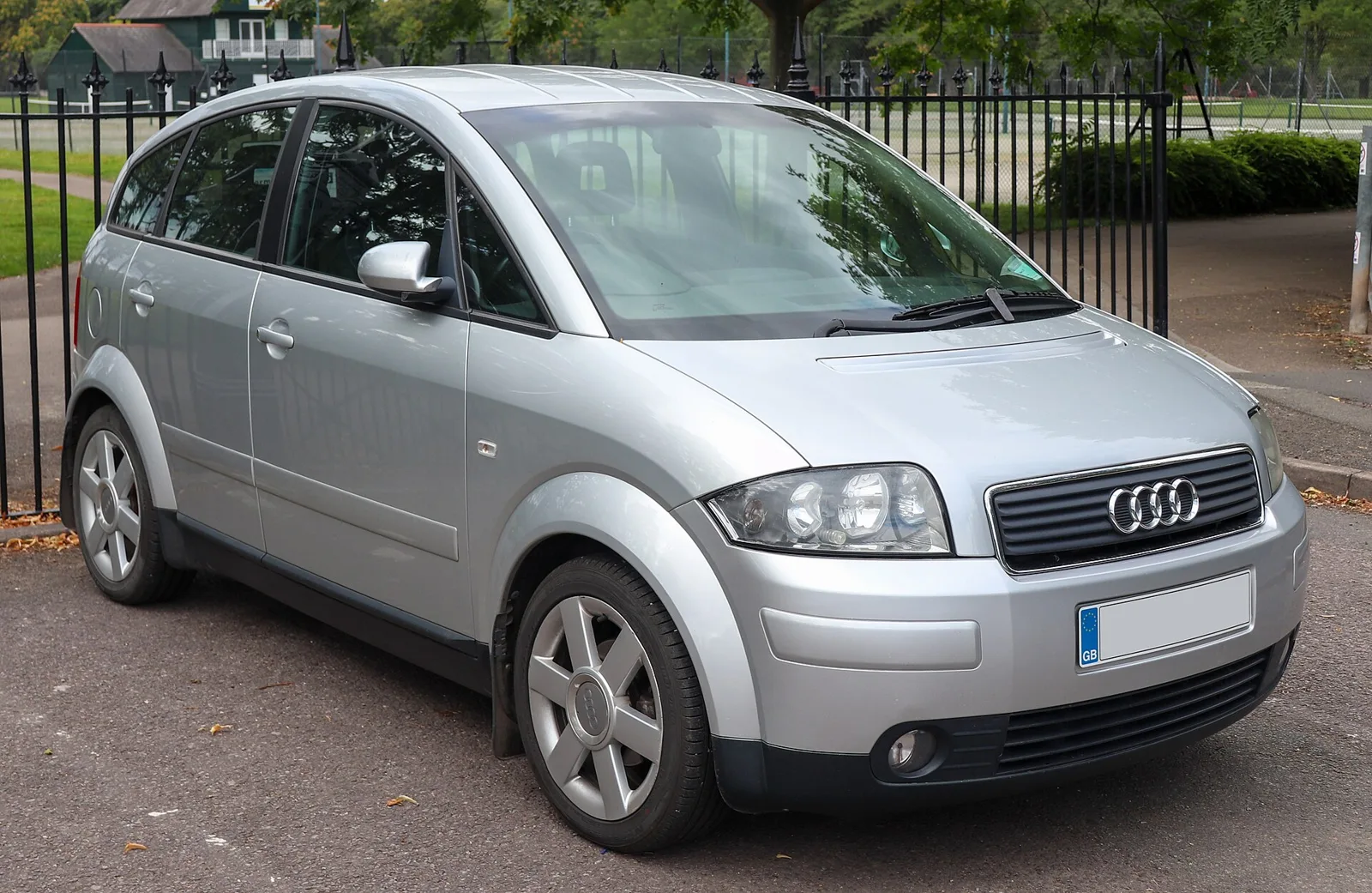
A lightweight aluminium five-door built from 1999 to 2005, which sold in modest numbers but pioneered space-frame design for mass-market cars.
The Audi A2 was a compact five-door built from 1999 to 2005 with an aluminium body. Its 3L diesel model was among the most economical cars sold in Europe. Audi built 176,377 units, and an A2 e-tron was announced in 2026.
The Audi A2, internally designated Typ 8Z, was a compact supermini with MPV-style proportions that Audi built from November 1999 until August 2005. Its body was largely aluminium, a bold choice for a mass-market car. This profile covers the design, engineering, sales story and the electric revival that followed.
The A2 was a car that many people admired but few bought, and that tension explains much of its story. It was an engineering showcase built on a production line that could not easily be made to pay.
What was the Audi A2?
The Audi A2 was a five-door compact hatchback with MPV-style proportions, built in Germany from November 1999 to August 2005. Its body was made from aluminium, making it significantly lighter than cars of its size. Audi built 176,377 units before the model was withdrawn.
It was based on the Al2 concept car shown at the 1997 Frankfurt Motor Show. The production car arrived only two years after the concept, which was a quick turnaround for a car with so much new engineering.
Audi built the A2 at its aluminium plant in Neckarsulm, on a special line purpose-built for it. The average car weighed 830 kg, and the last A2s were built in August 2005.
An aluminium supermini that proved lightweight construction could work at scale, even when the economics did not.
What was the A2's design brief?
The brief was summed up as a small Audi, not a cheap one. The A2 was meant to offer the quality of a larger Audi in a compact body, and it was intended to carry four people on a long drive on a single tank of fuel.
The car won a design award in 2001. Its styling was a surprise, since it arrived only two years after the study, and early reviews from What Car? and Autocar commented on how different it looked from the usual supermini.
Not everyone was won over. Some potential customers found the avant-garde styling too far from the Audi norm, and Audi was disappointed with the sales it achieved.
How did the A2's aluminium construction work?
The A2 used an Audi Space Frame built from castings and extrusions, laser-welded together. Its outer panels had little or no structural function, while the frame carried the loads. The result was a shell so light that two people could lift it.
The side panel over the doors, including the A and D pillars, weighed roughly 2 kg (4 lb). A 2002 model with standard equipment had a mass of 895 kg (1,973 lb), a striking figure for a car of its footprint.
The construction was expensive. Most of the parts were not off-the-shelf, and small production runs made aluminium costly, so the A2 cost more than rivals in its sector and lost ground to the A-Class.
Audi described the car as designed for aluminium from the start, with large, cost-effective castings used to consolidate parts. That approach was meant to make the structure cheaper over time, but it did not solve the basic economics of a small run.
How was the interior and service access arranged?
The boot offered 390 litres (13.8 cu ft) with the rear seats in place, which was significantly larger than the luggage space of the Audi A3. The rear passengers also benefited from a floor design that gave them room for their feet.
The floor was a sandwich design, with the fuel tank and electronics housed between two layers. The battery sat under the boot floor to balance the weight, a layout that kept the centre of the car low and stable.
The front of the car had a service hatch, which held the oil filler, washer fluid and dipstick behind a panel. The bonnet itself weighed 8 kg and lifted away on twist-lock catches, so the engine was easy to reach without a hinged bonnet.
How efficient was the A2's diesel range?
The 3L version was the efficiency showcase. It used a 1.2 TDI diesel with an automated gearbox, stop-start and narrower tyres, and it was the first five-door on sale in Europe averaging under 3 litres per 100 km. The 2003 Nordic Eco Run was won at 2.62 L/100 km by a version of the car.
Two versions of the 3L existed in Germany. The D4 used only 3 L/100 km and had no extras, while the D3 still managed 3.0 L/100 km with options for air conditioning and a winter package.
The 1.2 TDI produced 81 g/km of CO2 under the D4 standard, and its light-alloy block weighed 100 kg (220 lb). ECO mode limited power to 41 bhp (31 kW; 42 PS) and activated the stop-start system.
A total of 6,450 1.2 TDI models were built, a small number that reflects how few buyers the most efficient cars attracted at the time.
Which petrol and later diesel engines were offered?
The launch engines included a 75 PS (55 kW; 74 hp) petrol from February 2000, with a 75 PS diesel from September 2000. These engines covered most buyers who did not want the special 3L model.
A 1.6 FSI arrived in June 2002 with a larger 42 litre tank and a re-modelled rear spoiler. Non-S-line FSI cars received softer suspension tuning after complaints about the ride of other models.
A 90 PS (66 kW; 89 hp) TDI became available from September 2003, and diesel engines met Euro 4 emissions standards from that point. The range therefore kept pace with tightening rules without a major redesign.
Why did A2 production end?
Audi lost money on each A2 it built, with an estimated 4,000 pounds on every car sold in the UK, and an overall loss estimated at 7,530 euros per vehicle. In 2005 VW and Audi boss Bernd Pischetsrieder halted production, and the last cars were built in August 2005.
Sales were also weak against the A-Class. In 2002 about 20,000 A2s sold in Germany, against 80,000 A-Class cars, and the A2 was not among the models with the highest return on investment.
Mercedes-Benz sold about 1 million A-Class cars over the same period. That gap showed how difficult it was for a niche aluminium car to compete on volume with a more conventional rival.
Did the A2 ever go electric?
An A2 converted to electric power by Lekker Energie and DBM Energy drove 600 km (370 mi) from Munich to Berlin on a single charge. The car reached Berlin with 18% charge remaining and averaged 90 km/h (56 mph) for the trip.
At the 2011 Frankfurt Motor Show Audi showed an electric A2 concept with 24 kWh of usable charge and a weight of 1,150 kg. In June 2012 the project was put on hold, and the car remained a one-off concept.
In March 2026 Audi announced the A2 e-tron, a new battery electric compact that revives the nameplate with compact MPV looks. The name returns after a long gap, bringing the A2 idea back to a market that has changed a great deal.
What are the Audi A2 specifications?
The table lists the core figures for the production A2 and its concept successors, from the 1999 launch to the 2026 revival. Each row names the engine, body or concept it describes, so the 3L diesel and the concept car stay separate.
| Specification | Detail |
|---|---|
| Type | Typ 8Z compact MPV-styled supermini |
| Production | November 1999 to August 2005 |
| Total built | 176,377 units |
| 1.2 TDI built | 6,450 models |
| Body | Aluminium Audi Space Frame |
| Average weight | 830 kg |
| Boot | 390 litres (13.8 cu ft) |
| Drag coefficient | 0.25 to 0.29 |
| 3L CO2 | 81 g/km (D4 standard) |
| Nordic Eco Run | 2.62 L/100 km (2003) |
| Concept (2011) | 1,150 kg, 24 kWh battery |
| Revival | A2 e-tron, March 2026 |
The figures show a car that was light and efficient but expensive to build, which is the central trade-off of its story. The aluminium body delivered the weight savings, while the economics of small production runs set the limit.
How did the A2 compare with the A-Class on price and space?
Compared with the A-Class, the A2 was a costlier and more specialised car. Its body and interior were upmarket for a supermini, but the aluminium structure meant buyers paid more for a car that looked more radical than its rivals in the same segment.
The interior showed that approach in detail. Buyers could choose Cirrus cloth, Matrix cloth, Alcantara or leather, or full pearl Nappa leather, which gave the car a more upmarket feel than most superminis of its time.
Space was another selling point. The rear seats offered comfortable foot room for tall passengers because the footwell extended into the sandwich floor, which set the A2 apart from its compact competitors.
Still, many buyers preferred cheaper and more familiar choices, so the A2 remained a niche purchase in its segment despite its clear strengths.
What did the A2 teach engineers about lightweight design?
The A2 showed that lightweight construction could be built into a mass-market car, using a space frame, laser-welded castings and an aluminium shell. It also showed that small volumes and specialised parts can erase the savings that lighter materials promise.
The frame was optimised for large, cost-effective castings instead of stamped aluminium. That approach reduced the part count, but it did little to solve the economics of a low-volume production line.
Enthusiasts still study the A2 for its engineering, even though it was never a commercial success. Its lessons about material cost and volume remain useful for designers working on lightweight vehicles today.
What practical details made the A2 easy to service?
The A2 kept routine service simple. Oil, washer fluid and the dipstick sat behind the front service hatch, and the bonnet lifted away on twist-lock catches, which reduced the need to remove it for everyday checks by owners and workshops.
The battery sat under the boot floor, which helped the weight balance and left the engine bay less crowded for the technician. The bonnet itself weighed 8 kg, a figure that reflected how much of the car's structure was built from aluminium.
Its story also gives a useful perspective on how carmakers balance ambition and cost. A car built around a materials choice has to earn its place through volume, and the A2 never sold enough to justify the investment behind it.
Read today, the A2 is less a failure than an early statement of intent. It showed what an aluminium car could do at a time when most manufacturers had not yet tried.
Frequently asked questions
Was the A2 offered with four-wheel drive?
No. The A2 was the first Audi since the 1970s not to be offered with its quattro four-wheel drive option.
Which A2 was the most efficient?
The 3L model with the 1.2 TDI diesel was the most efficient version, with a D4 CO2 figure of 81 g/km.
Is there a new electric A2?
Audi announced the A2 e-tron, a battery electric compact, in March 2026, reviving the nameplate.
How many A2s were built?
The final production figure was 176,377 units across the model's life.