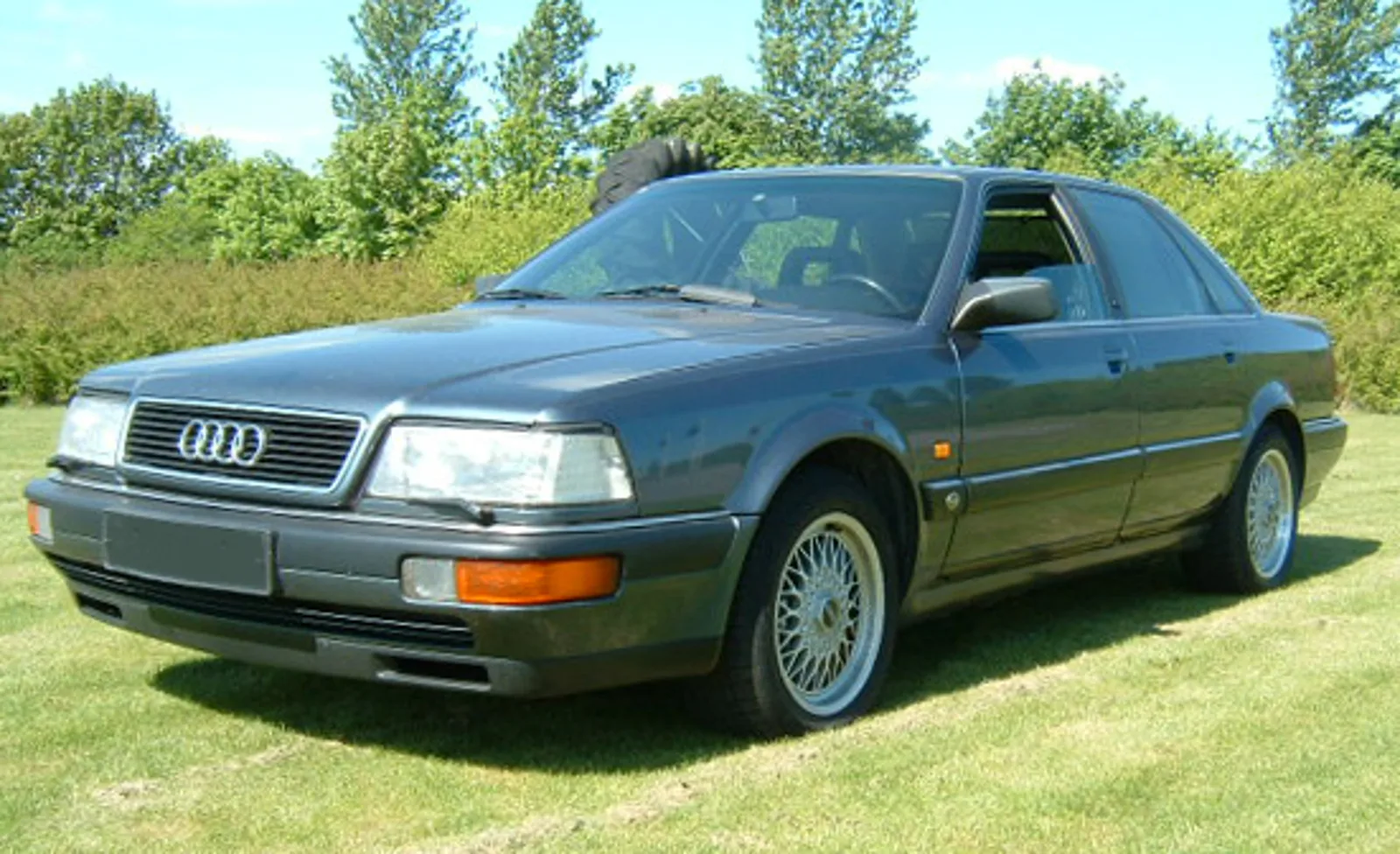
Audi's 1988 flagship put a V8 and quattro under one bonnet for the first time, and its racing version went on to win back-to-back DTM championships.
The Audi V8 was a four-door luxury flagship built by Audi from 1988 to 1993. It was the company's first V8 and the first Audi to combine quattro with an automatic transmission, and it was replaced by the Audi A8 in 1994. Its racing version won back-to-back DTM titles in 1990 and 1991.
Audi needed a halo car in the late 1980s, and the V8 was its answer. Built on a stretched version of a Volkswagen Group platform, the four-door flagship carried a new all-aluminium engine and quattro permanent four-wheel drive as standard, and its racing version later took back-to-back DTM championships.
Why did Audi build the V8?
The V8 was designed as a top-of-the-range flagship that would give Audi a new, elevated image. It was positioned as a viable alternative to established luxury rivals such as Mercedes-Benz and BMW, and it is regarded as a cornerstone of the Audi marque's modern history.
The car brought a long list of luxury features as standard, including leather seating and quattro four-wheel drive. A flagship has to justify its price against cars that already dominate the segment, so Audi built the V8 around comfort, equipment and all-weather traction.
Factory production began in October 1988 and ceased in November 1993, although sales of completed vehicles continued in 1994. The Audi A8 replaced the V8 that year, and North American buyers had to wait until 1996 to buy the A8.
The timing of the launch mattered. Audi had spent the 1980s building its reputation on quattro, and the V8 carried that technology into the flagship sedan segment at a moment when the brand wanted a car to match its rally and racing successes.
Audi's first V8 put quattro and an automatic gearbox together, and its racing version went on to win back-to-back DTM titles.
How was the Audi V8 built?
The V8 used an enlarged version of the bodyshell from the Audi 100 and 200, and it sat on a stretched version of the Volkswagen Group C3 platform, known as the D1 or D11. It was distinguished by a unique grille on the bonnet, new bumpers and headlights, and all-red tail lamps.
The body was galvanised steel, and Audi backed it with a 10-year anti-perforation warranty against corrosion. A long-wheelbase version, called the V8L after the German word for long, was assembled at the Steyr-Daimler-Puch factory in Graz.
The wheelbase was extended by 12 mm, and the track was wider, with pronounced fenders. Only alloy wheels were offered, ranging from 15 to 17 inches, and the interior carried more wood trim than the 100 and 200 that it was based on.
Inside, the V8 kept the basic architecture of the 100 and 200 but added a richer finish that suited a flagship. Leather, walnut and heated seats were standard, so the cabin felt more luxurious than the car it grew from.
What was the long-wheelbase V8L?
The long-wheelbase version, known in German as Lang, gave the V8 more rear legroom and a more formal character. The Graz plant that built it sat away from the main Audi line.
Audi's tradition of offering a long-wheelbase flagship continued with the A8, which was also sold in an A8L format. The V8L sat at the top of the range for buyers who wanted extra space in the back.
The standard-length car remained the main model, and the long-wheelbase version was the specialised choice for buyers who put comfort first.
What engines did the Audi V8 use?
The V8 used all-aluminium, 32-valve, double overhead camshaft engines. The original 3.6-litre displaced 3,562 cc and produced 184 kW (250 PS; 247 bhp) at 5,800 rpm, and a 4.2-litre with 4,172 cc arrived in August 1991.
The 3.6-litre was derived from the 1.8 16V engine in the Golf GTI, and it produced 340 N m (251 lbf ft) of torque at 4,000 rpm. The 3.6 could run on 95 RON fuel, but the 4.2 needed the more expensive 98 RON SuperPlus to deliver its quoted output.
The cam drive was a clever hybrid. A rubber and Kevlar toothed timing belt drove only the exhaust camshaft in each bank, while a simplex roller chain drove the inlet camshafts. That cut the number of components and made the belt easier and cheaper to service.
Timing belt intervals were 90,000 km (60,000 mi) for the 3.6 and 120,000 km (75,000 mi) for the 4.2. A thermostatically controlled electric cooling fan replaced the engine-driven fans of earlier cars, and it also cooled the engine oil.
How was the V8's engine management set up?
Both engines used a Bosch Motronic fully electronic engine control unit, with bank-selective knock control and lambda mixture control. Eight intake manifold-mounted injectors fed the cylinders from two common rails, one per bank, and fired in the engine's firing order.
The 4.2 needed 98 RON SuperPlus unleaded to deliver its quoted output, while the 3.6 could manage on 95 RON. Running the bigger engine on the lower grade reduced its power and increased fuel consumption, which made the fuel choice an important one for owners.
The V8 required unleaded petrol throughout, reflecting the catalyst-era engines of the period, and its electronic management kept the two banks tuned in step with each other.
Audi V8 specifications at a glance
The table lists the core figures for the car and its two engine sizes. Where a figure applies to only one engine, the table names that engine so the values stay separate.
| Specification | Detail |
|---|---|
| Body | Four-door, full-size luxury sedan |
| Production | October 1988 to November 1993 |
| 3.6-litre V8 | 3,562 cc, 184 kW (250 PS; 247 bhp) at 5,800 rpm |
| 3.6-litre torque | 340 N m (251 lbf ft) at 4,000 rpm |
| 4.2-litre V8 | 4,172 cc, introduced in August 1991 |
| Transmission | Four-speed ZF 4HP24A automatic; five-speed manual, later six-speed |
| Drive | quattro permanent four-wheel drive, 50:50 default split |
| Brakes | 310 mm front and 269 mm rear discs; Bosch ABS standard |
| Wheels | 15-inch standard; 16 or 17-inch optional |
| Timing belt interval | 90,000 km (60,000 mi) on the 3.6; 120,000 km (75,000 mi) on the 4.2 |
How did the Audi V8 handle and drive?
The quattro system normally split torque 50:50 between the axles, but it could shift the bias anywhere from 20:80 to 80:20 as conditions demanded. Manual versions used a Torsen centre differential, while automatics used a hydraulically controlled multi-plate clutch.
The ZF 4HP24A four-speed automatic offered S, E and M modes. Sport held gears to higher revs than Economic, and Manual let the driver choose each gear with the lever. Power-assisted rack and pinion steering was standard, with an optional servotronic variable-assistance system.
Brakes were ventilated discs at both ends. The 310 mm fronts were designed by Continental AG, with the caliper mounted inside the disc, and the 269 mm rears carried a cable-operated parking brake.
What was the Audi V8's racing career?
Audi built a Group A competition version of the V8 for the Deutsche Tourenwagen Meisterschaft (DTM). It began racing in 1990 with Schmidt MotorSport and won the title with Hans-Joachim Stuck, while Frank Biela took the 1991 crown for the second team, Audi Zentrum Reutlingen.
The DTM car ran a 3.6-litre V8 rated at 309 kW (420 PS; 414 bhp), later raised to 340 kW (462 PS; 456 bhp), with a six-speed manual gearbox. In 1990 all three teams claimed the Hockenheimring podium, and Audi became the first company to win back-to-back DTM titles.
In 1992 Audi changed to a 180 degree flatplane crankshaft, which the DTM organisers judged to be an illegal departure from the homologated part. Audi withdrew from the championship. Its rivals included the Mercedes 190, the BMW M3 and the Opel Omega 3000, and none of them had a V8 or four-wheel drive.
Who drove the V8 in the DTM?
Hans-Joachim Stuck led the Schmidt MotorSport team that ran the car from its 1990 debut. Stuck was joined by Walter Rohrl and Frank Jelinski, and the trio gave the team strong results from the start.
The second Audi team, Audi Zentrum Reutlingen, raced with Frank Biela and Hubert Haupt from 1991. Biela gave Audi the 1991 championship, but he could not defend the title the following year when the team withdrew.
Driving a road saloon in touring car racing demanded engine changes, lighter components and purpose-built chassis work, and Audi's success came from both driver talent and engineering effort.
What wheels and tyres did the V8 use?
Standard wheels were 15-inch light alloys, fitted with 215/60 R15 steel-belted radial tyres. The look was deliberately understated for a flagship, and the aero-style design kept the car's lines clean.
Buyers could upgrade to multi-spoke alloy wheels sourced from BBS, which carried Audi's centre-cap badge. They were offered in 16-inch and 17-inch sizes, and the larger wheels gave the car a sharper stance on the road.
Only alloy wheels were offered on the V8, so steel wheels were never an option. The wheel choice was part of the car's luxury positioning, with the BBS option giving buyers a visual alternative to the standard design.
What equipment did the Audi V8 include?
The standard V8 came with a BOSE audio system with eight speakers, walnut wood trim, leather upholstery and heated seats. Paint finishes were pearlescent or metallic, in colours that included pearl white, lago blue, blue mica, tornado red and black.
Standard ABS and quattro reinforced the flagship message, and the car offered optional multi-spoke alloy wheels from BBS in 16 and 17-inch sizes. The wheels gave the V8 a more purposeful look than the standard 15-inch items.
A one-off experimental Avant estate was built for the wife of a former Audi CEO. That car is now in storage at Neckarsulm rather than on display, which makes it one of the rarest versions of the model.
How did Audi end V8 production?
Factory production ended in November 1993, after about five years on sale. The A8 replaced the V8 in 1994, and sales of the remaining completed vehicles continued into that year.
The V8's legacy passed into the A8, which continued the flagship concept with a longer-wheelbase option. The Audi V8 remains a reference point for the brand's move into the German luxury segment.
Its story also shows how a car built on an existing platform could still carry a new identity. The stretched C3 underpinnings, a new all-aluminium V8 and permanent four-wheel drive gave Audi a flagship that looked and drove unlike the 100 and 200 it was built from. It remains a useful case study in that approach.
Frequently asked questions
Was the Audi V8 Audi's first V8?
Yes. It was the first car from Audi to use a V8 engine, and it was also the first Audi to combine quattro with an automatic transmission.
How much power did the 3.6-litre make?
The 3.6-litre produced 184 kW (250 PS; 247 bhp) and 340 N m (251 lbf ft) of torque, peaking at 5,800 rpm and 4,000 rpm respectively.
What fuel did the 4.2-litre need?
Running the 4.2 on 95 RON cut its power and raised fuel use, so 98 RON SuperPlus was the right choice for the quoted output.
Which drivers won the V8's DTM titles?
Hans-Joachim Stuck won the 1990 title and Frank Biela won the 1991 title, which made Audi the first company to take back-to-back DTM championships.