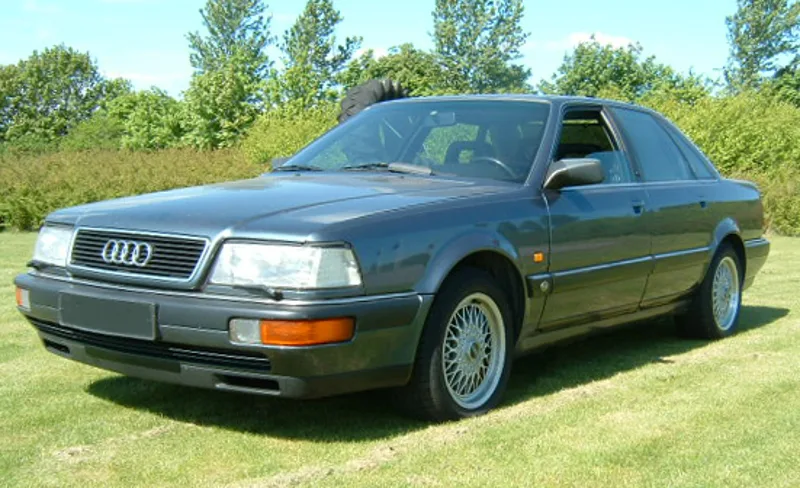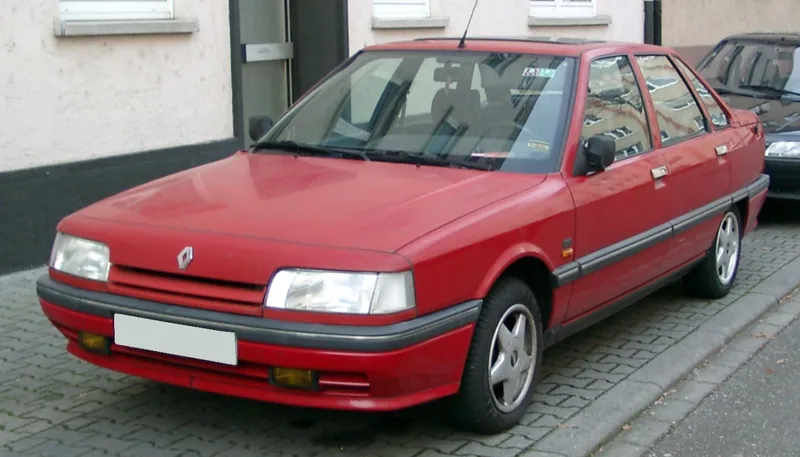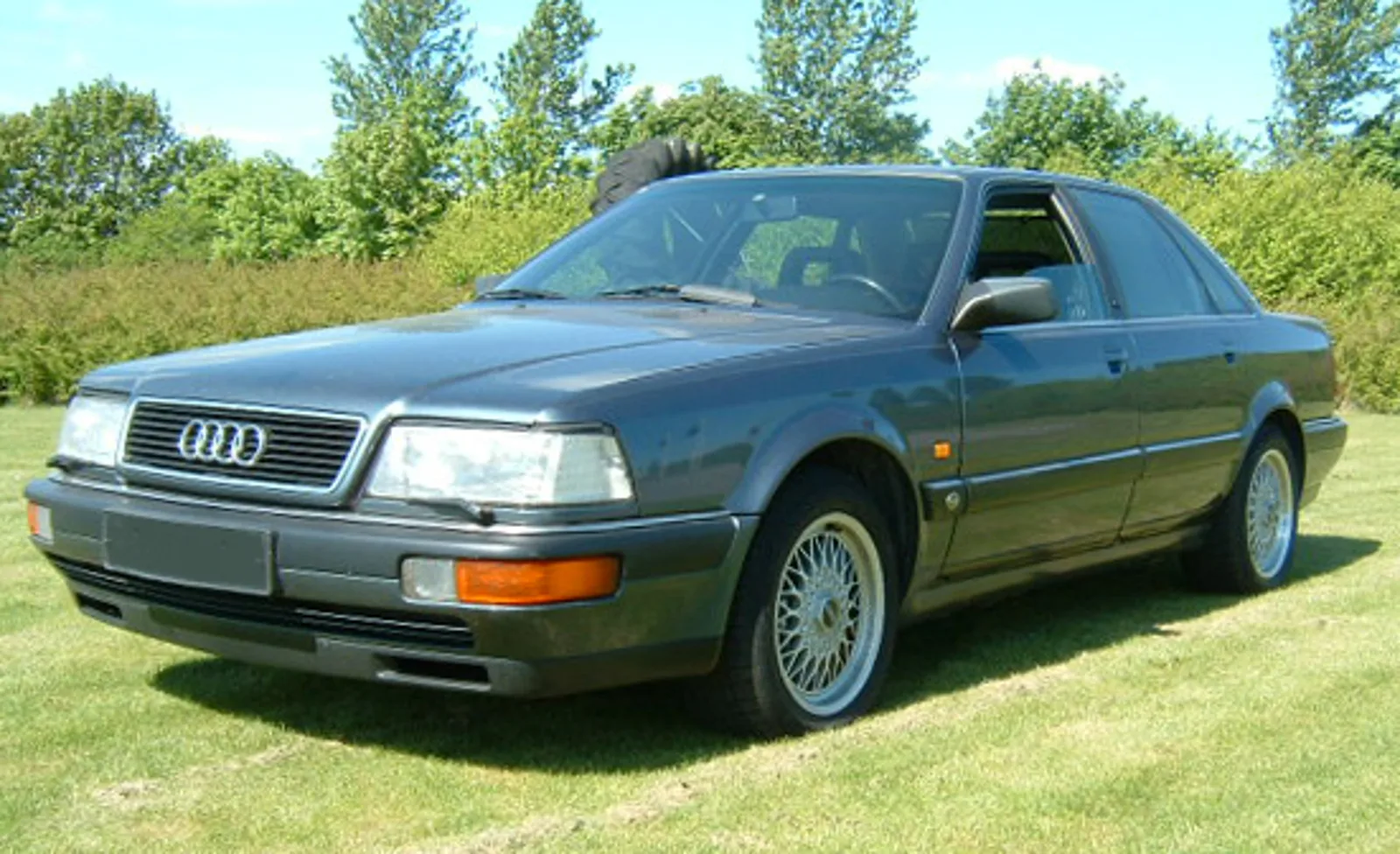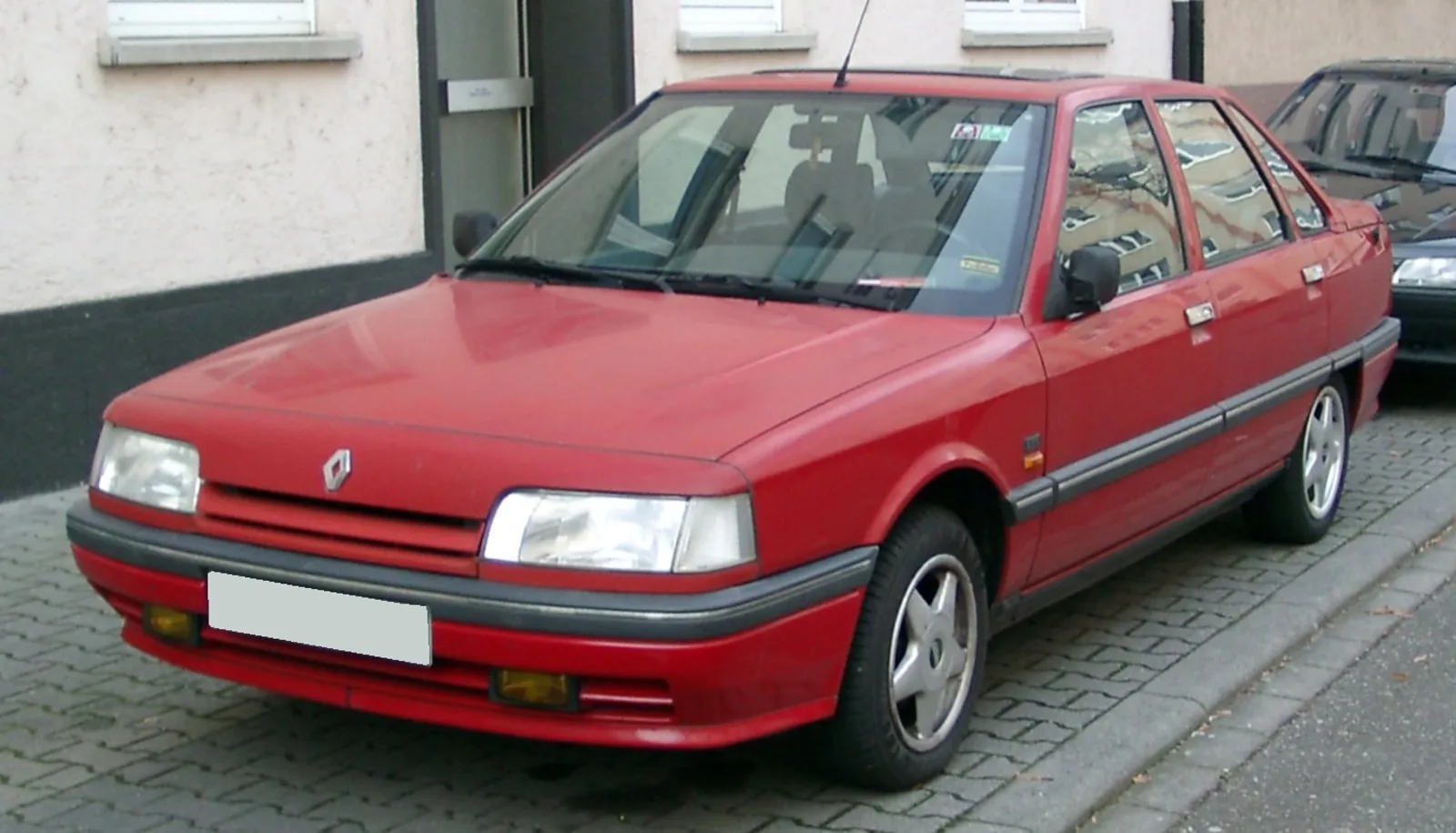
One sold over two million units as a practical family saloon across four continents; the other was Audi's first V8, first quattro automatic, and a DTM champion. Here is how the Renault 21 and Audi V8 really compare.
Renault built the 21 as an ordinary, high-volume family saloon across multiple continents, while Audi built the V8 as a low-volume, quattro-only flagship, its first car with eight cylinders. One prioritised affordability and parts availability; the other prioritised engineering prestige and a pair of DTM titles.
The Renault 21 was a mass-market family saloon sold in over two million examples across four continents; the Audi V8 was a hand-built flagship that gave Audi its first V8 engine and a pair of DTM championships. They shared a decade, not much else.
What are the Renault 21 and Audi V8?
The Renault 21 was a large family car built from 1986 to 1995, launched as the successor to the ageing Renault 18. The Audi V8 (Typ 4C) was a four-door luxury flagship built from 1988 to 1993, Audi's first car with a V8 engine.
Both cars arrived within two years of each other, but at opposite ends of the market. The Renault 21 replaced a popular but fading mainstream saloon and needed to sell in volume across ordinary dealerships; the Audi V8 existed purely to give Audi a credible answer to Mercedes-Benz and BMW at the top of the German luxury segment, a role so important Audi later called the car a cornerstone of its modern identity.
Audi became the first manufacturer to win back-to-back DTM titles, only to withdraw from the series the following year after officials ruled its crankshaft illegal.
How does the Renault 21's engine range compare to the Audi V8's?
The Renault 21 offered an unusually wide spread of four-cylinder petrol and diesel engines, from a modest 68 PS (50 kW; 67 hp) 1.4 litre up to a 175 PS (129 kW; 173 hp) 2.0-litre turbo. The Audi V8 offered exactly two engines in its entire run, both all-aluminium V8s.
Audi launched with a 3.6-litre V8 making 184 kW (250 PS; 247 bhp) at 5,800 rpm and 340 N.m (251 lb-ft) of torque at 4,000 rpm, itself derived from the Golf GTI's 1.8 16V engine architecture, before adding a 4.2-litre version in August 1991 that shared its rating with the engine used in the contemporary Audi S4. The Renault's breadth was really a function of market segmentation rather than outright performance ambition: different countries got different displacements entirely, from Argentina's locally built 1.8 and 2.2-litre units to Colombia's 1.6-litre C2L engine borrowed from the Renault 9, while Audi simply built the best V8 it could and offered customers a choice of displacement within that single formula.
Which was faster, the Renault 21 Turbo or the Audi V8?
The front-wheel-drive Renault 21 Turbo reached 227 km/h (141 mph) and hit 0-100 km/h in 7.4 seconds, genuinely quick for a mainstream family saloon of its era. No matching 0-100 km/h figure survives for the Audi V8, but a 250 PS-plus output carried in a flagship-class body already puts it in a different performance bracket entirely.
What is directly comparable is engineering ambition. The Renault's fastest variants needed a longitudinal engine layout because no gearbox existed to handle a more powerful engine in the transverse bay used by lesser models, a compromise that reportedly hurt the car's profitability by forcing two different engine-bay configurations down a single production line. The Audi V8, by contrast, was engineered from the outset around one driveline philosophy: every single car left the factory with quattro four-wheel drive, with no two-wheel-drive option ever offered.
Renault 21 vs Audi V8 at a glance
Set side by side, the gap in ambition and price point becomes obvious even before considering how each car actually drove.
| Specification | Renault 21 | Audi V8 |
|---|---|---|
| Built | 1986-1995 | October 1988-November 1993 |
| Body styles | Saloon, estate, liftback | Sedan, LWB, one-off Avant |
| Engine range | 1.4-2.2 L four-cylinder petrol/diesel | 3.6 L / 4.2 L all-aluminium V8 |
| Top petrol output | 175 PS (129 kW; 173 hp) | 250+ PS (184+ kW) |
| Drivetrain | FWD, optional Quadra 4WD | Quattro permanent 4WD, standard |
| Total production | 2,096,000 units | Factory run of five years |
| Motorsport | None recorded | Back-to-back DTM titles, 1990-1991 |
The Renault's seven-seat Nevada/Savanna estate, with its folding rear-facing child bench and standard roof rails, had no equivalent anywhere in the Audi range, where the closest thing to a load-carrying variant was a single experimental Avant built for one person.
How do their four-wheel-drive systems differ?
Renault's Quadra system was an option fitted only to specific variants: the TXi 2.0 12v and 2.0 Turbo saloons could have it, while the Nevada wagon could only get 4WD on its 8-valve 2.0 or naturally aspirated 2.1 diesel, never on the 12-valve or turbo engines. Audi's quattro, by contrast, was not an option at all; it was the only drivetrain the V8 ever offered.
The two systems also worked differently under the skin. Quattro split torque 50:50 between the axles by default but could shift the bias anywhere from 20:80 to 80:20, using a hydraulically controlled multi-plate clutch on automatic cars and a Torsen type 1 centre differential on manuals, with a second Torsen differential doing the same job at the rear axle instead of a conventional open unit. That is a meaningfully more sophisticated setup than the Renault needed for a family saloon chasing all-weather grip, and it reflects the different jobs the two systems were asked to do: Audi's had to make a 250 PS flagship feel secure in all conditions as a core selling point, while Renault's simply gave buyers in snowy markets another box to tick.
What else set the two cars' engineering apart?
Renault's own fuel-injection story deserves a mention of its own. The 2.2i engine introduced at the 1989 Frankfurt show ran on a Renix control unit, a joint venture between Renault and Bendix, a genuinely modern piece of engineering for a mainstream family saloon of that era to be carrying at all.
Audi, working at a different price point entirely, offered steering and wheel choices no Renault buyer would ever see. Buyers could specify an electronically variable 'Servotronic' power-steering system on top of the standard rack-and-pinion setup, and swap the factory alloy wheels for multi-spoke items sourced from BBS instead. Even paint reflected the gap between the two cars: Audi's launch palette ran to shades including pearl white, lago blue, tornado red and black, every one of them pearlescent or metallic as standard, a level of finish the Renault's more utilitarian colour chart never attempted to match.
How did Audi engineer the V8 to outlast its rivals?
Audi tackled one of the era's biggest fears, corrosion, head-on, wrapping the V8 in a galvanised steel body and backing it with a 10-year anti-perforation warranty, a guarantee few contemporaries of either car dared to offer.
Running costs reflected the choice of engine too: the 3.6 V8 needed a timing belt change every 90,000 km (60,000 mi) and was happy on ordinary 95 RON unleaded, while the larger 4.2 demanded pricier 98 RON 'SuperPlus' fuel to hit its full rated output, losing power and burning more fuel on anything less. Braking matched that ambition, with 310 mm front discs and 269 mm rear discs, backed on manual cars by a 240 mm single-plate clutch, numbers that dwarf anything the humble Renault 21 range ever needed to specify.
Which car sold in more places around the world?
The Renault 21 was a genuine world car by the standards of its era, built not just in France but in Argentina from late 1988, in Turkey into the mid-1990s, and sold in Colombia and, briefly, in North America as the Renault Medallion and then the Eagle Medallion after Renault sold its American Motors stake to Chrysler in 1987.
Those regional builds were not just rebadges either: Argentina ran its own 1.8, 2.0 and 2.2-litre engine options, and even imported a French-built liftback sold locally under the 'Alize' trim name. Turkey developed its own trim ladder, running from the basic 21 up through Manager and Concorde, and later added a cheaper Optima alongside a torquier Manager 2000, all built domestically by Oyak. Colombia introduced a 1.6-litre RS version in 1989 that became the first car assembled in the country with electronic fuel injection, renamed Etoile in 1990 once SOFASA took over local assembly, with a Penta hatchback body joining that same local range. The Audi V8 had no such global footprint. It was built in Germany, with the long-wheelbase version assembled by Steyr-Daimler-Puch in Graz, Austria, and its intended successor, the Audi A8, did not even reach North America until 1996, three years after the V8 itself had stopped rolling off the line. Total production across 2,096,000 Renault 21 units dwarfs anything the low-volume Audi flagship ever approached.
Did either car race?
Only the Audi V8 has a motorsport story worth telling. Audi built a Group A competition version for the Deutsche Tourenwagen Meisterschaft, running a 3.6-litre V8 tuned to 309 kW (420 PS; 414 bhp) and later 340 kW (462 PS; 456 bhp) through a six-speed manual, entering the series in 1990 with Schmidt MotorSport and drivers Hans-Joachim Stuck, Walter Rohrl and Frank Jelinski.
That debut season went about as well as possible: Audi swept the entire podium at the Hockenheimring, and Stuck took the title. A second team, Audi Zentrum Reutlingen, joined for 1991 with Frank Biela and Hubert Haupt, and Biela delivered Audi a second consecutive championship, making Audi the first manufacturer to win back-to-back DTM titles. The run ended in controversy in 1992, when officials ruled that Audi's re-forged 180-degree flatplane crankshaft deviated from the homologated production part, and Audi withdrew from the series rather than contest the decision. The Renault 21, built purely as a family saloon, has no comparable competition history recorded here at all.
Which car has the more unusual history?
Both cars collected genuinely strange footnotes along the way, just in very different registers. A Renault 21 TSE was gifted by Portugal's president Mario Soares to Vaclav Havel shortly before the Velvet Revolution, and that same car went on to serve as Czechoslovakia's official state car in 1989.
Audi's oddest story is more personal than political: a single Avant estate version of the V8 was built, not for sale, but for the wife of then-Audi CEO Ferdinand Piech. That one-off car no longer sits on display at the Audi Forum Ingolstadt; it survives in storage at Neckarsulm instead, a curious private footnote to a car whose public legacy was built on racetracks rather than garages.
Which one should you choose today?
These two cars were never really rivals, and that is exactly what makes comparing them useful. The Renault 21 represents the mainstream 1980s family saloon at its most pragmatic: cheap to build in multiple configurations, exported and locally assembled across continents, and good enough to win Car of the Year honours for its estate version.
The Audi V8 represents the opposite approach entirely: one engineering formula, executed without compromise, built in far smaller numbers, and validated not by sales charts but by consecutive championship trophies. A buyer chasing practicality, parts availability and sheer variety of surviving derivatives will find far more to work with in a Renault 21. A buyer chasing engineering pedigree, quattro history and the genuine novelty of Audi's first V8 will find the V8 the far more significant machine, even if it never came close to the Renault's production numbers.