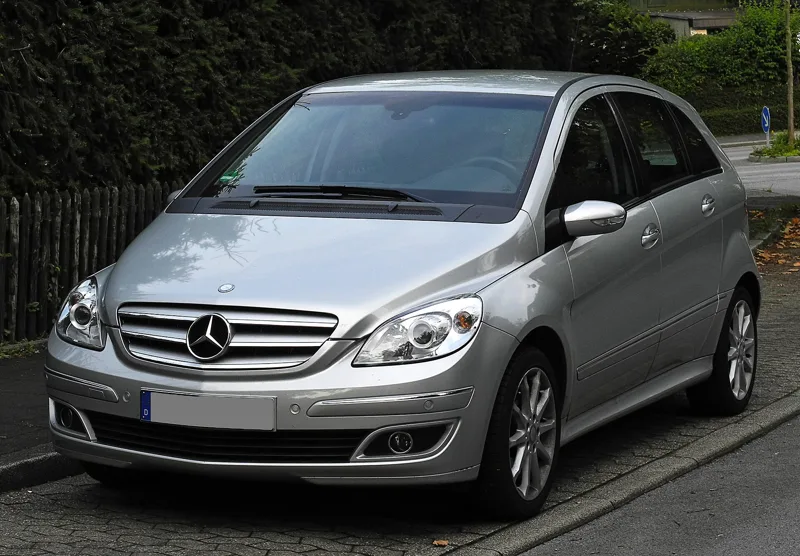
A 2004 people carrier with a sandwich floor, electronics-free selective dampers, flexible luggage space and a long run of petrol and diesel engines.
The Mercedes-Benz W169 was the second-generation A-Class, built from 2004 to 2012. It was a people carrier with three- or five-door bodies, a sandwich floor, electronics-free selective dampers and engines running from 82 PS to 193 PS (81 to 190 hp).
Mercedes-Benz once weighed a convertible and four-wheel drive for the second-generation A-Class, but both ideas were dropped by the second half of 2003. What reached the road was the W169, a people carrier built from 2004 to 2012 in three-door and five-door forms. It was longer and wider than the car it replaced, and it kept the sandwich floor of its predecessor.
Where did the W169 come from?
The W169 was the second generation of the A-Class, succeeding the W168. Development took shape in the early years of the new century, with a brief that asked for more interior space, greater safety and finer finish. Buyers had grown harder to please during the W168 years, and the new car had to meet that demand.
The first plan was to build on a classic people-carrier body, with other variants to follow. One of the more unusual ideas was a convertible, and four-wheel drive was also on the table. By the second half of 2003 those options were gone. The only change that went ahead was a choice between three-door and five-door bodies, and the long-wheelbase version was cancelled.
The specialist press published the first official photographs in mid-2004, and the W169 made its debut at the Paris Motor Show that year, when orders also opened. Launch cars were five-door only. The introduction tour lasted four days, crossed seven states and finished at the Castello Sforzesco in Milan, where every unit was received alongside figures from music, fashion and film.
The American campaign leaned on celebrity. Television spots featured Christina Aguilera, Giorgio Armani and Boris Becker. A fashion show came from the designer, and the pop singer sang Hello on stage, a song written for the occasion.
A people carrier with a sandwich floor, electronics-free dampers and luggage space that ran from 435 to 1,995 litres.
What changed in the design?
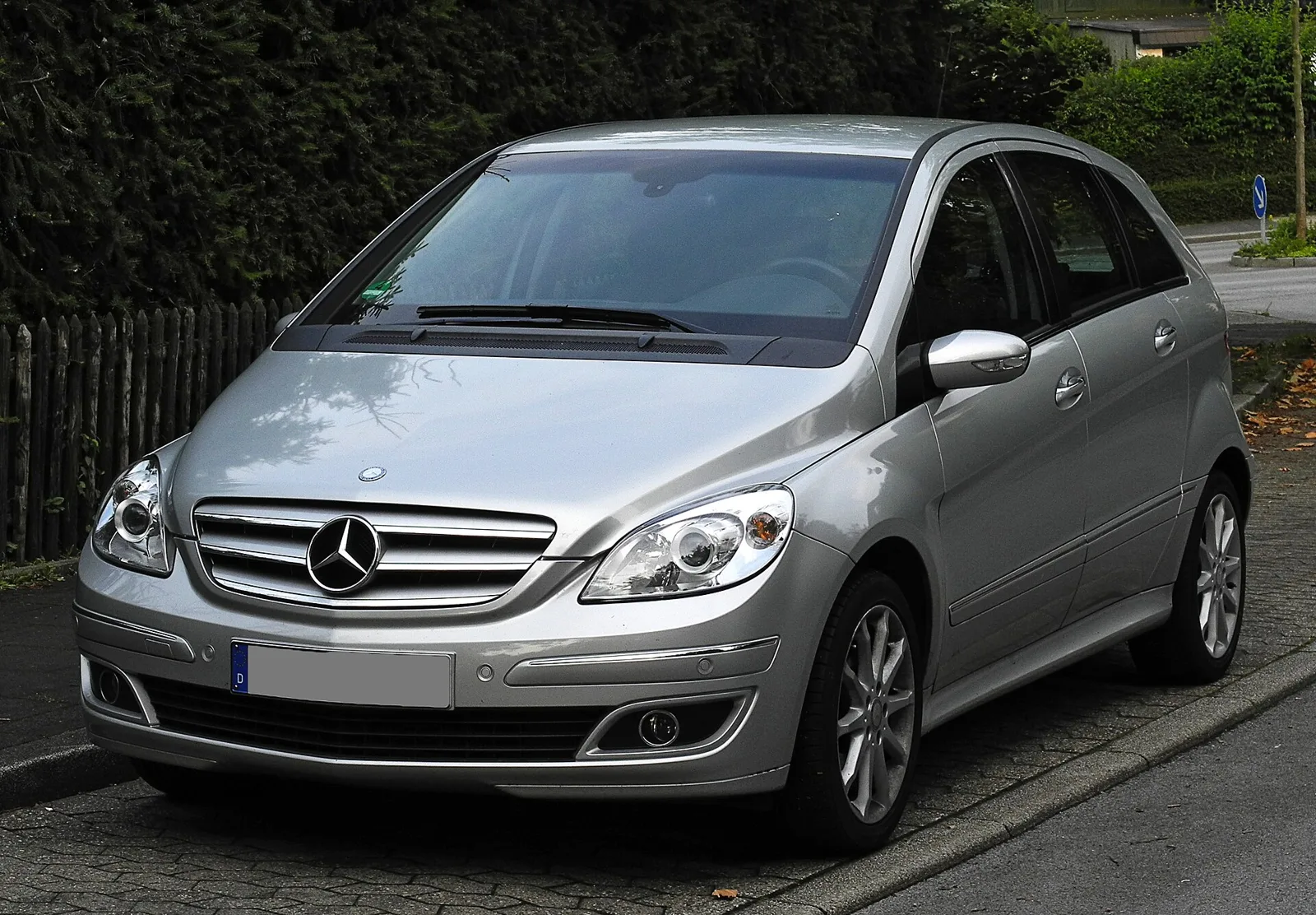
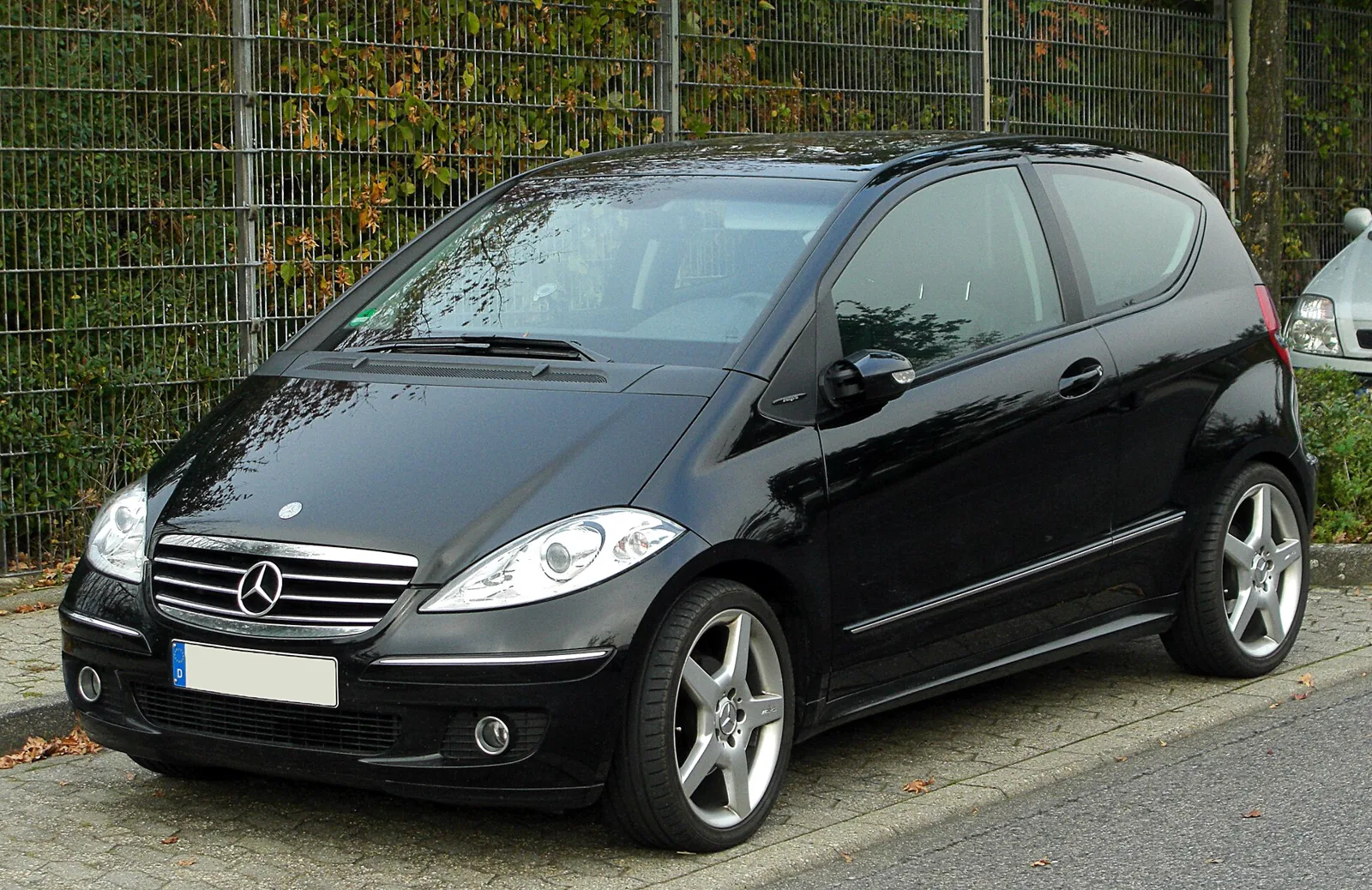
The W169 was longer and wider than the W168 but close to it in height. Its rounded shapes gave way to sharper curves and edges, so the car looked more elegant and more aggressive at once. It kept the people-carrier body style of its predecessor.
At the front, teardrop headlights sat on either side of a trapezoidal radiator grille. Two thin slats ran through its centre, and two thicker ones framed it at the top and bottom. Widened wheel arches added aggression, and they also let the track be widened for extra stability.
From the side, a longitudinal rib ran from the front wing, just beneath the door handles, and faded out at the rear light. The rear window did not cut forcefully into the flank, yet it was still large, and it met the rear light to form a triangular shape. The mirrors carried integrated indicators. The one point that raised doubts was the fit of the sheet-metal panels, which often showed considerable play.
What was inside the cabin?
The cabin was roomier than that of the previous model, thanks to the larger outside dimensions and to redesigned fittings that took up less internal volume. Thinner pillars let in more light and gave the driver better visibility. In overall character, the interior looked much like the contemporary W203 (C-Class) and W211 (E-Class).
Elegance reigned in the dashboard, instrument panel and centre console, which used aluminium and chrome inserts that suited the three main parts of the driving position. The multifunction steering wheel was attractive in its own right. The centre console avoided crowding with buttons and carried a display that was easy to read.
Modularity was one of the W169's strongest points. The rear bench could be folded or split, allowing several luggage layouts. Capacity started at a minimum of 435 litres and grew to 1,995 litres with the bench folded completely down. The sandwich structure also created a double floor whose space added to the normal luggage compartment.
How was the W169 engineered?
The W169 inherited the sandwich floor of the W168, a refined and costly construction with a gap between the floor panel and the cabin floor. In a frontal impact, the engine and gearbox were mounted so that they would slide into that gap rather than push into the cabin. Only the dimensions of the floor changed, to suit the larger body.
At the rear, a De Dion axle was attached to the body through an elastic joint, with two trailing arms that imitated a Watt's linkage to control toe-in as the body rolled. The front kept a MacPherson strut layout with a transverse triangular arm.
The most unusual suspension feature was the arrival of selective dampers. These self-adjusting units responded to the road surface and the driver's style without any electronics. A bypass controlled whether oil could flow freely through each damper, which set its firmness. It was the first use of such a system in the car industry.
Braking moved from the mixed layout of the W168 to discs on all four wheels. ABS, brake force distribution, ASR and ESP completed the picture. The power steering was electromechanical, and its assistance varied with road speed.
Which engines and trims did buyers get?
At launch the range had three petrol engines from the M266 family and three diesels from the OM640 family. The petrols displaced 1,498 cc (91.4 cu in), 1,699 cc (103.7 cu in) and 2,034 cc (124.1 cu in), while the 1,991 cc (121.5 cu in) diesels produced 82, 109 or 140 PS (81, 108 or 138 hp).
The three diesels were in fact one engine tuned for three power levels. The three petrol versions and the least powerful diesel came with a 5-speed manual gearbox, while the 109 PS (108 hp) and 140 PS (138 hp) turbodiesels had a 6-speed manual.
Four trim levels were offered at launch. Classic, Elegance and Avantgarde carried names used on the earlier W168, although each had new features. Classic had body-coloured bumpers and a matt black tailgate handle. Elegance kept the features that set the W168 Elegance apart: wood trim, alloy wheels, fog lamps and rear electric windows.
Avantgarde had a glossy black radiator grille with chrome slats, colour-matched mirrors and handles, an oval chrome exhaust tailpipe, polyellipsoidal headlights in place of the classic front lamps, and alloy wheels as standard. The fourth level, Classic Basic, was offered only with the 1.5 petrol engine or the 2-litre 82 PS (81 hp) turbodiesel. It was simpler still than Classic and the only trim without alloy wheels, using cheaper steel wheels with covers instead.
Standard equipment was good but could have been better, since an immobiliser and a radio should have been included from the Classic level upward. Every W169 left the factory with ABS, ESP, central locking, air conditioning, electric exterior mirrors, a split rear bench, front electric windows and an adjustable multifunction steering wheel. The option list added rear side airbags, head airbags, an immobiliser, a radio, directional self-adaptive xenon headlights, satellite navigation and parking sensors.
W169 specifications at a glance
| Specification | Detail |
|---|---|
| Production | 2004 to 2012 |
| Body styles | Five-door at launch; three-door Coupe added at the end of 2004 |
| Petrol engines | A150 1,498 cc (91.4 cu in), 95 PS (94 hp); A170 1,699 cc (103.7 cu in), 116 PS (114 hp); A200 2,034 cc (124.1 cu in), 136 PS (134 hp) |
| Diesel engines | 1,991 cc (121.5 cu in) common-rail turbodiesel; 82 PS (81 hp), 109 PS (108 hp) and 140 PS (138 hp) |
| Turbo variant | A200 Turbo, 193 PS (190 hp) |
| Manual gearboxes | 5-speed for the petrol versions and the least powerful diesel; 6-speed for the 109 PS and 140 PS diesels |
| Luggage capacity | 435 litres minimum; 1,995 litres with the rear bench folded |
| Tyre sizes | 185/65 R 15 (Classic and Elegance); 195/55 R 16 (Avantgarde) |
How did the range change after launch?
A couple of months after launch, a continuously variable CVT automatic joined the option list. At the end of 2004 the range gained a three-door version, which the company called the Coupe. Strictly speaking, Coach would have been the more accurate old term, but the three doors gave the car a sharper line.
In mid-June 2005 came smaller changes: the rev counter moved to a single-digit display, Isofix anchorages arrived, a glass panoramic roof was offered and diesels gained a particulate filter. A new Sport package suited the two richest trims. The A200 Turbo arrived at the same time, a boosted version of the A200 whose turbocharger raised output to 193 PS (190 hp).
Special editions followed. The Polar star arrived in 2006, and the Edition 10 in September 2007 marked the first ten years of the A-Class.
The 2008 facelift redesigned the front headlights, radiator grille and bumpers, and changed the rear light clusters and bumper. Inside, new upholstery fabrics were used and a new cup holder sat between the front seats. The richer versions also gained park assist, which found a parking space and steered the car into it.
In autumn 2008 the BlueEFFICIENCY package arrived. Changes to the front improved aerodynamic penetration, and the Start/Stop system switched the engine off at traffic lights or in queues, then restarted it when moving off. It applied to the A150, the A170 and the A160 CDI. The A160 CDI, not offered as a five-door, also gained energy recovery under braking.
In 2009 the A150 became the A160 and the A170 became the A180. BlueEFFICIENCY became standard on these models and on the A160 CDI, provided they kept the manual gearbox, and this time on both the three-door and five-door versions.
In 2010 the Coupe was withdrawn from some markets because demand had fallen, leaving only the five-door in those price lists, while Italy kept the three-door listed. That year also brought the Executive, Style and Premium trims. Style included a hi-fi system with a CD/MP3 player, wood inserts and upholstery in leather and fabric, with leather on the steering wheel and gear-lever gaiter. Premium was similar but used aluminium inserts instead of wood and added satellite navigation.
Why did the W169 matter?
The W169 showed that a people carrier could grow roomier, more elegant and more modular without losing its basic layout. Its sandwich floor and selective dampers were the engineering features that set it apart. The range ran from the 82 PS (81 hp) diesel to the 193 PS (190 hp) A200 Turbo.
How did the W169 leave production?
The W169 ended production in April 2012, a month after the third-generation A-Class was shown at the Geneva Motor Show in March. The successor was a two-box C-segment saloon rather than a people carrier. Severe recession in Europe meant leftover stock took almost a year to clear.
The third generation changed the body layout completely. It was a classic two-box saloon in the C-segment, no longer a people carrier. Production of the W169 stopped the following month, but the small people carrier stayed on sale so dealers could run down their stock.
Clearing that stock took time. Europe had been in a severe car recession for some years, so the leftover cars needed almost a year to sell. In many markets the W169 stayed on the price lists into the first months of the following year before it finally left them.