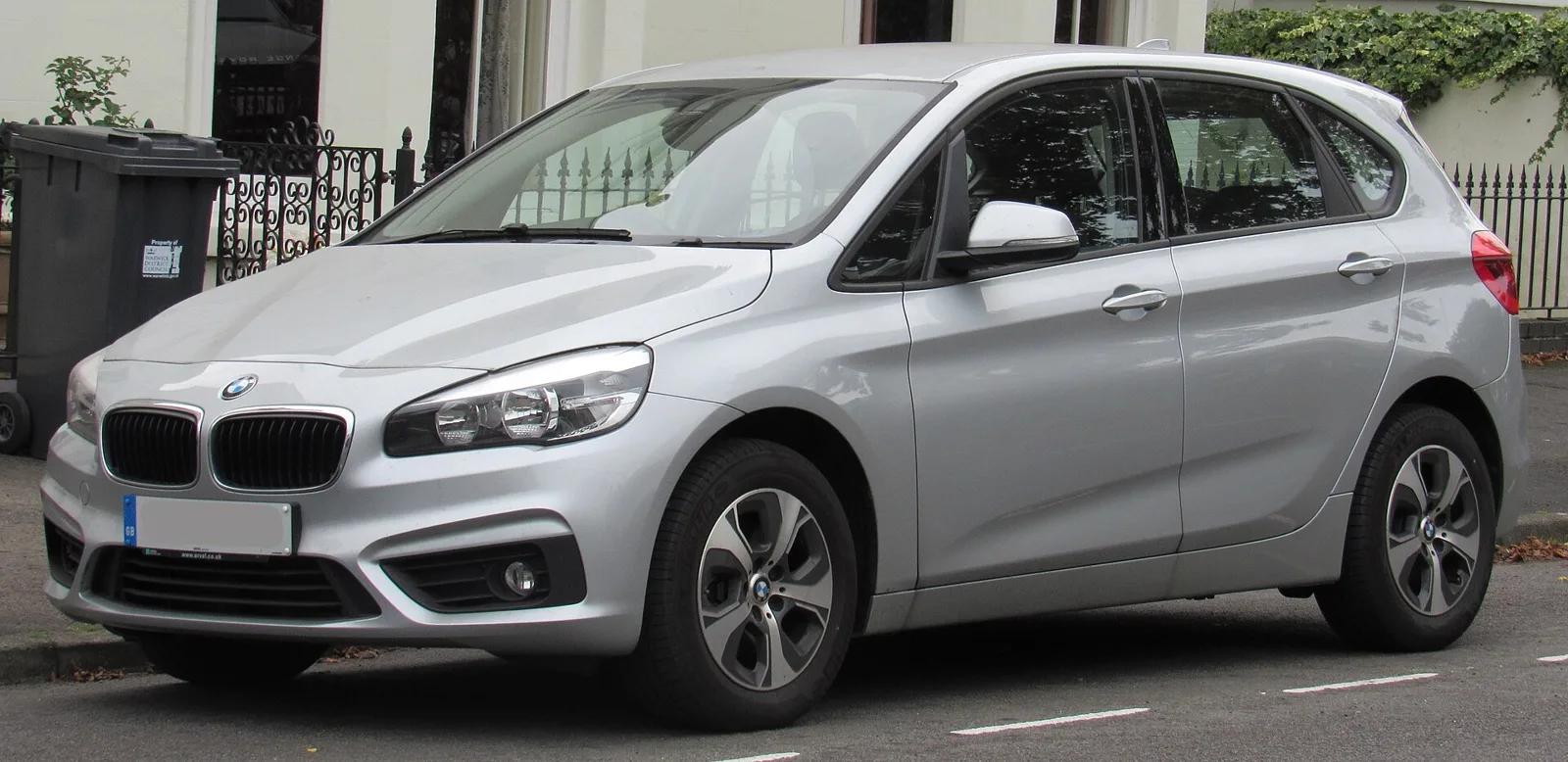
The compact MPV that gave BMW its first front-wheel-drive model, a Gran Tourer with up to seven seats and a plug-in hybrid that ran on the rear axle.
The BMW 2 Series Active Tourer, coded F45, is a compact MPV that BMW launched in 2014 with front-wheel drive. Its plug-in hybrid 225xe combined a three-cylinder petrol engine with a rear electric motor, 430,000 cars were built in total, and the successor reached the market in early 2022.
The BMW 2 Series Active Tourer, coded F45 internally, was a compact MPV and the first BMW model with front-wheel drive. It went on sale in 2014 from the Leipzig plant, and the range also included a plug-in hybrid version, the 225xe. BMW built 430,000 in total; the successor reached the market in early 2022.
Where did the Active Tourer come from?
The Active Tourer was presented at the Geneva Motor Show in March 2014. Production at the BMW plant in Leipzig began in July 2014, and sales followed from September. BMW introduced modular engines in 2013 and 2014, including the three-cylinder B37 diesel and B38 petrol units.
In 1987 Eberhard von Kuenheim, BMW's chairman from 1970 to 1993, told the staff magazine that the range would not be extended downwards and that there would be no BMW 214.
A compact MPV from BMW that became the company's first front-wheel-drive model, and later a plug-in hybrid with a rear electric motor.
Which engines did the launch line-up offer?
The launch range had a newly developed three-cylinder 218i with 100 kW (136 PS; 134 hp), the 225i with a 2.0-litre four-cylinder producing 170 kW (231 PS; 228 hp), and the 218d diesel with 110 kW (150 PS; 148 hp). BMW's new modular family included the B37 diesels and B38 petrols.
Further variants were launched in November 2014: the 220i with 141 kW (192 PS; 189 hp), an xDrive version of the 225i, a 216d at 85 kW (116 PS; 114 hp) and a 220d at 140 kW (190 PS; 187 hp), which could take xDrive too.
Was there a seven-seat version?
The 2 Series Gran Tourer, coded F 46, arrived in June 2015 with up to seven seats. It shared the front-wheel-drive platform of the Tourer and the Mini, and it was around 21 cm (8.3 in) longer, with a wheelbase 21 cm (8.3 in) longer than the standard car.
The second row offered slightly more room, and a third row of seats was possible.
Did the Active Tourer ever get a hybrid?
The 2012 concept already had hybrid drive. The plug-in hybrid 225xe, with all-wheel drive, was shown at the IAA 2015 in Frankfurt and became available from August 2016. Its combustion engine drove the front wheels, while an electric motor drove the rear.
The 1.5-litre three-cylinder petrol engine, an adapted B38, produced 100 kW (136 PS; 134 hp) and drove the front wheels through a conventional 6-speed automatic gearbox. The electric motor on the rear axle drew on the battery and, depending on the chosen drive mode, could propel the car alone or help the petrol engine.
How much power and torque did the 225xe produce?
The electric motor delivered 65 kW (88 PS; 87 hp) for about 12 seconds and drove the rear wheels through a single-speed gearbox. Together the two drives produced a maximum system output of 165 kW (224 PS; 221 hp) and 385 Nm (284 lb ft) of system torque. That torque figure is not directly comparable with conventional ratings.
Purely on electric power the 225xe reached up to 41 km on the NEFZ cycle and a top speed of 125 km/h (78 mph). Its lithium-ion battery initially held 7.7 kWh gross, with 5.7 to 6.1 kWh usable, and it sat beside the 36-litre petrol tank under the rear bench and the boot floor, so the boot had only 400 litres.
What fuel use did the 225xe claim?
The 225xe was rated at 2.0 to 2.1 l/100 km (134 to 141 mpg-imp; 112 to 118 mpg-US) on the NEFZ cycle, a figure that left out electricity consumption. On the WLTP cycle the rating was 2.3 to 2.5 l/100 km (113 to 123 mpg-imp; 94 to 102 mpg-US), and the maximum range was a little over 500 km.
Charging from an ordinary Schuko socket with the supplied charger takes 3 to 4 hours, and a wallbox or public charger is only a little faster. DC fast charging is not possible on this model.
From production on 1 July 2019 the 225xe and other BMW plug-in models received higher-density high-voltage batteries of the same size. These carry 9.7 kWh gross, with 8.8 kWh net when new, and lifted the electric range to 50 to 53 km on WLTP or 55 to 57 km on NEFZ. The total consumption of this version was given as 1.9 to 2.1 l/100 km of fuel and 13.5 to 14.2 kWh/100 km of electricity on NEFZ.
The move to WLTP cost the 225xe its German funding eligibility at first. From 1 September 2018 it no longer met the requirements for the federal environmental bonus for new electric vehicles.
What changed at the 2018 facelift?
The facelift was presented in January 2018 and built from March 2018. The six-speed automatics and the 220i's eight-speed unit gave way to a seven-speed dual-clutch gearbox from Getrag. The eight-speed automatic from Aisin stayed on for the 218d, 220d and 225i.
Diesel models with the B37 and B47 engines received an SCR system combined with a nitrogen oxide storage catalyst, so they met at least the Euro 6d-temp standard. The four-cylinder diesels used two turbochargers. Three-cylinder petrol engines had particulate filters from March 2018, and the engines installed from July 2018 followed the same route to Euro 6d-temp.
The four-cylinder petrol B48 reached the Euro 6c class from March 2018. The four-cylinder engines also received a twin-pipe exhaust system, and the lights and bumpers were changed. Since November 2020 every engine has met the Euro 6d requirements.
What was the chassis and aerodynamic specification?
The car reached drag coefficients (cw) between 0.26 and 0.29. The front suspension used newly developed MacPherson struts and triangular wishbones, and the rear used a newly developed multi-link axle carried on an axle carrier. Its steering hardware and software were tuned specifically for the front-drive layout.
Aluminium swivel bearings, together with high-strength steel axle carriers and control arms, reduced unsprung mass. The anti-roll bar is hollow with varying wall thicknesses, and the dampers at both ends are decoupled from the body by elaborate three-path top mounts.
The electromechanical power steering acts directly on the pinion, with hardware and software matched to front-wheel drive. A speed-sensitive Servotronic was available on request, and a sport steering offered a variable ratio that changed with steering wheel angle.
Safety and crash ratings
The Active Tourer scored five stars in the Euro NCAP crash test in 2014, and four stars in the C-NCAP test in 2015. Every variant, including the 214d with the weakest engine, had internally ventilated front disc brakes, and the rear axle also carried discs.
Which concept cars came before the production model?
The first study, the Concept Active Tourer, appeared in 2012. A second concept, the Concept Active Tourer Outdoor, followed in 2013, and both were shown before the production car went on sale in September 2014.
The 2012 study already had a hybrid drive, four years before the 225xe went on sale.
How did the successor arrive?
The successor, BMW U06, was presented in October 2021 and reached the market in early 2022. There is no longer a Gran Tourer variant.
BMW 2 Series Active Tourer key specifications
| Specification | Detail |
|---|---|
| Internal code | F45 |
| Presented | Geneva Motor Show, March 2014 |
| Built at | BMW plant in Leipzig, from July 2014 |
| Launch engines | 218i three-cylinder 100 kW (136 PS; 134 hp); 225i 170 kW (231 PS; 228 hp); 218d 110 kW (150 PS; 148 hp) |
| Plug-in hybrid 225xe | 165 kW (224 PS; 221 hp) system output, 385 Nm (284 lb ft) system torque |
| 225xe battery | 7.7 kWh gross at launch; 9.7 kWh gross from 1 July 2019 |
| 225xe electric range | Up to 41 km (NEFZ); top speed 125 km/h (78 mph) |
| 225xe fuel use | 2.0 to 2.1 l/100 km (134 to 141 mpg-imp; 112 to 118 mpg-US) on NEFZ |
| Drag coefficient | 0.26 to 0.29 |
| Euro NCAP | Five stars, 2014 |
| Total built | 430,000 |
| Successor | BMW U06, presented October 2021 |
How many Active Tourers were built?
The total number built was 430,000 units. The plug-in 225xe joined the range in August 2016, two years after the car's first sales in 2014. The successor came onto the market in early 2022.