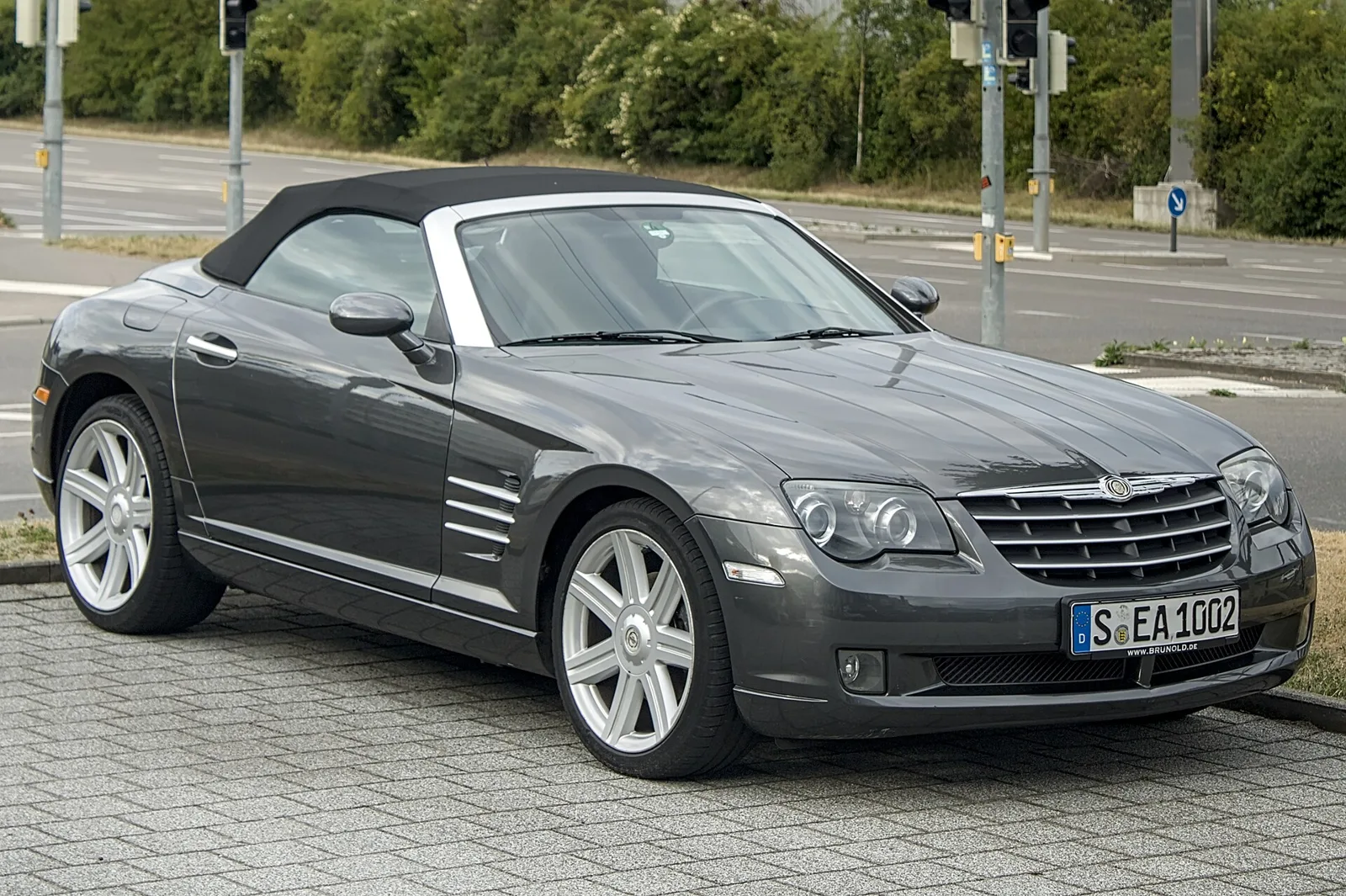
A two-seat rear-wheel drive coupe and roadster built by Karmann in Germany, with a Mercedes-Benz platform and a supercharged SRT-6.
The Chrysler Crossfire was a two-seat rear-wheel drive sports car sold from 2004 to 2008. Karmann built it in Germany on a Mercedes-Benz R170 platform, and the range included a supercharged SRT-6 model. Sales were slow, and production ended as part of Chrysler's restructuring.
The Chrysler Crossfire was Chrysler's attempt at a two-seat halo car during the DaimlerChrysler years. Most of its mechanics came from a Mercedes-Benz roadster, while Chrysler styled the body and interior around a concept that debuted in 2001. The result was a striking car that struggled to find buyers.
Where did the Crossfire come from?
The Crossfire began as a 2001 concept car at the North American International Auto Show, styled by Eric Stoddard and later refined by Andrew Dyson. Chrysler showed the production version at the 2002 Los Angeles Auto Show as a 2004 model, and the first car was assembled on 3 February 2003.
The production car was built by Karmann in Germany for the 2004 to 2008 model years. Chrysler's brief was a plush, refined sports car rather than a boy racer, and it was meant to compete with the roadsters already on the market. The name refers to two character lines running along the door panels, and also to the collaboration between the two companies.
The concept was designed to provoke a strong reaction. Chrysler's stylists aimed to polarise audiences, so that people would love the car or hate it. The team wanted a unique, almost sculptural coupe shape that would stand apart from anything else on the road.
A Mercedes-based two-seater with a German body, a Chrysler face and a supercharged SRT-6 that never found enough buyers.
How was the Crossfire styled?
The Crossfire has a wide stance, with 18-inch front and 19-inch rear wheels, and a boat-tail rear that critics compared with the AMC Marlin of 1965 to 1967. Chrysler also cited the Art Deco period and the Chrysler Building as inspiration, and Motor Trend linked the car to 1930s Bugattis and Talbot Lagos.
Chrysler executed the interior and exterior styling, while the chassis and running gear came from Mercedes. The engine bay is virtually identical to the one in the SLK320, and seats from the SLK320 bolt directly into the Crossfire. The dashboard layout, controls and instruments also closely follow the SLK320.
Chrysler said the production car shares about 39% of its parts with Mercedes-Benz vehicles. Dealers were required to invest in special equipment, tools and parts before they could market the new luxury model.
What did critics make of the styling?
Journalists and reviewers liked to link the Crossfire to earlier designs, and Motor Trend called its boat-tail theme provocative. Chrysler's own goal was a design people would love or hate, and the tail narrows into a teardrop shape as the roof edges converge over the rear fenders.
The rear fenders flare out over the rear wheels, which adds to the sculptural look Chrysler wanted. The objective was a unique, almost sculptural coupe, and the design team kept the wide stance as part of that brief.
How much power did the Crossfire make?
The base and Limited cars used a 3.2 L V6 from the Mercedes-Benz M112 family, rated at 215 hp (160 kW) and 229 lb ft (310 N.m) of torque. The SRT-6 used a supercharged version built by AMG, rated at 330 hp (246 kW) and 310 lb ft (420 N.m).
The SRT-6 shared its drivetrain, suspension and braking components with the Mercedes-Benz SLK 32 AMG, and it came only with the 5-speed automatic. The engine was a supercharged version of the M112, built by Mercedes' performance branch, AMG.
The standard transmission was a 6-speed manual, a variant of the NSG-370 unit from Mercedes. A 5-speed automatic, known as 5G-Tronic, was optional on the other models, and automatic cars returned better EPA fuel economy than the manual because of their gear ratios.
How was the SRT-6 different?
The SRT-6 combined the supercharged AMG V6 with suspension and brake modifications, a fixed rear spoiler and Z-rated Michelin Pilot Sport tyres. It came as both a coupe and a convertible, and it had no electronic wing, unlike the Base and Limited cars.
The SRT-6 kept the same tyre sizes as the other models but fitted Z-rated Michelin tyres to them. Its cabin used Alcantara and leather upholstery, which set it apart from the Base cars with their fabric seats.
What was the Crossfire chassis like?
The Crossfire used front unequal-length double wishbone suspension and a five-point multi-link rear, with recirculating ball steering carried over from the R170 platform. Wheels were 18-inch at the front and 19-inch at the rear on every model. Standard tyres were 225/40R18 at the front and 255/35R19 at the rear.
The first production car was driven off the line by Chrysler Group's chief operating officer, Wolfgang Bernhard, in Germany. The car's underpinnings stayed on the Mercedes-derived platform throughout production.
What equipment did the Crossfire come with?
Standard kit included leather-trimmed seats, a leather-wrapped steering wheel, keyless entry with an alarm, air conditioning and a Becker AM/FM stereo with an anti-theft system and a single-disc CD player. Convertibles added a power-retractable cloth roof, and the rear wing deployed automatically on base and Limited models.
Optional equipment included an automatic transmission, a six-speaker Infinity sound system with two subwoofers mounted behind the seats, a CD-based navigation system and extra interior colours. The electronic wing deployed at about 65 mph and dropped back at 45 mph, and a manual switch raised or lowered it at any speed.
Why did Chrysler stop making the Crossfire?
Sales were slow, with an average supply of about 230 days during November 2005, against an original target of 20,000 units a year in the US. Chrysler discontinued the car after the 2008 model year as part of its restructuring, and the last car was assembled on 17 December 2007.
The original contract with Karmann was for about five years. A small number of cars were imported to the US and Mexico in 2006, and almost all of those were roadsters, so the coupe never gained the volume the plan assumed.
Which Crossfire trims and models were sold?
The 2005 range came as a coupe and a roadster, each in Base, Limited and SRT-6 trims. Base cars had matte black windshield frames and fabric seats, while the Limited and SRT-6 models added fog lights. The SRT-6 used Alcantara and leather upholstery.
For 2006 and 2007 an SE Roadster in Blaze Red Crystal Pearl was offered as a base model. The SRT-6 was special order only for 2006.
What was the Crossfire's place in DaimlerChrysler?
The Crossfire was developed during the period when Chrysler and Daimler-Benz were merged as DaimlerChrysler, and its name nods to that collaboration. Chrysler conceived it as a two-seat halo car for the brand, using components that were already available on a two-seat roadster chassis.
Using the existing roadster chassis let Chrysler concentrate on the styling and interior, which it executed itself. The car sat at the top of Chrysler's range as a halo model, and the company wanted it to give the brand a touch of class.
The goal of a plush and refined sports car meant the Crossfire was aimed at comfort and character as much as outright performance, which is why its SRT-6 version was the exception rather than the rule.