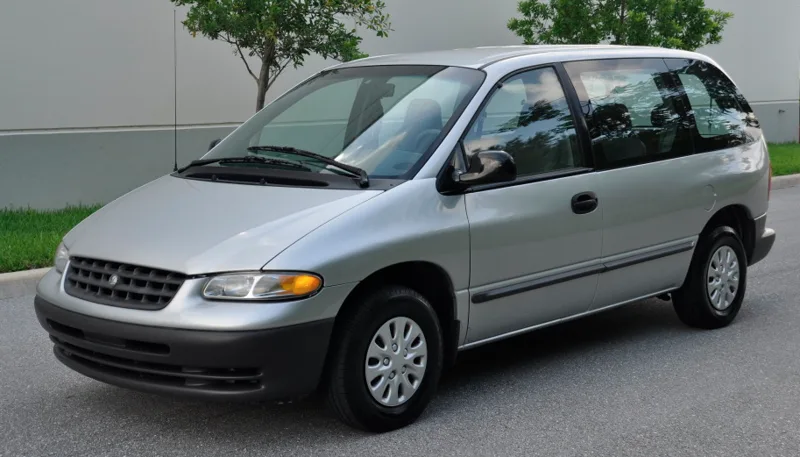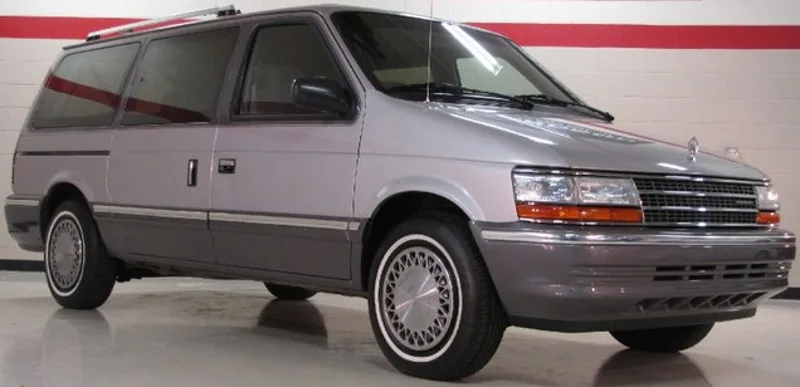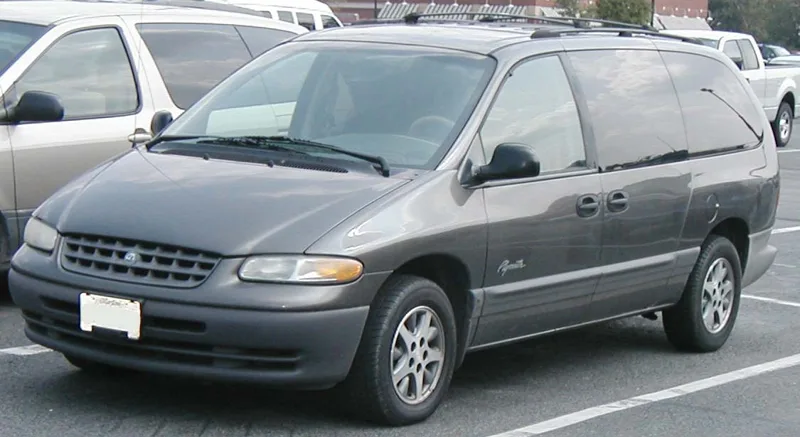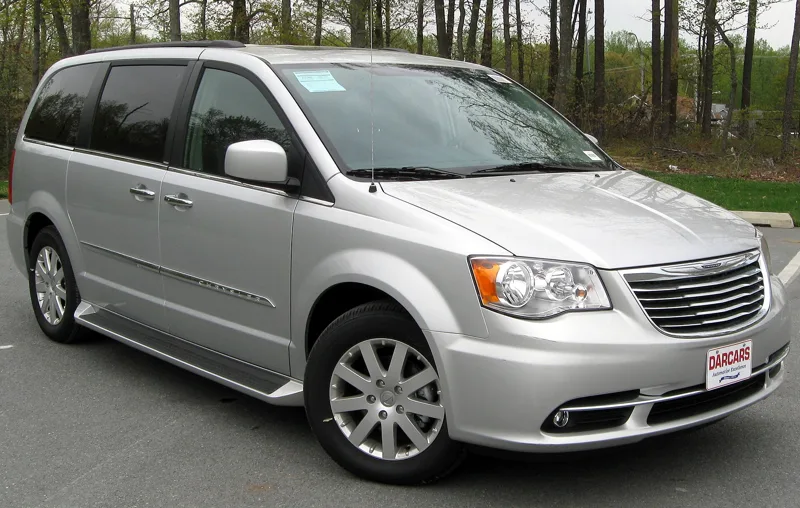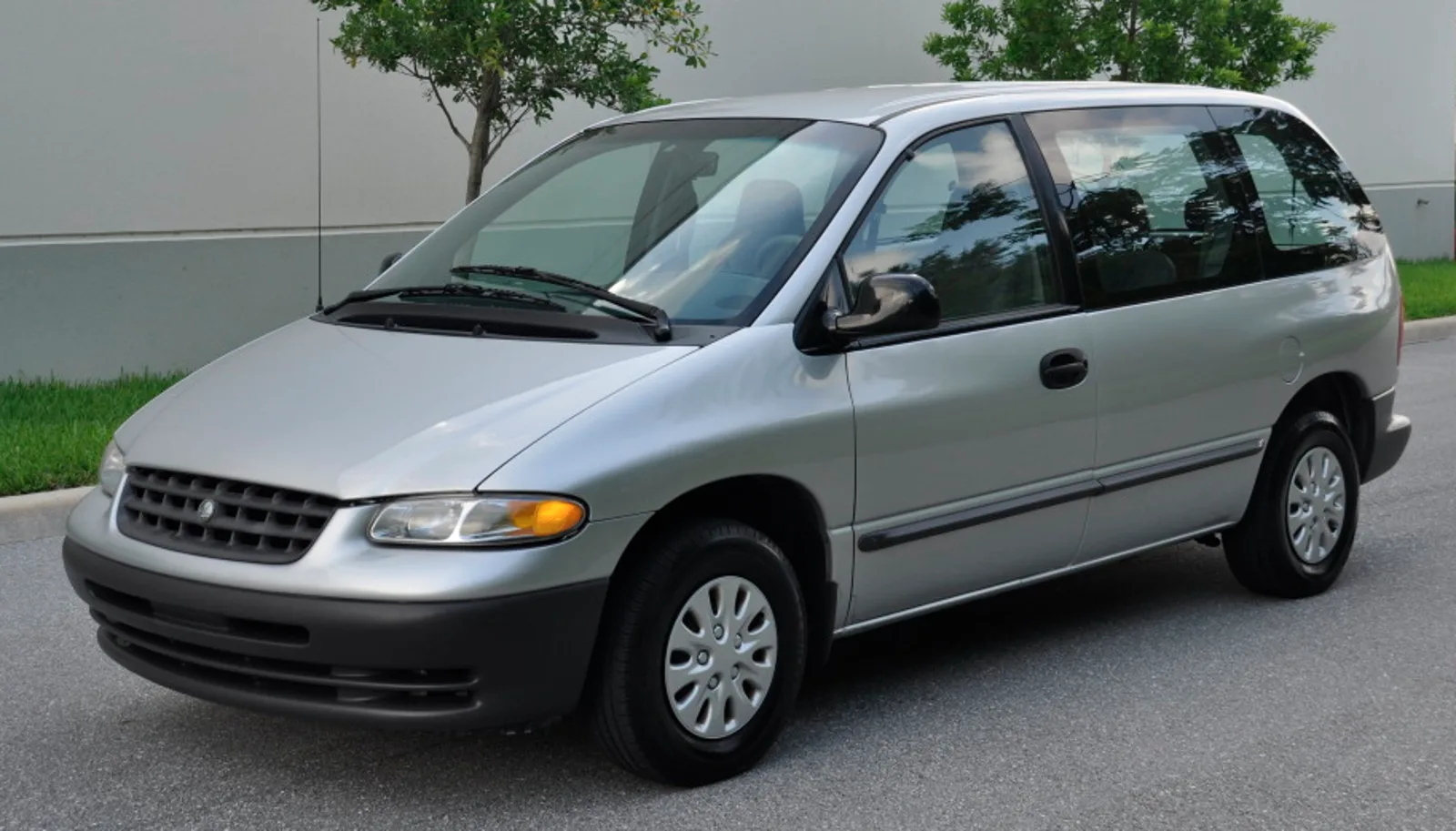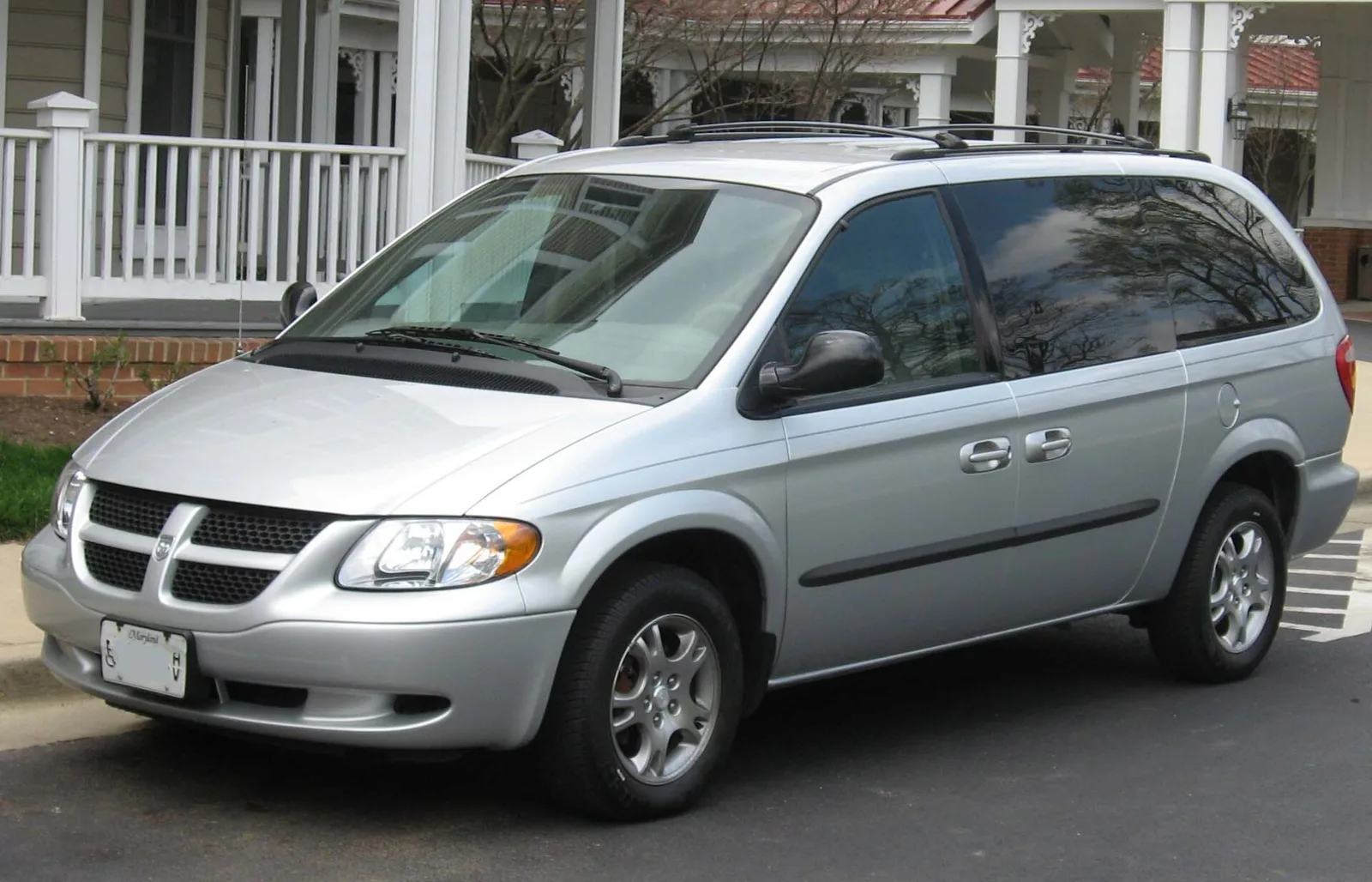
A 2001 to 2007 update of the NS design that retired the Plymouth name, made sliding doors standard and introduced fold-flat seating for 2005.
Sold from 2001 to 2007, the RS vans refined the NS design with standard sliding doors, a new dashboard and, from 2005, optional fold-flat Stow 'N Go seating. Plymouth was retired during the launch, and the Voyager name moved to the Chrysler brand.
The fourth generation of Chrysler minivans, the RS platform, was sold from the 2001 to 2007 model years. It refined the NS design rather than replacing it, and it closed the Plymouth era, because the brand was retired as the vans launched.
Its most lasting contribution was a seat system. The 2005 Stow 'N Go arrangement folded both rear rows into the floor, leaving a cargo area of 4,550 L (160.7 cubic feet) on the long-wheelbase vans.
How did the RS design relate to the NS?
The RS design was an evolution of the NS rather than a clean sheet. It kept the dual-wheelbase body and carried over the suspension, but it changed the body mounts, headlamps, dashboard and seating, and it made sliding doors standard on both sides.
Development ran from February 1996 to December 1999. The plan treated the NS as a base to build on, not something to replace. Brandon Faurote's design was signed off in January 1997, with production approval following in October 1997.
The vans were unveiled at the 2000 North American International Auto Show in a promotional tie-in with Nabisco, which used the reveal to show its Mini Oreos inside the van. The first RS minivans left the Windsor line on July 24, 2000, and went on sale that August.
A refinement of the NS design that put fold-flat seats in the family minivan.
What was the RS chassis like?
The RS chassis carried over both NS wheelbases, with the short version at 113.3 inches and the long version at 119.3 inches, a length that had not changed since 1994. Front MacPherson struts and a leaf-sprung solid rear axle were kept.
The body mounts for both axles were changed to reduce road noise, which was one of the goals of the update.
Brakes followed the same logic. Front-drive vans kept front discs and rear drums as standard, while four-wheel discs were offered on several option packages.
Which engines did the RS minivans use?
The 2.4-litre four returned as the standard engine, but only in the United States. The Mitsubishi V6 was dropped as the base V6 for the first time since 1987, and the 3.3-litre and 3.8-litre V6s from the EG series were offered as the options.
Gearboxes were simplified. The 2.4 started with a three-speed TorqueFlite automatic, and both V6s used a four-speed Ultradrive. After October 2001 the TorqueFlite was dropped, and all three engines went to the four-speed automatic in North America. The AutoStick manual selection was also removed from the column shifter.
The European range was different. Voyagers there had diesels, including a VM Motori 2.5-litre turbodiesel four with a five-speed manual, and a 2.8-litre diesel that took a four-speed automatic after 2005. Chinese production from 2007 used the Mitsubishi 3.0-litre V6.
How did the RS body change?
The RS body was largely a refinement of the NS, with the front fascia given a further degree of divisional identity. The headlamps were more than doubled in size and made 80 percent brighter, which answered a criticism of the previous generation.
Power sliding doors were a segment first. Their operating components sat entirely within the door, and the door reversed if it met an object. The doors could be opened from the key fob or from buttons on the B-pillar or overhead console.
The dashboard was completely changed, with a tachometer standard for the first time on all versions. The centre portion extended nearly to the floor, and a removable centre console could be fitted. The front seat tracks were lengthened rearward for taller drivers.
The third-row seat moved to a 50/50 split, which cut the weight of each section to lift, and the second row could be a bench or individual buckets depending on trim. The Easy-Out Roller Seats were revised for easier use.
How did Stow 'N Go work?
Stow 'N Go replaced the removable Easy-Out rear seats for the 2005 model year, folding both rear rows flat into the floor. It was optional, offered only on the long-wheelbase van, and it paired a third-row bench with second-row buckets.
Engineers first made a mock-up of the concept with an Erector Set. Chrysler then invested $400 million in the development programme, which took 18 months from approval to production. The whole floorpan was redesigned, and that required changes to the rear suspension, fuel tank, exhaust, spare tyre well, parking brake cables and climate control lines.
The trade-off was all-wheel drive, which could no longer be offered with the seating system. The third row folded flat in a 60/40 split and could fold backward for tailgate seating, while the second row folded independently of it.
The seats added underfloor storage, and with both rows folded the cargo volume reached 4,550 L (160.7 cubic feet). Popular Science gave the system its Best of What's New award for 2005. The RT generation later revised it as Super Stow 'N Go.
How safe were the RS minivans?
Early crash results were weak. The 2001 model earned a Poor rating in the IIHS 40 mph offset test, and a fuel leak was part of the problem. Chrysler corrected the leak from the 2002 models, which lifted the rating to Acceptable.
The 2001 van protected its occupants reasonably well and kept dummy movement well controlled, so the leak was the main defect. From 2006 optional side curtain airbags and a stronger B-pillar were offered, and the IIHS side test then rated the van Acceptable with the side airbags fitted.
Even with those airbags, the driver still faced a chance of serious neck injuries, rib fractures and internal organ injuries. Rear passengers were judged to face a low risk of significant injury in a crash of that severity.
Euro NCAP results were a different story. The right-hand drive Town & Country, sold as the Grand Voyager in Europe, performed very poorly. The left-hand drive car did much better, scoring 9 points in the frontal impact and a potential four-star adult occupant rating, and Thatcham's whiplash rating was Acceptable overall.
How was the RS range marketed?
For 2001 the vans were sold by Chrysler and Dodge, with the Voyager name carried through the Chrysler brand. In Europe the same van was sold as the Chrysler Voyager, and the Dodge Caravan sat in the middle of the range.
The Voyager was the entry-level Chrysler minivan, below the Caravan and the Town & Country. After Plymouth closed, the Caravan became the mid-trim Dodge, and its role depended on trim, with entry-level and Grand versions working as counterparts to the Town & Country.
A cargo van returned for 2003 as the Dodge (Grand) Caravan C/V, the first since 1995. Its side windows were deleted and replaced with composite panels, the cargo floor used a plastic similar to pickup bedliners, and rubber cab flooring replaced carpet. It bridged the gap between the outgoing Ram Van and the Mercedes-built Sprinter.
What were the Town & Country trims?
The Town & Country stayed the flagship, but it took on a wider role than before. Its LX, LXi and Limited trims continued in 2001, and by 2005 the LXi had become the Touring. The 2005 revision added a large rectangular eggcrate grille borrowed from the PT Cruiser.
Entry-level eL and eX trims were added in 2002 to accommodate the Voyager name's move to the Chrysler line, and they were dropped after 2003. For 2004 the entry trim became an unnamed short-wheelbase base model, and the LX was dropped from retail sale.
The 2005 update added larger headlamps and a driver's knee airbag as standard. Side curtain airbags covered all three rows, were standard on the Limited and optional on others, but could not be ordered with the moonroof.
What was the Chrysler Voyager in North America?
The Voyager became a Chrysler in North America for 2001, offered only on the short-wheelbase body after the Grand Voyager was discontinued there. It was distinguished from the Town & Country by its eggcrate grille and a high-mounted Chrysler wing emblem.
Base and LX trims came first, with an entry-level eC added for 2002. After 2003 the Voyager nameplate was dropped in North America, and it did not return until 2020. For 2004 the vehicle reappeared as an unnamed base Town & Country, which sold through 2007.
What was the export Chrysler Voyager?
Outside North America the RS Voyager was built in Graz, Austria, and it differed mechanically from the Town & Country. It shared much of its body with the Town & Country and was one of the largest vehicles in the European MPV segment.
The 2.4-litre gasoline four was standard, and buyers could choose a 2.5-litre turbodiesel with a five-speed manual. A 2.8-litre turbodiesel came only with a four-speed automatic, and before 2007 a 3.3-litre V6 was available in Europe.
Trims ran from the SE base Voyager to the LX on the Grand Voyager, followed by Signature, Executive and Executive XS. Europe accounted for over 80 percent of Voyager production, and the van was sold in more than 70 countries. Chrysler held a 12 percent share of the European MPV segment.
This was the last generation of Chrysler minivans built in Austria, which closed a long run of European production for the Graz plant.
How did the Dodge Caravan change in these years?
The Caravan returned with SE, Sport and ES trims in 2001, after the base and LE trims used since 1984 were dropped. Its trim list changed again in 2002 and 2003, and by 2004 the SXT had replaced the Sport and ES as the flagship.
The 2004 model became the first Chrysler minivan to mark 20 years of production, and Chrysler offered an Anniversary Edition package on the SXT. The 2005 facelift squared off the front, with design cues similar to the Dodge Magnum station wagon.
Where else were RS minivans built or sold?
Licensed production took RS-based vans beyond North America. In Taiwan, China Motor Corporation built Town & Country minivans from 2005 to 2007, and in 2007 production moved to China, where Soueast assembled Grand Voyager and Grand Caravan models until late 2010.
The Taiwanese vans were based on the export Grand Voyager and used the 3.0-litre Mitsubishi V6 for the first time since 2000. They had LED taillights, backup cameras and mirror-mounted turn signals. In Brazil the RS vans were known as the Chrysler Caravan and Chrysler Grand Caravan.
The RS Voyager and Caravan were discontinued after 2010 in China, where the Grand Voyager moved to the RT design. The Grand Caravan was replaced by the Dodge Journey, which entered local production in 2009.
RS minivan engines at a glance
| Engine | Years | Power | Torque |
|---|---|---|---|
| 2.4 L EDZ four | 2001 to 2007 | 150 hp (110 kW) at 5400 rpm | 165 lb ft (224 N m) at 4000 rpm |
| 3.3 L EGA V6 | 2001 to 2007 | 180 hp (130 kW) at 5000 rpm | 210 lb ft (280 N m) at 4000 rpm |
| 3.8 L EGH V6 | 2001 to 2007 | 200 hp (150 kW) at 5000 rpm | 245 lb ft (332 N m) at 4000 rpm |
| 3.0 L Mitsubishi 6G72 V6 | 2007 to 2010, China | 150 hp (110 kW) | 176 lb ft (239 N m) |
| 2.5 L VM Motori turbodiesel four | Europe, five-speed manual | - | - |
| 2.8 L R 428 turbodiesel | Europe, four-speed automatic, after 2005 | - | - |