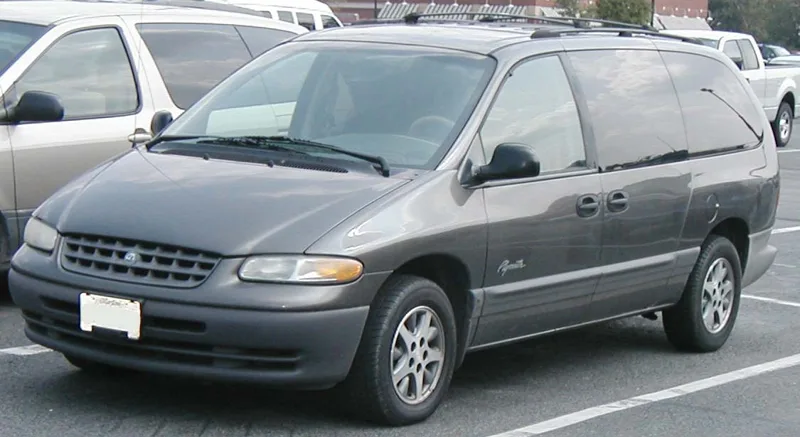
Chrysler's S-platform vans gave American families a front-drive alternative to the full-size station wagon and set the template the segment followed.
The first-generation Chrysler minivans were the 1984 to 1990 Dodge Caravan and Plymouth Voyager, built on the front-drive S platform. They started with K-car powertrains and later gained Mitsubishi V6 engines, giving families a van-sized alternative to the station wagon.
Chrysler's first minivans reached showrooms in November 1983 as the 1984 Dodge Caravan and Plymouth Voyager, ahead of chief rivals from Chevrolet and Ford. Built on the front-drive S platform, the first generation ran until the 1990 model year and popularised the minivan as a type of vehicle. Its roots reach back to a Ford programme from the early 1970s.
Where did the garageable van idea come from?
The idea dates to the early 1970s, when Ford and the truck division of Dodge each looked at a garageable van as an alternative to the Volkswagen Microbus. Ford's Carousel reached running-prototype stage in 1973 before the oil crisis halted it.
Dodge's version never got beyond a clay model. Chrysler chairman Lynn Townsend took the view that Ford and General Motors would have built such a van by now if buyers wanted one.
The Carousel was derived from the Ford Club Wagon. It adopted a lower garageable roofline, along with automotive-style interior and exterior features, and it was the closest prototype to the goal that later shaped Chrysler's own van.
The first Chrysler minivans turned a clay-model idea from the early 1970s into a segment that other makers would chase.
What did Chrysler set out to build in 1977?
When development restarted at the end of 1977, Chrysler set four goals. The van had to fit a standard garage, offer car-like noise and vibration levels, provide a low flat load floor, and carry removable rear seats. A 1982 model year was the planned launch target.
The removable seats had a practical purpose: they had to let the floor carry a 4x8 sheet of building material. Chrysler's research across the United States asked customers what they wanted, and the answers matched those four goals. Potential buyers called the early concept sketches ugly, yet Chrysler still saw a market approaching 1 million vehicles a year.
Personnel changes shaped the project. Lee Iacocca and Hal Sperlich moved to Chrysler in 1978 after leaving Ford, and that same year Chrysler merged the truck engineering division of Dodge into its car side. Both men were senior enough to shape the programme's direction.
Why was front-wheel drive chosen?
Chrysler chose front-wheel drive by 1979 under the codename T-115. The van used the same transverse engine and transmission family as the K-cars, but it had a separate body structure. Lee Iacocca approved the project at the end of 1979, at a cost of $500 million.
Rear drive was considered as well. The K-car and the L-body Omni and Horizon were both candidate donor platforms, but the L-body was ruled out as too light-duty for a vehicle of this size and for the six-cylinder engine planned for it.
The body went through many changes on the way to production. Early plans called for four sedan-style doors, and then two sliding doors for easier parking-lot access. Chrysler settled on a single sliding door, partly because it wanted to sell the van to commercial buyers, and the left-side sliding door option was deleted to reduce production costs.
How did the 1984 styling change over time?
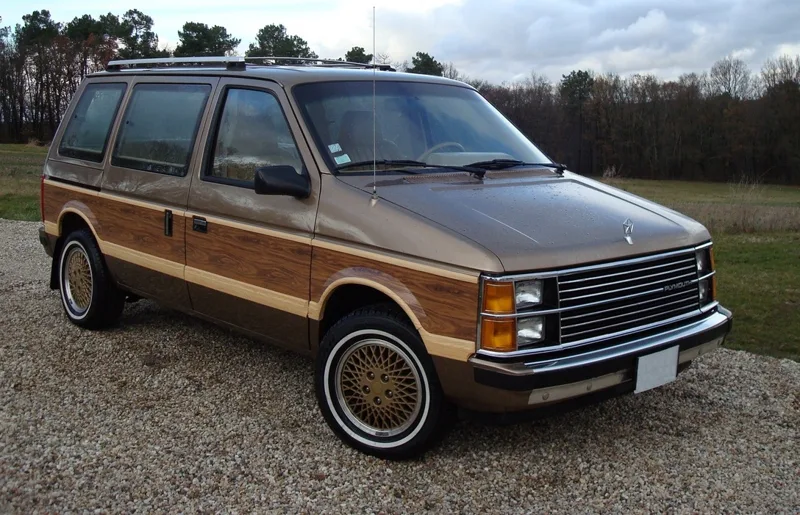
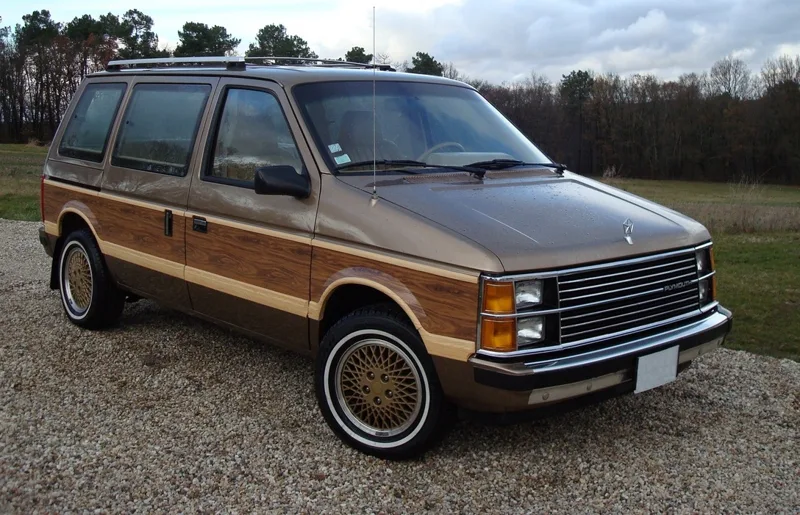
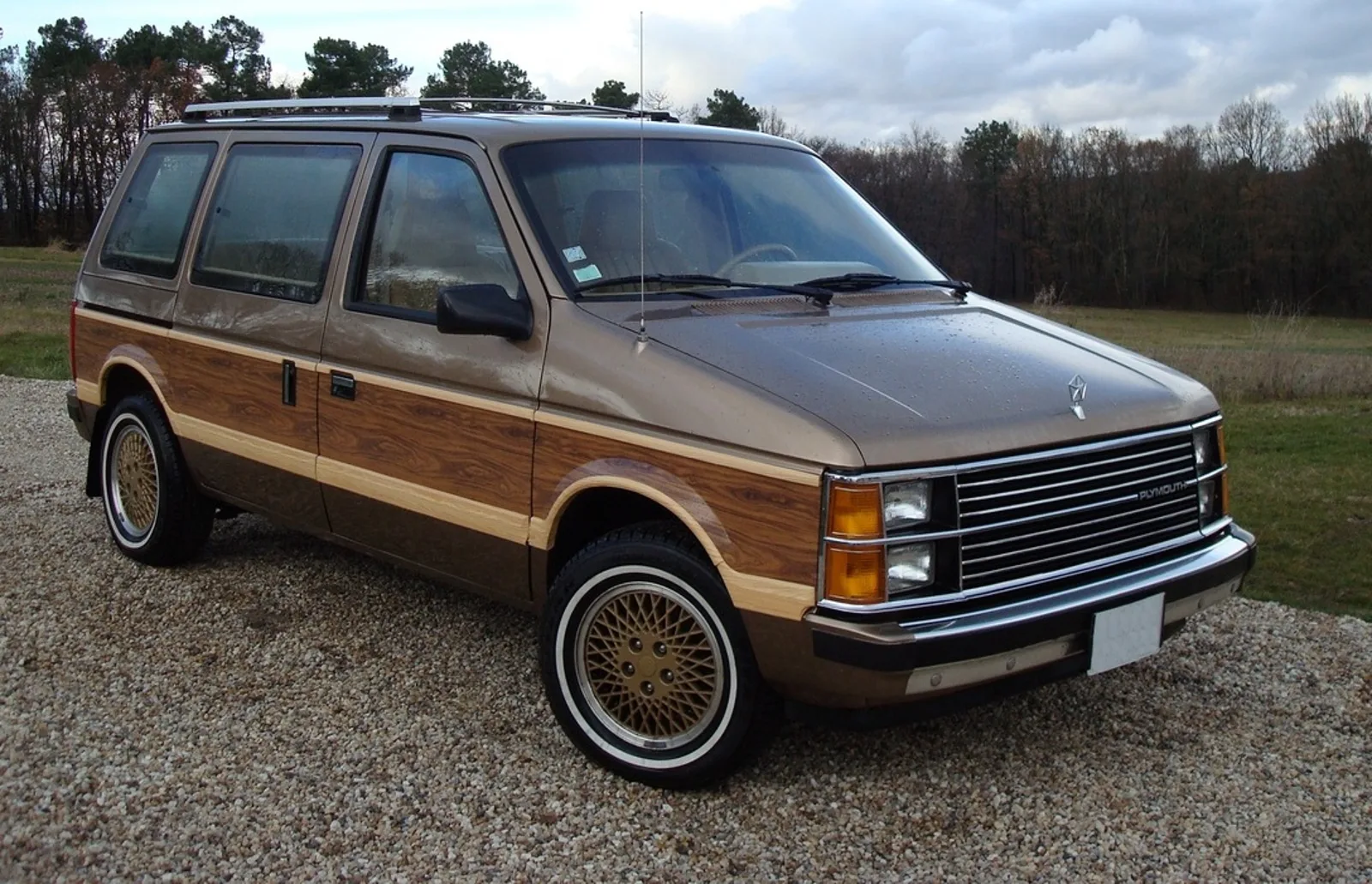
The 1984 vans carried vertically stacked headlamps. The Caravan wore an eggcrate grille, while the Voyager's grille had horizontal trim, and top-trim examples could be ordered with simulated woodgrain paneling. That woodgrain option was a feature found only on the first two generations.
In 1986 the vans moved from 4-lug to 5-lug wheels, in line with other Chrysler models. Chrysler also fitted a bumper-mounted air dam to reduce high-speed wind noise. For 1987, every version except the Mini Ram Van received flush-lens composite headlamps.
Which engines and transmissions did the vans use?
The K-car 2.2L four was judged inadequate for the van, and the 3.7L Slant Six could not be mounted transversely. A Mitsubishi 2.6L four filled the gap until 1987, when Chrysler moved to a Mitsubishi 3.0L V6. Chrysler's own V6 arrived in 1989, and the company did not use the 3.9 L LA 239 V6 for the line.
Output rose gradually. The base 2.2L produced 96hp, while the optional Mitsubishi 2.6L made 104hp. The mid-1987 fuel-injected 2.5L four produced 100hp, and a 3.0L V6 with 136hp arrived the same year. A turbocharged 2.5L four with 150hp followed in 1989.
A three-speed TorqueFlite A413 automatic was offered with most inline-fours, along with a five-speed manual. V6 versions relied on the TorqueFlite until the four-speed Ultradrive arrived in 1989. The Ultradrive suffered gear hunt, which wore its internal clutches, and it needed Mopar ATF+3 fluid rather than the Dexron II that many owners put in. Dealers later retrofitted or replaced many early units under warranty, so most first-generation Caravans eventually received an updated transmission.
How did the body and cabin work?
The vans used a liftgate supported by gas struts, and they offered a cargo floor about 7 feet long. Chrysler built a storage drawer under the passenger seat, because the dashboard left no room for a conventional glovebox. That drawer was later kept on the Chrysler minivans and the PT Cruiser.
Seating varied with trim. Five passengers in two rows was the standard layout, while seven or eight passengers came with three rows. The second row used low-back seats, because the vans counted as light trucks, or high-back seats with headrests. The Convert-a-bed fold-flat rear seat arrived in 1985.
The vans were among the first mass-produced cars with dedicated cup holders outside the glovebox. They also shared visible parts such as wheel covers, door handles and instrument panels with the Aries and Reliant, which kept costs down.
How big were the first-generation vans?
The standard-length Dodge Caravan and Plymouth Voyager measured 2 inches shorter and 2 inches wider than a K-car station wagon, yet they offered nearly double the cargo space. Their cargo floor ran about 7 feet, and the liftgate was unlocked with a key rather than a remote.
Removing the rear seats turned the interior into a load area large enough for a 4x8 sheet of building material, which was one of the four original design goals. That flexibility was the selling point for tradesmen and families alike.
Specifications at a glance
| Item | Detail |
|---|---|
| Model years | 1984 to 1990 |
| Platform | Chrysler S platform, front-wheel drive, unibody |
| Wheelbase | 112.1 inches standard, 119.1 inches Grand |
| Launch | November 1983 |
| Engine range | 2.2L I4 with 96hp up to 3.3L V6 with 150hp |
| Transmissions | Three-speed TorqueFlite A413, five-speed manual, four-speed Ultradrive from 1989 |
| Development cost | $500 million |
| Town & Country total | 5,404 built |
What did the Mini Ram Van and Caravan C/V offer?
The Mini Ram Van was the cargo version of the S-platform vans from 1984 to 1988. A Ram nameplate under the side mirror marked it out, and from 1989 it was renamed the Caravan C/V. Its model-specific headlight clusters used dual sealed-beam lamps, a departure from the passenger van.
Window configurations ranged from none at all to a full set. The Caravan C/V could also be ordered with 50/50 split rear doors in fibreglass, which an outside vendor installed between the factory and the dealer. Conversion vans built on the same platform were sold through Chrysler dealers and by independent converters.
Cargo production expanded to both wheelbases in 1987, when the Grand models arrived. The cargo variants therefore gained the same long-wheelbase choice as the passenger vans.
What did the Grand models add?
The long-wheelbase Grand Caravan and Grand Voyager arrived for the 1987 model year. They stretched the wheelbase by seven inches and the overall length by fourteen, to 119.1 inches between the axles. For 1987 they were the largest vehicles in the North American segment.
With both rear seats removed, the Grand versions offered 150 cubic feet of cargo room, which is 25 more than a standard-wheelbase van. The long wheelbase became the most popular configuration, and the front bench seat and Convert-a-bed were dropped for 1987.
Was there a Chrysler Town & Country in the first generation?
The Town & Country was the flagship of Chrysler's minivan range, introduced in the spring of 1989 as an early 1990 model. It used the long-wheelbase body, leather seats, an Infinity sound system and a crystal Pentastar hood ornament. Only 5,404 examples were built, which made it the rarest of all Chrysler minivans.
The 1990 Town & Country started life with the 3.0L Mitsubishi V6 producing 142hp, a unit the EPA treated as a 1989 vehicle. Chrysler then fitted its own 3.3L V6 with 150hp as a running change during production. Both engines went with the Ultradrive four-speed automatic.
Chrysler pitched the Town & Country against upmarket rivals, including an Aerostar Eddie Bauer and the Oldsmobile Silhouette. Its waterfall grille echoed the New Yorker, and it shared its 15-inch wheels with the Voyager LX.
How did the export Voyager differ?
From the 1988 model year Chrysler exported minivans to Europe under the Chrysler Voyager name. The export van was a Caravan underneath, wearing the nose of the Caravan C/V cargo van, and it competed with the Renault Espace and the Volkswagen Transporter.
European rules required changes. The export model had amber turn signal lenses, turn signal repeaters and a licence plate surround embossed with the Chrysler name. Under the skin it shared most of its powertrain with the North American van, except for the turbocharged 2.5L and the 3.3L V6.
Many export Voyagers were built with manual transmissions, which were uncommon on the North American vans. Each export van therefore carried a set of changes that the North American models did not need.
How were the vans marketed?
The early Voyager commercials in 1984 starred the magician Doug Henning, who promoted the Magic Wagon's cargo space, low step-in height and manoeuvrability. The vans were sold on practicality rather than prestige, and the advertising reflected that focus.
Tina Turner fronted Voyager commercials in 1989, and the pop singer Celine Dion appeared in Canadian commercials in 1990.
The campaigns leaned on the features Chrysler stressed most: passenger room, load space, ease of entry and handling. Families and fleet buyers were the target, and the advertising spoke to both groups with the same message about practicality.
How did the vans stack up against rivals?
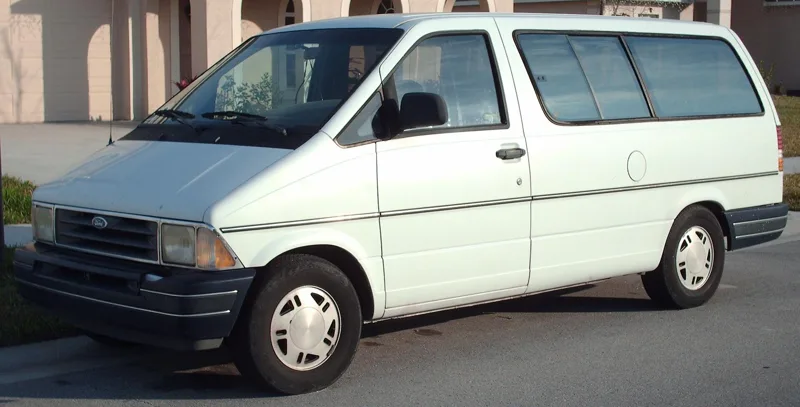
The Dodge Caravan and Plymouth Voyager were the first minivans from an American manufacturer, so Chrysler reached the market ahead of the Chevrolet Astro, the GMC Safari and the Ford Aerostar. Those three followed as direct competitors rather than pioneers, and each was judged against a design that buyers already knew.
Chrysler's Caravan C/V matched the split rear doors of the Chevrolet Astro, a layout also common on traditional cargo vans. That kept the cargo variant competitive for fleet buyers who expected rear doors to open wide.
The Grand models set the pace on size in 1987. That single model year was the high point of the first generation's size advantage.
What did the first generation leave behind?
By popularising the minivan, the first generation set a formula that later Chrysler vans refined. The under-seat storage drawer, for one, survived into later generations of Chrysler minivans and the PT Cruiser.