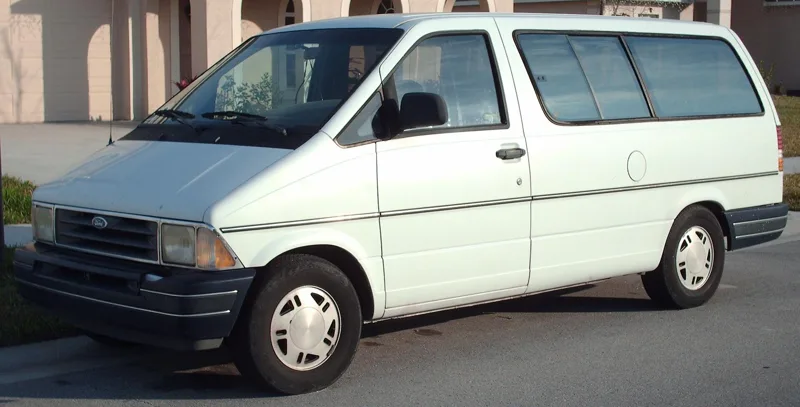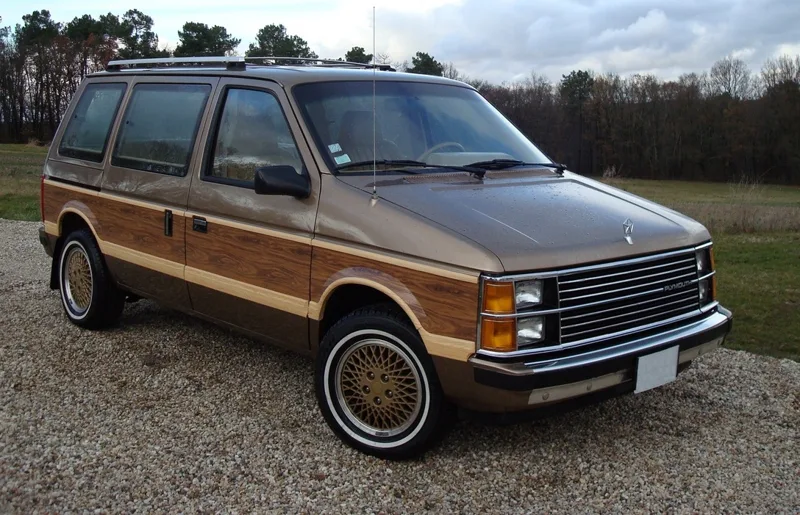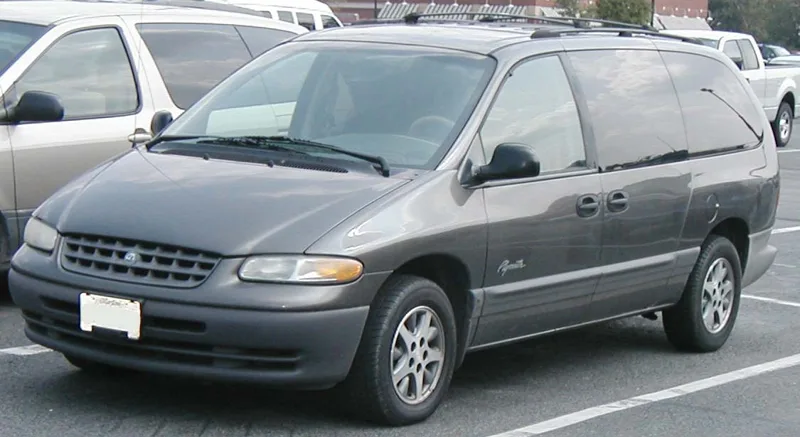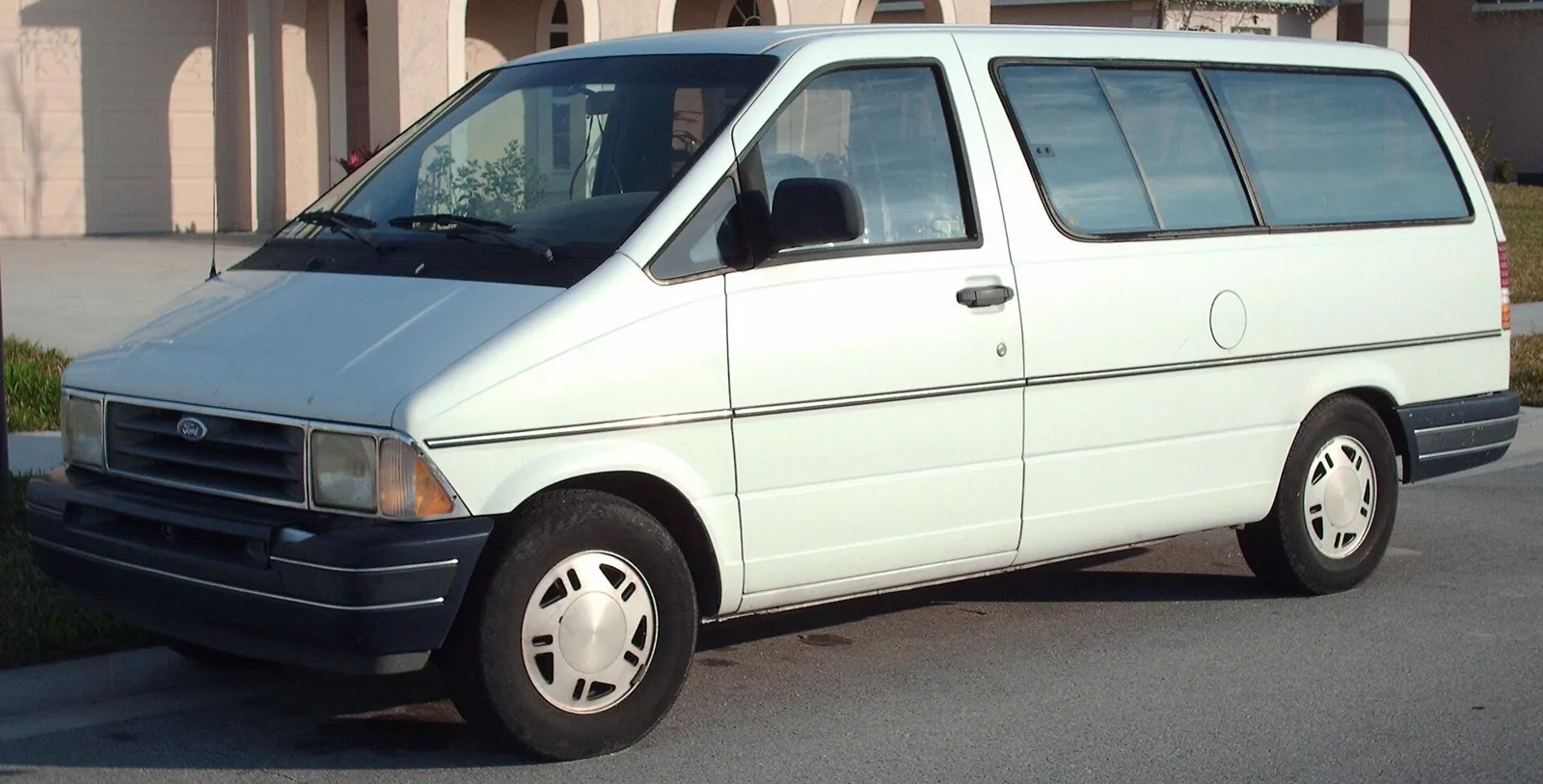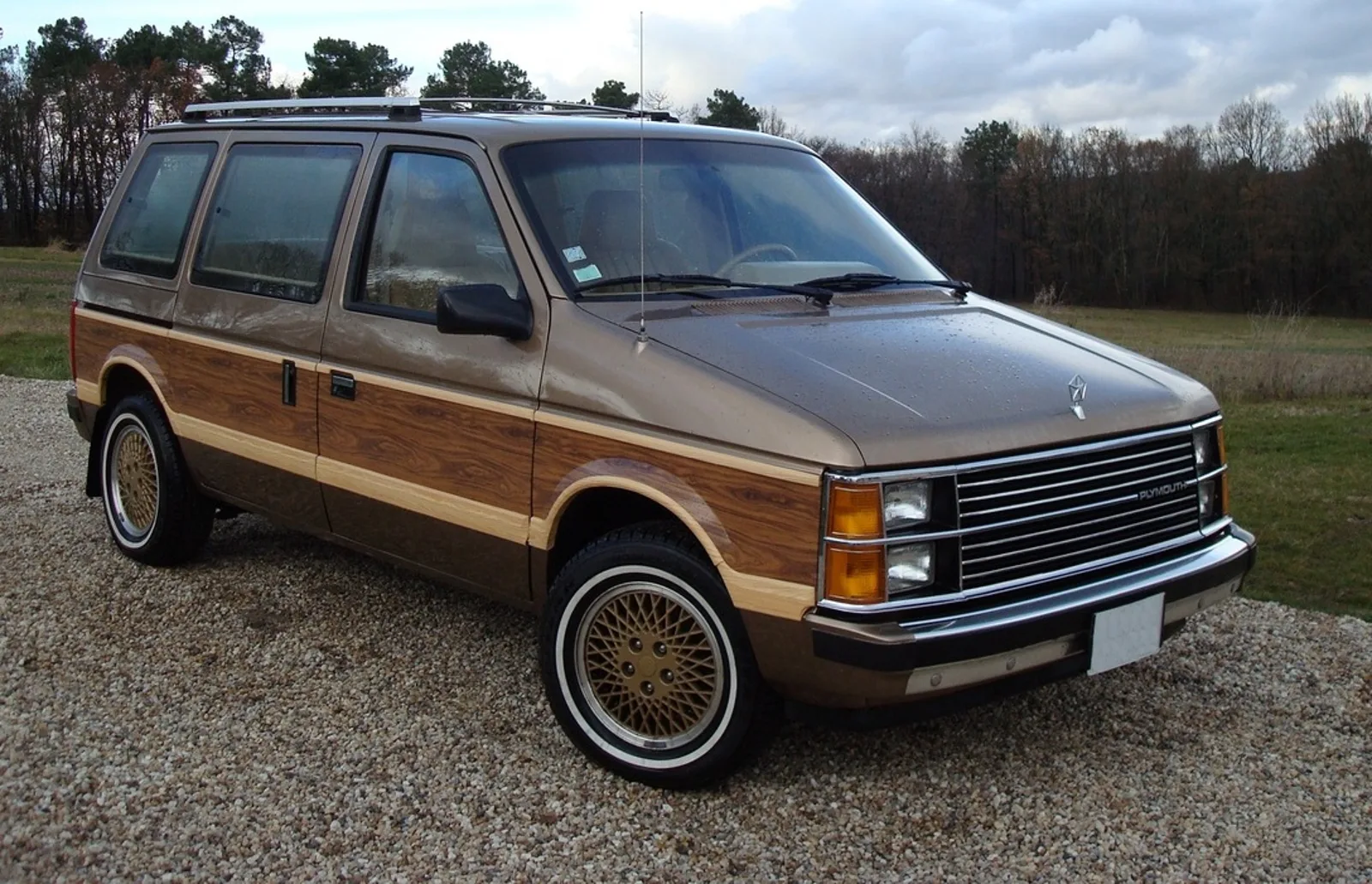
Chrysler's first minivans reached showrooms almost two years before Ford's Aerostar, and the two vans then split on drive layout, towing and engines.
The Chrysler vans went on sale in November 1983 as the Dodge Caravan and Plymouth Voyager, while the Ford Aerostar followed in 1986. Chrysler built on front-wheel drive, while Ford's rear-wheel drive design carried a 5,000-pound tow rating. Both makers offered V6 engines during the decade.
Chrysler's first minivans and the Ford Aerostar were rivals from the mid-1980s, yet they took opposite routes to the road. Chrysler's vans used front-wheel drive and reached showrooms first, while Ford built its van on a rear-wheel drive chassis designed to tow. The two layouts shaped how each van was driven, loaded and sold.
Which van reached showrooms first?
Chrysler was first by almost two years. The Caravan and Voyager launched in November 1983, and Ford's Aerostar trailed them by nearly two years, arriving with the 1986 model year. Ford's earlier Carousel prototype never reached production under any name.
Chrysler had restarted its van project at the end of 1977, aiming at a 1982 launch. Lee Iacocca and Hal Sperlich, both gone from Ford in 1978, moved into similar roles at Chrysler. By 1979 the team had picked front-wheel drive for the project, codenamed T-115.
The T-115 project cost $500 million and was funded as part of $1.5 billion in federal loan guarantees given to Chrysler. Its design shifted a good deal before launch. The rear door plan went from four sedan-style doors to two sliding doors and then to one, with the left-side option deleted to cut costs.
Two minivans from the mid-1980s: one front-wheel drive and first to market, the other rear-wheel drive and built to tow.
The Carousel and the garageable van idea
Ford's rival concept, the Carousel, was a garageable van built on the 124-inch wheelbase of the Club Wagon chassis and tested from 1972 to 1974. Its roofline sat about 12 inches lower than a standard Club Wagon, and it carried a 460 V8. The 1973 oil crisis stopped it.
Ford ended development of the Carousel in 1974, but by 1980 it had committed to a smaller vehicle. That vehicle became the Aerostar, an all-new design that kept the Carousel's roughly six-foot height and long wheelbase.
Why did the Aerostar use rear-wheel drive?
Ford chose rear-wheel drive to give the Aerostar a car-like ride on a 119-inch wheelbase and to meet a towing goal of 5,000 pounds, a figure that matched the Ford Ranger in development at the time. The layout also let the van share mechanical parts with several Ford light trucks.
The Chrysler S platform took the opposite path. It was a unibody, front-wheel drive design that shared its transverse engine and transmission with the K-cars, but its body structure was distinct and gave a higher hoodline and seat height. The standard wheelbase was 112.1 inches, and the Grand version stretched to 119.1 inches.
The Aerostar's frame was a hybrid. It combined unibody construction with full-length frame rails, which is what gave it the 5,000-pound rating. Its front suspension broke from Ford's light-truck practice.
Specifications side by side
| Specification | Chrysler minivans (first generation) | Ford Aerostar |
|---|---|---|
| Model years | 1984 to 1990 | 1986 to 1997 |
| Launch | November 1983, for the 1984 model year | 1986 model year; launch airlift in summer 1985 |
| Drive layout | Front-wheel drive, S platform, unibody | Rear-wheel drive; unibody with full-length frame rails |
| Wheelbase | 112.1 inches standard; 119.1 inches Grand | 119 inches |
| Towing | Not given | 5,000 pounds |
| Launch engines | 2.2-litre four, 96 hp; optional Mitsubishi 2.6-litre four, 104 hp | 2.3-litre four, 100 hp; optional 2.8-litre V6, 115 hp |
| Later engines | 3.0-litre Mitsubishi V6, 136 hp (1987); turbo 2.5-litre, 150 hp (1989); 3.3-litre V6, 150 hp (1990) | 3.0-litre V6, 145 hp (1986); 4.0-litre V6, 160 hp (1990) |
| Transmission | Not given | Five-speed manual until 1995, mostly cargo vans and XL trim; four-speed automatics |
| All-wheel drive | Not given | E-4WD, 1990 to 1997, on XLT and Eddie Bauer trims |
| Drag coefficient | Not given | Cd 0.37 |
| Development cost | $500 million (T-115 project) | Over $300 million |
| Build location | Saint Louis Assembly, Fenton, Missouri; Windsor Assembly, Ontario | St. Louis Assembly Plant, Hazelwood, Missouri |
| Production total | Not given | 2,029,577 in a single generation |
What engines did each van offer?
At launch the Caravan and Voyager had two inline-four engines, a 96 hp 2.2-litre and an optional 104 hp Mitsubishi 2.6-litre. The Aerostar started with a 100 hp 2.3-litre four and a 115 hp 2.8-litre V6, and by 1988 the 3.0-litre V6 was its only engine.
Chrysler's engine line moved in steps. In mid-1987 the 2.2-litre gave way to a fuel-injected 2.5-litre rated 100 hp, and a Mitsubishi 3.0-litre V6 arrived at 136 hp in March of that year. The Mitsubishi V6 later rose to 142 hp, a turbocharged 2.5-litre came in the 1989 model year at 150 hp, and a 150 hp 3.3-litre V6 joined the list for 1990.
Ford's engines followed a similar path. The 2.8-litre V6 was replaced during 1986 by a 145 hp 3.0-litre shared with the Taurus and Mercury Sable. A 160 hp 4.0-litre V6 arrived for 1990, paired with the all-wheel drive system. A five-speed manual lasted until 1995, and a five-speed automatic arrived for the 4.0-litre in 1997.
How did the two vans compare on towing and cargo space?
The Aerostar was the towing specialist, with a 5,000-pound rating that was two and a half times the Caravan's. The standard-length Caravan offered nearly double the cargo space of a K-car station wagon, and the Grand version reached 150 cubic feet with both rear seats removed.
The Grand Caravan and Grand Voyager arrived in May 1987, adding seven inches of wheelbase and fourteen inches of length. Ford's answer came for 1989, when it released an extended-length Aerostar that added 14 inches to the rear body. That version became the most popular Aerostar of the 1990s.
Interior, seating and the sliding door
The Chrysler vans offered five passengers in two rows, or seven or eight in three rows. A Convert-a-bed fold-flat rear seat arrived in 1985. The dashboard left no room for a conventional glovebox, so Chrysler fitted a large storage drawer under the passenger seat, and the vans were among the first mass-produced cars with cup holders outside the glovebox.
Ford's goals for the Aerostar included garageability, seven-passenger seating with walk-around interior space, compact-car fuel economy and towing comparable to full-size station wagons. The Aerostar's sloped nose and one-box shape gave it a drag coefficient of 0.37, which bettered the Lincoln Mark VII.
What did each programme cost to develop?
The Aerostar cost less to develop than Chrysler's minivans, and it was built at the same time as the Taurus, which cost Ford $3.5 billion. Ford spent over $300 million on the van, while Chrysler's T-115 project reached $500 million.
Chrysler's own research had also pointed to a large audience. It found a potential market of nearly 1 million vehicles a year, and Chrysler was already selling 215,000 of them.
Ford's path ran through concept vehicles. The 1982 Ford Aerovan, a two-door wagon, and the 1984 Ford APV, a three-door MPV, were both Ghia-designed and both derived from the Ford Escort. The Aerovan previewed the sloped-nose front of the Aerostar and of the larger 1986 Ford Transit.
Ford staged the launch in summer 1985 with the Aerostar Airlift, using eight Lockheed C-130 Hercules transport aircraft to fly Aerostars into eight cities across the United States at once.
How did the two vans differ in their chassis and suspension?
The Chrysler vans used MacPherson struts at the front and a beam rear axle on leaf springs, with front disc and rear drum brakes. The Aerostar used unequal-length A-arms and coil springs at the front, and a coil-sprung live rear axle at the back.
Coil springs at all four corners were rare for a minivan. The Aerostar was the only one of its kind sold in North America while it lasted, and its three-link rear layout resembled the Panther-platform chassis of the period, though the two did not share parts.
The Aerostar kept front disc and rear drum brakes through its production, as the Chrysler vans did. The difference lay in how the rear was located and how the front was sprung.
How did the body shapes differ?
Chrysler's vans kept a boxy profile with a liftgate, and their side windows were made flush with the body in 1981 to cut wind noise and drag. The Aerostar used a sloped, one-box shape, and its Cd of 0.37 bettered the Lincoln Mark VII.
The Chrysler liftgate was supported by gas struts and unlocked by key, a layout shared with the K-car station wagons. Visible parts such as wheel covers, door handles and instrument panels came from the Dodge Aries and Plymouth Reliant.
The Aerostar's long wheelbase put its wheels near the corners and kept overhangs short, which set it apart from European one-box vans. Ford also used plastic bumper covers, a plastic fuel tank and a plastic rear hatch, along with aluminium for the driveshaft, axles and wheels, to improve fuel economy.
Which variants mattered most?
The long-wheelbase Grand was the most popular Chrysler configuration, while the extended-length Aerostar became the most popular Ford version during the 1990s. The Chrysler range also grew with an export Voyager and a luxury Town and Country.
The Chrysler Voyager was introduced for export sale in 1988, mainly to Europe, as a competitor for the Renault Espace. The Town and Country arrived for 1990, serving as one of the first luxury-oriented minivans, and it had been the Chrysler station wagon since 1951.
Ford's all-wheel drive system, E-4WD, was a more specialised option, available from 1990 on XLT and Eddie Bauer trims. It was not intended for off-road driving, and it used a centre differential controlled by an electromagnetic clutch.
The 5,000-pound rating matched that of the Chevrolet Astro and GMC Safari, and the hybrid frame design later appeared in the 1971 to 1996 Chevrolet Van and the 1984 to 2001 Jeep Cherokee XJ.
How did the Aerostar's line-up develop?
The Aerostar came as passenger and cargo vans, with an extended-length body option. Most were sold in the United States and Canada, only a limited number were exported, and Ford built the whole model line at one plant.
Ford's extended-length Aerostar, launched for 1989, became the most popular version during the 1990s. The cargo van role was left unfilled, and the Ford Transit Connect became the closest successor in size and capability.
The Windstar was the Aerostar's intended successor. It arrived for the 1995 model year as a front-wheel drive van, and Ford kept both lines on sale until the Aerostar ended in 1997. Ford's 1988 changes were minor: the exterior badging moved from both fenders to the tailgate and changed from chrome to silver, and the V6 and Electronic Fuel Injection badges were removed because both features were now standard.
Ford considered innovative design and features a key selling point of the vehicle, even though the Aerostar trailed the Chrysler minivans to market.
Which buyer suits each van?
A buyer who wanted one of the first American minivans, with front-wheel drive and several seating layouts, would look at the Chrysler. A buyer who needed to tow, or who wanted all-wheel drive between 1990 and 1997, would look at the Aerostar.
Neither van wins on every count. The Chrysler range had the head start and more seating layouts, while the Aerostar brought rear-wheel drive, a 5,000-pound tow rating and, for a time, all-wheel drive. The choice depends on whether a family needs the first van or the one built to pull.