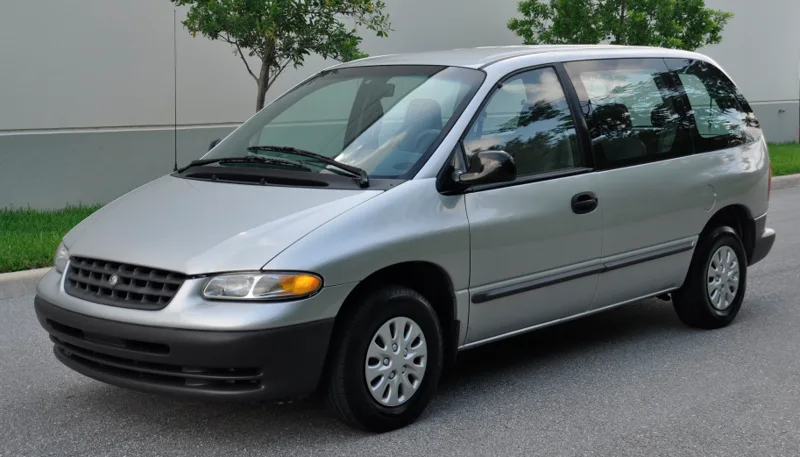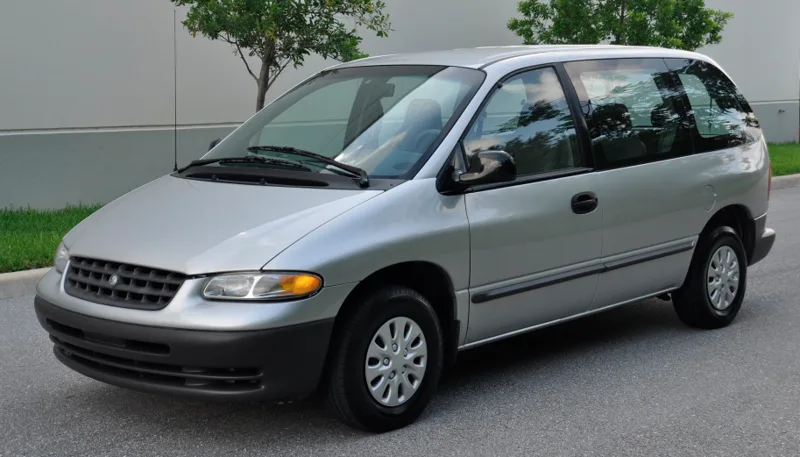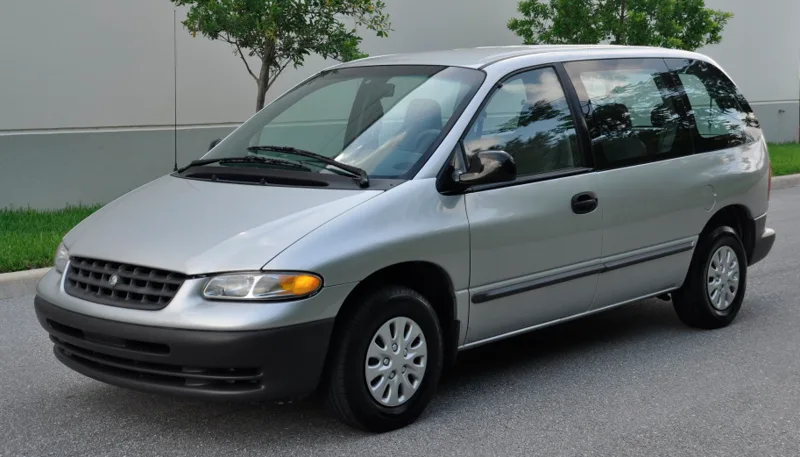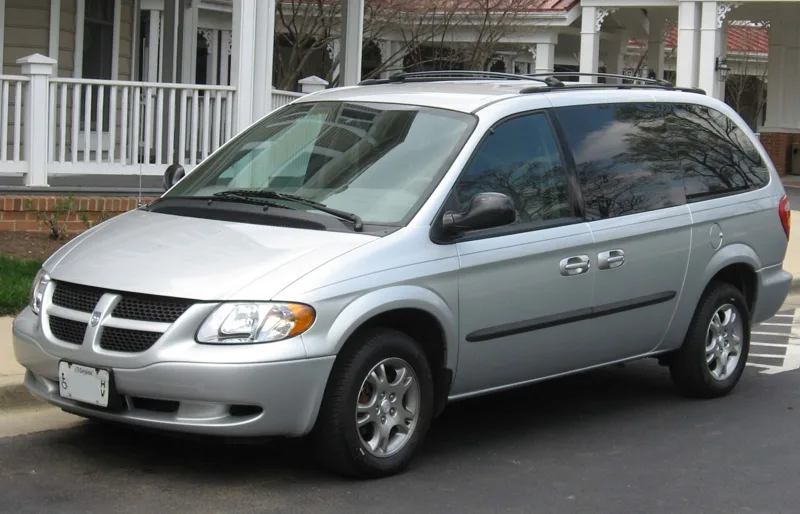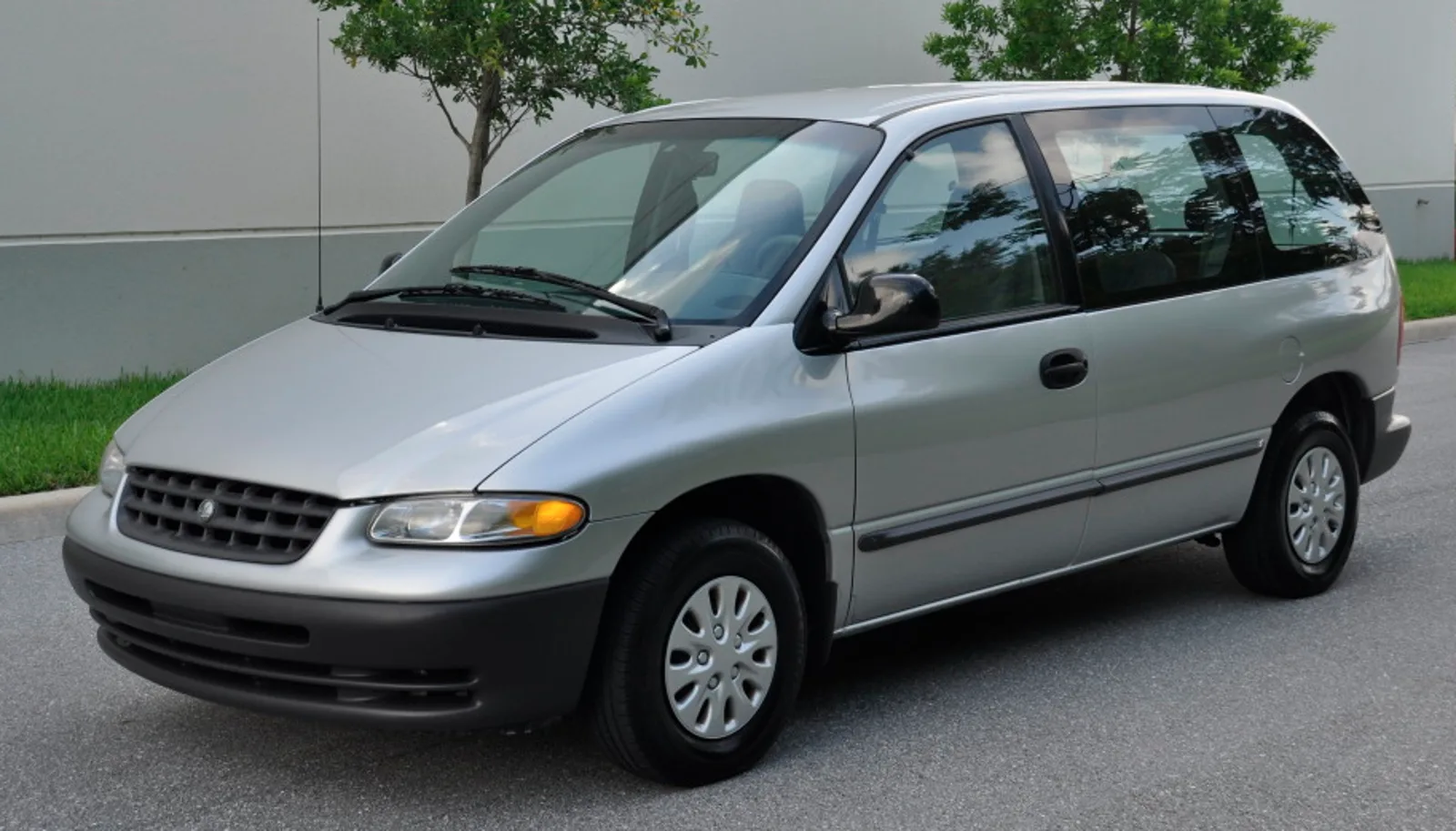
The third-generation Chrysler minivan brought a front-drive, cab-forward body, a driver-side sliding door and a three-division line-up from 1996 to 2000.
Front-drive, with a driver-side sliding door and a three-division line-up, the NS vans of 1996 to 2000 gave North American minivans their modern layout. Rivals from Ford, Honda, Toyota and General Motors adopted the same form.
The third-generation Chrysler minivans, built on the NS platform, were sold from the 1996 to 2000 model years. They were the first ground-up redesign since the original vans arrived, and the shape they set was copied across North America.
The NS generation also closed a chapter. The cargo van was dropped, every van became a passenger model, and this was the last generation sold as the Plymouth Voyager before Chrysler retired the Plymouth brand in 2001.
What made the NS platform different?
The NS platform was a completely new unibody with front-wheel drive and a transverse engine, designed from the ground up as a minivan. The first-generation vans had shared structure with the K-car, which the NS did not.
The front track was widened by three inches. That let the engine and transaxle sit lower, reduced the turning circle and lowered the cowl. The suspension kept MacPherson struts at the front and leaf springs with a beam axle at the rear, even though a four-wheel double wishbone layout had been studied.
Front-drive vans had front disc brakes and rear drums. All-wheel drive vans received four-wheel discs from 1997.
A ground-up minivan whose shape most of North America went on to copy.
How was the NS minivan developed?
Development began in 1990 under a team led by Tom Gale and Chris Theodore, with design work by Don Renkert approved in September 1991 and a design freeze in May 1992. The NS was the first all-new Chrysler minivan in a decade, and it was partly a response to Ford's front-drive replacement for the Aerostar, which arrived as the 1995 Windstar.
Chrysler benchmarked the Ford Aerostar, Mercury Villager and Toyota Previa, and drew on customer input and warranty data. The NS was also the first Chrysler vehicle designed with CATIA, a computer design system that allowed much tighter tolerances than before.
Owners were asked about a driver-side sliding door priced at $300, and 85% said they would buy a van with a second sliding door, even as an extra-cost option. The feature had been planned for the first-generation vans, but Chrysler removed it in 1980 over concerns about tooling costs.
The floor layout was a compromise. A lower floor was considered, because research said the step-in height was too high, but it would have cost buyers the higher driving position they wanted. Chrysler kept the previous floor height and eased it into lower door sills.
That floor design also let the same van take all-wheel drive, larger wheels and tyres, CNG tanks and batteries for electric vehicles without major modification. The powertrain choice came down to a transverse layout, which reduced overall length.
Why was the NS body cab-forward?
The NS body moved its dashboard and windshield forward in a cab-forward layout. The roof was raised while the cowl dropped, which allowed a less radical windshield angle, and the wiper module was made removable for better engine bay access.
The body was an extensive shift from the boxy design of the first two generations. The vans were taller on average, but the drag coefficient fell from 0.39 to 0.35, which matched the Ford Windstar and was bettered only by the GM APV minivan.
No body panels were carried over from the earlier vans, and all three divisions adopted new model badging. The look also contrasted with the controversial styling of GM's APV minivans.
What engines did the NS minivans use?
The 1996 vans introduced a new 2.4-litre four-cylinder, the first new four in the line since 1987, rated at 150 hp. In states that did not observe California emissions standards, a Mitsubishi 3.0-litre V6 was standard. In states that followed California's rules, the Chrysler 3.3-litre V6 was standard.
The 3.8-litre V6 was standard on the Dodge Caravan ES and Chrysler Town & Country LXi. Although the 2.4 was smaller than the 2.5-litre it replaced, it nearly matched the 3.0-litre V6 for output and fuel economy.
Changes followed in 1999. The 3.8 became optional on the Plymouth Voyager Expresso, and Canadian buyers lost the 2.4, which was replaced by the 3.0-litre V6 as standard. Manual gearboxes disappeared in the United States and Canada, with a three-speed TorqueFlite automatic for the 2.4 and 3.0 and a four-speed Ultradrive for the 3.3 and 3.8.
Export vans had their own engines. The standard unit was a 2.0-litre SOHC four taken from the Neon, with a DOHC 2.0-litre option and a VM Motori 2.5-litre diesel four. Export models offered a five-speed manual or an automatic, and all-wheel drive was not sold in the United Kingdom.
Did the sliding door change the minivan?
The NS was the first mid-size minivan to offer a driver-side sliding door. Earlier examples had appeared on compact MPVs such as the Nissan Stanza Wagon and Nissan Axxess, and the NS track was redesigned to take less interior space.
The sliding door used a three-track mounting system, and its exterior track was hidden below the side windows. The door became standard on the Town & Country in 1997, and from 1999 it was optional on every Caravan.
Other access changes followed. The liftgate gained an exterior handle for the first time, which ended the pop-and-lift motion of the two earlier generations, and the exterior door handles changed from flip-up to pull-out designs.
How did the Easy-Out Roller Seats work?
Chrysler introduced the Easy-Out Roller Seats in 1996, and the system stayed in use across the NS generation. Each seat latched to floor strikers, and when released, eight rollers lifted it so it could roll fore and aft or come out of the van.
Ergonomic levers at the seatbacks released the floor latches with one hand and without tools, and the seats rose onto the rollers in a single motion. For the first time, front bucket seatbacks also folded forward.
The system was awkward with bench seats. Two- and three-person benches could be unwieldy to handle, and the lighter second-row buckets had no rollers at all. Bench seat stanchions were moved inboard to reduce bending stress and save weight.
In 2001, later generations moved to a quad configuration, with bucket or captain chairs in the second row and a 50/50 third-row bench. Each section weighed under 50 lb (23 kg).
How safe were the NS minivans?
Crash results were mixed. The 1996 to 2000 Dodge Grand Caravan earned a Marginal rating in an IIHS 40 mph offset test, while the NHTSA gave it four stars for the driver and front passenger in a frontal impact. European tests of the Chrysler Voyager were far worse.
The IIHS graded the structure and restraints Acceptable, but foot injuries were very high in the offset test. The side-impact results were stronger, with five stars for the driver and three for the rear occupant.
The same side test recorded a fuel leak that could cause a fire hazard.
The European NCAP results were harsher. The 1999 Chrysler Voyager earned no points in the frontal impact, its body structure became unstable and the steering column was driven back toward the driver. The 2007 model reached 19 percent in the frontal test and two stars overall out of a possible five.
Folksam, a Swedish insurer, published a report in May 2009 covering 172 car models. The 1996 to 2000 generation earned a Safest rating, meaning at least 30 percent safer than the average car, while the 1988 to 1996 generation was rated Average.
Which divisions sold the NS minivans?
Three divisions sold the NS vans from 1996: Plymouth, Dodge and Chrysler. The Plymouth Voyager was the entry-level model, the Dodge Caravan sat in the middle and the Chrysler Town & Country was the flagship.
The vans came in standard and extended Grand lengths, and the Town & Country introduced a standard-length body for the first time. The line was introduced in March 1995 for the 1996 model year, and all Chrysler minivans became passenger vans as the Caravan C/V cargo van was discontinued.
What changed on the Chrysler Town & Country?
The Town & Country was the flagship and received a short-wheelbase body for the first time, along with several trims. It dropped the simulated woodgrain trim that dated to 1965 and replaced the crystal Pentastar hood ornament with a medallion-style grille badge.
The base trim was LX, replacing the LE trim of the Voyager and Grand Voyager in the United States, with SX on the short-wheelbase car from 1997 to 1999. The LXi was the top trim. In 1997 the driver-side sliding door became standard on the Town & Country.
For 1998 a mid-cycle revision added a redesigned grille with a winged Chrysler badge and an updated interior. The Town & Country Limited debuted above the LXi, and for 2000 the short-wheelbase body was discontinued, which ended the SX trim.
What did the Dodge Caravan add to the range?
The Caravan was the mid-range model, distinct from the Plymouth Voyager, and it wore a Ram emblem on the hood. It was the only NS minivan with a hood-mounted emblem, and it offered base, SE, LE and ES trims, with a Sport package on several.
Seven-passenger seating was standard on every Caravan, whatever the body length. For 1999 the Caravan ES introduced an Autostick gear selector, a first for a minivan, operated by a momentary switch on the column shifter.
What was the Plymouth Voyager?
The Plymouth Voyager was the entry-level Chrysler-group minivan, using the same bodyshell as the Caravan with different trim and feature content. It had a dark grey eggcrate grille, matte grey bumpers across every trim and a Rallye option package on the SE.
Before calendar 1996 the NS Voyager carried the Pentastar, and it then switched to a sailboat Plymouth grille emblem. The LE trim was dropped in the United States to reduce overlap, and the Rallye package became the Expresso for 1998.
In 2000, as Chrysler withdrew the Plymouth brand, the Voyager was marketed under both the Chrysler and Plymouth names. That was the final year of the Plymouth Voyager as a separate line.
What were the export Chrysler Voyagers?
Outside the United States and Canada, the NS vans were sold as Chrysler (Grand) Voyagers, using the Dodge Caravan body and interior under the GS platform designation. They were built at Saint Louis Assembly and by Eurostar in Graz, Austria.
The export Voyager was the first to be built in right-hand drive, which opened sales in Australia and the United Kingdom. It used the 2.0-litre four from the Neon and a 2.5-litre diesel, and it was the only third-generation Chrysler minivan offered with a manual transmission.
A commercial version survived in the Netherlands as the Dodge Ram Van after the passenger model was discontinued in most markets. In some Asian and Latin American markets, GS vans were sold as the Chrysler (Grand) Caravan.
What concepts and special models came from the NS platform?
In 1999 Dodge introduced the Caravan EPIC, a fully electric minivan sold only to fleets on lease. Chrysler unveiled three concept minivans the same year, for the 15th anniversary of its minivan production, and a Caravan R/T and Voyager XG rounded out the special models.
The EPIC was powered by 28 12-volt NiMH batteries and could travel up to 80 miles (130 km) on a single charge. Only a few hundred were produced, production ended in 2001, and returned leases meant most were crushed. About 10 remain in private hands today.
The Pacifica concept was derived from the Town & Country and had a raised roof, a full-length skylight and a 2+2+2 layout with power-operated middle-row seats. Its grille and headlamps borrowed from the LHS sedan. The Pacifica name later reappeared on a 2004 to 2008 crossover and again for 2017.
The 1999 Caravan R/T swapped the 3.8 for the 3.5-litre V6 from the Chrysler 300M, which produced 253 hp and was paired with a four-speed AutoStick. Its hood scoops were carried over from the Dodge Viper RT/10, and the interior had black leather seats and racing-style pedals. From 2011 to 2016, Dodge sold a largely cosmetic Grand Caravan R/T.
The Plymouth Voyager XG was a four-seat minivan aimed at younger, active drivers. It had 17-inch wheels shared with the Prowler, a full-length retractable fabric sunroof and a removable storage pod behind the seats. It used the export Voyager's 2.5-litre diesel and five-speed manual.
Did the NS minivans win awards?
The NS vans won major honours in their launch year. The Dodge Caravan was named the 1996 Motor Trend Car of the Year, a distinction no other minivan has earned, and the vans also took the 1996 North American Car of the Year award.
Car and Driver put the vans on its Ten Best list for both 1996 and 1997.
NS minivan specifications at a glance
| Item | Detail |
|---|---|
| Generation | Third generation of Chrysler minivans, NS platform, 1996 to 2000 |
| Development | Began 1990; design approved September 1991; design freeze May 1992 |
| Development cost | $2.8 billion, about $4.6 billion in 2017 dollars |
| Drag coefficient | 0.35, down from 0.39 |
| Standard engines, 1996 | 2.4 L four, 150 hp; Mitsubishi 3.0 L V6 or Chrysler 3.3 L V6 by region |
| Optional V6 | 3.8 L on Caravan ES and Town & Country LXi |
| Transmissions | 3-speed TorqueFlite for 2.4 L and 3.0 L; 4-speed Ultradrive for 3.3 L and 3.8 L |
| Export engines | 2.0 L SOHC standard; 2.0 L DOHC option; 2.5 L VM Motori diesel four |
| IIHS offset test | Marginal (1996 to 2000 Dodge Grand Caravan) |
| NHTSA frontal test | 4 stars for driver and front passenger |
| NHTSA side test | 5 stars driver, 3 stars rear occupant |