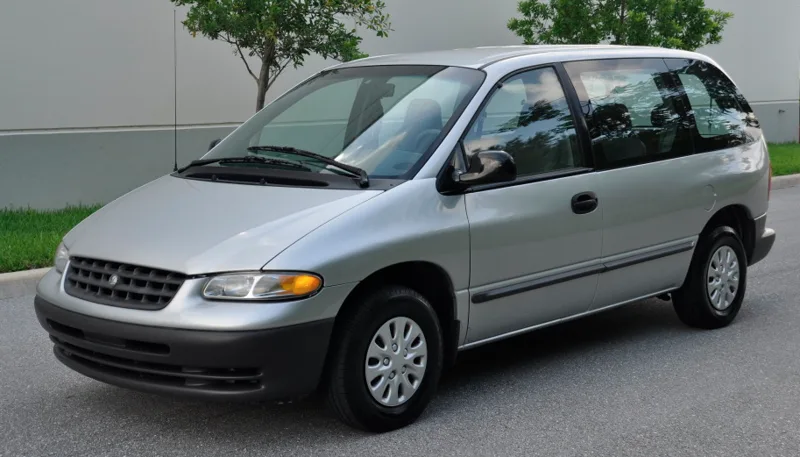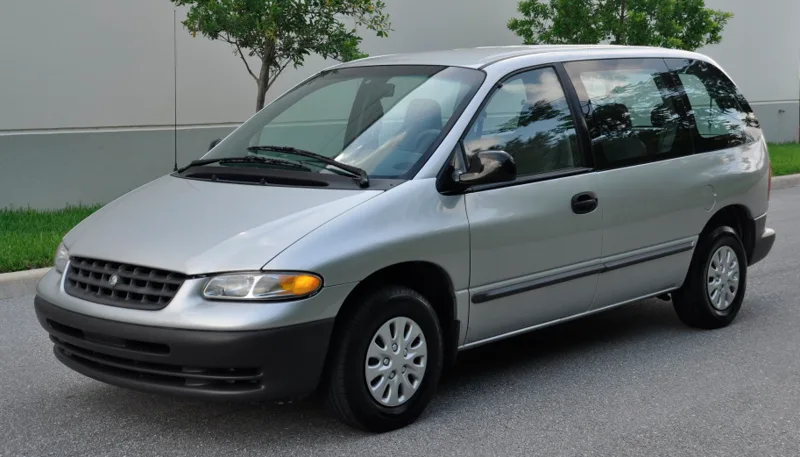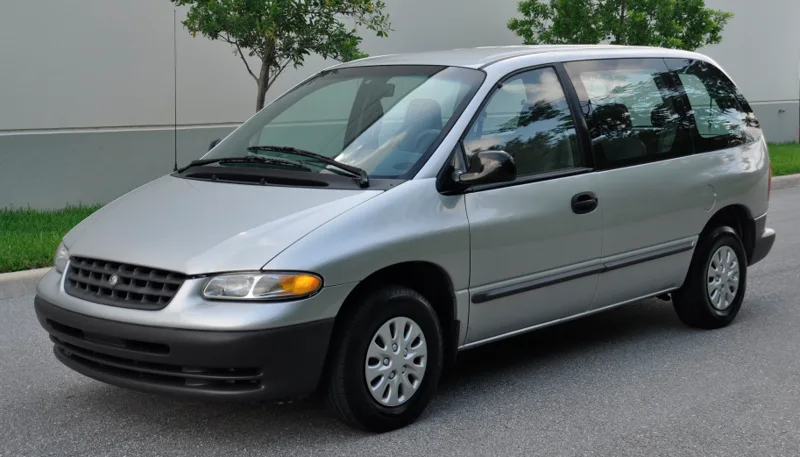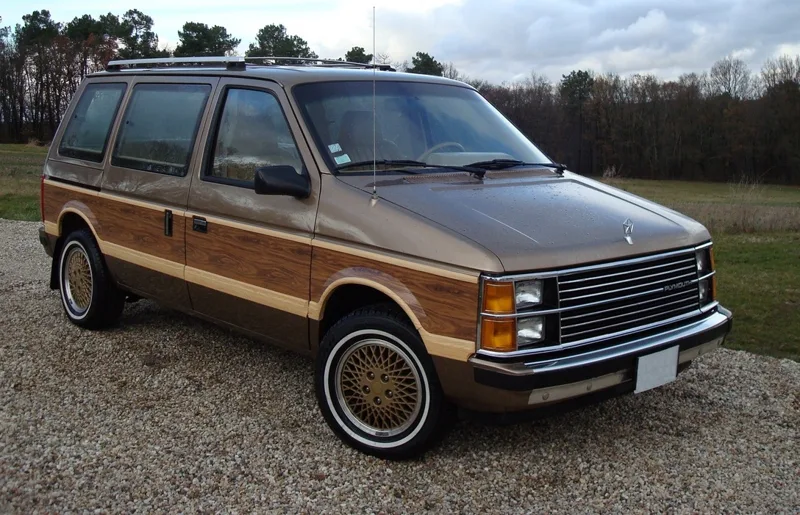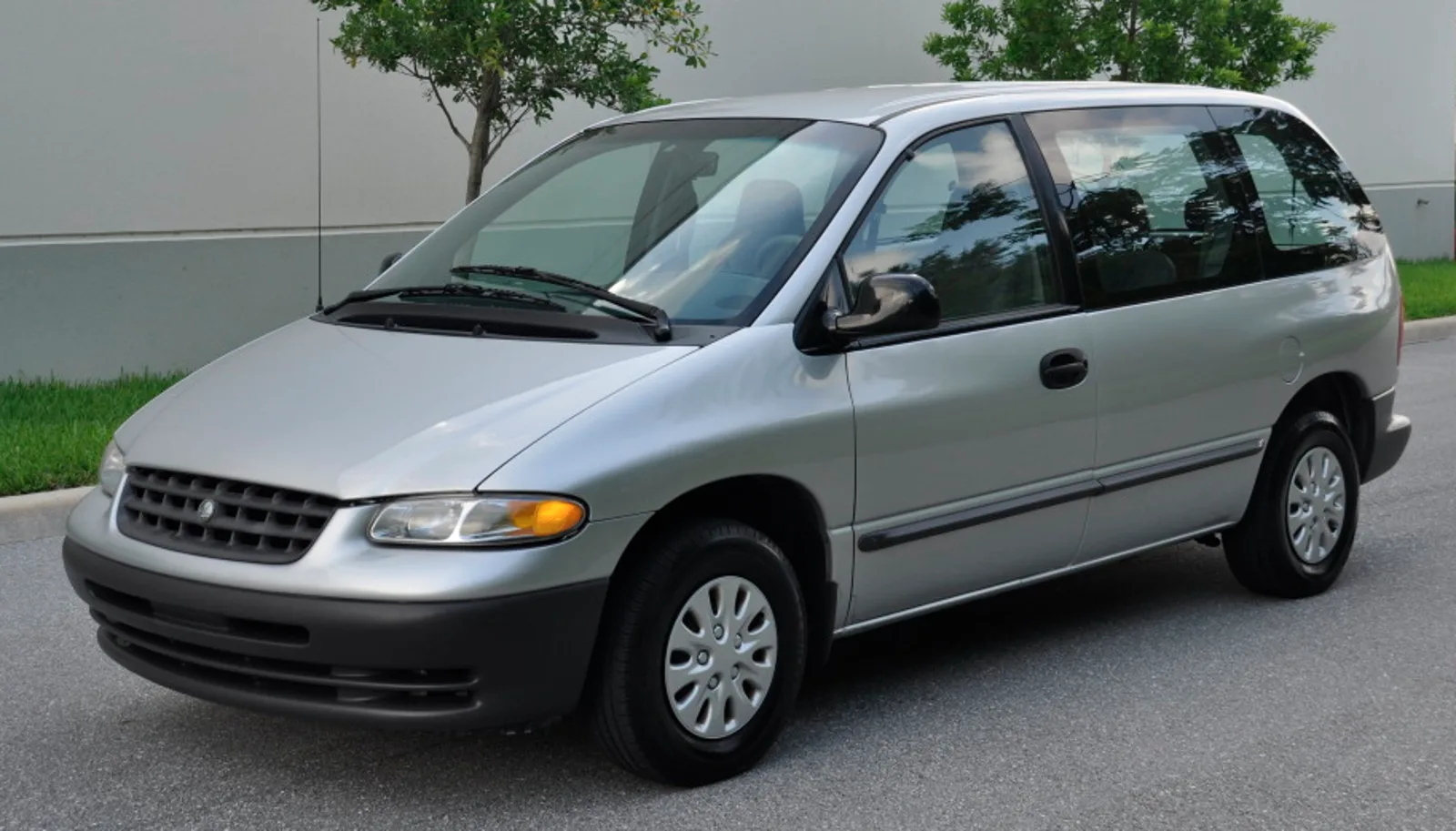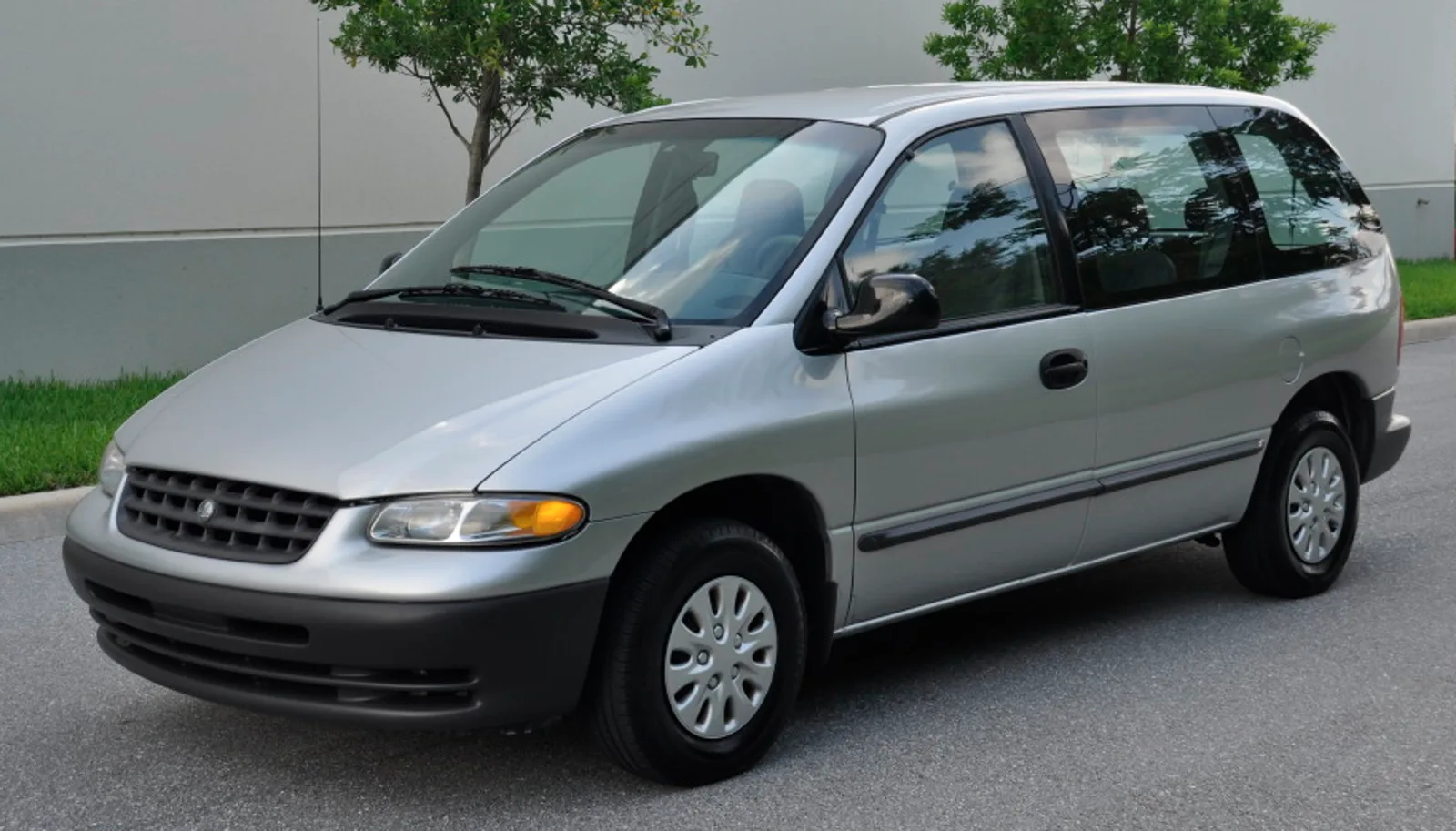
A driver-side sliding door on one side, a Camry-based front-wheel drive van on the other, and crash test results that did not point the same way.
The Chrysler NS minivans sold from 1996 to 2000 and the Toyota Sienna from 1998 were direct rivals in North America. The NS vans brought a driver-side sliding door to mid-size minivans, while the Sienna offered front-wheel drive and Camry-based underpinnings.
The Chrysler NS minivans and the Toyota Sienna were built for the same North American family buyer, but they reached that goal from different directions. The Chrysler vans were designed from the ground up as minivans, with a driver-side sliding door and a cab-forward body. The Sienna began as a front-wheel drive van on a revised Camry platform, and a 2003 redesign enlarged it to match its rivals.
Why were these two vans rivals?
Both vans were aimed at North American families who wanted three rows of seats and front-wheel drive. The Toyota Sienna was named among the chief competitors of the NS vans, alongside the Ford Windstar and Honda Odyssey. The Odyssey also gave the Sienna trouble, arriving a year after it and proving larger.
Chrysler's development work used the Ford Aerostar, Mercury Villager and Toyota Previa as reference points. The Previa was the van the Sienna replaced, so Toyota was moving from a mid-engined, rear-wheel drive layout to a conventional front-wheel drive one at the same time.
Two family vans chasing the same buyer, one with the sliding door first and the other with later all-wheel drive.
How did the Chrysler NS vans take shape?
Development began in 1990 under Tom Gale and Chris Theodore, and design work by Don Renkert was approved in September 1991. A design freeze followed in May 1992. The programme cost $2.8 billion, about $4.6 billion in 2017 dollars, making it the most costly Chrysler vehicle of its time.
The NS platform ended a decade without an all-new Chrysler minivan. It was also among the first Chrysler vehicles designed with CATIA, a system that allowed much tighter design tolerances. The vans were also a response to Ford's front-wheel drive replacement for the Aerostar, which appeared in 1994 as the 1995 Windstar.
The body broke with the boxy shape of the first two generations. The cab-forward layout moved the dashboard and windshield forward, and the cowl dropped to allow a less radical windshield angle. On average the vans stood three inches taller than their predecessors, yet the drag coefficient fell from 0.39 to 0.35, matching the Ford Windstar and bettered only by the GM APV.
The driver-side sliding door was the headline change. Chrysler's research asked owners about a $300 option, and 85% of participants said they would buy the van with a second sliding door even as an extra-cost option. The feature had been planned for the first-generation minivans but was dropped in 1980 because of tooling costs.
The NS vans were the first mid-size minivans to offer that door. Compact minivans such as the Nissan Stanza Wagon and Nissan Axxess had used one before, but no mid-size van had. Other changes were practical: the liftgate gained an exterior handle that ended the pop-and-lift routine, the second and third rows could be released by a floor latch and rolled out, and the front bucket seatbacks folded forward for the first time. Dual-zone climate control was an option, a first for minivans.
Where the Sienna started and how it grew
Toyota launched the Sienna in 1997 for the 1998 model year, replacing the mid-engined, rear-wheel drive Previa. It was marketed as the Camry of minivans, and its 3.0-litre 1MZ-FE V6 produced 145 kW (194 hp) and 284 N-m (209 lb-ft). The first-generation van came in CE, LE and XLE trim and was built at Georgetown, Kentucky.
Toyota claimed best-in-class fuel economy for the first van, at 15 L/100 km (16 mpg-US; 19 mpg-imp) in the city and 11 L/100 km (22 mpg-US; 26 mpg-imp) on the highway. The driver-side sliding door was standard only on the XLE until the 2001 model year, when it became standard on every model.
The first generation also faced a class-action settlement over engine oil sludge in the V6 engines of many Toyota models. Oil smoke, oil that turned dark soon after a change and high oil consumption were among the symptoms.
Toyota unveiled the second generation on 6 January 2003 at the North American International Auto Show in Detroit, and production moved from Georgetown to Indiana. Volume rose by 45% and cargo space by 39% over the first van. Toyota assigned Yuji Yokoya as chief engineer, and he and his family drove the previous model more than 53,000 miles (85,000 km) to find its weak points.
The second-generation van used a 3.3-litre 3MZ-FE V6 with a five-speed automatic, and its gear lever moved from the steering column to the centre console. The flat-folding third row let the van carry 1.2 by 2.4 m (4 by 8 feet) building materials such as plywood and drywall sheets. All-wheel drive was offered on the pricier trims with a 50:50 split front to rear.
The third generation premiered at the Los Angeles Auto Show in December 2009 for the 2011 model year and reached US dealers that February. It was designed at Calty studios and engineered in Ann Arbor, Michigan and in Japan.
Which engines did each van offer?
The NS vans opened with a 2.4-litre four-cylinder rated at 150 hp, the first new four in Chrysler's minivan line since 1987. Three V6s followed, depending on emissions rules. The Sienna relied on V6 engines in its first two generations, and the third added a four-cylinder.
The 2.4-litre replaced a 2.5-litre and nearly matched the 3.0-litre V6 in output and fuel economy, despite its smaller size. It was shared with the JA-platform cars.
In states that did not follow California emissions standards, the Mitsubishi 3.0-litre V6 was standard. In California-standard states the Chrysler 3.3-litre V6 took that role, and the 3.8-litre V6 was standard in the Dodge Caravan ES and Chrysler Town and Country LXi. Manual gearboxes disappeared from US and Canadian vans. The 2.4 and 3.0 used a three-speed TorqueFlite automatic, while the 3.3 and 3.8 used a four-speed Ultradrive.
Export vans had their own range, with a 2.0-litre SOHC four, a DOHC 2.0-litre borrowed from the Neon and a 2.5-litre VM Motori diesel. Each could be had with a five-speed manual or an automatic.
The Sienna's V6 grew from the 3.0-litre 1MZ-FE at launch to the 3.3-litre 3MZ-FE in the second generation. For 2007 a 3.5-litre 2GR-FE V6 rated 198 kW (266 hp) took over, and it used a timing chain where earlier Siennas had a belt. The third generation kept the 2GR-FE, paired it with a six-speed transmission and added the 1AR-FE four, the first Toyota four offered in a North American minivan since the Previa was discontinued in late 1997.
Specifications side by side
| Specification | Chrysler minivans (NS) | Toyota Sienna |
|---|---|---|
| Model years covered | 1996 to 2000 | 1998 (first generation), 2004 (second), 2011 (third) |
| Drive layout | Front-wheel drive; all-wheel drive optional | Front-wheel drive; all-wheel drive optional from the second generation |
| Sliding door | Driver side; first mid-size minivans to offer one | Driver side; standard on all models from the 2001 model year |
| Four-cylinder engine | 2.4-litre, 150 hp | 1AR-FE, third generation only |
| V6 engines | 3.0-litre (Mitsubishi), 3.3-litre (Chrysler), 3.8-litre | 3.0-litre 1MZ-FE at 194 hp; 3.3-litre 3MZ-FE; 3.5-litre 2GR-FE at 266 hp from 2007 |
| Transmission | Three-speed TorqueFlite or four-speed Ultradrive; no manual in the US or Canada | Five-speed automatic (second generation); six-speed (third generation) |
| Drag coefficient | 0.35 | 0.30 (second generation) |
| Build location | Windsor, Ontario and Fenton, Missouri | Georgetown, Kentucky (first generation); Indiana (second) |
| Fuel economy | Not given | 17 mpg-US city, 23 highway, front-wheel drive (second generation) |
| Towing | Not given | 1,600 kg (3,500 lb) on 2004 to 2007 models |
| IIHS frontal test | Dodge Grand Caravan 1996 to 2000: Marginal, 40 mph offset | First generation: Good in all six frontal measures |
| Folksam real-world rating | 1996 to 2000 generation: Safest | Not given |
| Stability control | Not given | Optional on the first generation; standard from 2008 |
How did the two vans fare in crash tests?
The results depended on the test. The 1996 to 2000 Dodge Grand Caravan rated Marginal in the IIHS 40 mph offset test, yet a 2009 real-world study by the Swedish insurer Folksam rated that generation Safest. The first Sienna earned Good marks in all six IIHS frontal measures.
NHTSA gave the Grand Caravan four stars for the driver and front passenger in frontal impact. In the side test it earned five stars for the driver and three for the rear occupant, and the same test recorded a fuel leak that could cause a fire hazard.
European results were harsher on the Chrysler Voyager. The 1999 model scored no points in the frontal test, after its steering column was driven back toward the driver. The 2007 model reached 19% in the frontal test and earned two stars out of five overall, with the final adult star struck through.
Folksam's study covered 172 car models and was published in May 2009. The 1988 to 1996 generation rated Average, while the 1996 to 2000 generation rated Safest, defined as at least 30% safer than the average car.
The Sienna's safety content moved forward in steps. Anti-lock brakes were standard on the first generation, while side torso airbags and Vehicle Stability Control were optional. Side airbags for all three rows became standard on every model for 2006, and Vehicle Stability Control became standard for 2008. The third generation was the first Sienna to earn an IIHS Top Safety Pick.
Did the Sienna's later generations sell beyond North America?
The later generations did reach other markets, although the first ones were a North American story. The third generation went on sale in South Korea from November 2011, making it the first Toyota minivan sold there, and it reached Taiwan in July 2016. Earlier Siennas had been exported to selected Asian and European markets.
The fourth generation, introduced for the 2021 model year, moved the Sienna to a hybrid drivetrain and onto Toyota's TNGA-K platform, a base that also underpins most of Toyota's larger MPVs and crossovers. Chinese production began in July 2021 through two Toyota joint ventures, and the van is sold in China as the Toyota Granvia.
The Sienna was never built in right-hand drive and is not sold in right-hand drive markets. Those markets are served by the Alphard and Vellfire, along with the HiAce and Granvia.
How did the Sienna's sportier trim come about?
The SE trim arrived with the third generation as the first sportier Sienna. It added revised bodywork, clear tail lamps, 19-inch wheels, firmer suspension and revised steering tuning. Chief engineer Kazuo Mori reportedly had to overcome corporate opposition to get it into the range.
Mori was an avid autocrosser, and AOL Autos described the SE as slipping a sports car into a minivan. The SE sat alongside base, LE, XLE and Limited trims, and all-wheel drive came only with the V6 on the LE, XLE and Limited.
Toyota's EPA figures for the third generation ranged from 19 mpg-US city and 24 highway for the four-cylinder to 16 city and 22 highway for the all-wheel drive V6. An optional tow package for the V6 was rated for 1,600 kg (3,500 lb), and the 2011 model year brought an electric power steering system in place of hydraulic.
Which buyer suits each van?
The NS vans suit a buyer who wants a driver-side sliding door and a choice of three badges, from the entry-level Plymouth Voyager up to the Chrysler Town and Country. The Sienna suits a buyer who wants all-wheel drive on the later vans or a sportier SE model with 19-inch wheels.
No single figure settles which van was the better buy. Each one's strengths depend on what a family needs: a sliding door, a four-cylinder engine, or all-wheel drive from the second Sienna onward.
The third generation also brought a set of comfort features. An optional sliding second row with lounge-style recliner seats, a 16.4-inch LCD screen for rear passengers and a Smart Key with push-button start all arrived with it.