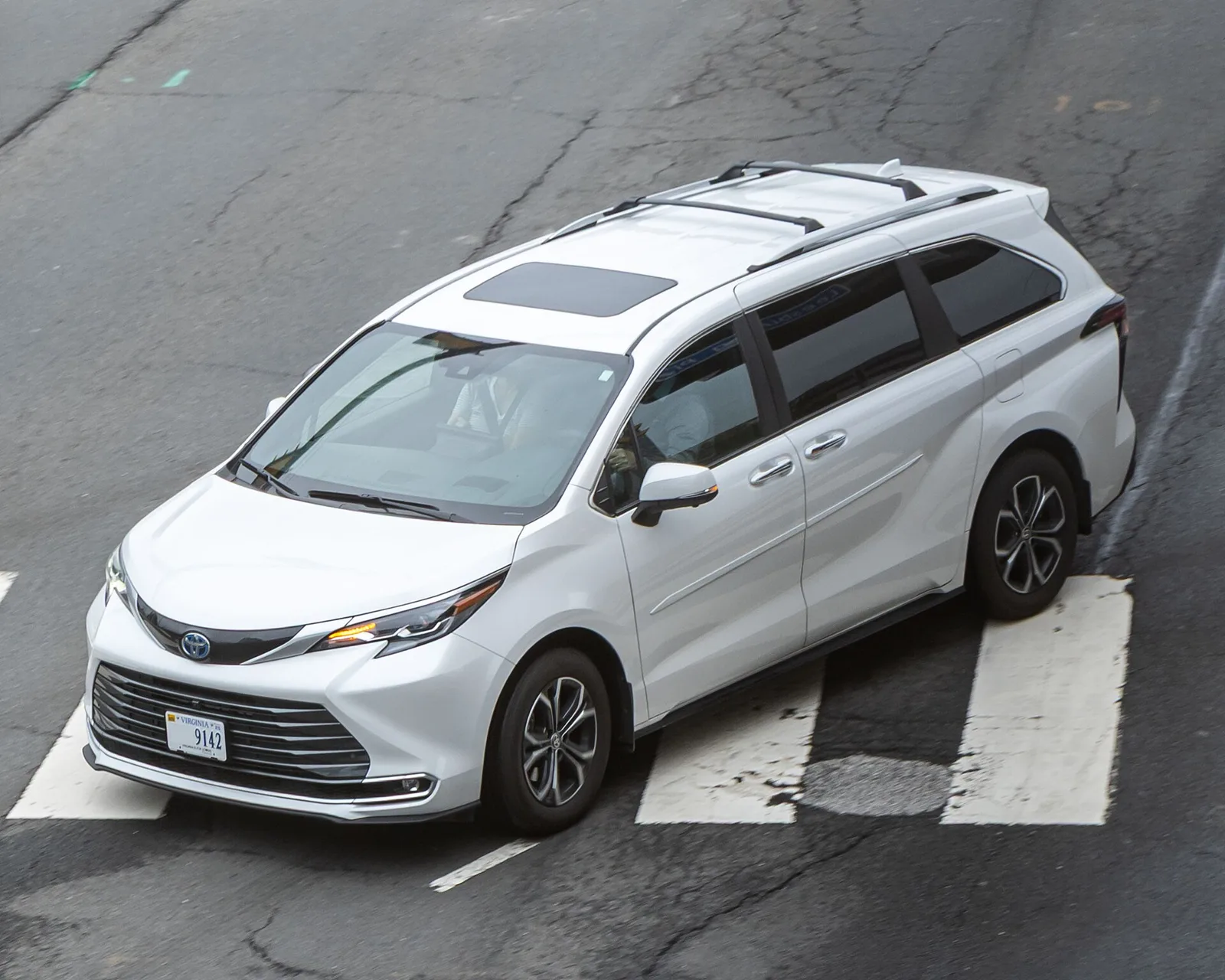
Built mainly for North America, the Sienna replaced the Previa in 1997, grew up across four generations and ended up as a hybrid family van.
The Toyota Sienna is a North American minivan that replaced the Previa in 1997 on a Camry-derived front-drive platform. It went through four generations, gained AWD and a four-cylinder option, and turned fully hybrid in 2020.
The Toyota Sienna is a minivan built mainly for North America, named after the Italian city of Siena in Tuscany. It replaced the Previa from the 1998 model year, switching to a front-wheel-drive layout on a platform shared with the Camry. Now in its fourth generation, it has moved to hybrid power on every trim, though for many years it was the only North American minivan offered with all-wheel drive.
Toyota's long-running family van has kept a front-drive core throughout, with each redesign adding room, safety kit or drivetrain choices. The story runs from a Camry-derived launch in 1997 through a larger second generation and a sportier third, to a hybrid fourth generation built for global sale.
Why did Toyota build the Sienna?
Toyota launched the Sienna in North America in 1997 as the successor to the mid-engined, rear-drive Previa. The new van used a conventional front-wheel-drive layout and shared a heavily revised platform with the Camry, so buyers got familiar hardware in a family vehicle.
Early Siennas, like the Previa before them, were smaller than many rival minivans. A 2003 redesign for the 2004 model year raised the dimensions to match the competition, a change that mattered in a segment where interior room sells vans.
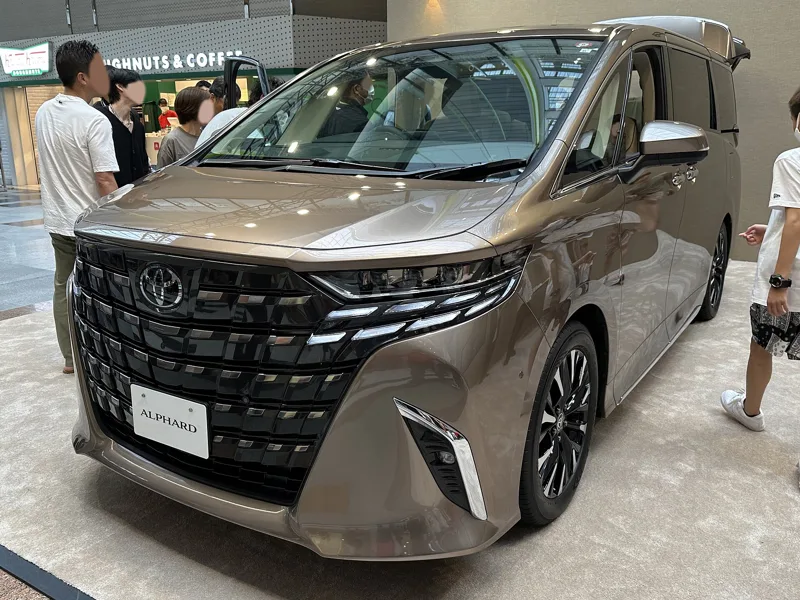
At launch the marketing leaned on the Camry's reputation, calling the Sienna the Camry of minivans. Right-hand-drive markets were never a focus, because the Alphard and Vellfire, along with the HiAce and Granvia, already held that part of the market.
A Camry-based family van that kept a front-drive core through four generations, then went hybrid.
How did the first-generation Sienna perform?
The launch Sienna carried a 3.0-litre 1MZ-FE V6 rated at 145 kW (194 hp), with 284 N-m (209 lb-ft) of torque. Toyota claimed 15 L/100 km (16 mpg-US; 19 mpg-imp) for city driving and 11 L/100 km (22 mpg-US; 26 mpg-imp) for highway driving.
A year after launch the redesigned Honda Odyssey arrived with its own V6 and more size than the Sienna. The Toyota remained a sensible family choice, but it was no longer the largest vehicle in its class.
What trims did the first generation offer?
The first-generation Sienna came in three trims, CE, LE and XLE. LE and XLE cars had second-row captain's chairs, while CE models used a two-passenger bench in that row. The seats could be folded and removed as needed, which let owners switch between seating and cargo layouts.
On the XLE the sliding driver-side door and roof rack came as standard, whereas LE and CE buyers paid extra for them. XLE buyers also received leather seats and a wood trim package, which set the top grade apart from the rest of the range.
Toyota built these early vans at Georgetown, Kentucky. By 2001 the sliding door had become standard on every model, which made the range more consistent.
Was the first-generation Sienna safe?
The first-generation Sienna stood out for its safety equipment among minivans of its time. Buyers could add side torso airbags mounted in the front seats, along with Vehicle Stability Control, and anti-lock brakes came as standard. The Insurance Institute for Highway Safety scored it Good across all six frontal crash measures, a far better result than the Previa achieved.
The model was not without trouble. It was caught up in a class-action settlement over engine oil sludge in the V6 engines fitted to many Toyota models. Symptoms included oil smoke in the exhaust, oil turning black soon after a change, petrol odour in the oil and eventual engine failure.
How did the early Sienna models change?
The Sienna received a facelift for the 2001 model year, with redesigned grille, bumper and tail lights, plus revised controls for the heating system. Variable valve timing arrived on the engine, and peak figures rose to 157 kW (210 hp) and 298 N-m (220 lb-ft).
A Symphony Package arrived for LE models in the 2002 model year, adding a premium JBL cassette, captain's chairs in the front and middle rows, and heated mirrors. The 2003 model year brought no changes at all, which left the van waiting for its big redesign.
Why did the second generation grow so much?
Toyota showed the second-generation Sienna at the Detroit auto show on 6 January 2003. It offered 45% more volume and 39% more cargo space than the first generation, and production moved from Georgetown to Toyota Motor Manufacturing Indiana. The growth answered rivals that had outsized the early Siennas.
Chief engineer Yuji Yokoya led the project. He and his family drove the previous model more than 85,000 km (53,000 miles) across North America to find where its design fell short.
The seats moved to a 60/40 split, and the flat-folding third row could be specified even on all-wheel-drive cars. Folded flat, the third row left room for sheet goods such as plywood and drywall, measuring 1.2 by 2.4 m (4 by 8 feet).
What did the second generation offer on the road?
The second generation used an updated ULEV-certified 3.3-litre 3MZ-FE V6 with a new five-speed automatic. The gear selector moved from the steering column to the centre console and gained a gated shift pattern, while the all-wheel-drive system split power 50:50 front and rear.
Styling work gave the car a Cd=0.30 drag coefficient. The turning radius was 11.2 m (37 ft).
For 2007 the 3.3-litre gave way to a ULEV-II 3.5-litre 2GR-FE V6 rated at 198 kW (266 hp). It used a timing chain rather than a belt, which lowered routine maintenance. A 2006 update also changed the rating method, bringing output down to 160 kW (215 hp) from 172 kW (230 hp).
How safe and well equipped were the later second-generation vans?
Side torso airbags and side curtain airbags became standard on all 2006 trims, and Vehicle Stability Control became standard for 2008. Later IIHS frontal offset results gave the second generation an overall Good rating, with each of six measured areas also rated Good.
Earlier cars without side airbags scored Acceptable for side impacts, so the late upgrades mattered. Standard kit from the outset included anti-lock brakes, brake assist, traction control and tyre-pressure monitoring, alongside electronic brake force distribution.
What did the third generation bring?
The third generation debuted at the Los Angeles show in December 2009, as a 2011 model. Calty studios styled it, and engineers in Ann Arbor, Michigan and Japan finished the work before it reached dealers in February 2010. It was the first Sienna to earn an IIHS Top Safety Pick, though the award applied to the 2011 model year only.
American customers had five trims to pick from: base, LE, XLE, Limited and the newcomer SE. SE cars got a reworked body, clear rear lamps, 19-inch (480 mm) alloys, a firmer ride and sharper steering. Chief engineer Kazuo Mori, a keen autocrosser, reportedly had to fight corporate resistance to get the SE into the line-up.
How did third-generation engines and fuel economy work?
The third generation kept the 3.5-litre 2GR-FE V6, now paired with a six-speed transmission. It also added a four-cylinder 1AR-FE, the first four-cylinder Toyota had offered in a North American minivan since the Previa's last year in 1997. Electric power steering replaced the hydraulic system.
EPA estimates for the four-cylinder were 12.4 L/100 km (19 mpg-US; 22.8 mpg-imp) in the city and 9.8 L/100 km (24 mpg-US; 28.8 mpg-imp) on the highway. Front-drive V6 models managed 13.1 L/100 km (18 mpg-US; 21.6 mpg-imp) in the city, while AWD cars returned 14.7 L/100 km (16 mpg-US; 19.2 mpg-imp) in the city and 10.7 L/100 km (22 mpg-US; 26.4 mpg-imp) on the highway.
An optional tow package for V6 models was rated at 1,600 kg (3,500 lb), a figure that carried into later generations.
What family features did the third generation add?
The second row could optionally slide, with Lounge Seating recliners borrowed in concept from the Lexus LS. Toyota's Smart Key with push-button start was also new, and the rear entertainment screen grew to a 41.7 cm (16.4-inch) LCD with two viewing modes.
The back-up camera gained a 180 degree panoramic view. Newcomer options included a Pre-Collision System, an automatic high beam dimmer, Safety Connect and a stability system called Vehicle Integrated Dynamics Management. Driver's knee airbags became standard equipment.
Toyota presented a power-lift rotating seat for disabled passengers as an industry first. The one-touch seat lowers to within 48 cm (19 inches) of the ground. When the second-row seats were removed, their rack-like base stayed bolted to the floor, so the floor was no longer flat.
How did the third generation change in its later years?
The four-cylinder was dropped for the 2013 model year. A mid-cycle refresh redesigned the dashboard and centre console, replaced the earlier DVD system with a Blu-ray unit offering HDMI and SD card inputs, and added new tail lights. The changes were incremental, so each later year built on the same basic van.
The 2017 model year swapped the six-speed for an eight-speed automatic, and a revised 2GR-FKS V6 with D4-S direct injection lifted output to 221 kW (296 hp), and torque reached 357 N-m (263 lb-ft). A mild facelift followed with a new grille, headlights and side skirts, plus standard Safety Sense.
For the 2019 model year AWD became available on the SE, and the front-drive Limited was dropped. CarPlay arrived alongside the Entune 3.0 media system, and the 2020 model year added a Nightshade Edition in four exterior colours.
What changed with the fourth generation?
Toyota unveiled the fourth-generation Sienna virtually on 18 May 2020, after a planned New York show reveal was moved online. Sales began on 27 October 2020, and every trim came with a hybrid powertrain as standard, which made hybrid power the default for the whole range.
The fourth generation sits on the GA-K platform and keeps the 1,600 kg (3,500 lb) tow rating of the generation before it. AWD is optional, using a third electric motor to drive the rear wheels.
The trims became LE, XLE, Limited, the sport-oriented XSE that replaced the SE, and the top Platinum. Platinum cars added a built-in vacuum, a refrigerated compartment, a heads-up display and a 360 degree camera view.
Family features include 18 cup holders, seven USB ports (only one of which carries data), four-zone climate control, onboard Wi-Fi, power sliding doors and a liftgate, and a voice amplification system for speaking to rear passengers. Standard safety aids also cover adaptive cruise, blind-spot alerts, emergency braking that acts automatically, and lane-keeping.
Where is the Sienna built and sold now?
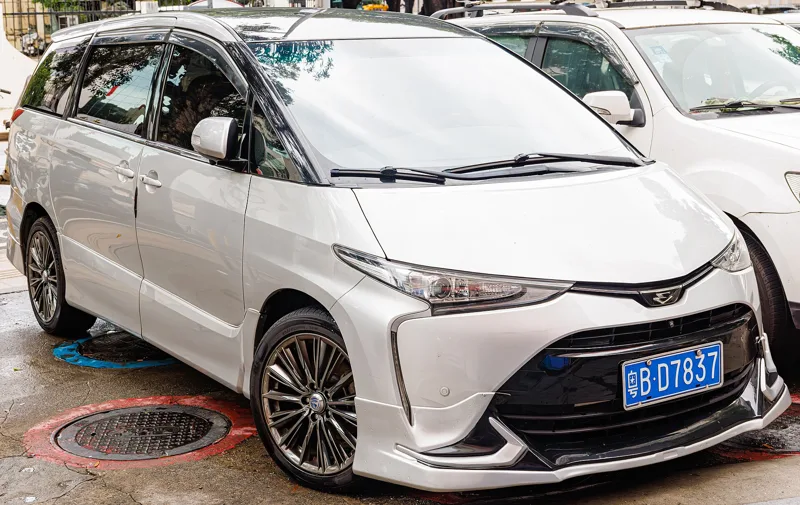
From early 2021 the Sienna was available in Taiwan and Mexico. In July 2021 production started in China with GAC Toyota, and a rebadged version called the Granvia, built by FAW Toyota, adopted the styling of the North American XSE.
The Chinese cars were the first Siennas built outside the United States. Earlier generations had been exported to select Asian and European markets, but production abroad had not happened before.
Special editions followed. The 2021 Woodland Edition, based on the XLE, came with standard AWD, raised suspension and a tow package. A 25th Anniversary Edition limited to 2,525 units arrived in 2022, based on the XSE.
A 2024 update gave the interior a 12.3-inch touchscreen (8-inch on the LE), a 12.3-inch digital driver's display and an Advanced Rear Seat Reminder that detects children and pets left in the back.
What are the main Sienna specifications?
| Specification | Detail |
|---|---|
| Launch engine (1998 model year) | 3.0-litre 1MZ-FE V6, 145 kW (194 hp) |
| Launch torque | 284 N-m (209 lb-ft) |
| Second-generation engine | 3.3-litre 3MZ-FE V6 with a five-speed automatic |
| Second-generation space gain | 45% more volume and 39% more cargo space than the first generation |
| Third-generation four-cylinder economy | 12.4 L/100 km (19 mpg-US; 22.8 mpg-imp) city, 9.8 L/100 km (24 mpg-US; 28.8 mpg-imp) highway |
| Third-generation AWD V6 economy | 14.7 L/100 km (16 mpg-US; 19.2 mpg-imp) city, 10.7 L/100 km (22 mpg-US; 26.4 mpg-imp) highway |
| 2017 model year V6 output | 221 kW (296 hp); 357 N-m (263 lb-ft) |
| Towing capacity | 1,600 kg (3,500 lb), third and fourth generations |
| Fourth-generation powertrain | Hybrid on all trims; optional AWD with a third motor |
| Second-generation turning radius | 11.2 m (37 ft) |
_Washington_DC_Metro_Area,_USA_(10).jpg)