From a compact 1994 people mover shaped by Japan's economic crisis to a hybrid minivan rebuilt for export, the Odyssey has changed with every market it served.
Honda's Odyssey minivan has been built since 1994, when Japan's 1990s economic crisis shaped its compact size. Since 1999 the car has come in larger North American and smaller Japanese forms, and the range now sits in its fifth generation.
The Honda Odyssey is a minivan that Honda has built since 1994, and it is now in its fifth generation. It was first conceived in Japan after the country's 1990s economic crisis, which shaped its compact size. Since 1999 Honda has sold a larger version in North America and a smaller one in Japan and other markets.
Why was the first Odyssey so small?
The first Odyssey was developed in Japan after the 1990s economic crisis, which limited the size and overall concept of the vehicle. It was built in an existing facility with only minimal modification, so the result was a smaller minivan in the compact MPV class. It was launched in Japan and North America in 1994, and it was marketed in Europe as the Honda Shuttle.
The compact size suited the Japanese domestic market, where the car was well received. North American buyers were less enthusiastic, and later generations diverged to reflect market variations.
The first generation was based on the fifth-generation Accord sedan. Every Japanese model had a dual air conditioning system, with separate controls for the front and rear seat rows, and from the first generation onward every model was a six- or seven-seater.
A compact people mover born from Japan's economic crisis that grew into a family minivan for five generations.
How did the first Odyssey sell and compete?
In 1995 the Odyssey took the Car of the Year prize from Japan's Automotive Researchers' and Journalists' Conference. It sold strongly at home, where it faced the Toyota Gaia, Toyota Ipsum and Nissan Presage. European sales suffered because the car offered neither a manual transmission nor a diesel engine.
The Japanese range started with B, S and L grades. The Exclusive model was added in January 1996, and the M grade arrived in October 1996 to sit between the S and L. The base B grade was then discontinued.
The August 1997 facelift discontinued the Exclusive grade. In October 1997 it was replaced by the Prestige model, sold in VG and VZ grades.
What engines did the first Odyssey use?
The original 2.2-litre engine produced 130 PS (96 kW; 128 hp). A slightly larger 2.3-litre unit offering 150 PS (110 kW; 148 hp) replaced it in August 1997. In October 1997 a 200 PS (147 kW; 197 hp) V6 became available in the domestic market.
Optional four-wheel drive was offered on the RA2 and RA4 chassis. From 1997 the 3.0-litre V6, the J30A, was fitted to the RA5 chassis, which was front-wheel drive only. The L and Aero models had a sunroof.
What changed with the 1999 second generation?
In December 1999 a larger second-generation Odyssey appeared in Japan and Australia, with a left-hand drive version for China. The new car measured 85 mm (3.3 in) more in length and 10 mm (0.4 in) more in width, yet it was a major upgrade of the first car rather than a new design. Its shape and appearance stayed close to the original.
The base model kept a 2.3-litre VTEC four-cylinder, the F23A, in RA6 and RA7 form. The J30A V6, now producing 210 PS (154 kW), went into the RA8 and RA9 Absolute and Prestige models. The 2000 Odyssey was the first Honda to receive a five-speed automatic, although only the V6 had it, and the four-cylinder cars kept a four-speed.
The gearboxes also introduced Honda S-matic, a tiptronic-style manual mode that let the driver call the shifts with plus and minus positions on the selector while keeping the classic hydraulic automatic. The interior was completely new, with the column shifter moved to the centre console and a touchscreen digital climate control that worked with Honda's new navigation system.
Australia took to the second generation at first, but sales hit an all-time low in 2002. In 2003 the country sold only 649 units, roughly a third of the total for 2000.
How did the Odyssey change in the 2001 and 2003 updates?
The November 2001 facelift added the MQ grade, a sportier Absolute model and new Honda emblems. The Absolute got a body kit and darker lens tail lights, and clear-lens tail lights replaced the amber indicators across the range.
Special editions followed. The Premium Sound Spirit, based on the MQ grade, arrived in February 2003 with a Bose sound system and 16-inch aluminium wheels. In May 2003 the Fine Spirit variant appeared, with a special body colour, forged-metal-style interior trim and genuine leather on the steering wheel.
Why did the third generation sell so well?
The third-generation Japanese-built Odyssey was the first full redesign since 1994. It went on sale in Japan in October 2003 and reached Australia and many other countries from early 2004. It kept the five-door body but looked sleeker, lower and more car-like, and it was designed with multi-level parking in mind.
The new car came with the 2.4-litre K24A i-VTEC engine, producing 160 PS (118 kW). The same engine was used in the CR-V and Accord. The V6 was dropped completely, and a 200 PS (147 kW) version of the K24A was adopted for the sporty Absolute, which made 190 PS (140 kW) with 4WD.
The 2WD cars used a continuously variable transmission, while the 4WD version came only with an automatic. Cruise control appeared on the Japanese model for the first time, and the new DPS system was fitted to the four-wheel-drive version. The K24A variant matched the fuel consumption of the old 2.2-litre engine.
In Australia the Odyssey achieved its best-ever sales year in 2005, with 3,543 sold, and it outsold the Toyota Tarago for the first time.
What did the fourth generation add?
Sales of the fourth-generation Odyssey in Japan began on 17 October 2008, with M, L, Li and Absolute grades. The engine and transmission were fundamentally the same as before, but power and fuel economy were improved. The front-wheel-drive cars used a 2.4-litre engine with a CVT, while the 4WD and high-output Absolute used a five-speed automatic.
Two outputs were offered in Japan: 173 PS in most cars, and 204 to 206 PS in the Absolute grade. One of the biggest changes was that electronic stability control and standard curtain airbags became fitted to every grade.
The M Fine Spirit grade was added in September 2009, and a facelift with a redesigned grille followed on 6 October 2011. The M Fine Spirit was then replaced by the M-S, the L was discontinued, and the MX joined the range in July 2012 above the M and below the Li. In Australia the Odyssey was the best-selling people mover among private buyers.
What were the key Odyssey specifications?
| Specification | First generation (1994) | Third generation (2003) | Fifth generation (2013) |
|---|---|---|---|
| Launch | 1994, Japan and North America | October 2003 in Japan; early 2004 in Australia | Teased 26 September 2013; on sale in Japan 1 November 2013 |
| Body | Compact MPV, six or seven seats | Five-door, lower and sleeker | Bigger, dual power sliding doors, seven or eight seats |
| Base engine | 2.2-litre, 130 PS (96 kW; 128 hp) | 2.4-litre K24A i-VTEC, 160 PS (118 kW) | 2.4-litre i-VTEC Earth Dreams, 175 PS (173 hp; 129 kW) |
| Top output | 3.0-litre V6, 200 PS (147 kW; 197 hp) from October 1997 | 200 PS (147 kW) K24A in Absolute | 190 PS (187 hp; 140 kW) with direct injection in Absolute |
| Torque | Not given | Not given | 225 N-m (23 kg-m; 166 lb-ft), Absolute 237 N-m (24 kg-m; 175 lb-ft) |
| Fuel economy | Not given | Not given | 14.0 km/L (40 mpg-imp; 33 mpg-US), JC08 cycle |
| Suspension | Four-wheel double wishbone in earlier generations | Not given | MacPherson strut front, torsion beam rear |
What makes the fifth-generation Odyssey different?
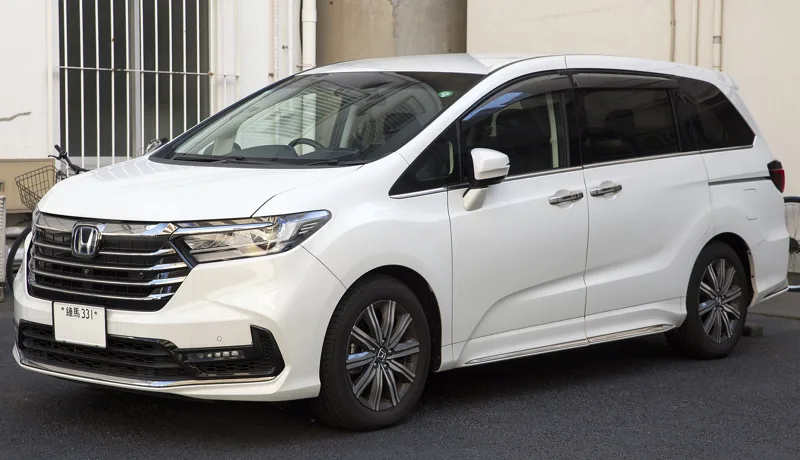
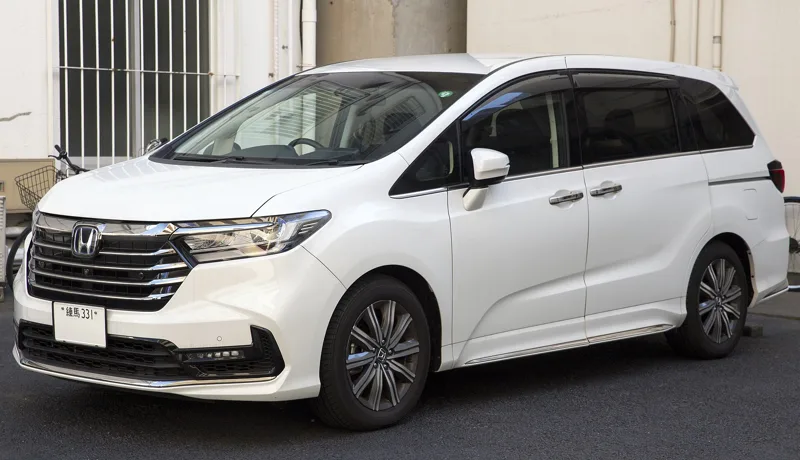
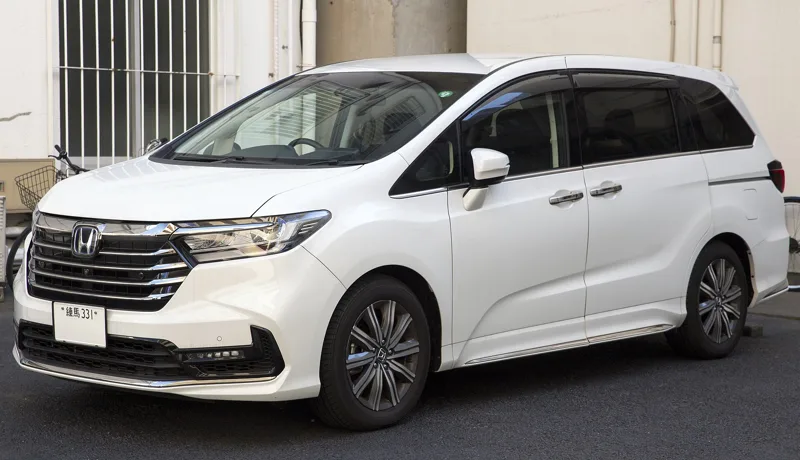
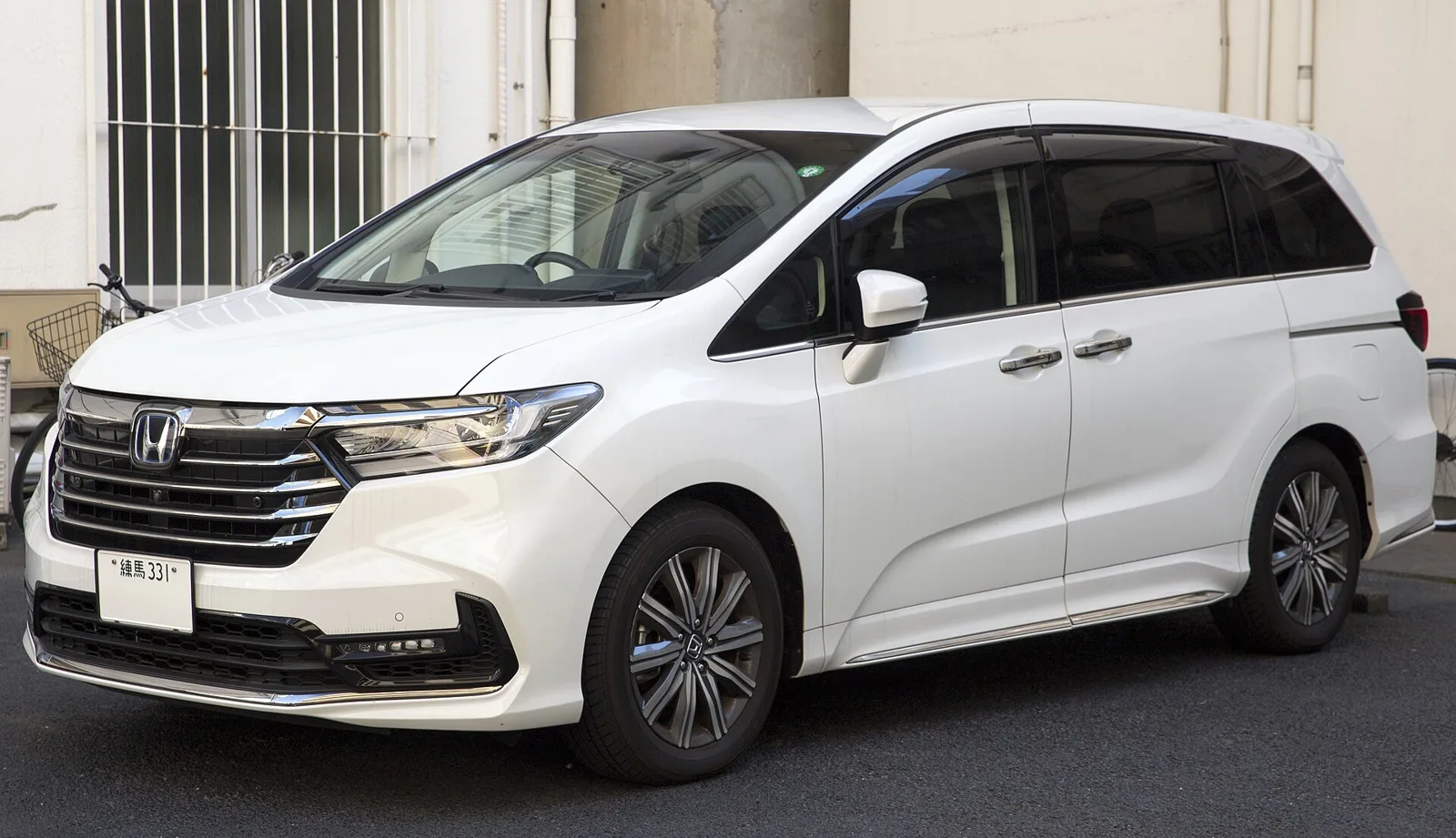
The fifth-generation Odyssey for the international market was teased on 26 September 2013 and went on sale in Japan on 1 November 2013. Honda had previewed the design with a concept called the Concept M at the 2013 Shanghai Auto Show. It was bigger than its predecessors and the rear hinged side doors were replaced by dual power sliding doors.
Seven-seat versions offered premium cradle seats with ottomans on the second row. The RC1 is front-wheel drive and the RC2 is four-wheel drive, and both come as seven- or eight-seaters. Honda's new 2.4-litre i-VTEC Earth Dreams engine, producing 175 PS (173 hp; 129 kW), powers the range, and direct injection lifts the top Absolute grade to 190 PS (187 hp; 140 kW).
The suspension changed as well. The four previous generations used four-wheel double wishbones, but the fifth moved to a MacPherson strut at the front and a torsion beam at the rear. In Japan the model replaced the first-generation Elysion and competed with the Toyota Alphard and Nissan Elgrand in the full-size luxury MPV class.
How did the Odyssey evolve after 2016?
The hybrid version reached Japan on 4 February 2016, using a 2.0-litre petrol engine and Honda's Sport Hybrid i-MMD system. The system used smaller and lighter key components than the two-motor setup in the Accord Hybrid, and its power control unit was 23 percent smaller and 27 percent lighter. The hybrid was unlikely to reach the United States, because the US Odyssey uses a larger platform.
In Australia the fifth generation went on sale in February 2014 as the VTi, based on the Japanese G grade, and the VTi-L, based on the Absolute. It became the best-selling model in its segment in 2014 with 2,552 sales, and it held 26.6 percent of the market. Sales reached 2,836 in 2015.
China received the car through Guangqi Honda from July 2014, and the Absolute grade followed in July 2015. A related Elysion, based on the Odyssey but with a different front and a design resembling the Honda Legend, went on sale in China through Dongfeng Honda from 9 January 2016.
A facelift on 16 November 2017 brought new bumpers, LED fog lamps and a range of driver assistance features, including adaptive cruise control and collision mitigation braking. The top grade gained lane-keeping assist and blind-spot monitoring. The China version was updated in July 2018, and the Odyssey Sport Hybrid was launched there on 29 April 2019.
The second facelift arrived in Japan in November 2020 with two-piece grilles, a redesigned dashboard and a 7.0-inch information display in place of the 3.5-inch unit. Production in Japan ended in December 2021 with the closure of Honda's Sayama plant, and the remaining stock was sold by September 2022.
In April 2023 Honda brought the Odyssey back to Japan as a hybrid only, imported from China, where it is built at Guangqi Honda's plant in Guangzhou. Exports from China began on 23 September 2023.
Why is the Odyssey remembered?
At its debut the Odyssey won the Japan Car of the Year Award in the special category and the RJC New Car of the Year Award. By September 1997 more than 300,000 had been sold, which made it Honda's fastest-selling new car and broke the Civic's record. Wheels magazine named it Car of the Year for 1995.
The Odyssey's European launch was as the Shuttle. British former Grand Prix driver Jonathan Palmer said its handling matched that of any executive saloon.